
Table of Contents
Road Traffic Accident Claim Advice Scotland: Complete Guide
Last Updated: July 20, 2026
When a road traffic accident happens, the immediate aftermath can feel overwhelming. Injuries, vehicle damage, and uncertainty about what comes next often leave victims unsure of their rights. This guide from Scotland Claims Injury Lawyers covers everything you need to know about making a road traffic accident claim advice scotland, from the moment the accident occurs through to settlement or court proceedings.
Understanding your entitlements after a road traffic accident is crucial. Many people don't realise they have a legitimate claim for compensation, whilst others make costly mistakes that weaken their position. Below, we'll walk you through the entire claims process, explain what evidence matters most, and show you how to avoid the pitfalls that derail most claims.
The first few minutes after a road traffic accident are critical. Your actions at the scene directly influence the strength of your eventual claim.
Safety comes first. If you're injured, do not move unless absolutely necessary. If the accident is minor and you're able to move safely, get yourself and any passengers to a safe location away from traffic. Switch on hazard lights and, if safe, place warning triangles behind your vehicle.
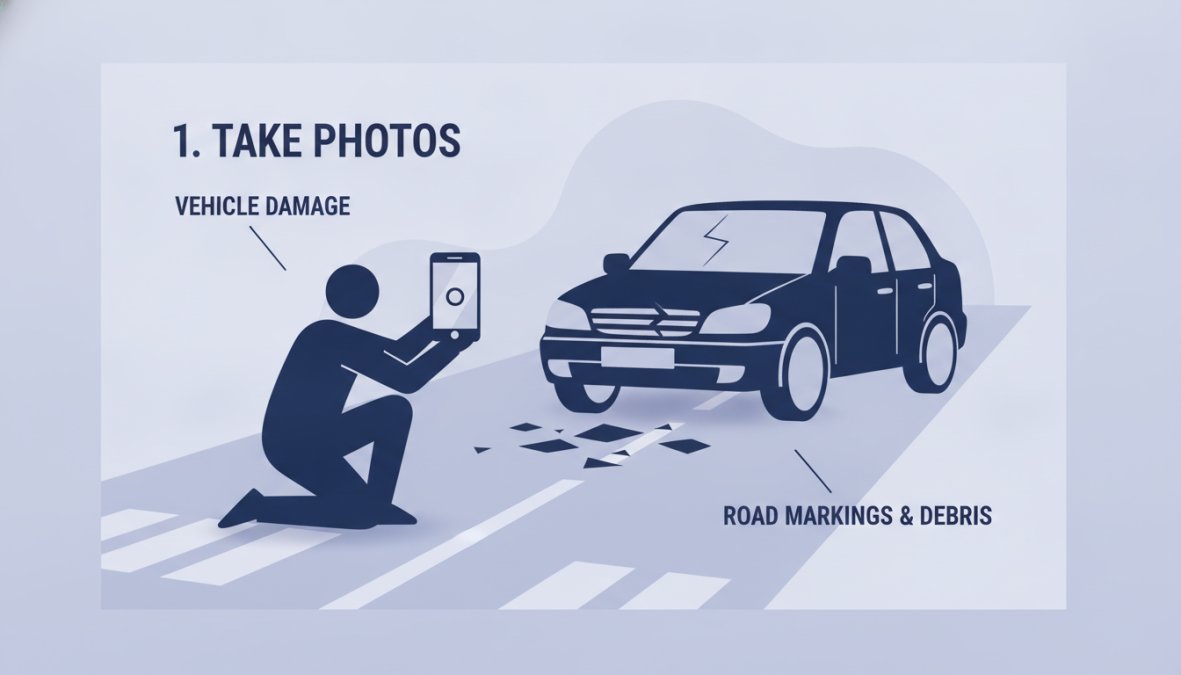 Person taking photographs of vehicle damage at accident scene with smartphone, showing road markings and debris
Contact emergency services if anyone is hurt. Call 999 immediately. Even if injuries seem minor, shock can mask pain. A paramedic assessment creates an official medical record, which becomes essential evidence for your claim later.
Report the accident to police. In Scotland, you're legally required to report any accident involving injury or significant damage. Request a crime reference number or incident report number, which becomes crucial evidence.
Notify your own insurance company. Contact them within the timeframe specified in your policy, usually within 48 hours. Provide factual information only; don't admit fault or speculate about liability.
Gathering Evidence for a Road Traffic Accident Claim
Evidence is the backbone of any road traffic accident claim. Without solid evidence, even legitimate claims struggle to progress.
Photographs and Scene Documentation
Photographs create an objective record of the accident scene, vehicle damage, and road conditions. Take photographs of all vehicle damage, the accident scene including road markings and traffic signals, skid marks or debris, weather conditions, and your injuries within the first few days.
Use your smartphone camera and take multiple shots from different angles. Include reference points like road signs or building landmarks that establish location. If you're unable to photograph the scene yourself, ask a witness or emergency responder to do so.
Pro Tip
Photograph your injuries daily for the first week after the accident. Visible bruising, swelling, and cuts provide compelling evidence of impact force and often persuade insurers to settle faster.
Witnesses provide independent accounts of how the accident happened. At the scene, approach anyone who witnessed the accident and ask for their full name, date of birth, contact telephone number and email, home address, and brief account of what they saw. Write this down immediately.
Get contact details for other drivers and passengers involved. Obtain their insurance details, registration numbers, and vehicle descriptions. If the accident occurred near a business with CCTV cameras, note the business name and address. CCTV footage is powerful evidence, and businesses are more likely to retain it if requested promptly.
Key Takeaway
Witness statements are invaluable. A single credible witness can transform a disputed claim into a straightforward one. Prioritise gathering witness contact details above almost everything else at the scene.
Medical Records and Treatment Evidence
Medical evidence establishes the link between the accident and your injuries. Seek medical attention promptly, ideally within 48 hours. If you attend A&E, the hospital creates an official medical record with timestamps and clinical observations.
Keep copies of hospital discharge summaries, A&E letters, GP consultation notes, prescriptions, physiotherapy records, and private medical reports. Request your complete medical records from your GP and any hospitals or specialists who've treated you. If you've had private treatment, retain all invoices and reports.
Time Limit for Accident Claims Scotland
In Scotland, the time limit for personal injury claims is three years from the date of the accident. Once three years have passed, your claim is time-barred and cannot be pursued.
Exceptions exist for claims by children (the three-year period begins when the child turns 16) and claims involving incapacity. The clock starts on the date of the accident, not the date you first realised you were injured.
Start your claim well before the three-year deadline. Ideally, instruct a solicitor within 12 months of the accident. This allows time for evidence gathering, medical assessment, and negotiation with the insurer.
Watch Out
Missing the three-year deadline means losing your right to claim entirely. Set a calendar reminder if your accident occurred more than two years ago and contact Scotland Claims Injury Lawyers immediately.
Eligibility for a Road Traffic Accident Claim
Not every accident results in a valid claim. Understanding eligibility is essential before investing time and energy in pursuing compensation.
Establishing Negligence and Liability
To succeed in a road traffic accident claim, you must prove the other party was negligent. Negligence has four elements: duty of care (the other road user had a legal responsibility to drive safely), breach of duty (the other driver breached that duty through careless or dangerous driving), causation (the breach directly caused the accident), and damage (you suffered injury or loss as a result).
Proving negligence requires evidence. Police reports, witness statements, photographs, and expert analysis all contribute. In some cases, liability is obvious; in others, it is disputed and requires investigation.
Who Can Claim: Drivers, Passengers, Cyclists and Pedestrians
Drivers can claim if another vehicle collided with theirs and the other driver was negligent. Passengers have equal rights to claim against the other road user's insurer. Cyclists frequently suffer serious injuries and can claim against motor vehicles that collide with them. Pedestrians hit by vehicles have strong claims if the driver was negligent. E-scooter users occupy a grey area in Scottish law, but if a motor vehicle collided with you whilst on an e-scooter, you can claim against the driver.
No Win No Fee Scotland Accident Claims Explained
The "no win no fee" arrangement removes financial risk from claiming. Under a conditional fee agreement, your solicitor only charges a fee if your claim succeeds.
If your claim succeeds: You receive compensation from the opposing party's insurer. Your solicitor deducts their fee from that compensation before you receive your settlement. This fee is typically a percentage of the compensation awarded, commonly between 15% and 25%.
If your claim fails: You pay nothing to your solicitor.
Scotland Claims Injury Lawyers operates on a no win no fee basis and does not charge a success fee. You keep 100% of your compensation when you win.
Key Takeaway
No win no fee removes the financial barrier to claiming. You can pursue legitimate claims without risking your own money.
Your Rights and Protections
The Damages (Scotland) Act 2011 and the Civil Procedure Rules provide protections for claimants under conditional fee agreements. Your solicitor must explain the agreement clearly before you sign. The fee must be reasonable, and you have the right to challenge it if excessive.
Before signing any conditional fee agreement, ask Scotland Claims Injury Lawyers to explain what percentage fee they'll charge if you win, whether they charge a success fee (we don't), whether ATE insurance is included, what happens if your claim is abandoned, and whether you'll be liable for the opposing party's costs if you lose.
Car Accident Compensation Scotland: Types and Amounts
Compensation in road traffic accident claims falls into two categories: general damages and special damages.
General Damages for Pain, Suffering and Loss of Amenity
General damages compensate for non-financial losses: pain, suffering, and reduced quality of life. Scottish courts apply the Judicial College Guidelines.
Pain and suffering reflects the physical discomfort you've experienced from the moment of injury through recovery. The assessment considers severity of initial injury, duration of pain, impact on daily activities, and medical intervention required.
Loss of amenity compensates for activities you can no longer enjoy or can only enjoy with difficulty. Examples include inability to play sports, attend social activities, garden, cook, or care for dependents. Loss of amenity is highly individualised; a keen golfer who cannot golf receives more compensation for a wrist injury than a non-golfer with the same injury.
Psychological injury is increasingly recognised by Scottish courts. Road traffic accidents frequently cause post-traumatic stress disorder, anxiety disorders, depression, and adjustment disorders. Psychological injury compensation is assessed using the Judicial College Guidelines, depending on diagnosis, duration, treatment required, and impact on work and relationships.
Judicial College Guidelines ranges for common injuries in Scotland:
- Whiplash injury, mild (full recovery within 6 months): £1,000-£3,000
- Whiplash injury, moderate (recovery 6-18 months): £3,000-£10,000
- Whiplash injury, severe (chronic symptoms): £10,000-£50,000
- Fractured ankle (simple fracture, full recovery): £5,000-£15,000
- Fractured ankle (complex fracture, residual stiffness): £15,000-£30,000
- Fractured leg (simple fracture, full recovery): £10,000-£25,000
- Fractured leg (complex fracture, permanent disability): £25,000-£60,000
- Back injury, moderate (recovery 6-12 months): £5,000-£20,000
- Back injury, severe (chronic pain, ongoing treatment): £20,000-£100,000+
- Head injury with concussion (full recovery): £3,000-£10,000
- Head injury with post-concussion syndrome: £10,000-£50,000
- Facial scarring (minor): £1,000-£5,000
- Facial scarring (significant): £5,000-£50,000+
- PTSD or anxiety disorder (mild, short-term): £3,000-£10,000
- PTSD or anxiety disorder (moderate, 1-2 years): £10,000-£30,000
- PTSD or anxiety disorder (severe, 3+ years): £30,000-£100,000+
- Depression (mild, short-term): £2,000-£8,000
- Depression (moderate to severe, chronic): £8,000-£50,000+
Scottish courts use these ranges as a starting point. Judges consider where within the range your injury falls, aggravating factors, age and life expectancy, prognosis, and comparative case law.
Pro Tip
Scottish courts often award at the higher end of the range for injuries with clear, documented psychological impact. If your accident caused both physical injury and diagnosed PTSD, the combined valuation is typically higher than the sum of separate valuations.
Special Damages: Financial Losses and Rehabilitation
Special damages compensate for quantifiable financial losses directly caused by the accident.
Lost earnings is the most common special damage. If you were unable to work during recovery, you can claim the wages you lost, including reduced earnings on return to work, bonuses or commissions lost, pension contributions not made, and promotion or pay rise delayed.
Calculating lost earnings requires payslips for the 12 months before the accident and a letter from your employer confirming absence dates, salary, and any bonuses or benefits lost. For self-employed claimants, tax returns for 2-3 years before the accident and bank statements showing income during absence are required.
Medical and rehabilitation costs are recoverable if you've paid for private treatment: physiotherapy, osteopathy, chiropractic treatment, counselling or psychological support, specialist consultations, prescriptions and medications, and medical equipment. Keep all invoices and receipts.
Travel costs for medical appointments can be claimed. Calculate mileage at the standard Inland Revenue rate (currently 45p per mile for cars) or claim actual costs for public transport, taxis, or parking.
Childcare or care costs are recoverable if the accident forced you to pay for care you wouldn't otherwise have needed. Keep invoices and receipts.
Vehicle damage and repair costs are usually recovered through your own insurance claim. Damage to personal property such as mobile phones, glasses, clothing, or jewellery can be claimed with receipts for replacement items.
Key Takeaway
Special damages are often larger than general damages, particularly in cases where the claimant was unable to work for extended periods. Ensure your solicitor calculates special damages comprehensively; nothing should be overlooked.
How to Make a Road Traffic Accident Claim in Scotland
The claims process follows a structured path.
Step 1: Seek Legal Advice and Instruction
Contact a solicitor as soon as possible after the accident, ideally within weeks. During the initial consultation, your solicitor will discuss what happened, assess liability, evaluate your injuries and losses, explain the claims process and timescales, discuss no win no fee arrangements and costs, and advise whether your claim is worth pursuing.
Scotland Claims Injury Lawyers offers free initial consultations. We'll assess your claim honestly; if it's weak, we'll tell you.
Step 2: Notify the Responsible Party's Insurer
Your solicitor will write to the other driver's insurer, providing details of the accident, your account of what happened, details of your injuries, copies of medical evidence, photographs and police reports, and details of financial losses.
The insurer has 30 days to respond. They may accept liability, dispute liability, request further information, or offer settlement.
Step 3: Obtain Medical Evidence and Valuations
Your solicitor will arrange medical examination by a doctor or specialist, producing a medical report detailing your injuries, prognosis, and impact on daily life. The insurer may request their own medical examination.
Your solicitor also gathers evidence of financial losses: payslips, invoices for treatment, receipts for travel costs, and correspondence with your employer.
Your solicitor prepares a formal claim including a detailed account of the accident and injuries, medical report, evidence of financial losses, photographs and police reports, witness statements, valuation of general damages, valuation of special damages, and legal argument on liability and negligence.
This is submitted to the insurer with a settlement demand specifying the total compensation sought.
Step 5: Negotiate Settlement or Proceed to Court
Most claims settle through negotiation. Your solicitor and the insurer's representative exchange offers and counter-offers until agreement is reached. Settlement negotiations typically take 3-6 months.
If settlement cannot be reached, your solicitor may advise proceeding to court. Court proceedings are more formal and time-consuming, but sometimes necessary when the insurer refuses to acknowledge liability or makes unreasonably low offers.
Contributory Negligence and Its Impact on Your Claim
Contributory negligence occurs when you bear some responsibility for the accident. This reduces your compensation proportionally. For example, if you were hit by a car whilst jaywalking, you may be found 30% contributorily negligent, reducing your compensation by 30%.
Scottish courts assess contributory negligence based on whether you failed to take reasonable care for your own safety, including not wearing a seatbelt, jaywalking, cycling without lights at night, being distracted, or speeding.
Contributory negligence doesn't prevent you from claiming; it simply reduces the amount you receive. The insurer often raises contributory negligence arguments to reduce settlement offers. Your solicitor will challenge unfounded claims and negotiate reasonable reductions where contributory negligence genuinely applies.
Watch Out
If you were not wearing a seatbelt when injured, expect a reduction in compensation. However, this doesn't prevent you from claiming.
Common Mistakes to Avoid When Making a Road Traffic Accident Claim
Admitting fault at the scene. Never apologise or accept blame. Stick to factual statements.
Failing to report to police. Always report the accident to police, even if it seems minor.
Not gathering witness details. Witnesses are invaluable; failing to get their contact information is a major mistake.
Posting about the accident on social media. Insurance companies monitor social media. Avoid discussing your claim online.
Accepting the insurer's first offer. Initial offers are typically low. Your solicitor will negotiate higher settlements.
Delaying medical treatment. Seeking treatment promptly creates medical records. Delaying treatment weakens your claim.
Not keeping records. Keep all receipts, invoices, medical letters, and appointment notes.
Instructing the wrong solicitor. Instruct a solicitor with experience in road traffic accident claims.
Vulnerable Road Users: E-Scooter, Cyclist and Motorcycle Accidents
Vulnerable road users, cyclists, motorcyclists, and e-scooter users, suffer disproportionately high injury rates. The law recognises this vulnerability.
Cyclists are protected under Scottish law. When a motor vehicle collides with a cyclist, the motor vehicle driver is usually found negligent unless the cyclist was acting recklessly. Cyclists have strong claims even for minor accidents.
Motorcyclists face similar vulnerability. Motorcycles offer no protection from impact, so injuries are typically severe.
E-scooter users occupy uncertain legal territory. If you were injured when a motor vehicle collided with you whilst on an e-scooter, you can claim against the driver.
Vulnerable road users should gather additional evidence: photographs showing the severity of vehicle damage, photographs of your injuries, witness statements emphasising that you were following road rules, medical evidence of serious injury, and evidence of ongoing recovery.
The Motor Insurers' Bureau (MIB) provides protection for vulnerable road users in hit-and-run accidents where the vehicle cannot be identified.
Psychological Impact and Support Beyond Compensation
Road traffic accidents cause psychological injury alongside physical injury. For many claimants, the psychological impact, anxiety, PTSD, depression, is more disabling than the physical injury itself.
Types of Psychological Injury After Road Traffic Accidents
Post-traumatic stress disorder (PTSD) develops in some accident victims, particularly those who experienced severe impact, loss of consciousness, or fear for their life. Symptoms include intrusive memories, flashbacks or nightmares, avoidance behaviours, hypervigilance, negative mood changes, and sleep disturbance.
Driving anxiety and phobia is extremely common. You may experience panic attacks when driving, anticipatory anxiety as you approach the accident location, generalised driving fear, or passenger anxiety.
Depression and anxiety disorders often follow accidents. The trauma, combined with physical pain, financial stress, and disruption to normal life, can trigger major depressive disorder, generalised anxiety disorder, or adjustment disorder.
Accessing Mental Health Support in Scotland
NHS mental health services (free):
- Your GP: Start here. Your GP can assess your mental health, prescribe medication if appropriate, and refer you to NHS psychological therapy services.
- NHS Talking Therapies: Available in all Scottish health boards, providing free cognitive behavioural therapy, counselling, and other psychological therapies. Waiting times vary (typically 4-12 weeks).
- Crisis teams: If you're in acute distress or having thoughts of self-harm, contact your local crisis team.
- NHS 24: Call 111 for mental health advice outside normal GP hours.
Private mental health services:
- Private therapists and counsellors: Available throughout Scotland, typically costing £40-£100 per session. Costs are recoverable as special damages.
- Occupational health services: If your employer offers occupational health, they may provide counselling.
- Employee Assistance Programmes (EAP): Some employers offer free confidential counselling.
Specialist services:
- PTSD services: Some NHS boards offer specialist PTSD treatment. Ask your GP for referral to trauma-focused CBT or EMDR.
- Driving anxiety: Some private therapists specialise in driving anxiety. Graded exposure therapy is effective.
- Addiction services: If you've developed problematic alcohol or drug use following the accident, addiction services are available.
Pro Tip
Don't wait for your claim to settle before seeking mental health support. Treatment now improves your recovery and quality of life. Contemporaneous treatment records strengthen your compensation claim.
Evidencing Psychological Injury for Your Claim
To claim compensation for psychological injury, you must provide evidence that you have a diagnosable psychological condition, the condition was caused by the accident, and the condition has caused significant impact on your life and work.
Medical evidence required:
- GP records: Your GP's notes documenting your presentation after the accident, symptoms, and any referrals or treatment.
- Psychological assessment report: A report from a clinical psychologist or psychiatrist assessing your mental health, confirming your diagnosis, describing your symptoms, explaining how they impact daily life and work, providing a prognosis, and recommending treatment.
- Treatment records: If you've received counselling or therapy, request records from your therapist.
- Prescription records: If you've been prescribed medication, your GP can provide a record of prescriptions.
Impact evidence:
Document how the psychological injury has impacted your life: work impact (time off work, reduced hours), relationship impact (reduced intimacy, conflict with partner), activity impact (stopped activities you previously enjoyed), and daily functioning (sleep quality, concentration, mood, anxiety levels).
Recovery Pathways and Prognosis
Psychological injury is treatable. With appropriate support, most claimants recover significantly or fully.
PTSD: Trauma-focused CBT and EMDR are evidence-based treatments with high success rates. Most people show significant improvement within 12-16 weeks.
Driving anxiety: Graded exposure therapy is highly effective. Most people regain normal driving within 8-12 weeks.
Depression and anxiety: Cognitive behavioural therapy, medication, or a combination are effective. Most people respond within 8-12 weeks.
Prognosis varies by severity of initial trauma, pre-existing mental health, access to treatment, social support, and engagement with treatment.
Watch Out
Don't minimise psychological injury or assume it will resolve on its own. Untreated PTSD and anxiety can become chronic. Early treatment dramatically improves outcomes.
Compensation for Psychological Injury
Scottish courts recognise psychological injury as a legitimate head of damage. Key factors affecting valuation include diagnosis, duration, severity, treatment required, impact on work, and prognosis.
Typical valuations (Scottish courts, 2024-2025):
- Mild anxiety or adjustment disorder (short-term): £2,000-£5,000
- Moderate anxiety or depression (6-12 months, some work impact): £5,000-£15,000
- Moderate PTSD (6-12 months, responds to treatment): £8,000-£20,000
- Severe anxiety or depression (12+ months, significant work impact): £15,000-£40,000
- Severe PTSD (12+ months, significant avoidance, ongoing treatment): £25,000-£75,000+
- Chronic psychological injury with permanent residual symptoms: £50,000-£150,000+
Your solicitor will obtain a psychological assessment report and use this to argue for compensation within the appropriate range.
Key Takeaway
Psychological injury is as real and disabling as physical injury. Ensure your solicitor properly assesses and values psychological injury. Seek professional mental health support early.
Glossary of Legal Terms for Road Traffic Accident Claims
Breach of duty: Failure to meet the legal standard of care.
Causation: The link between the defendant's negligence and your injury.
Conditional fee agreement: A "no win no fee" arrangement where your solicitor's fee depends on success.
Contributory negligence: When you bear partial responsibility for the accident.
Damages: Compensation awarded by a court or agreed in settlement.
Defendant: The person being sued (usually the other driver or their insurer).
Duty of care: The legal obligation to avoid injuring others.
General damages: Compensation for pain, suffering, and loss of amenity.
Liability: Legal responsibility for the accident and resulting injury.
Negligence: Failure to exercise reasonable care, resulting in injury to others.
Plaintiff/Claimant: The person bringing the claim.
Prescription period: The time limit for raising a claim. In Scotland, this is three years from the accident date.
Settlement: Agreement between parties to end the claim without court proceedings.
Special damages: Compensation for quantifiable financial losses.
Conclusion: Your Next Steps
Road traffic accident claims in Scotland are straightforward when approached systematically. Gathering evidence promptly, instructing an experienced solicitor early, and understanding your rights dramatically improves outcomes.
If you've been injured in a road traffic accident, don't delay. The three-year prescription period is absolute; missing it means losing your claim entirely. Contact Scotland Claims Injury Lawyers for a free consultation. We'll assess your claim honestly, explain the process clearly, and handle negotiations with the insurer. We don't charge a success fee, so you keep 100% of your compensation when you win. Get started with Scotland Claims Injury Lawyers today and secure the compensation you deserve.
Frequently Asked Questions
What is the time limit for making a road traffic accident claim in Scotland?
In Scotland, you generally have three years from the date of the accident to make a road traffic accident claim. This is the prescription period under Scots law. However, if you were under 16 at the time of the accident, the clock starts when you reach 16, giving you until age 19. It is crucial to act promptly as evidence becomes harder to obtain and witnesses' memories fade. Seeking legal advice early ensures you do not miss this critical deadline.
How does no win no fee work for accident claims in Scotland?
No win no fee means you pay nothing upfront for legal representation. Your solicitor only receives payment if your claim is successful. This arrangement removes the financial risk from pursuing your claim and ensures your solicitor is motivated to achieve the best outcome. You retain 100% of your compensation when you win, with no hidden success fees deducted from your settlement. This model makes justice accessible regardless of your financial circumstances.
What evidence do I need to gather for a road traffic accident claim?
Essential evidence includes photographs of vehicle damage, road conditions, and scene layout taken immediately after the accident. Collect witness statements and contact details from anyone who saw what happened. Obtain the police report and incident number. Gather medical records documenting all treatment and injuries sustained. Keep receipts for vehicle repairs, lost earnings, and other financial losses. Preserve any CCTV footage from nearby businesses or traffic cameras. The more comprehensive your evidence, the stronger your claim.
Can I claim for a road traffic accident if I was a passenger in the car?
Yes, passengers can claim compensation for injuries sustained in a road traffic accident, regardless of who was driving. You can claim against the driver at fault or their insurance company. Your claim is based on the negligence of the other party involved in the accident, not the vehicle you were travelling in. As a passenger, you have the same rights to compensation for general damages (pain and suffering) and special damages (financial losses) as any other accident victim.
What types of compensation can I receive for a car accident in Scotland?
Compensation falls into two categories. General damages cover pain, suffering, and loss of amenity from your injuries—amounts vary based on injury severity and recovery time. Special damages reimburse quantifiable financial losses: medical treatment costs, vehicle repair or replacement, lost earnings during recovery, travel expenses, and rehabilitation costs. The total compensation depends on the nature of your injuries, impact on daily life, and financial impact of the accident. Your solicitor will calculate both elements based on your specific circumstances.
What happens if the other driver's insurance company denies liability?
If liability is disputed, your solicitor will gather evidence to establish negligence: demonstrating the other party owed a duty of care, breached that duty, and caused your injuries as a result. This evidence includes witness statements, police reports, photographs, and expert analysis if needed. If settlement negotiations fail, your case may proceed to court proceedings where a judge will determine liability. The Motor Insurers' Bureau (MIB) can assist if the at-fault driver is uninsured or untraced, ensuring you still have a route to compensation.
Will I have to go to court for my road traffic accident claim?
Most road traffic accident claims settle before court through negotiation between your solicitor and the insurance company. Court proceedings are reserved for cases where settlement cannot be reached. Your solicitor will attempt to resolve your claim efficiently at the earliest opportunity. If court is necessary, your solicitor will guide you through the process and represent your interests. Many claimants worry about court involvement, but the vast majority of claims resolve through settlement discussions without needing formal court action.