What is negligence in law? A Scotland guide

TL;DR:
- Negligence in Scots law involves failing to exercise reasonable care, causing harm or loss to others.
- Proving a claim requires establishing duty of care, breach, causation, and actual damage; missing any element causes rejection.
Negligence in law is defined as the failure to exercise the standard of care that a reasonable person would apply in the same circumstances, resulting in harm or loss to another. In Scots law, this concept sits at the heart of personal injury claims, from road traffic accidents to workplace injuries and slips or trips. Understanding what constitutes negligence is not merely academic. It determines whether you have a valid claim, how much compensation you may recover, and how quickly you need to act. This guide explains the core legal principles in plain terms, so you can make informed decisions about your rights.
What is negligence in law under Scots legal principles?

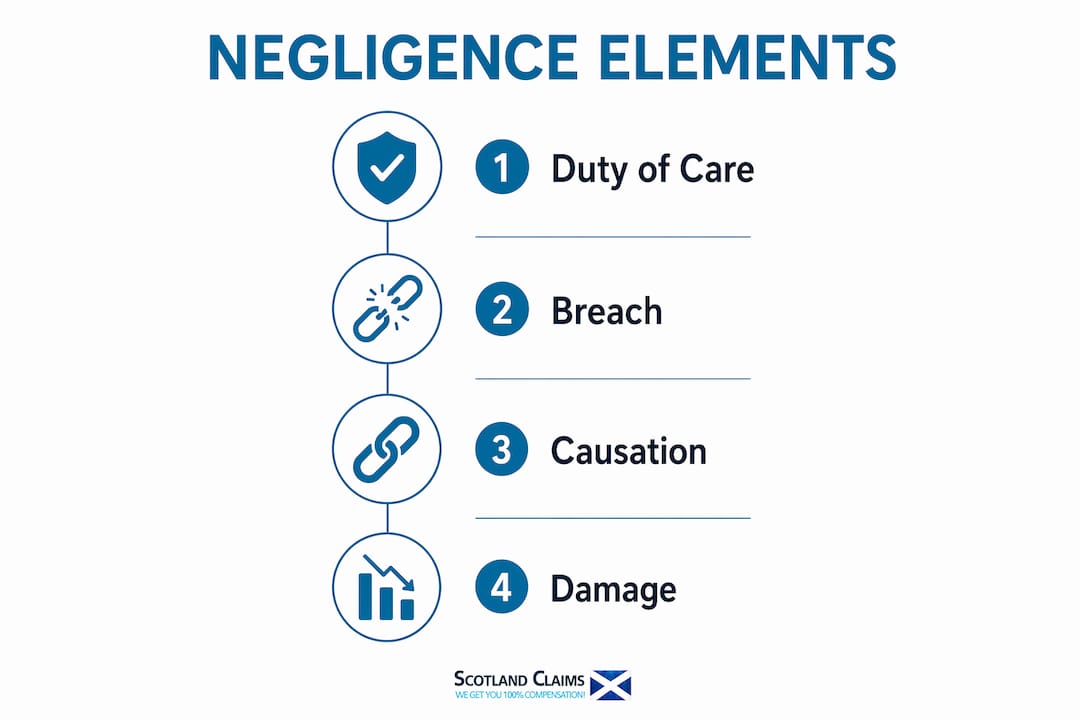
Negligence in tort law, or more precisely in Scots law under the law of delict, is built on four essential elements. Every personal injury claim in Scotland must satisfy each one before a court will award compensation. Miss any single element and the claim fails, regardless of how serious the injury.
The four elements are:
-
Duty of care. The defender (the person or organisation you are claiming against) must have owed you a legal duty to take reasonable care. A driver owes a duty of care to other road users. An employer owes a duty of care to employees. A supermarket owes a duty of care to shoppers on its premises.
-
Breach of duty. The defender must have fallen below the standard expected of a reasonable person in their position. A driver who runs a red light breaches that duty. An employer who fails to maintain scaffolding breaches theirs.
-
Causation. The breach must have directly caused your injury or loss. If you slipped on a wet floor but would have fallen regardless due to a pre-existing condition, causation becomes contested. Courts apply the “but for” test: but for the defender’s breach, would the harm have occurred?
-
Damage. You must have suffered actual, quantifiable harm. This includes physical injury, psychological injury, financial loss, or a combination of all three.
One additional principle worth knowing is res ipsa loquitur, which translates as “the thing speaks for itself.” Under this doctrine, burden shifts to the defender once the claimant establishes that the cause of the accident was under the defender’s control and that the accident would not ordinarily happen without negligence. This is particularly relevant in cases involving faulty equipment or unexplained accidents on managed premises.
Pro Tip: Keep a written record of your injury, symptoms, and any communications with the responsible party from the very first day. Courts weigh contemporaneous notes heavily when assessing credibility.
| Element |
What it means in practice |
| Duty of care |
A legal obligation to avoid causing harm to others in foreseeable circumstances |
| Breach of duty |
Falling below the standard a reasonable person would maintain |
| Causation |
A direct link between the breach and the harm suffered |
| Damage |
Actual loss, whether physical, psychological, or financial |
What types of negligence apply in Scottish personal injury cases?
Not all negligence is the same. Scottish courts recognise several distinct forms, and the type that applies to your situation shapes how your claim is assessed and what evidence you need.
The most common scenarios include:
- Road traffic accidents. A driver who is distracted, speeding, or under the influence owes a duty of care to every other road user. If you were injured as a passenger or a non-fault driver, you are entitled to pursue a claim against the at-fault party.
- Workplace injuries. Employers in Scotland have statutory duties under the Health and Safety at Work etc. Act 1974 alongside common law duties. Failing to provide safe equipment, adequate training, or a safe working environment constitutes negligence at work.
- Slips, trips, and falls. Occupiers of land and premises owe a duty under the Occupiers’ Liability (Scotland) Act 1960. A wet floor without a warning sign, or a cracked pavement left unrepaired, are textbook examples of breach.
- Industrial disease and latent injuries. Conditions such as asbestosis or noise-induced hearing loss may not appear until decades after the negligent exposure. Scots law accommodates this through the “date of knowledge” rule, which is explained further below.
- Wilful acts versus negligence. Negligence is always unintentional. A deliberate act causing harm is a different matter entirely and falls outside the scope of a standard negligence claim.
“The distinction between negligence and a wilful act matters enormously in Scots law. Negligence requires proof that the defender failed to meet a reasonable standard of care, not that they intended harm. This distinction shapes both the legal test and the available defences.”
Courts assess each type of negligence on its own facts. A workplace accident claim, for instance, will scrutinise training records and risk assessments. A road accident claim will rely on police reports, dashcam footage, and witness statements. The type of negligence determines the evidence you need to gather and the legal standard applied.
How does contributory negligence affect your compensation?
Contributory negligence is the legal finding that a claimant’s own actions contributed to the harm they suffered. It does not extinguish a claim. It reduces the compensation awarded in proportion to the claimant’s share of responsibility.
The legal basis is the Law Reform (Contributory Negligence) Act 1945, which applies across Scotland. Under this Act, a court apportions damages according to each party’s degree of fault. If you are found 25% responsible for your own injury, your compensation is reduced by 25%.
Common examples where contributory negligence is raised include:
- Not wearing a seatbelt in a road traffic accident
- Ignoring posted safety warnings in a workplace
- Walking in an area clearly marked as out of bounds
- Wearing unsuitable footwear on a known hazardous surface
Critically, showing a claimant was careless is not sufficient. The defender must prove that the claimant’s actions directly caused or contributed to the harm. Superficial allegations of victim fault rarely succeed without concrete evidence. Apportionment of damages is a matter of judicial discretion, decided on the specific facts of each case.
Evidence is the deciding factor. CCTV footage, maintenance logs, inspection records, and photographs taken at the scene all influence how blame is divided. Early and thorough investigation significantly affects the outcome. Delay allows evidence to disappear and memories to fade.
Pro Tip: Photograph the scene of your accident immediately, before anything is cleaned up or repaired. This single step has saved countless claims from being undermined by contributory negligence arguments.
| Scenario |
Likely contributory negligence finding |
| No seatbelt in a road accident |
15–25% reduction in damages |
| Ignoring a clear safety warning sign |
20–33% reduction in damages |
| Wearing inappropriate footwear on a wet surface |
Fact-specific, typically 10–25% |
| Following all safety protocols but still injured |
No contributory negligence |
What are the time limits for negligence claims in Scotland?
Time limits in Scotland are strict, and missing them ends your claim permanently. Personal injury claims in Scotland are generally subject to a three-year limitation period. The clock starts from the date of the accident or, crucially, from the date you first became aware of the injury and its cause.
The steps for pursuing a claim are as follows:
- Identify the date of knowledge. This is the date you knew, or ought reasonably to have known, that you suffered a loss caused by another party’s negligence. For latent conditions such as industrial disease, the limitation period runs from this date, not from the original negligent act.
- Gather evidence promptly. Photographs, medical records, witness details, and any correspondence with the responsible party should be collected as soon as possible.
- Follow the Pre-Action Protocol if applicable. Claims valued at £25,000 or less must adhere to a Compulsory Pre-Action Protocol before court proceedings begin. This requires early exchange of information and a genuine attempt to settle without litigation.
- Instruct a specialist solicitor. For claims over £25,000, there is no compulsory pre-action protocol, but legal representation remains critical.
- Commence proceedings within the limitation period. Scottish courts strictly enforce these deadlines. Miscalculating the start date is one of the most common and most avoidable reasons claims are dismissed.
Once litigation begins, trials in Scotland are typically scheduled approximately nine months after proceedings commence. The Pre-Action Protocol for smaller claims exists precisely to reduce this burden by encouraging early settlement. Acting promptly gives you the best chance of a full and fair outcome. You can review the claim time limits that apply to your specific situation before taking any further steps.
Key takeaways
Proving negligence in Scotland requires satisfying all four elements: duty of care, breach, causation, and actual damage. Miss one and the claim cannot succeed.
| Point |
Details |
| Four elements are non-negotiable |
Duty, breach, causation, and damage must all be established for a claim to succeed. |
| Contributory negligence reduces, not removes, compensation |
Your award is reduced proportionally to your share of fault under the 1945 Act. |
| Time limits are absolute |
The three-year period starts from the date of knowledge, not necessarily the accident date. |
| Evidence determines outcomes |
CCTV, photos, and records decide how blame is apportioned and whether claims succeed. |
| Pre-Action Protocol applies to smaller claims |
Claims of £25,000 or less must follow a compulsory protocol before court proceedings begin. |
Why understanding negligence law in Scotland matters more than people realise
I have seen too many people in Scotland lose valid claims not because the law was against them, but because they waited too long or underestimated how much evidence matters. The three-year time limit sounds generous until you factor in how long it takes to gather medical records, trace witnesses, and instruct a solicitor. By the time some people contact a lawyer, the clock has already run down to weeks.
The contributory negligence argument is the one that surprises people most. Defenders and their insurers raise it routinely, often on thin grounds, hoping claimants will accept a reduced offer rather than fight. What most people do not realise is that courts require concrete evidence to apportion blame. A vague assertion that you should have been more careful rarely holds up. The role of evidence in injury claims cannot be overstated. Photographs taken at the scene, a GP visit within 48 hours, and a written account of what happened are worth more than any legal argument made months later.
My honest advice is this: do not try to assess your own claim in isolation. Scots law has specific procedural rules, limitation nuances, and evidentiary standards that differ from English law. Getting advice from a solicitor who specialises in Scottish personal injury law is not a luxury. It is the difference between a successful claim and a dismissed one.
— Roger
How Scotland Claims Injury Lawyers can help with your negligence claim
If you have been injured through someone else’s negligence, Scotland Claims Injury Lawyers connects you with specialist injury lawyers in Scotland who understand Scots law inside out. For every type of claim - including road traffic accidents, whiplash, slips, trips, and workplace accidents - the success fee is capped at 18% including VAT, unlike many large national firms that charge the full 20% including VAT. The service operates on a No Win No Fee basis, meaning no upfront costs and no fees if your claim is unsuccessful. Use the compensation calculator to get an estimate of what your claim may be worth, then request a free callback to take the next step.
FAQ
What is the legal definition of negligence in Scotland?
Negligence in Scots law is the failure to exercise the standard of care a reasonable person would apply in the same circumstances, resulting in harm to another. It is established through four elements: duty of care, breach of that duty, causation, and actual damage.
How long do I have to make a negligence claim in Scotland?
The standard limitation period is three years from the date of the accident or from the date you first became aware of your injury and its cause. Scottish courts enforce this deadline strictly, and missing it will end your claim.
What is contributory negligence and how does it affect my claim?
Contributory negligence is a finding that your own actions contributed to your injury. Under the Law Reform (Contributory Negligence) Act 1945, your compensation is reduced in proportion to your share of fault. It does not prevent you from claiming altogether.
What is res ipsa loquitur and when does it apply?
Res ipsa loquitur means “the thing speaks for itself.” It applies when an accident would not normally occur without negligence and the cause was under the defender’s control. Once established, the burden shifts to the defender to disprove negligence.
Do I need to follow a protocol before making a personal injury claim in Scotland?
Claims valued at £25,000 or less are subject to a Compulsory Pre-Action Protocol, which requires early exchange of information and an attempt to settle before raising court proceedings. Claims above this threshold have no such compulsory requirement.
Recommended