Contributory negligence in scotland: your 2026 guide

TL;DR:
- Contributory negligence reduces a claimant’s damages proportionally based on their share of fault but does not eliminate the right to claim.
- Courts assess blameworthiness and causative potency to determine the percentage of fault attributable to the claimant, which can be challenged and adjusted on appeal.
Contributory negligence is defined as a legal principle where your compensation is reduced if you are partly responsible for causing your own injury. Under the Law Reform (Contributory Negligence) Act 1945, Scottish courts do not bar your claim entirely because of partial fault. Instead, they reduce your damages to the extent considered just and equitable. This is a critical distinction for anyone pursuing a personal injury claim in Scotland. Understanding the contributory negligence definition, how courts apply it, and what you can do about it could protect a significant portion of your compensation.
What is contributory negligence in scottish personal injury law?
Contributory negligence is the legal doctrine that reduces a claimant’s damages when their own conduct contributed to the harm they suffered. Before the 1945 Act replaced the complete bar, a claimant found even slightly at fault could recover nothing at all. The modern approach reflects fairness: you can still claim, but your award is adjusted proportionally.
The court’s job is to weigh your share of responsibility against the defender’s and arrive at a percentage reduction. There is no fixed formula for this. The judge applies a “just and equitable” standard, which means the outcome is fact-specific and discretionary every time.
This matters practically because a 20% finding of contributory negligence on a £50,000 award reduces your payout to £40,000. A 50% finding halves it. Knowing how courts reach those figures gives you a real advantage when building your claim.
Pro Tip: If you are unsure whether your own behaviour could be used against you in a claim, speak to a specialist solicitor before the other side raises it. Early legal advice shapes how evidence is gathered and presented.
The legal test courts apply
Courts do not reduce damages simply because a claimant was careless. The defender must prove two things: first, that the claimant was at fault, and second, that this fault caused or contributed to the harm. Carelessness alone is insufficient. This is an objective, fact-sensitive test applied to the specific circumstances of each incident.
The key questions a court asks are:
- Did the claimant fail to take reasonable care for their own safety?
- Did that failure directly contribute to the injury or its severity?
- What proportion of the overall blame is attributable to the claimant versus the defender?
Understanding negligence in law as a broader concept helps here. Contributory negligence sits within that framework as a specific defence rather than a standalone claim.
What are common examples of contributory negligence in scotland?
Real cases illustrate how contributory negligence laws operate in practice far better than abstract rules. Scottish courts have dealt with contributory negligence across road traffic accidents, workplace injuries, and slip and trip claims, and the outcomes vary considerably depending on the evidence.
The landmark case of Jackson v Murray is the clearest example of how apportionment works at the highest level. In that case, a 13-year-old girl stepped out from behind a school minibus and was struck by a car. The initial court found her 90% contributorily negligent. The Inner House of the Court of Session reduced this to 70%. The Supreme Court then set the figure at 50%, applying the just and equitable principle to balance both parties’ blameworthiness and causative contribution. That shift from 90% to 50% represents a dramatic difference in the compensation the claimant actually received.
Common scenarios where contributory negligence is raised in Scotland include:
- Slip and trip accidents where the claimant walked through an area with visible warning signs or known hazards.
- Road traffic accidents where a passenger failed to wear a seatbelt, increasing the severity of their injuries.
- Workplace accidents where an employee ignored a safety procedure they had been trained to follow.
- Pedestrian accidents where someone crossed a road at an unsafe point or without checking for traffic.
- Sporting or leisure injuries where a participant took an obvious risk beyond the normal scope of the activity.
In each scenario, the court examines the claimant’s specific behaviour, not a general impression of carelessness. Evidence about what the claimant knew, what they could see, and what a reasonable person would have done in the same position all feed into the apportionment decision. You can find further examples of negligence cases that illustrate how Scottish courts have handled these situations in practice.
How is the contributory negligence percentage decided?
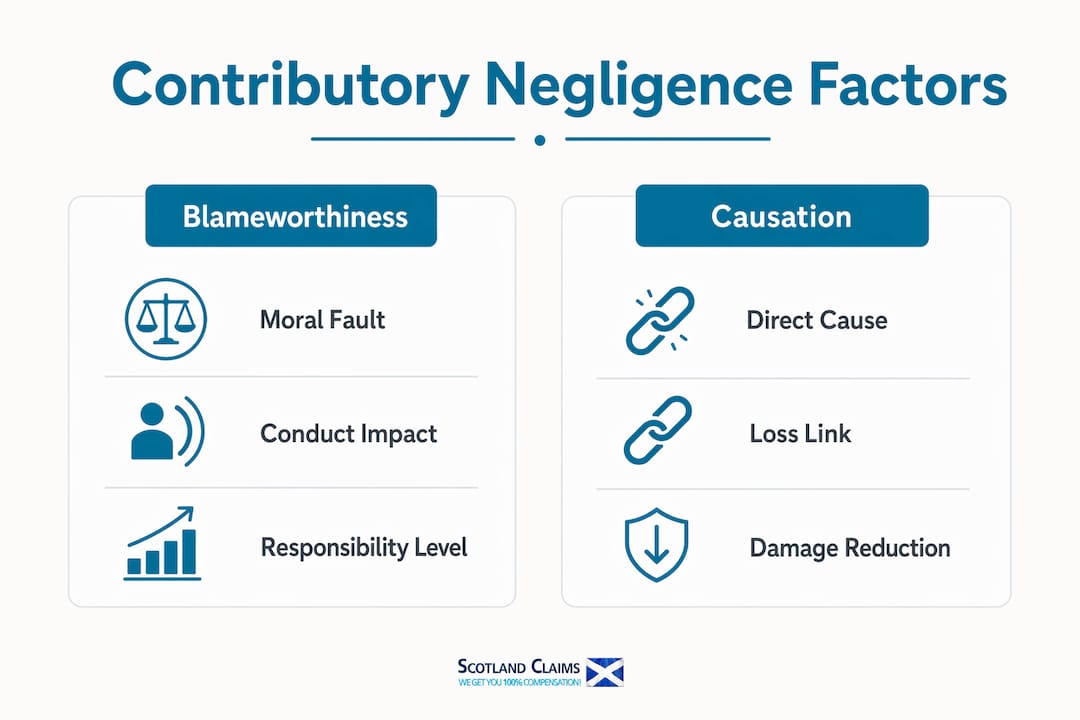
Scottish courts weigh two distinct factors when setting the apportionment percentage: blameworthiness and causative potency. Blameworthiness asks how culpable each party’s conduct was. Causative potency asks how much each party’s conduct actually contributed to bringing about the harm. These two factors do not always point in the same direction, which is why apportionment is discretionary and without a fixed formula.

| Factor |
What It Measures |
Example |
| Blameworthiness |
Moral culpability of each party’s conduct |
Speeding driver vs. pedestrian crossing carelessly |
| Causative potency |
How much each party’s fault caused the harm |
Faulty brakes vs. failure to wear a seatbelt |
| Just and equitable |
Overall fairness of the percentage split |
Court balancing both factors to reach a final figure |
The table above shows why two cases with similar facts can produce different percentages. A defender driving at excessive speed carries high causative potency even if the claimant also behaved carelessly.
Pro Tip: Never accept an insurer’s first offer of settlement where contributory negligence has been alleged without having a solicitor review the apportionment figure. Insurers routinely overstate a claimant’s share of fault.
Can a contributory negligence finding be appealed?
Yes. Appellate courts can modify a contributory negligence award if the lower court’s figure falls outside a reasonable range or misapplies the law. Jackson v Murray itself demonstrates this: the figure moved through three court levels before settling at 50%. Appellate intervention is a genuine safeguard against excessive or unfair reductions. The negligence claim procedure in Scotland includes these review stages, and understanding them matters if you believe an initial finding was disproportionate.
What practical steps should claimants take when contributory negligence is alleged?
Acting quickly and methodically after an accident significantly affects how a contributory negligence allegation can be challenged. Early collection of evidence is the single most important step a claimant can take. Fact-sensitive apportionments rely heavily on what the claimant was doing at the time of the incident, and that evidence disappears fast.
The steps below apply whether you are dealing with a slip and trip, a road accident, or a workplace injury:
- Secure CCTV footage immediately. Businesses and local authorities typically overwrite footage within 28–31 days. Request preservation in writing as soon as possible after the accident.
- Photograph the scene. Capture the exact location, any hazards, warning signs, lighting conditions, and your footwear or clothing. Courts assess what a reasonable person would have noticed.
- Obtain maintenance and inspection records. In slip and trip claims, these records show whether the defender knew about the hazard. They also reveal whether the claimant had any reason to expect the danger.
- Record witness details. Independent witnesses who saw the incident can corroborate your account of your own behaviour and contradict an inflated contributory negligence allegation.
- Understand the mitigation rule. The mitigation rule applies before contributory negligence is calculated. Losses you could have avoided through reasonable care are excluded from the damages pool before apportionment begins. This means some damages may be removed entirely before the percentage reduction is even applied.
- Check your claim eligibility. Reviewing your injury claim eligibility in Scotland helps you understand which heads of loss are in play and which might be affected by a contributory negligence finding.
One point that surprises many claimants: apportionment applies only to damages causally connected to the claimant’s fault. Damages unrelated to the contributory fault remain unaffected. If you suffered two separate injuries in an accident and your conduct contributed to only one, the reduction applies to that injury’s damages alone.
Key takeaways
Contributory negligence in Scotland reduces your compensation proportionally based on your share of fault, but it does not end your right to claim.
| Point |
Details |
| Damages reduced, not barred |
The 1945 Act means partial fault reduces your award rather than cancelling your claim entirely. |
| Causation must be proved |
The defender must show your fault directly contributed to the harm, not merely that you were careless. |
| No fixed apportionment formula |
Courts weigh blameworthiness and causative potency on the facts, so outcomes vary significantly between cases. |
| Appeals can correct unfair findings |
As Jackson v Murray shows, appellate courts will adjust percentages that fall outside a reasonable range. |
| Evidence collection is decisive |
CCTV, photographs, and maintenance records are the strongest tools for challenging an inflated contributory negligence allegation. |
The uncomfortable truth about contributory negligence allegations
Most people I speak with assume that if they were “a bit careless,” their compensation will be slashed by half or more. That assumption is wrong, and it costs claimants money. Courts require the defender to prove causation, not just point at something the claimant did. Claimants often wrongly assume slight carelessness means a large reduction, when in reality a minor lapse with no real causal link to the injury may attract no reduction at all.
The other misconception I encounter regularly is that once a contributory negligence percentage is set, it is final. Jackson v Murray proves otherwise. A 90% finding became 50% through the appeals process. That is the difference between receiving 10% of your damages and receiving half. The system is designed to be corrected when it gets things wrong.
What I would tell anyone facing a contributory negligence allegation is this: get specialist legal advice before you respond to the other side’s position. The way you frame your evidence and your account of events in the early stages shapes everything that follows. A solicitor who understands Scottish apportionment law will know which facts matter most and how to present them. Choosing one with a no-win-no-fee arrangement and low fees means you keep more of whatever you recover.
— Roger
How Scotland Claims Injury Lawyers can help with your claim
If contributory negligence has been raised against you, or you are worried it might be, Scotland Claims Injury Lawyers connects you with specialist injury lawyers who handle Scottish personal injury claims every day. Scotland Claims Injury Lawyers offers 100% compensation on all claim types - whether your injury involves whiplash or a more serious accident such as a slip, trip, or workplace incident, no success fee is ever deducted, so you keep every penny of your compensation. Most other large national firms charge up to 20% including VAT. Use the compensation calculator to get an estimate of what your claim could be worth, then speak to a solicitor on a no win no fee basis with no upfront costs.
FAQ
What is the contributory negligence definition in scots law?
Contributory negligence is a legal principle under the Law Reform (Contributory Negligence) Act 1945 where a claimant’s damages are reduced proportionally if their own fault contributed to their injury. The reduction is set at whatever percentage the court considers just and equitable.
Is contributory negligence a complete defence in scotland?
No. Contributory negligence is a partial defence that reduces the claimant’s damages rather than barring the claim entirely. A claimant found 40% contributorily negligent still recovers 60% of their assessed damages.
How does contributory negligence work alongside the mitigation rule?
The mitigation rule is applied first: losses the claimant could have avoided through reasonable care are excluded from the damages pool before any apportionment calculation begins. Contributory negligence then reduces the remaining recoverable damages by the relevant percentage.
Can a contributory negligence percentage be challenged after judgment?
Yes. Appellate courts in Scotland can adjust a contributory negligence finding if it falls outside a reasonable range or reflects a misapplication of the law, as demonstrated in Jackson v Murray where the Supreme Court reduced the finding from 70% to 50%.
What evidence helps challenge a contributory negligence allegation?
CCTV footage, photographs of the scene, maintenance and inspection records, and independent witness statements are the most effective forms of evidence. Securing these as quickly as possible after an accident is critical because much of this material is overwritten or lost within weeks.
Recommended