Road traffic accident checklist Scotland: protect your claim

TL;DR:
- In Scotland, after a road traffic accident, remaining calm, calling emergency services if needed, and exchanging accurate information are crucial steps to protect your legal rights. Documenting the scene, injuries, witness details, and personal account promptly greatly strengthens your compensation claim. Seeking expert legal advice and reporting actions within specified timeframes ensure your case remains strong and optimally supported.
Being involved in a road traffic accident in Scotland is a frightening experience, and in the chaos that follows, it is remarkably easy to miss steps that could later cost you your compensation. The decisions you make in the minutes and hours after a collision directly affect whether your claim succeeds or fails. This checklist walks you through every essential action, from the moment the impact happens to the point where you contact a specialist lawyer, so that nothing falls through the cracks and your legal rights remain fully protected.
Table of Contents
Key Takeaways
| Point |
Details |
| Safety comes first |
Always check for injuries and call 999 in emergencies to protect everyone involved. |
| Share required details |
Legally, you must exchange insurance, identity, and vehicle information at the scene. |
| Prompt reporting |
Contact police and notify your insurer within 24 hours to fulfil legal requirements. |
| Evidence is crucial |
Collect photographs, medical records, and witness statements to support your claim. |
| Seek expert help |
Access specialist legal support and no win no fee options to maximise your compensation. |
Assess safety and call emergency services
Understanding the importance of safety, let’s unpack the critical first steps to take after an accident.
The very first thing you need to do is stay calm. That sounds obvious, but panic causes people to forget basic actions that could protect their health and their legal position. Take a breath, turn off your engine, and switch on your hazard lights. Then check yourself and your passengers for injuries before stepping out of the vehicle. If it is safe to do so, check on the occupants of the other vehicle as well.
After a road traffic accident in Scotland, your first priorities are safety, checking for injuries, and calling 999 when there are injuries, the road is blocked, or there is a serious situation. The law in Scotland requires you to stop at the scene of an accident, and failing to do so is a criminal offence. Many people are unaware that driving away, even briefly, can seriously undermine any future claim they try to make.
The types of road traffic accident that occur on Scottish roads vary enormously, from rear-end shunts on the M8 to rural single-track collisions. Each brings different risks and different legal considerations, which is why following a consistent approach matters regardless of how minor or serious the accident appears.
Here is what you should do immediately at the scene:
- Switch on hazard lights and, if available, place a warning triangle at a safe distance behind your vehicle
- Check for injuries to all parties and call 999 immediately if anyone is hurt, the road is blocked, or the situation poses a danger to other road users
- Call 101 if the situation is less urgent, such as when all parties are uninjured but you cannot exchange details at the scene
- Move vehicles off the road if it is safe and legal to do so in order to reduce further collision risk
- Do not admit liability or apologise, as this can be used against you during the claims process
“Staying at the scene and calling the correct emergency number is not just about following the law. It creates an official record of the incident from the very beginning, which is one of the strongest foundations for a compensation claim.”
Pro Tip: Even if you feel unhurt immediately after a collision, adrenaline can mask pain and injury. Always seek a medical assessment as soon as possible, ideally on the same day. This protects both your health and your legal claim.
Once safety is ensured and emergency services contacted if necessary, your next duty is to properly exchange information.
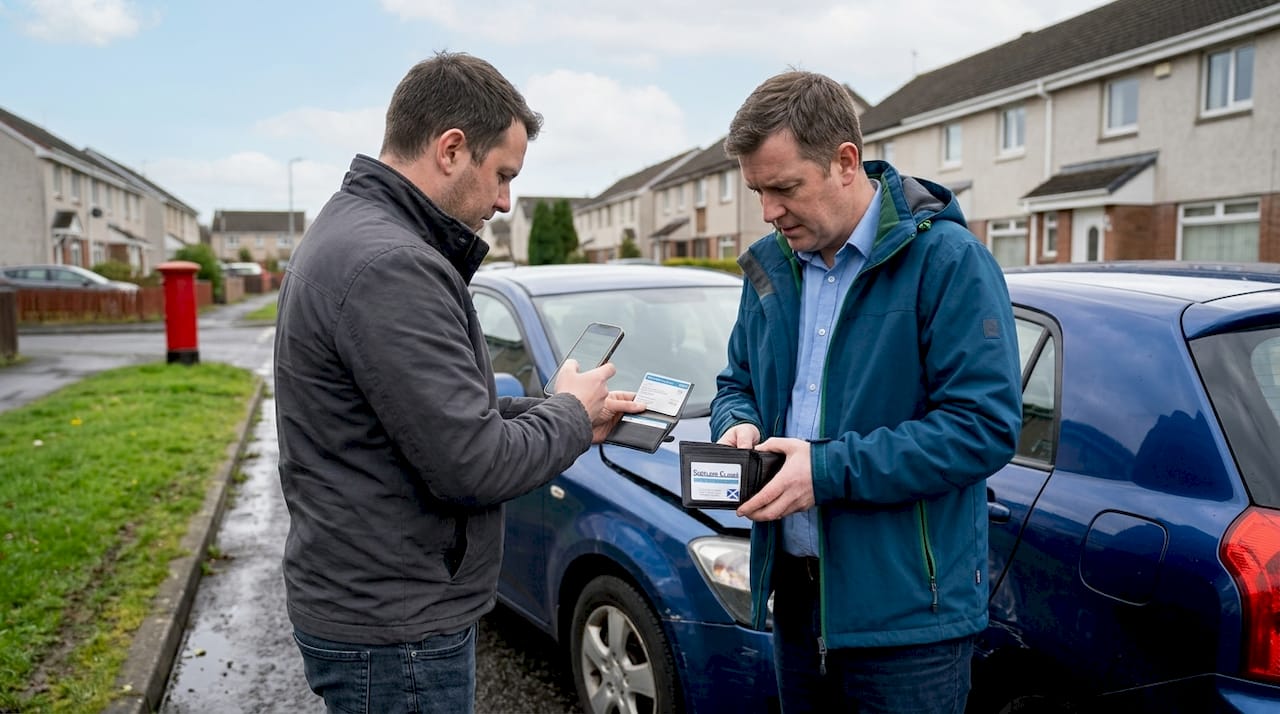
Exchanging the correct details at the scene is a legal obligation under the Road Traffic Act 1988, which applies in Scotland. Failing to provide your information to another driver who reasonably requests it is an offence. You need to give your name, address, vehicle registration, and insurance details if asked. You should also collect the same from the other party.
You should exchange the required details at the scene, including insurance details when asked and vehicle identifiers, and if there is any doubt or you could not exchange details, report appropriately to the police. This is not just a legal formality. The information you gather at this stage forms the factual backbone of your future claim, and gaps in it can cause significant delays or outright rejection.
When it comes to police involvement, the rules are not always black and white. Some accidents may not require police attendance if both parties exchange details and there is no injury or alleged offence, but you should escalate to police via 999 or 101 where there are injuries, the road is blocked, or details cannot be exchanged. Understanding this distinction helps you respond correctly to each scenario rather than either under-reporting or over-reporting.
Understanding what injury claim documents are needed ahead of time can save you considerable stress later. Having this knowledge at the back of your mind means you can start collecting the right information from the very first moment. A legal intake specialist will also be able to advise you on exactly what is required for your specific type of accident.
Follow this numbered sequence to exchange information properly:
- Provide your full name and current home address to the other driver
- Share your vehicle registration number and make and model of the car
- Give your insurance company name and policy number if the other party asks
- Collect the same details from every other driver involved in the collision
- Note the names and contact details of any witnesses present at the scene
- Write down the badge numbers of any attending police officers
- If the other driver refuses to share details, note as much as you can (vehicle registration, make, colour) and report to the police immediately
Pro Tip: Use your phone to photograph the other driver’s insurance certificate and driving licence rather than trying to write everything down by hand. This removes transcription errors and provides a time-stamped record.
Report to police and notify insurers promptly
Having exchanged details, you’ll need to follow up with police and insurers to ensure your rights are preserved.
Reporting to the police and notifying your insurer are two separate requirements that run in parallel. Missing either one can create complications that are very difficult to resolve later in the claims process. Report to the police and inform your insurer within 24 hours are the twin pillars of your post-accident obligations in Scotland.
Keeping written records of every communication you have, whether with police, your insurer, or the other party’s insurer, is essential. Dates, times, names of people you spoke to, and summaries of what was discussed all become valuable reference points. Insurers sometimes dispute timelines, and having a paper trail protects you.
Understanding your reporting obligations is easier with a clear overview:
| Action |
Deadline |
Why it matters |
| Report accident to police |
Within 24 hours (if no immediate report at scene) |
Legal requirement; protects against criminal liability |
| Notify your own insurer |
Within 24 hours |
Required by most policy terms; preserves claim validity |
| Request a crime reference number |
At time of reporting |
Provides official documentation for your claim |
| Seek medical attention |
Same day if possible |
Links injuries to the accident; supports medical evidence |
| Contact a specialist lawyer |
As soon as possible |
Preserves limitation periods and claim strategy |
When you contact your insurer, be factual and measured. Describe what happened without speculating about fault or making statements that could be interpreted as admissions. Your insurer needs the facts. The question of liability is for your lawyer to address. Using the correct accident claim forms in Scotland ensures your documentation meets the required legal standard from the outset.
Key reporting actions to complete within 24 hours:
- Report to the police if injuries occurred or details could not be exchanged
- Obtain a police incident reference number for your records
- Contact your own insurer and provide a factual account of events
- Confirm that your insurer has recorded the notification and obtain their reference number
- Begin a written log of all accident-related communications
Document evidence for your claim
With police and insurers notified, gathering evidence becomes your next essential step to maximise claim success.
Evidence is the currency of a successful personal injury claim. Without it, your case rests on your word against the other party’s account, which is a much weaker position. Strong, timely evidence gives your solicitor the material to build a compelling argument for the compensation you deserve.
It is worth understanding that insurer details and vehicle identifiers should be recorded promptly along with keeping your insurer informed within 24 hours. This is because memories fade quickly after a traumatic event, and physical evidence at the scene (such as tyre marks and vehicle positions) can be cleared away within hours.
Here is a direct comparison of strong versus weak evidence, so you can see exactly what difference your actions at the scene make:
| Strong evidence |
Weak evidence |
| Dated photographs of vehicle damage, road position, and injuries |
A verbal description from memory days later |
| Witness statements with full contact details |
A vague recollection that “someone saw it happen” |
| Medical records linking injuries to the accident date |
A GP visit weeks after the accident with no clear connection |
| Dashcam footage showing the moment of impact |
A general claim that the other driver was at fault |
| Official police report with incident number |
No report made and no reference number obtained |
| Weather and road condition notes taken at the scene |
A general statement that “it was a bit slippery” |
To build evidence that genuinely supports your claim, work through this checklist as soon as it is safe to do so:
- Photograph all vehicles involved from multiple angles, including close-ups of damage and wide shots showing road positions
- Photograph skid marks, road signs, traffic signals, and any hazards that contributed to the accident
- Take photographs of your visible injuries immediately and continue photographing them as they develop over subsequent days
- Collect names, phone numbers, and email addresses from witnesses
- Ask witnesses if they are willing to provide a written statement
- Keep every medical appointment letter, prescription, and diagnosis report related to your injuries
- Retain receipts for any expenses caused by the accident, including taxi fares, prescriptions, and physiotherapy
Understanding how to prepare injury evidence in Scotland gives you a significant advantage. The reason documenting accident evidence matters so profoundly is that insurers often try to reduce settlement offers by questioning the extent of injuries or disputing how the accident happened. Solid evidence closes those arguments down. Many claims fail not because the accident did not happen, but because of easily preventable claim mistakes in evidence gathering.
Pro Tip: Create a dedicated folder on your phone or computer the same day as your accident. Store every photograph, document, and email in one place. Disorganised evidence is nearly as damaging as no evidence at all when it comes to building your claim.
The overlooked step that can make or break your claim
Having covered the official checklist, let’s discuss the often-neglected action that can transform your claim outcome.
Here is something that surprises many accident victims. The legal and administrative steps, the police reports, the insurer notifications, the witness details, are all things people at least know they should try to do. What genuinely undermines claims, far more often than people realise, is the failure to create a personal written record in the immediate aftermath.
We have seen situations where everything technically correct was done, and yet the claim ran into difficulty because the injured person could not accurately describe what happened in sequence, how their pain changed over time, or what impact the injuries had on their daily life. Insurers and legal teams rely heavily on this personal narrative. When it is missing or inconsistent, it creates doubt.
The reason this step gets skipped is entirely understandable. After a road accident, you are shaken, stressed, possibly in pain, and dealing with practical chaos. Sitting down to write a detailed account feels like the last thing you should be doing. But a brief, honest written record made within 24 hours, describing the accident, your injuries, your emotional state, and how your daily routine has been disrupted, is worth more than you might imagine.
The importance of documenting every detail clearly and promptly is consistently underestimated. And the common claim mistakes we see repeatedly involve people who exchanged details and reported correctly, but then assumed the rest would take care of itself. It does not.
Your personal account matters because it demonstrates the human reality behind the accident. It connects the evidence to your experience. Insurance companies deal in facts and figures, but a well-documented personal impact statement, written while events were fresh, is a powerful counterweight to any attempt to minimise your suffering. Our strong advice is to write that account tonight, not next week.
Get expert support for your road traffic accident claim
Knowing what to do after an accident is one thing. Having a specialist on your side to navigate the legal process is another entirely.
At Scotland Claims, we connect accident victims across Scotland with experienced injury lawyers in Scotland who handle road traffic accident claims on a No Win No Fee basis. That means no upfront costs and no fees if your claim is unsuccessful. You keep 100% of your compensation. Use our compensation calculator to get an instant estimate of what your claim could be worth, then speak to one of our specialists who will guide you through every step with complete clarity.
Frequently asked questions
Who should I call after a road traffic accident in Scotland?
Call 999 if anyone is injured, the road is blocked, or the situation is dangerous; use 101 for non-emergency situations where details simply cannot be exchanged at the scene.
You must exchange your name, address, insurance details, and vehicle identifiers with the other driver, and document any refusal to provide these details immediately.
How soon should I notify my insurer after an accident?
You should notify your insurer within 24 hours of the accident to protect your policy terms and avoid any reduction in the compensation you can claim.
When am I required to report an accident to the police?
You must report within 24 hours if there are injuries, the road is blocked, or details could not be exchanged; police attendance is not always required if both parties exchange details and there is no injury or alleged offence.
What is the most important evidence for a compensation claim?
Photographs taken at the scene, dated medical records linking your injuries to the accident, and witness statements with contact details are the three most powerful pieces of evidence for any road traffic accident claim in Scotland.
Recommended