Role of court proceedings in claims: Scottish guide

TL;DR:
- Most personal injury claims in Scotland are resolved through early negotiations and pre-action protocols before reaching court. Court proceedings are a formal last resort that only occurs if parties cannot settle, often extending the claim process and increasing costs. Proper evidence, timely responses, and effective legal guidance are crucial to avoid pitfalls and ensure fair compensation.
Most people assume that making a personal injury claim automatically means going to court. That assumption causes unnecessary anxiety and, in some cases, puts people off pursuing compensation they genuinely deserve. The role of court proceedings in claims is frequently misunderstood. Courts do not always sit at the centre of the process. In Scotland, the legal system actively encourages resolution before a case ever reaches a judge. Understanding how court fits into the broader picture helps you make better decisions and manage your expectations from the very start.
Table of Contents
Key takeaways
| Point |
Details |
| Court is rarely the first step |
Pre-action protocols must be followed before formal court proceedings can begin in personal injury claims. |
| Early settlement is encouraged |
ADR methods like mediation resolve many claims before trial, saving time and costs. |
| Court involvement affects timelines |
Proceeding to court typically extends how long your claim takes and can affect net compensation amounts. |
| Evidence and compliance matter |
Missing deadlines or failing to document your injury properly can reduce or delay your compensation. |
| Fee protections exist |
With Scotland Claims, clients keep 100% of their compensation on every type of claim - no success fee is ever deducted, unlike most large firms which charge up to 20% including VAT. |
The role of court proceedings in claims
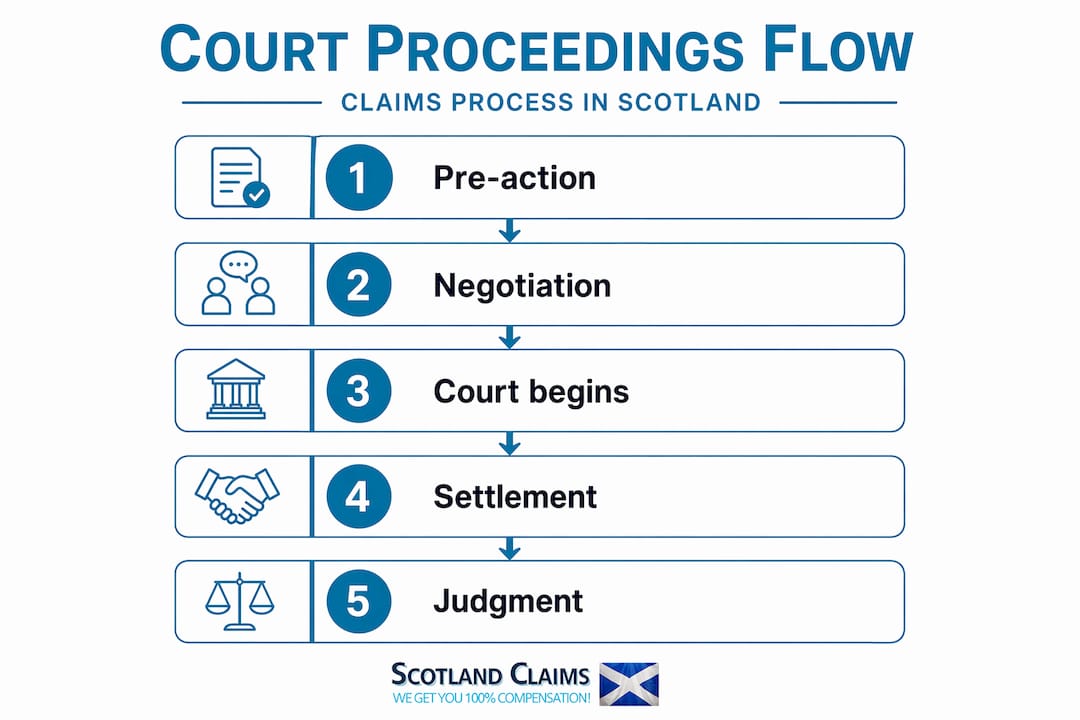
Before examining what happens inside a courtroom, it helps to understand where court fits within the overall claims process. Court proceedings in lawsuits represent a formal escalation. They are not the default route. In Scotland, personal injury claims follow a structured pathway designed to resolve disputes before litigation becomes necessary.
The court’s formal involvement typically only begins when negotiation fails or a defendant refuses to engage properly. The judicial proceedings and claims resolution process is built around the idea that early, fair settlement benefits everyone. This framing changes how you should think about your claim entirely. Rather than dreading court, focus on what needs to happen to settle your case without getting there.
Pre-action protocols: what happens before court
Pre-action protocols are mandatory steps that both parties in a personal injury claim must follow before court proceedings can be issued. The Pre-Action Protocol sets defined steps to encourage early settlement, requiring information exchange and giving each side a genuine opportunity to resolve the dispute.
The key stages of the pre-action process include:
- Notification letter: You or your solicitor sends a letter of claim to the defendant, outlining the accident, injuries, and the basis for liability.
- Acknowledgement deadline: The defendant must acknowledge receipt within 21 days of receiving your claim letter.
- Investigation period: After acknowledgement, the defendant typically has a set period (often three months) to investigate and respond.
- Information exchange: Both parties share relevant documents, including medical records, accident reports, and witness statements.
- Settlement negotiations: With evidence on the table, both sides attempt to reach an agreed settlement figure.
The protocol exists precisely to reduce unnecessary court involvement. When it works well, your claim settles at this stage without any formal court proceedings.
Ignoring these protocols often results in higher legal costs or adverse cost orders. Courts take a dim view of parties who skip steps or refuse to engage. If a defendant refuses reasonable contact or a claimant fails to follow proper procedure, the court can impose cost penalties that directly affect the financial outcome.
Pro Tip: Keep a written record of every communication during the pre-action stage. Dates, responses, and correspondence gaps can all be used later to demonstrate whether the other party cooperated appropriately.
If pre-action steps fail to produce a settlement, your solicitor will advise you to issue formal proceedings. Court proceedings start formally by filing a claim form and a detailed statement of case, which marks the transition from informal negotiation to a structured legal process governed by procedural rules.
Here is what that process typically looks like in Scotland:
- Issuing the claim: Your solicitor drafts and submits the formal claim to the appropriate court. In Scotland, this is usually the Sheriff Court for lower-value claims, with the Court of Session handling more serious or complex cases.
- Service on the defendant: The court serves the claim on the defendant, who then has a set timeframe to respond formally.
- Defence filing: The defendant lodges their defence, setting out which parts of your claim they accept or dispute.
- Acknowledgement of service: In many cases, the defendant first acknowledges receipt before providing a full defence.
- Directions from the court: Once both statements are lodged, the court issues directions. These set out the timetable for the case, including deadlines for evidence, expert reports, and any hearings.
Understanding your personal injury rights in Scotland at this stage matters enormously. Your solicitor’s role becomes more active here. They manage correspondence with the court, meet all procedural deadlines, and build the strongest possible case for you. The role of solicitors at this point should not be underestimated. They translate a complex procedural process into something manageable for you as a claimant.
How courts manage claims once proceedings start
Once formal proceedings are underway, the court takes an active role in managing the litigation. Courts control claim progression through case management hearings, directions, and by actively encouraging fair settlement at every stage.
The court’s management role includes several key functions:
- Case management hearings: Judges review the state of the case, check both parties are complying with directions, and set or amend timelines.
- Evidence review: Written statements, medical reports, and expert opinions are submitted to the court. Oral evidence may also be heard at trial.
- Legal arguments: Each side presents its case on liability, causation, and the extent of your injuries and losses.
- Mediation encouragement: Courts frequently push parties toward alternative dispute resolution (ADR) even after proceedings have started. This includes structured mediation where a neutral third party helps negotiate a settlement.
The practical outcomes available to a court once proceedings are running include:
| Outcome |
What it means for you |
| Settlement before trial |
Both parties agree on a compensation figure, ending proceedings early |
| Judgment at trial |
A judge determines liability and awards compensation after hearing all evidence |
| Partial settlement |
Liability is agreed but quantum (the amount) is contested and decided at hearing |
| Claim dismissed |
If evidence is insufficient or procedural rules are seriously breached |
Many personal injury claims are successfully settled through negotiation or ADR before trial. This is good news for claimants. Settlement means quicker access to your compensation without the uncertainty of a judge’s decision.
Practical effects of court on your compensation
The honest reality is that court involvement changes the financial picture of your claim. Court proceedings generally increase claim duration and can raise legal costs, which directly affects how much money ends up in your pocket after everything is resolved.

For straightforward claims such as whiplash or road traffic accident injuries where you are not at fault, you retain 100% of your compensation through Scotlandclaims. No deductions are taken from your settlement at all. For every type of injury claim - including slips, trips, and accidents at work - Scotland Claims Injury Lawyers never deducts a success fee, so you keep 100% of your compensation. Most large and national firms charge up to 20% including VAT, making that difference significant when your compensation figure runs into thousands of pounds.
Beyond fees, longer claims cost more to run. Every hearing, report, and procedural step adds to the overall cost of litigation. This is another reason why the pre-action protocol stage matters so much. Settling early is not just faster. It is frequently more financially efficient.
Pro Tip: Before proceedings are issued, ask your solicitor to give you a realistic assessment of settlement value versus trial risk. A bird in the hand is often worth considerably more than the uncertainty of a judge’s award.
Good claims management throughout the process keeps costs controlled and timelines realistic. The difference between a well-managed claim and a poorly run one can be measured in months and thousands of pounds.
Key legal pitfalls to avoid in court proceedings
Understanding the how court affects claims is only useful if you also know what can go wrong. Several common mistakes create unnecessary complications.
- Inadequate evidence: Courts expect detailed, well-organised evidence. Proper documentation and compliance with court rules are crucial to avoid setbacks. Photographs, medical records, wage slips for loss of earnings, and witness details all matter.
- Missing deadlines: Court directions come with firm deadlines. Missing them can result in your evidence being excluded or your claim facing penalties.
- Refusing ADR without good reason: Courts can impose cost penalties on parties who refuse reasonable settlement offers or ignore ADR invitations. This can seriously affect the financial outcome of your claim.
- Poor communication with your solicitor: Court proceedings require prompt responses. Delays on your end slow the entire process.
- Underestimating the complexity: Even what looks like a straightforward claim can develop complications once proceedings begin. Specialist legal representation reduces the risk of procedural errors that cost you money.
Why you document evidence from the very first day cannot be overstated. Courts decide cases on the strength of what they can see, not what claimants say they remember.
My perspective on court proceedings in Scottish claims
I have seen a lot of injury claimants walk through the process believing that issuing court proceedings is either inevitable or terrifying. In my experience, both views are wrong.
The compulsory pre-action protocol makes court a last resort, promoting early settlement while evidence is fresh. The system is genuinely designed to keep claims out of court. When it works, claimants get fair compensation faster and with less stress. When it fails, it is usually because one party did not engage properly at the pre-action stage.
What I have learned is that the claimants who do best are those who stay organised, respond quickly, and trust their legal team to guide them through each stage. Court proceedings carry real weight when they happen. But they are a tool, not a punishment. Used correctly, the threat of formal proceedings often pushes defendants toward settlement when they might otherwise drag their heels.
My advice? Focus your energy on building a strong, well-evidenced claim from day one. Let the legal process work as it is designed to. You will be in a far stronger position whether your claim settles early or goes all the way to a hearing.
— Roger
How Scotland Claims Injury Lawyers supports you through this process
If you are pursuing a personal injury claim in Scotland and want to understand exactly how court proceedings might affect your outcome, Scotland Claims Injury Lawyers is here to help. Our no win no fee injury lawyers handle everything from road traffic accidents and whiplash injuries to more serious cases involving slips, trips, and workplace accidents.
For whiplash and road traffic accident claims where you are not at fault, you keep 100% of your compensation. For every claim type - whiplash, serious injuries, and everything in between - you keep 100% of your compensation, as we never deduct a success fee, unlike most large firms which charge up to 20% including VAT. Our specialist injury solicitors guide you through every stage, from pre-action protocols to court proceedings if needed. Get in touch for a free consultation and find out where your claim stands today.
FAQ
What is the role of court proceedings in personal injury claims?
Court proceedings provide a formal legal framework for resolving injury claims when pre-action negotiations fail. They set procedural rules for evidence, hearings, and outcomes, and give both parties a structured path to resolution.
Do all personal injury claims in Scotland go to court?
No. Most claims settle during the pre-action protocol stage through negotiation or mediation. Court proceedings only begin when the parties cannot agree on liability or compensation through earlier stages.
How do court proceedings affect compensation amounts?
Court proceedings can increase costs and extend timelines, which may reduce net compensation. However, a court judgment can also award higher compensation than an initial offer, particularly in serious injury cases.
What happens if a defendant ignores pre-action protocols?
Courts treat non-compliance seriously. Failing to follow protocols often results in cost penalties against the non-compliant party, and the court may take account of their conduct when making cost orders.
How long do personal injury court proceedings take in Scotland?
Simple claims that settle before trial can resolve within months. Cases that proceed to a full hearing can take one to three years depending on complexity, court availability, and the conduct of both parties.
Recommended