3 Year Deadline: Evidence Checklist for Public Liability in Scotland
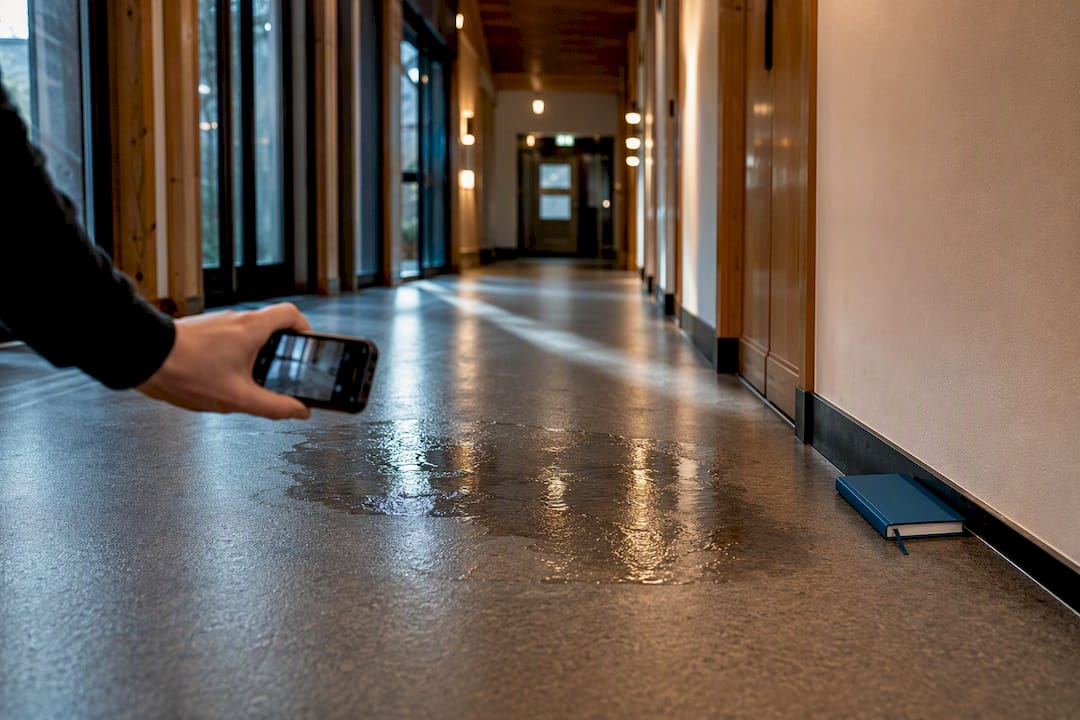
Yes, if you were injured in a public place because someone else failed in their duty of care, you can bring a public liability claim in Scotland. Act now: photograph the scene, get witness details, see a GP, and contact a solicitor before the three-year deadline under the Prescription and Limitation (Scotland) Act 1973 runs out. Legal specialists can assess your case for free and start the pre-action process.
TL;DR:
- Claims are valid only if your injury resulted from someone else’s failure to maintain safety, such as unmarked wet floors or broken public paving.
- Property owners, councils, and event organizers are common defendants, with insurers playing a significant role in the settlement process.
- You must gather evidence quickly, including photographs, witness contacts, and medical records, within the first hours after the incident.
- The three-year limit starts from the injury date or the date you became aware of its link to negligence, so prompt legal advice is essential.
- Most claims settle through negotiation before reaching court, with early evidence being crucial to support liability and determine fair compensation.
Scotland Claims Injury Lawyers
Get Help With Your Injury Claim
Scotland Claims Injury Lawyers connects people injured through accidents or negligence with specialist injury lawyers in Scotland.
Table of Contents
Does your incident count as a public liability claim?
Not every accident in a public place gives rise to a claim. It depends on whether someone else’s failure caused your injury, not just bad luck.
Common examples that do qualify:
- A slip on an unmarked wet floor in a shop or supermarket
- A trip caused by broken paving, potholes, or trailing cables in a public venue
- Injury from defective gym or play equipment
- Food poisoning traced to a restaurant or café
- An attack or bite from a dog or other animal in a public space
What generally falls outside this category: medical negligence, purely criminal assaults by another individual (these usually sit with the Criminal Injuries Compensation Authority rather than a civil liability claim), and incidents already covered under a different insurance policy, such as your own travel cover.
If your situation matches the first list, photograph the scene immediately, note down anyone who saw what happened, and see a GP even for minor injuries. Those three actions do more for your claim than anything a solicitor can add later.
Who you can sue and common defendants in Scotland
Public liability claims in Scotland are brought against whoever owed you a duty of care and failed in it, known as the defender. That is rarely a person; it is almost always an organisation standing behind an insurance policy.
Typical defenders include:
- Occupiers and business owners, such as shops, pubs, and leisure centres
- Councils and local authorities, for pavements, parks, and public buildings
- Event organisers and commercial operators running festivals, markets, or venues
Insurers matter more than most claimants expect. A defender’s ability to pay depends on whether they hold public liability insurance, and the insurer, not the business, usually handles negotiations and settlement from an early stage. Claims against public bodies such as councils tend to move more slowly, since they follow internal complaints procedures and formal notice requirements before matters reach a solicitor’s desk. Occupiers carry specific legal duties under Scots law, covered in more depth in our guide to occupiers’ liability in Scotland.
How to start a public liability claim in Scotland
Starting a claim follows a fairly fixed sequence, and skipping a step tends to cost you time later rather than saving it.
- Get medical attention and keep records. A GP or A&E visit creates the medical paper trail that links your injury to the incident date.
- Gather evidence at the scene. Photos, witness names and contact details, and any incident report filed with the venue.
- Trigger the pre-action protocol. A compulsory pre-action protocol applies to most personal injury actions in Scotland, requiring your solicitor to send formal notice to the defender, who must then investigate and respond within set timescales, disclosing relevant documents such as maintenance logs or CCTV footage, as outlined in Brodies’ guide to Scottish claims procedure.
- Instruct a solicitor. Most claimants choose a No Win No Fee arrangement over self-funding, since it removes the upfront financial risk entirely.
- Let value determine the court. Lower-value claims typically proceed through simple or summary cause procedure, while higher-value or more complex cases move to ordinary cause or the Sheriff Personal Injury Court.
Pro Tip: Don’t wait for a solicitor to tell you to gather evidence. By the time formal pre-action letters go out, CCTV footage from the day of your accident may already have been overwritten.
What evidence proves liability under Scots law
Scots law approaches personal injury through the law of delict, and that framework asks three linked questions rather than one broad “was someone negligent?” query. You need to show loss was caused, that the loss is not too remote from the wrongdoing, and that the defender was at fault, referred to as culpa, according to academic analysis of Scots negligence principles. Negligence itself is the trigger; the loss is what the court actually examines first.
Evidence that carries weight in practice:
- Medical records confirming the injury and its treatment
- Incident or accident report forms lodged with the venue at the time
- Maintenance and inspection logs showing whether the hazard was known
- CCTV footage of the moment of injury
- Written witness statements taken close to the event date
Most negligence and personal injury disputes in Scotland settle through negotiation rather than a court hearing, according to a Scottish Parliament research briefing, which makes early, well-organised evidence far more valuable than late, dramatic evidence. Gaps usually appear where claimants delay seeing a doctor or fail to note a witness’s details before that person leaves the scene for good.
How long do you have to make a claim?
The clock on a Scottish public liability claim is governed by the triennium: three years from the date of injury, or from the date you became aware the injury was linked to someone else’s fault, under the Prescription and Limitation (Scotland) Act 1973.
- Most claims run from the accident date itself, straightforward and easy to calendar.
- Delayed discovery cases, such as an injury that only reveals its severity months later, run from the date of knowledge instead.
- The Scottish Law Commission has reviewed how the date-of-knowledge test operates and discussed proposals to extend limitation periods in certain circumstances, though the standard three-year rule remains the one to plan around today.
- If you think you are close to, or past, the deadline, seek legal advice urgently rather than assuming the claim is dead. Our guide on personal injury time limits in Scotland covers borderline cases in more detail.
What compensation and costs look like in practice
Compensation in a successful public liability claim typically covers several distinct heads of loss, and Scottish practice tends to separate them clearly rather than awarding one lump figure.
- Solatium, for pain, suffering, and loss of amenity
- Past and future loss of earnings, where the injury affected your work
- Medical and care costs, including private treatment or family care time
- Related expenses, such as travel to appointments or damaged property
Settlement, not a court hearing, is the outcome in most cases, often reached after a formal offer or tender from the defender’s insurer once liability and evidence are clear. Costs protection matters here: Qualified One-Way Costs Shifting (QOCS) generally shields claimants from paying the defender’s legal costs if the claim is unsuccessful, provided the case was conducted properly, as explained in Brodies’ Scottish court procedure guide.
Pro Tip: Ask any solicitor upfront whether their No Win No Fee agreement takes a success fee from your settlement. Scotland Claims Injury Lawyers takes nothing, so successful clients keep 100% of their compensation.
Common defences and how contributory negligence works
Defenders and their insurers rarely accept liability outright, and knowing their usual arguments helps you prepare stronger evidence from day one.
- Denial of liability, arguing the defender took reasonable care and the hazard was not foreseeable
- Causation disputes, claiming your injury stems from a pre-existing condition rather than the incident
- Novus actus interveniens, arguing something else broke the chain between the defender’s failure and your injury
Contributory negligence reduces, rather than defeats, a claim: if you were partly to blame, such as ignoring a clearly marked warning sign, your award can be reduced proportionately. Contemporaneous notes, photos, and witness statements taken at the scene are your best defence against this reduction. Our detailed breakdown of contributory negligence in Scotland explains how percentages get calculated in practice.
How a specialist Scottish solicitor helps your claim
A solicitor’s job on a public liability claim goes well beyond writing letters. They collect and organise evidence, correspond directly with the defender’s insurer, lodge court documents where needed, and put a realistic value on your losses based on comparable Scottish settlements.
- Local expertise matters because pre-action protocol timescales, court procedure, and delict framing differ from the rest of the UK.
- Solicitors negotiate settlements far more often than they attend court, reflecting the wider pattern of negotiated outcomes in Scottish negligence cases.
- Before instructing anyone, check the fee terms carefully: ask specifically whether a success fee comes out of your compensation, and how much.
Our guide to the role of solicitors in Scottish personal injury claims sets out exactly what to expect at each stage of representation.
Do you have to go to court, or can it be settled another way?
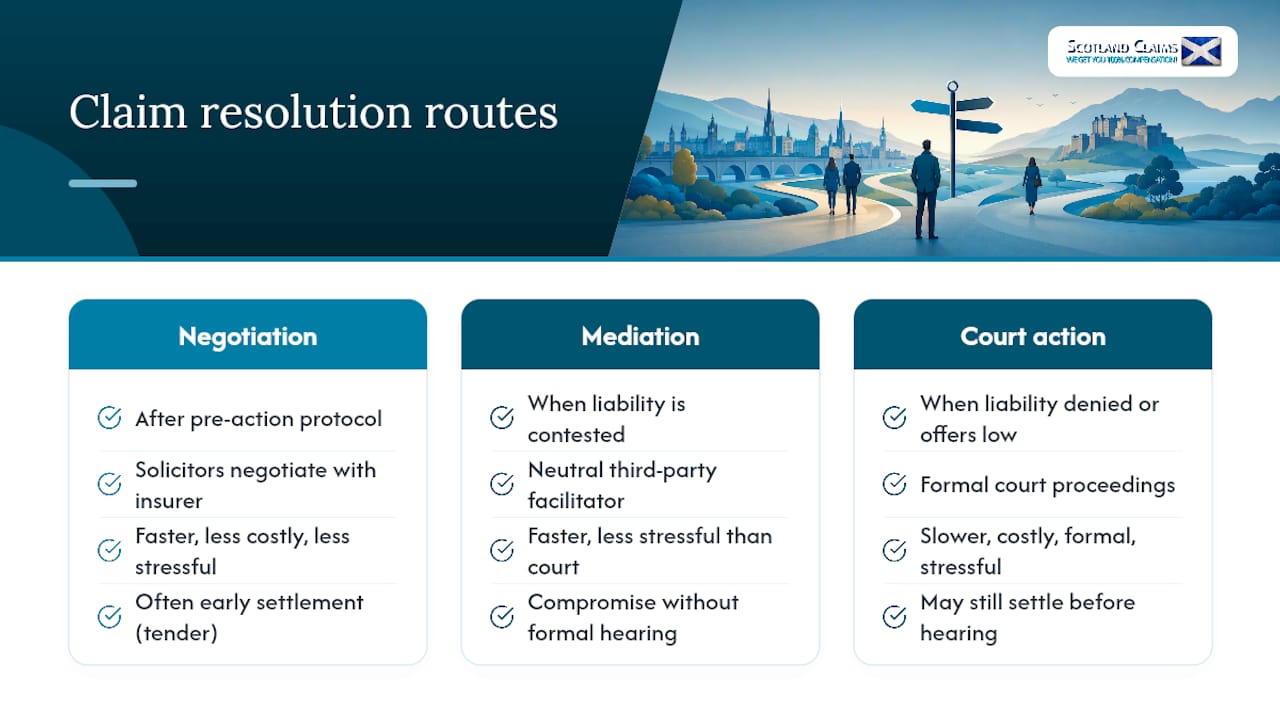
Litigation is the last resort, not the default route, for a public liability claim in Scotland. Most cases resolve long before a sheriff ever sees the paperwork, through direct negotiation between your solicitor and the defender’s insurer once the pre-action protocol has run its course.
Negotiated settlement works because both sides usually want to avoid the cost and delay of a court hearing. Once your solicitor sends the formal pre-action letter, the insurer investigates, and the two sides exchange evidence and offers. If liability is reasonably clear, insurers frequently make an early settlement offer, sometimes called a tender, to limit their own legal costs. Accepting, rejecting, or countering that offer is a strategic decision, and it is one reason having a solicitor who understands typical settlement values for your type of injury matters more than legal knowledge alone.
Mediation, while less common in personal injury than in commercial disputes, can also feature where liability is contested but both parties want to avoid a drawn-out sheriff court process. A neutral third party helps both sides reach a compromise without a formal hearing, which can be faster and less stressful, particularly where the injury and its impact are not seriously disputed but the value of the claim is.
Court action remains available and sometimes necessary, especially where a defender denies liability outright or where an insurer’s offer falls well short of what your evidence supports. Value determines which court hears the case, from simple procedure for smaller claims up through the Sheriff Personal Injury Court for more serious injuries. Even once court proceedings begin, most claims still settle before a final hearing; going to court is a pressure point in negotiations, not a guaranteed destination.
Preserving evidence at the scene: what actually helps later
What you do in the first hour after an accident often decides the claim more than anything a solicitor does months later.
Photograph everything relevant before it changes: the hazard itself, the wider area for context, any warning signs (or their absence), and your visible injuries. Take multiple angles and, where possible, include something in the frame that shows scale, such as a coin or shoe next to a pothole. If the venue has an accident book or incident report form, ask to complete one before you leave, and request a copy or a reference number.
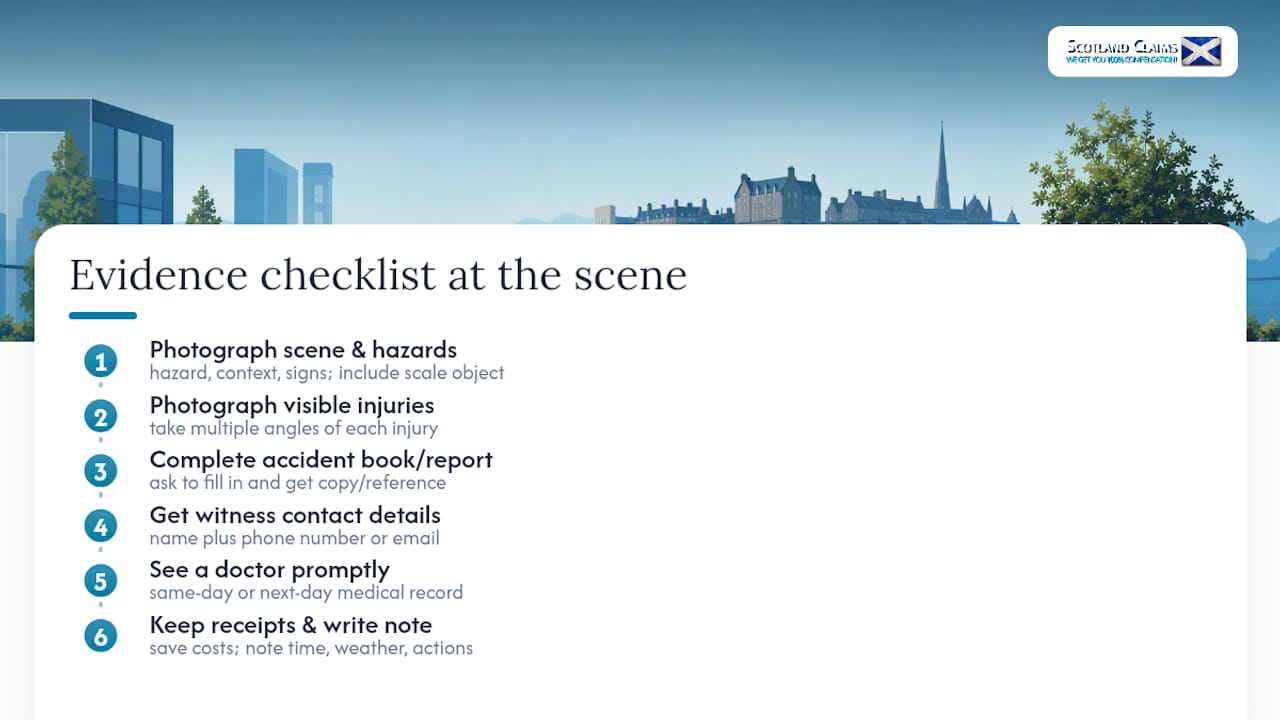
Witnesses vanish quickly in busy public places. Ask anyone who saw what happened for their name and a phone number or email address there and then; a stranger who saw a wet floor with no warning sign can be the single most persuasive piece of evidence in your entire case, and most people are willing to help if asked immediately rather than weeks later.
See a doctor even if the injury feels minor at the time. Adrenaline masks pain, and a same-day or next-day medical record does more to fix the date and severity of your injury than a memory recalled months afterward. Keep every receipt tied to the incident, from taxi fares to over-the-counter medication, since even small costs add up as part of your claim.
Finally, write down what happened while it is fresh, including the time, weather conditions, and exactly what you were doing beforehand. Memory fades fast, and a contemporaneous account carries more weight with insurers and courts than a reconstruction written six months later.
Author perspective: Scots law and practical claim strategy
Scots delict cares less about labelling someone “negligent” than about proving your loss was caused and not too remote. Focus your energy on evidence and speed, not on winning a legal argument in your head.
— Roger
How Scotland Claims Injury Lawyers can help you start your claim
Scotland Claims Injury Lawyers is the alternative to firms that take a slice of your settlement. That applies to whiplash and road traffic accident injuries where you were the non-fault driver or passenger, and to more serious injuries including slips, trips, and workplace accidents.
There is no upfront cost as these cases typically run on a No Win No Fee basis. If you think you have grounds for a public liability claim, start with a free assessment through our injury lawyers in Scotland page, or get an early sense of what your claim might be worth using the compensation calculator. Request a callback today and a specialist will talk you through your options with no obligation.
This article is general information, not a substitute for advice from a qualified lawyer. Consult a qualified legal professional about your own circumstances before acting on anything here.
Sources
FAQ
What constitutes a public liability claim?
A public liability claim arises when you are injured in a public or commercial space because the person or organisation responsible for that space failed in their duty of care, such as an unmarked wet floor or a defective piece of equipment.
What are the four proofs needed to show negligence?
Under Scots delict, you generally need to show a duty of care existed, that it was breached, that the breach caused your loss, and that the loss was a foreseeable, non-remote consequence of that breach.
What does public liability cover not include?
Public liability claims don’t cover medical negligence, criminal assaults by another individual, or losses already covered under a separate insurance policy such as travel insurance.
What are some examples of public liability claims?
Common examples include slips on unmarked wet floors, trips over broken paving or trailing cables, injuries from faulty gym or play equipment, food poisoning at a restaurant, and dog attacks in public spaces.
How long do I have to make a public liability claim in Scotland?
You generally have three years from the date of injury, or from the date you became aware it was linked to someone else’s fault, under the Prescription and Limitation (Scotland) Act 1973.
Recommended