What is third party liability in Scotland?

TL;DR:
- Third party liability in Scotland involves holding negligent parties other than the injured person responsible for compensation. Identifying all potential liable parties, gathering evidence promptly, and acting within three years are crucial to successful claims. Insurance coverages for third parties facilitate compensation and legal defense, but proof of duty, breach, and causation is essential under Scots law.
Third party liability is the legal responsibility of a party other than the injured person or the direct wrongdoer to compensate for harm caused. In personal injury claims across Scotland, this concept is central to identifying who you can claim against and how much compensation you may recover. Understanding third party liability means recognising that fault can extend well beyond the person who directly caused your accident. Employers, manufacturers, and property owners can all carry legal responsibility, and Scotland’s strict three-year deadline for raising court proceedings makes identifying those parties quickly a matter of urgency.
What is third party liability in personal injury claims?
Third party liability is defined as the legal obligation of someone other than the injured claimant to provide compensation for injury or loss. The “third party” sits outside the direct relationship between you (the first party) and whoever caused the immediate harm (the second party). In practice, this means a wider net of responsibility than most accident victims initially expect.

Consider a warehouse worker injured by faulty machinery. The employer who failed to maintain the equipment is a third party. The manufacturer who supplied a defective component is also a third party. Both can carry liability simultaneously, which is why multiple parties may be responsible for a single accident, complicating but also expanding your compensation options.
The third party liability definition matters in Scotland because it shapes the entire claims strategy. Identifying every potentially liable party from the outset preserves your legal rights and prevents you from settling for less than you are owed.
Who can be a liable third party in Scotland?
Third parties liable in Scottish personal injury cases include a broader range of individuals and organisations than most claimants realise. The key categories are:
- Employers. If your employer failed to provide safe systems of work, adequate training, or properly maintained equipment, they carry liability even if a colleague directly caused the accident.
- Manufacturers. A company that produces defective goods, from faulty vehicle parts to unsafe work tools, can be held responsible under product liability law when those defects cause injury.
- Property owners and occupiers. Under the Occupiers’ Liability (Scotland) Act 1960, owners of premises owe a duty of care to visitors. A wet floor with no warning sign, a broken staircase, or a poorly lit car park can all give rise to a claim.
- Local authorities and road managers. Councils responsible for road maintenance can be liable if a pothole, missing signage, or poorly gritted surface contributed to a road traffic accident.
- Contractors. A contractor hired to carry out repairs or construction work who creates a hazard that injures a passer-by carries independent liability, separate from the property owner.
Pro Tip: Do not assume the person who directly caused your accident is the only party worth pursuing. In road traffic accidents, for example, a vehicle manufacturer whose faulty brakes contributed to a collision may carry liability alongside the driver.
The practical value of identifying all liable third parties is significant. Where additional parties beyond the driver are liable, multiple insurance coverages may be involved, which broadens the pool of compensation available to you.
How does third party liability insurance work?
Third party liability insurance covers the legal defence costs and compensation owed by the insured when they are responsible for injury or property damage to others. It does not cover the insured’s own injuries or losses. This distinction matters enormously for claimants: when you pursue a third party claim, you are typically claiming against their insurer, not the individual directly.
Liability insurance shifts financial risk from individuals and businesses to insurers, which means injured parties have a realistic and solvent compensation path even when the liable party has limited personal assets. An employer with a valid employers’ liability policy, or a property owner with public liability cover, gives you a funded defendant to claim against.
Understanding what covers third party liability in practice involves knowing the limits of those policies. Insurers will scrutinise:
- Whether the policy was active at the time of the accident.
- Whether the type of incident falls within the policy’s scope.
- Whether any exclusions apply, such as deliberate acts or specific hazardous activities.
- Whether the claim value falls within the policy’s financial limits.
- Whether the insured notified the insurer of the claim promptly.
Policies typically have limits, deductibles, and exclusions that shape coverage boundaries, which is why insurers frequently dispute claims on technical grounds. Knowing this in advance helps you build a stronger case.
Pro Tip: Ask your solicitor to identify all insurance policies held by each potential third party before making any formal claim. Employers’ liability insurance is compulsory in the UK, so there is almost always a policy to claim against in workplace injury cases.
What do you need to prove third party liability?
Establishing third party liability in Scotland requires satisfying three legal elements under Scots law. Foreseeability alone is insufficient; you must demonstrate duty, breach, and causation with sufficient proximity.
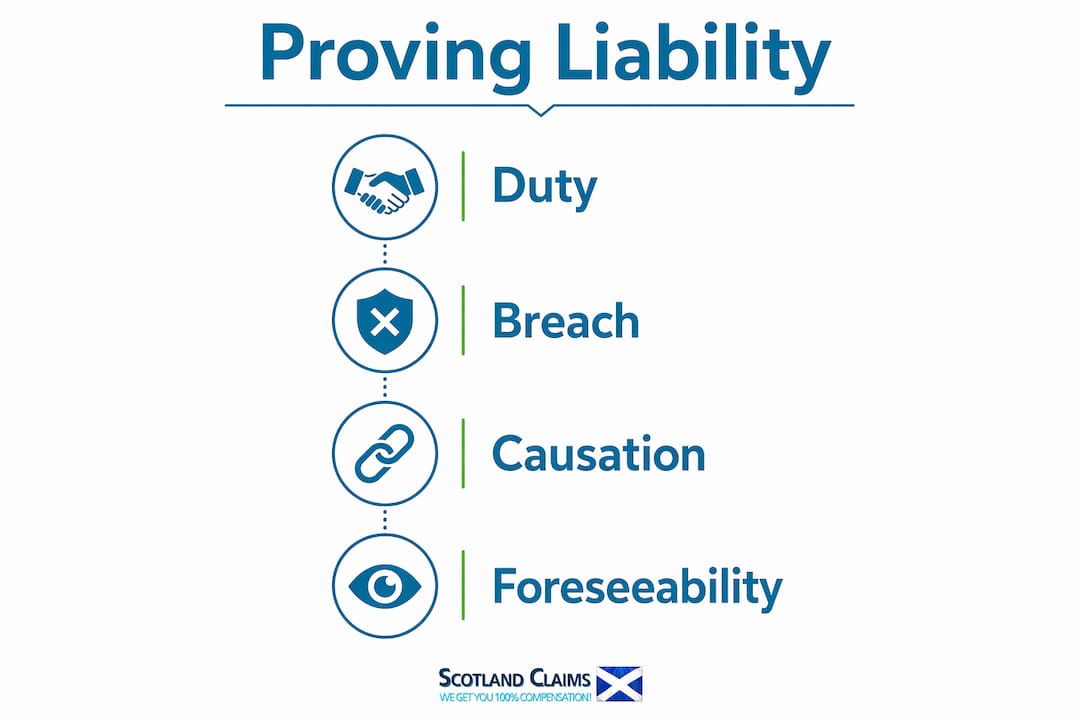
Duty of care. The third party must have owed you a legal duty. Employers owe employees a duty of care. Occupiers owe visitors a duty under statute. Manufacturers owe consumers a duty not to place defective products on the market.
Breach of duty. The third party must have fallen below the standard of care expected of a reasonable person or organisation in their position. A council that received repeated reports of a dangerous pothole but failed to repair it has likely breached its duty.
Causation. The breach must have directly caused your injury or loss. If the defective equipment would not have caused harm regardless of the breach, causation fails. This is often where insurers focus their challenges.
Evidence that strengthens a third party liability claim includes:
- Photographs taken at the scene immediately after the accident.
- Accident report forms and internal records from employers or premises managers.
- Medical records linking your injuries directly to the incident.
- Witness statements from anyone who saw the accident or the hazardous condition.
- Expert reports, such as engineering assessments of defective machinery or road condition surveys.
Early evidence gathering significantly improves claim success rates, because physical evidence deteriorates and witnesses’ memories fade. The moment you are able to do so safely, document everything.
How does the three-year time limit affect your claim?
Scotland operates a “triennium” rule: you generally have three years from the accident date to raise court proceedings. Missing this deadline typically results in your claim being time-barred, regardless of how strong the underlying evidence is.
The table below summarises how the time limit applies across common third party liability scenarios in Scotland:
| Scenario |
Time limit |
Key consideration |
| Road traffic accident |
3 years from accident date |
Identify all liable parties, including manufacturers and road managers |
| Workplace injury |
3 years from accident or date of knowledge |
Employer and contractor liability may both apply |
| Defective product injury |
3 years from date of knowledge of defect |
Manufacturer and retailer may both carry liability |
| Slip or trip on premises |
3 years from accident date |
Gather photographic evidence of the hazard immediately |
| Injury involving a minor |
3 years from their 16th birthday |
Extended period applies under Scots law |
Scottish claims often fail due to missed deadlines rather than weak facts. This makes early legal advice not just helpful but genuinely decisive. You can read more about protecting your claim deadline and why acting promptly matters in Scottish personal injury law.
The three-year period sounds generous, but building a third party liability case takes time. Identifying all liable parties, gathering expert evidence, and negotiating with multiple insurers requires months of preparation. Starting early gives your solicitor the best possible foundation.
Key takeaways
Third party liability in Scotland requires identifying every negligent party beyond the direct wrongdoer, gathering evidence promptly, and acting within the three-year triennium to preserve your right to compensation.
| Point |
Details |
| Third party liability definition |
Legal responsibility of a party other than the injured person to compensate for harm caused. |
| Who can be liable |
Employers, manufacturers, property owners, local authorities, and contractors can all carry third party liability. |
| Insurance coverage |
Third party liability insurance covers defence costs and compensation owed to others, not the insured’s own losses. |
| Proof required |
Duty of care, breach, and causation must all be established; foreseeability alone is not sufficient under Scots law. |
| Three-year deadline |
Court proceedings must be raised within three years of the accident date or the claim becomes time-barred. |
Why third party liability claims reward those who act early
Having worked with accident victims across Scotland for years, the pattern I see most often is this: claimants who wait underestimate how many parties may share responsibility for their injury. They focus on the person directly in front of them, whether that is the driver who hit them or the colleague who knocked them over, and miss the employer, the manufacturer, or the council whose negligence set the conditions for the accident.
The uncomfortable truth about third party liability claims is that they are as much an evidence exercise as a legal one. The law is relatively clear. What decides outcomes is whether you can prove, with documentation, that a specific party owed you a duty and fell short of it. Insurers know this. They count on claimants arriving late, with incomplete records and fading witness recollections.
What I have found genuinely changes outcomes is treating the accident date as the start of a legal process, not just a medical one. Photograph the scene. Report the incident formally. Keep every receipt and medical record. Then speak to a solicitor who understands road traffic accident claims and the full range of third party liability scenarios in Scotland.
The claimants who recover the most compensation are rarely those with the most dramatic injuries. They are the ones who identified every liable party, gathered the right evidence, and instructed a specialist before the trail went cold.
— Roger
How Scotland Claims Injury Lawyers can help with your third party liability claim
Scotland Claims Injury Lawyers specialises in personal injury claims across Scotland, including complex third party liability cases involving employers, manufacturers, and property owners. For road traffic accident injuries where you are not at fault, as either a driver or passenger, you keep 100% of your compensation. For all claim types - including slips, trips, and workplace accidents - Scotland Claims Injury Lawyers deducts no success fee whatsoever, so you keep 100% of your compensation, while most large national firms charge up to 20% including VAT. All claims are handled on a No Win No Fee basis, meaning no upfront costs and no fee if your case is unsuccessful. Speak to the injury lawyers at Scotlandclaims today for a free case evaluation.
FAQ
What is the third party liability definition in simple terms?
Third party liability is the legal obligation of someone other than the injured person to pay compensation for harm caused. In personal injury claims, this typically means an employer, manufacturer, or property owner whose negligence contributed to the accident.
What is the difference between third party and first party liability?
First party insurance covers the insured’s own injuries and losses. Third party liability insurance covers compensation and legal costs owed to others when the insured is at fault. In personal injury claims, you claim against the third party’s insurer, not your own.
What covers third party liability in Scotland?
Third party liability is covered by policies such as employers’ liability insurance, public liability insurance, and motor insurance. These policies pay out compensation and legal defence costs when the insured party is found responsible for another person’s injury or loss.
How long do you have to make a third party liability claim in Scotland?
You generally have three years from the date of the accident to raise court proceedings in Scotland. Missing this triennium deadline means your claim is typically time-barred, regardless of the strength of your evidence.
Can more than one third party be liable for the same accident?
Yes. Multiple parties can carry simultaneous liability for a single accident. A road traffic collision, for example, may involve a negligent driver, a manufacturer of defective vehicle components, and a local authority responsible for poor road conditions, each carrying separate legal responsibility.
Recommended