Role of solicitors in Scotland personal injury claims

TL;DR:
- Solicitors actively manage personal injury claims from the first contact, not just court appearances.
- Early consulting with a specialist increases chances of higher compensation and better case outcomes.
- Funding options like No Win No Fee and insurance remove financial risks for claimants in Scotland.
Most people assume a solicitor only enters the picture if their case ends up in front of a judge. That assumption costs injury victims time, evidence, and money. In reality, solicitors handle claims, evidence, negotiations and representation from the very first phone call. The earlier you bring in a specialist, the stronger your position becomes. This guide walks you through exactly what solicitors do in Scottish personal injury claims, how the process unfolds step by step, and how to fund your case without any upfront risk.
Table of Contents
Key Takeaways
| Point |
Details |
| Solicitors’ essential roles |
Scottish solicitors manage evidence, negotiate settlements, and offer expert advice in personal injury claims. |
| Claims process explained |
From initial consultation to settlement or court, the process is structured and supported by your solicitor. |
| Flexible claim funding |
No Win No Fee and insurance options help claimants pursue cases without upfront financial risk. |
| Specialist expertise matters |
Accredited, trauma-informed specialists often secure higher compensation and better client outcomes. |
How Scottish solicitors support personal injury claims
Solicitors are not simply courtroom figures. They are qualified legal professionals who guide your claim from the moment you first seek advice right through to settlement or, where necessary, litigation. Understanding their full range of responsibilities changes how you approach your own case.
Solicitors are regulated by the Law Society of Scotland, which means they must meet strict professional and ethical standards. That regulation protects you as a client and ensures the advice you receive carries genuine legal weight. When you work with injury lawyers in Scotland, you benefit from that oversight at every stage.
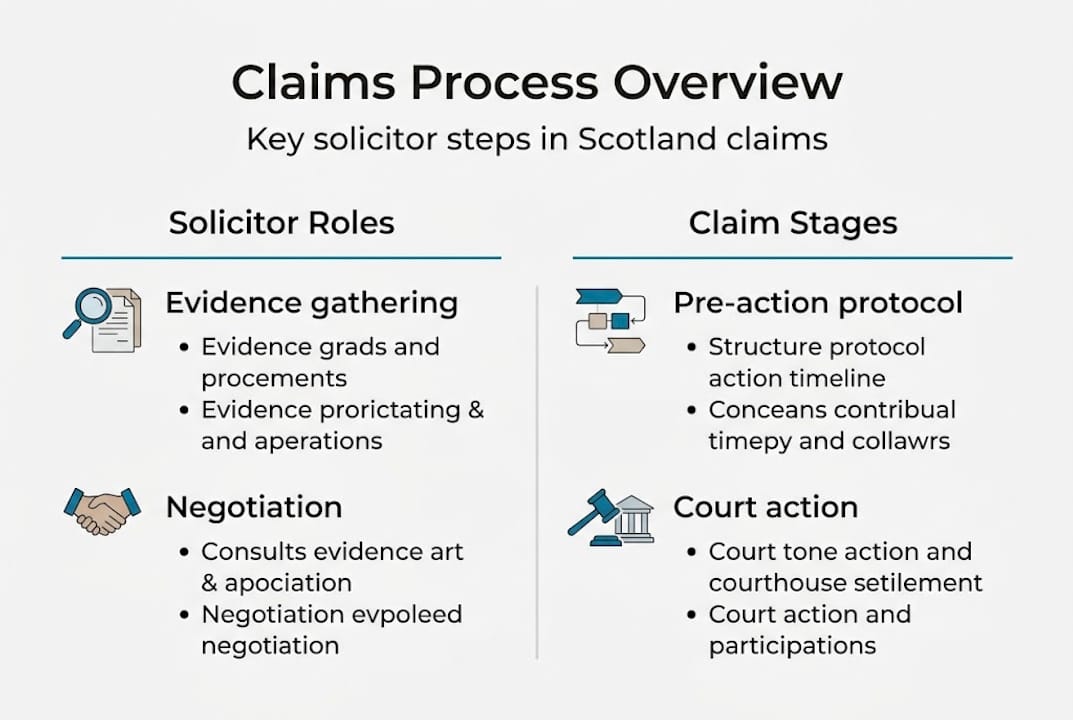
So what do they actually do on a day-to-day basis? Quite a lot, as it turns out. Solicitors handle claims, evidence gathering, negotiations and court appearances, meaning their involvement is active and continuous rather than occasional. Here is a breakdown of their core responsibilities:
- Initial legal advice: Assessing whether your claim has merit and explaining your rights clearly
- Evidence management: Gathering witness statements, CCTV footage, accident reports, and medical records
- Medical coordination: Arranging independent medical assessments to quantify your injuries
- Claim notification: Formally notifying the at-fault party or their insurer of your intention to claim
- Negotiation: Engaging with insurers to reach a fair settlement without court involvement
- Litigation: Representing you in the Sheriff Court or Court of Session if negotiations fail
“A specialist personal injury solicitor does not simply react to events. They shape the claim from the outset, ensuring evidence is preserved and legal deadlines are met.”
Most personal injury claims in Scotland settle before they ever reach a courtroom. That means your solicitor’s negotiation skills and knowledge of case value are often more important than their advocacy in front of a judge. Consulting your injury claim rights guide early helps you understand what you are entitled to before any negotiation begins. Starting with a specialist rather than a general practitioner makes a measurable difference to the outcome.

Step-by-step claims process with a solicitor
Understanding the overall role leads naturally to the question of how claims actually unfold in practice. The process follows a clear sequence, and knowing each stage removes much of the anxiety around making a claim.
Here is how a typical personal injury claim progresses in Scotland:
- Initial consultation: Your solicitor reviews the facts, assesses liability, and advises on the strength of your case
- Evidence gathering: Medical records, photographs, witness accounts, and employer or police reports are collected
- Independent medical assessment: A specialist examines you and produces a report quantifying your injuries and prognosis
- Claim intimation: Your solicitor formally notifies the defender (the at-fault party) of the claim
- Negotiation: Offers and counter-offers are exchanged; most cases resolve at this stage
- Litigation: If no fair settlement is reached, court proceedings are raised
The full claims process is built around protecting your interests at each stage. One critical point: the pre-action protocol is mandatory for claims under £25,000 and encourages early settlement between parties before litigation is considered.
There is also a strict three-year limit from the date of your accident, or from when you first became aware of your injury, to begin a claim. Missing that window almost always means losing your right to compensation entirely.
| Feature |
Out-of-court settlement |
Court litigation |
| Average duration |
6 to 18 months |
18 to 36 months |
| Costs to claimant |
Lower overall |
Potentially higher |
| Privacy |
High |
Lower (public record) |
| Outcome certainty |
Negotiated agreement |
Judge’s decision |
| Stress level |
Generally lower |
Generally higher |
The vast majority of claimants who follow the process correctly, and who seek advice on claiming injury compensation early, resolve their cases through negotiation. Court is the exception, not the rule.
Funding your claim: No Win No Fee, insurance, and solicitors’ freedom
With procedures outlined, the next practical concern is cost. Many people avoid pursuing a legitimate claim because they fear legal fees. The good news is that several funding options exist in Scotland that remove that financial barrier entirely.
Claims can be funded through No Win No Fee agreements, Legal Expenses Insurance, and you retain the freedom to choose your own solicitor regardless of what your insurer suggests.
Here is how each funding route works:
- No Win No Fee (speculative fee agreements): You pay nothing upfront. If your claim succeeds, your solicitor’s fees are recovered from the defender. If you lose, you owe nothing. This is the most common arrangement for personal injury claims in Scotland.
- Legal Expenses Insurance (LEI): Many home and motor insurance policies include LEI as a standard feature. It can cover your solicitor’s fees whether you win or lose. Check your existing policies before assuming you have no cover.
- Trade union funding: If you are a union member, your union may fund your claim and provide access to specialist solicitors at no cost to you.
Pro Tip: Before signing any funding agreement, ask your solicitor to explain exactly how their fees are calculated and what happens if your claim is only partially successful. A clear answer upfront prevents surprises later.
| Funding type |
Upfront cost |
Risk to claimant |
Best suited for |
| No Win No Fee |
None |
Very low |
Most personal injury claims |
| Legal Expenses Insurance |
None (if policy held) |
Very low |
Policyholders with existing cover |
| Trade union funding |
None |
Very low |
Union members |
One point that surprises many claimants: your insurer may recommend a solicitor, but you are under no obligation to use them. Insurers sometimes recommend panel solicitors who prioritise quick settlements over maximum compensation. Reading about No Win No Fee arrangements in detail helps you make an informed choice. Even for minor injury claims, specialist representation under a No Win No Fee agreement is often worthwhile. Knowing the right questions to ask injury solicitors before you commit ensures you find the right fit.
Specialist solicitors: Edge cases, expertise, and maximising outcomes
Claim funding and procedures matter, but so does choosing the right type of solicitor. A generalist may handle your claim competently, but a specialist personal injury solicitor brings a depth of knowledge that genuinely changes results.
Specialists secure 25 to 30% higher compensation on average, are protected by Qualified One-Way Costs Shifting (QOCS) which shields claimants from paying the defender’s costs if the claim fails, and bring trauma-informed practice alongside Law Society accreditation to every case.
Here is where specialist expertise makes the biggest difference:
- Contributory negligence: If the defender argues you were partly at fault, a specialist knows how to challenge that assessment and protect your compensation
- Catastrophic injuries: Spinal, brain, and back injury claims require detailed medical evidence and long-term loss calculations that generalists often undervalue
- Complex liability: Workplace accidents, multi-vehicle collisions, and public liability cases involve overlapping legal duties that demand specialist knowledge
- Knee injury claims: Soft tissue and joint injuries are frequently undervalued by insurers; specialists know the medical evidence needed to counter low offers
QOCS is worth understanding in plain terms. It means that if your claim is brought honestly and fails, you generally will not be ordered to pay the other side’s legal costs. That protection encourages legitimate claimants to pursue their rights without fear of financial ruin.
Pro Tip: Ask any solicitor you consider whether they hold a Law Society of Scotland personal injury accreditation. Accredited solicitors have demonstrated specialist knowledge through a formal assessment process, not just years of practice.
The expertise of a personal injury solicitor extends well beyond legal knowledge. They understand how insurers value claims, which medical experts carry weight in Scottish courts, and how to present your case in the most compelling way possible. That combination is difficult to replicate with a general legal practitioner.
Why specialist Scottish solicitors matter more than ever
There is a tendency to treat solicitor selection as an afterthought, something to sort out once you have decided to claim. We think that gets it exactly backwards. The solicitor you choose shapes your claim before a single letter is sent.
Scots law is distinct from English and Welsh law in meaningful ways. Prescription periods, court procedures, and judicial attitudes to damages all differ. A solicitor who primarily practises in England and Wales may not fully grasp those distinctions, and that gap can cost you. Local expertise is not a marketing phrase; it is a practical necessity.
What we have seen, time and again, is that claimants who seek early specialist input recover more, stress less, and avoid procedural mistakes that can derail otherwise strong cases. The personal injury rights landscape in Scotland has also evolved, with stronger protections for claimants and clearer pre-action obligations on defenders. Specialists who keep pace with those changes give you a genuine advantage. Do not wait until your case becomes complicated before seeking expert advice. The best time to consult a specialist is as soon as possible after your accident.
Connect with Scottish injury solicitors for personal claims
If you have been injured through someone else’s negligence, the next step is straightforward. Scotland Claims connects you directly with specialist injury lawyers in Scotland who understand Scots law, work on a No Win No Fee basis, and are focused on recovering the maximum compensation you are entitled to. Use our compensation calculator to get an initial estimate of what your claim may be worth, then speak with a specialist who can assess your specific circumstances. There are no upfront costs and no fees if your claim is unsuccessful. Our No Win No Fee solicitors are ready to help you take that first step with confidence.
Frequently asked questions
How long do I have to start a personal injury claim in Scotland?
You generally have three years from the accident or the date you became aware of your injury to begin a claim. Missing this deadline almost always means losing your right to compensation.
Do most personal injury cases in Scotland go to court?
No. Most claims settle out of court through negotiation between your solicitor and the defender’s insurer, which is faster and less stressful for everyone involved.
Can I choose my own solicitor even if my insurer recommends one?
Yes. You have the freedom to choose your own solicitor regardless of your insurer’s recommendation, and exercising that right often leads to better outcomes.
What is No Win No Fee in Scottish personal injury claims?
No Win No Fee means you pay nothing unless your claim succeeds. If you lose, you owe no solicitors’ fees, making it a genuinely risk-free way to pursue the compensation you deserve.
Recommended