
Your right to compensation has an expiry date that the Scottish courts rarely extend. If you've been injured on the job, the work accident claim time limit scotland follows a strict three-year "time bar" that can permanently block your path to justice. Many workers hesitate because they fear complex paperwork or worry that high lawyer fees will swallow their payout. You shouldn't have to choose between your financial recovery and your peace of mind.
We know how stressful it is to face a ticking clock while recovering from an injury. This guide provides clear confirmation of exactly how much time you have left to act. You'll learn how the three-year rule applies to different scenarios, including how the "date of knowledge" works for industrial diseases that take years to develop. We'll also explain how to secure 100% of your settlement without losing a penny to success fees. By understanding these legal deadlines, you can take control and ensure you don't lose the compensation you deserve.
Key Takeaways
- Master the strict three-year "time bar" under Scottish law to prevent your right to compensation from expiring permanently.
- Identify the precise moment your countdown begins, whether your injury was a sudden workplace accident or a gradual industrial disease.
- Navigate the work accident claim time limit scotland for children and protected adults to ensure every family member's rights are upheld.
- Secure your evidence and witness statements immediately to prevent the "evidence decay" that often undermines delayed claims.
- Retain 100% of your compensation with a zero success fee model that prioritises your financial recovery over legal profits.
Understanding the 3-Year Time Limit for Work Accident Claims in Scotland
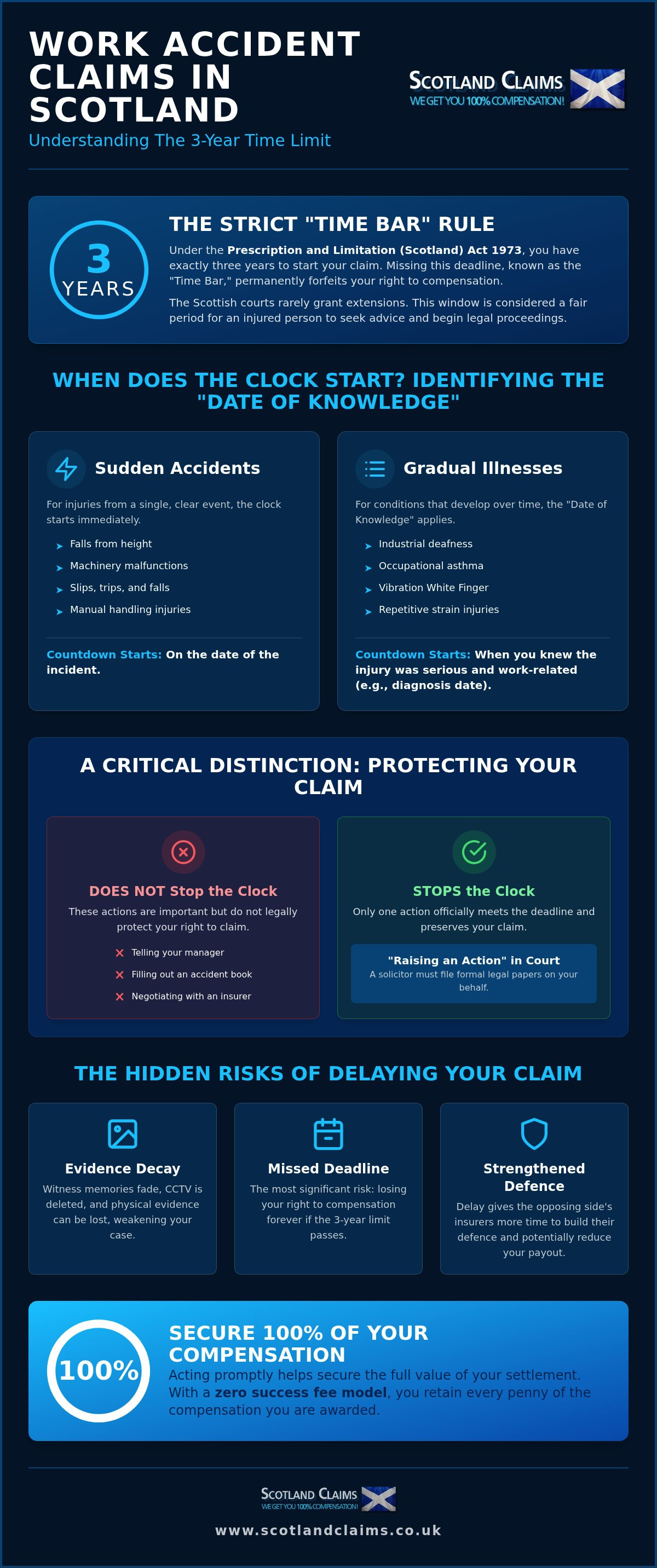
The law in Scotland is clear. You have exactly three years from the date of your workplace injury to secure your right to compensation. This deadline is known as the "Time Bar." It is established by the Prescription and Limitation (Scotland) Act 1973. Unlike in England or Wales, where procedures and terminology differ, Scotland operates under its own distinct legal system. Failing to respect the work accident claim time limit scotland means you lose the legal right to pursue your employer for damages. The courts rarely grant extensions. They view this three-year window as a fair and sufficient period for any injured worker to seek specialist advice and begin proceedings.
Prescription and Limitation (Scotland) Act 1973
Section 17 of this Act is the specific rule governing personal injury claims. It creates a balance of fairness for everyone involved. Pursuers get a reasonable window to understand the full extent of their injuries. Simultaneously, Defenders are protected from facing claims many years after an event when evidence has likely vanished. This concept of Prescription in Scots law ensures that legal disputes don't hang over people indefinitely. If you wait three years and a day, your claim is effectively dead. It becomes "time-barred," and no amount of evidence can revive it once that statutory gate has closed.
The Difference Between Raising Court Action and Notifying a Claim
A common and dangerous mistake is believing that telling your manager about your injury or filling out an accident book stops the clock. It doesn't. To meet the work accident claim time limit scotland, you must "raise an action" in court. This involves a specialist solicitor drafting formal legal papers and serving them to the defender. Simply negotiating with an insurance company or waiting for a medical report won't protect your position if the three-year mark passes without court papers being filed. Informal discussions do not pause the countdown.
Our team at Scotland Claims Injury Lawyers understands this urgency. We fast-track the initial assessment process to ensure your case is prepared and protected long before the deadline looms. We focus on speed and efficiency because we know that delay only benefits the insurance companies. By acting early, you protect the full value of your settlement. We operate a zero success fee model, ensuring you retain 100% of your compensation. Don't let the clock run down on the money you're legally owed.
When Does the Clock Start? Identifying the "Date of Knowledge"
For most people, the work accident claim time limit scotland begins the exact second an injury occurs. If you trip over a cable or suffer a manual handling injury, the calendar starts counting down immediately. These are sudden, identifiable events where the cause and effect are obvious. However, the law recognises that not every workplace injury is instantaneous. For those suffering from industrial diseases or repetitive strain, identifying the starting point requires a more specialised approach.
Sudden Accidents vs. Long-Term Illness
Sudden accidents provide a clear-cut timeline. Examples include falls from height, machinery malfunctions, or warehouse slips. In these cases, the three-year limit is fixed to the date of the incident. Long-term conditions like Vibration White Finger, industrial deafness, or occupational asthma are different. These illnesses often develop over decades of exposure. The law uses the "Date of Knowledge" to determine when your three-year window opens. This is the date you first realised your symptoms were serious enough to warrant a claim and were caused by your employment. Your GP records play a vital role here. They act as a formal timestamp for when you first sought medical help for your symptoms.
The "Date of Knowledge" Framework
The Prescription and Limitation (Scotland) Act 1973 sets out the criteria for this starting point. It focuses on "reasonable practicability." This means the court asks when a reasonable person in your position should have known about the injury and its link to work. If you were exposed to harmful noise in the 1990s but only received a diagnosis of industrial deafness last month, your three-year clock likely started on the day of that diagnosis. It doesn't matter if your last negligent exposure was years ago; the law protects your right to claim from the moment of discovery.
You should seek legal advice the moment you receive a diagnosis for a work-related condition. Our specialists investigate your employment history to find the negligent party, even if that company has changed names or ceased trading. You can use our work injury claims assessment to determine exactly where you stand in the timeline. We ensure you retain 100% of your settlement by operating with zero success fees. Don't risk your compensation by guessing when your clock started. Let an expert confirm your remaining time today.
Exceptions to the Standard 3-Year Personal Injury Limit
While the work accident claim time limit scotland is usually absolute, the law makes specific allowances for those who cannot legally or mentally act for themselves. These exceptions ensure that vulnerable individuals aren't unfairly barred from justice. However, these rules are technical. You should never assume an exception applies without expert verification. In most cases, the court expects you to act as soon as you are physically and legally able to do so.
Injuries to Children and Minors
In Scotland, the legal "Age of Majority" for personal injury claims is 16. If a child is injured at work, perhaps during a part-time job or a school placement, the three-year clock is paused. It only begins ticking on their 16th birthday. This means they have until their 19th birthday to bring a claim themselves. This differs from the rules in England, making it vital to use a solicitor who understands the specific Scottish landscape.
Parents don't have to wait until the child turns 16. You can bring a claim on their behalf at any time before they reach that age. Acting early is always superior; it allows us to secure CCTV footage and witness statements before they disappear. Any settlement awarded to a minor is typically held in a trust or by the Accountant of Court until they reach adulthood. This ensures the funds are protected for their future needs and not spent prematurely.
Court Discretion and Rare Exceptions
Under Section 19A of the Prescription and Limitation (Scotland) Act 1973, judges have a limited, discretionary power to override the time bar. You shouldn't rely on this. Scottish courts use this power very sparingly. They will only allow a late claim in exceptional circumstances where it's "equitable" to do so. The court will closely examine the length of your delay and whether that delay has unfairly prejudiced the defender's ability to mount a legal defence.
Provisions also exist for individuals lacking mental capacity. If an injured worker cannot manage their own affairs, the three-year limit does not run during the period of their incapacity. For fatal accidents, Section 18 of the Act gives the deceased's dependents or estate three years from the date of death, or the date of knowledge of the cause of death, to raise an action.
Whether you are dealing with an injury to a minor or a complex fatal accident case, the stakes are too high to guess. You can use our compensation calculator to start assessing the value of your case. We provide the expertise needed to navigate these exceptions while ensuring you keep 100% of your settlement. Our focus is on protecting your interests and securing the full value of your claim before any legal window closes.
The Hidden Risks of Delaying Your Work Injury Claim
Waiting three years to start your claim is a dangerous gamble. While the work accident claim time limit scotland gives you a 36-month window, the physical evidence of your accident often disappears in weeks. Every day you delay allows the scene of the accident to change and the trail to go cold. This directly affects your compensation settlement value. A claim backed by fresh, indisputable evidence is always worth more than one based on three-year-old memories. You need to act whilst the facts are clear and the proof is still accessible. Delaying your claim only gives the insurance company more time to build a case against you.
Vanishing Evidence and Altered Workplaces
Employers often fix defects immediately after an accident occurs. While this makes the workplace safer, it can destroy the proof of negligence you need. CCTV footage is frequently overwritten every 30 days. Maintenance logs and equipment inspection records can be lost during office moves or digital migrations. If you don't act quickly, the broken machinery, faulty PPE, or slippery floor that caused your injury will be gone before a specialist can inspect it. Early legal intervention ensures these critical records are legally preserved. We move fast to secure accident books and safety reports before they are "misplaced" by insurance investigators.
Witness Credibility and Availability
Memories are fragile. A colleague who saw your accident will remember specific details clearly for a few weeks. Three years later, those details become hazy. Defenders use this memory fade to cast doubt on your version of events. They will search for minor inconsistencies to undermine your credibility in court. There is also the practical issue of staff turnover. People move to new jobs, retire, or move house. Tracking down a witness years after they left the firm is difficult and often impossible. A statement taken whilst the event is fresh is an immovable piece of evidence that protects your settlement. Don't let your employer's record-keeping or staff changes dictate your financial recovery. Most companies only keep physical accident books for a limited time before they are filed away in deep storage.
Start your work injury claim now to protect your evidence
How to Secure 100% Compensation Before the Deadline
You now understand the strict nature of the work accident claim time limit scotland. Knowing the deadline is only half the battle. You also need to ensure that your settlement isn't eroded by hidden costs. Many firms promise justice but deduct a significant portion of your payout as a "success fee" once the case is won. We believe you should keep every penny of the compensation you are legally entitled to. Our goal is to provide a results-oriented service that removes the financial stress of legal action. We focus on securing your full entitlement whilst managing the ticking clock on your behalf.
The 100% Compensation Advantage
Our model is built on transparency and fairness. Most personal injury firms in Scotland deduct up to 20% from your final settlement to cover their costs. If your claim is worth £12,000, they keep £2,400, leaving you with only £9,600. With the Scotland Claims Injury Lawyers 100% Compensation Guarantee, you keep the full £12,000. We recover our legal costs directly from the at-fault party's insurance company. This ensures that your financial recovery is complete. This commitment to integrity is why our injury lawyers Scotland service is a leading choice for workers. We don't believe in profiting from your misfortune or taking a "cut" of your settlement.
Starting Your Risk-Free Claim Today
Taking the first step shouldn't feel like a financial gamble. We operate a strict No Win, No Fee framework. If your claim is unsuccessful, you owe us nothing. This removes the barrier to justice. It allows you to challenge powerful employers and their insurers without any personal financial risk. Our solicitors at Scotland Claims Injury Lawyers are authorised and regulated by the Law Society of Scotland. They handle the complex negotiations, medical assessments, and court filings on your behalf. You can focus on your recovery whilst we protect your legal rights and manage the legal timeline.
The process starts with a single phone call. Our 24-hour freephone helpline is available for shift workers and those needing immediate advice. During your initial consultation, we will confirm your remaining time under the work accident claim time limit scotland and assess the strength of your evidence. Once we take on your case, we move rapidly to secure witness statements and maintenance logs. We handle the heavy lifting. This ensures your claim is formally raised in court long before the three-year window closes. You retain the full value of your settlement, secured by experts who value fairness over profit.
Secure Your Settlement Before the Clock Stops
The three-year window for your claim is a legal boundary that doesn't move. Whether you suffered a sudden fall or a gradual illness, the work accident claim time limit scotland requires decisive action to protect your rights. Waiting until the final months only risks the loss of vital evidence and witness testimony. You deserve a legal partner who prioritises your recovery over their own profits. By acting now, you ensure that your case is built on fresh proof and handled by specialists regulated by the Law Society of Scotland.
We provide a transparent path to justice with zero success fees and no hidden charges. You've already dealt with the stress of an injury; don't let a missed deadline add to your burden. Our 100% Compensation Guarantee ensures you keep every penny of your award. It's time to reclaim what you've lost and move forward with total financial integrity.
Start your claim online and keep 100% of your compensation
Your recovery is our priority. Take control of your future today by securing the justice you're legally owed.
Frequently Asked Questions
What is the standard time limit for a work accident claim in Scotland?
In Scotland, you have exactly three years from the date of your workplace injury to raise a formal court action. This work accident claim time limit scotland is established by the Prescription and Limitation (Scotland) Act 1973. Simply notifying your employer or starting negotiations with an insurer doesn't stop this clock. You must ensure your solicitor files the necessary court papers before this three-year window expires to protect your right to compensation.
Can I still claim if my accident happened more than three years ago?
It is very difficult to claim once the three-year limit has passed. The Scottish courts rarely exercise their discretionary power to allow late claims. You might still have a case if you only recently discovered the link between your work and your injury, or if the victim was under 16 at the time. However, in most standard accident scenarios, the claim is considered "time-barred" and cannot be pursued further once the deadline expires.
Does the 3-year limit apply if I am claiming for an industrial disease?
Yes, the three-year limit applies, but the countdown starts from your "date of knowledge" rather than the date of exposure. This is the date you first realised you had a serious condition caused by your employment. For illnesses like industrial deafness or lung disease, this date is often confirmed by your first medical diagnosis. You should seek specialist legal advice immediately upon receiving a diagnosis to ensure you meet this strict deadline.
What happens if I only discovered my injury recently but the accident was years ago?
If your injury wasn't immediately apparent, the work accident claim time limit scotland may start from the date you discovered the harm. This is common with repetitive strain or internal injuries that develop over time. The court looks at when a reasonable person should have known about the injury and its link to work. We use your medical records and expert testimony to establish this starting point and protect your right to claim compensation.
Will I be sacked if I start a claim against my employer?
No, it is illegal for an employer to dismiss you for making a legitimate personal injury claim. You are protected by employment law against unfair dismissal. Most employers understand that claims are handled by their insurance company, not their own pocket. Our role is to handle the process professionally to minimise workplace friction. If you face any retaliation or bullying behaviour for claiming, you may have additional grounds for a separate legal action.
How much does it cost to start a no win no fee claim in Scotland?
It costs nothing to start your claim with our team. We operate a strict No Win, No Fee model, meaning you face zero financial risk if your case is unsuccessful. Unlike many competitors who deduct a 20% success fee from your payout, we ensure you keep 100% of your compensation. We recover our legal costs directly from the at-fault party's insurer. This transparent approach ensures you retain the full value of your settlement.
Can I make a claim on behalf of a child who was injured at work?
Yes, you can act for a child under 16. In Scotland, the three-year time limit for minors is paused until their 16th birthday. This means they have until age 19 to raise an action. However, we strongly advise starting the process immediately. Acting early allows us to secure fresh evidence and witness statements before they disappear, ensuring the strongest possible case for your child's future financial security and medical needs.
What is the "Time Bar" in Scottish personal injury law?
The "Time Bar" is the informal name for the statutory limitation period. It is a procedural rule that prevents the court from hearing a personal injury case once the three-year limit has passed. Once a claim is time-barred, your legal right to seek compensation is effectively extinguished. This rule exists to ensure fairness, preventing defenders from facing claims after evidence has decayed and memories have faded. Acting before the bar falls is critical.