Occupiers’ liability in scotland: your rights explained

TL;DR:
- Occupiers’ liability in Scotland is governed solely by the 1960 Act, which applies to all entrants regardless of permission. It requires the control-holder to take reasonable, proportionate care to prevent foreseeable injuries, including trespassers. Claims depend on proving duty, breach, and causation, with Scots law offering broader protections than in England and Wales.
Occupiers’ liability is defined as the legal duty owed by the person or organisation controlling a property to take reasonable care that anyone on that land does not suffer injury or harm. In Scotland, this duty is governed exclusively by the Occupiers’ Liability (Scotland) Act 1960, not the Acts that apply in England and Wales. Understanding what is occupiers’ liability matters enormously if you have been hurt on someone else’s premises, because it determines who is legally responsible and whether you can claim compensation.
What is occupiers’ liability under scottish law?
Occupiers’ liability in Scotland is the duty of the person or business controlling property to take reasonable care to prevent injury from hazards arising from the land or its activities. The Occupiers’ Liability (Scotland) Act 1960 is the sole governing statute for these cases in Scotland. This is a critical starting point, because many people and even some legal practitioners mistakenly apply English law frameworks to Scottish claims.

The occupiers’ liability definition under the 1960 Act is broader than most people expect. The duty applies to all entrants on the land, regardless of whether they had permission to be there. That single fact separates Scottish law from the position in England and Wales in a meaningful way, and it has direct consequences for anyone injured on private or commercial property north of the border.
Understanding occupiers’ liability also means recognising what the law does not require. Occupiers are not expected to eliminate every conceivable hazard. The standard is reasonable care, focused on proportionate management of foreseeable and avoidable risks. A landowner cannot be expected to fence every ditch on a large rural estate, but they can be expected to repair a broken step at the entrance to a shop.
Who qualifies as an occupier under scottish law?
The word “occupier” does not mean owner. Control of premises determines liability, not the name on the title deeds. This distinction matters enormously when you are trying to identify who is responsible for your injury.
In practice, the following parties can each qualify as an occupier:
- The property owner who manages the premises directly
- A tenant who has taken on day-to-day control under a lease
- A management company contracted to maintain a building or estate
- A facilities agent responsible for specific areas such as car parks or communal spaces
- Multiple parties simultaneously, where control is shared between a landlord and a tenant
The key question courts ask is: who exercised actual control over the part of the premises where the injury occurred? Parties controlling premises must be identified carefully, including landlords, tenants, agents, and management companies, because liability depends on who held that control at the relevant time.
Pro Tip: If you were injured in a shared building such as a block of flats or a shopping centre, more than one party may share occupier status. A specialist Scottish injury lawyer can identify all liable parties, which can strengthen your claim significantly.
This complexity is one reason why occupiers’ liability claims in Scotland are not always straightforward. A slip in a supermarket car park might involve the retailer, a property management firm, and a local authority, each with different degrees of control over the surface where you fell.
What duty of care does an occupier owe in scotland?
The duty of care under the 1960 Act requires occupiers to take reasonable steps to prevent injury from risks that are foreseeable and avoidable. The law does not demand perfection. It demands proportionate action.
To understand what this means in practice, consider three scenarios:
- A wet floor in a supermarket. A spillage that has been present for an hour without a warning sign or clean-up represents a foreseeable and avoidable risk. An occupier who fails to act has likely breached their duty.
- A tree root on a forest path. A large estate managing miles of walking trails cannot realistically inspect every root. Courts give weight to the practical limits of what is manageable, so liability here is less certain.
- A broken handrail on a staircase. A known defect that has been reported but not repaired is a clear breach. The occupier had notice of the risk and failed to act.
The 1960 Act’s approach is built on proportionality. As the Lycetts analysis of rural land access confirms, foreseeability and proportionality are central to every occupiers’ liability dispute in Scotland. If a risk was not realistically manageable, liability may be defeated even when an injury occurred.
One of the most important points in Scottish law is this:
The duty of care under the Occupiers’ Liability (Scotland) Act 1960 applies equally to lawful visitors and trespassers. Permission to be on the land is not a condition of protection.
This is not the position in England and Wales, where trespassers receive different and generally weaker protection. In Scotland, a child who wanders onto a neighbouring property and is injured by an unfenced hazard may have a valid claim, just as a paying customer in a shop would.
How does scotland’s law differ from england and wales?
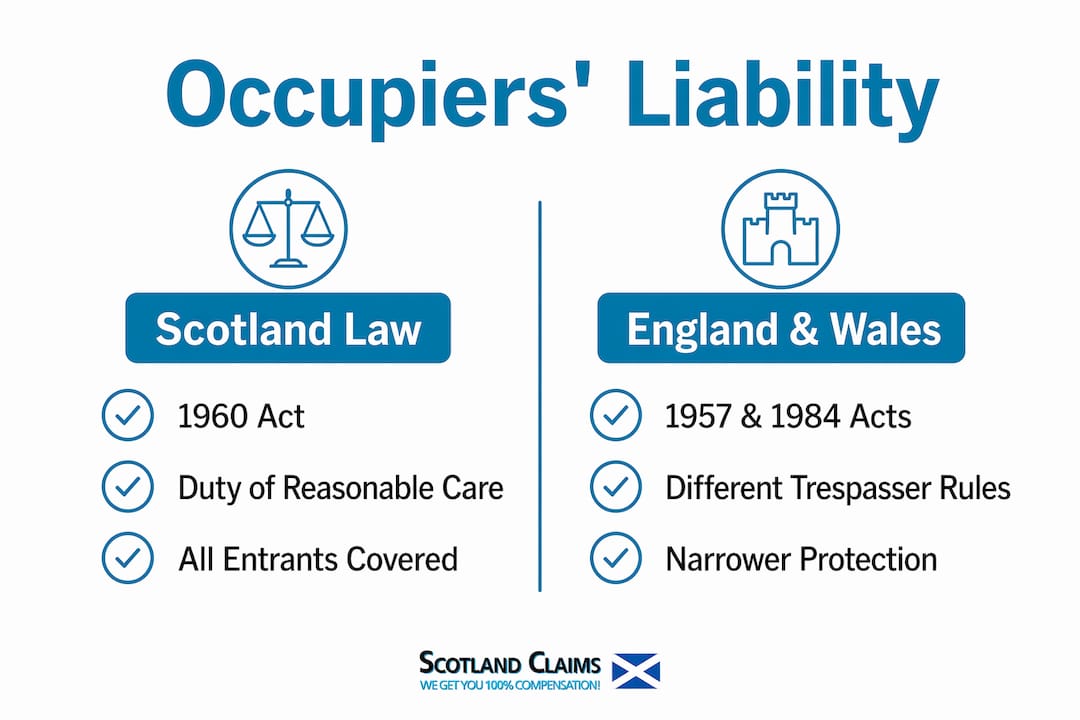
The 1957 and 1984 Acts that govern occupiers’ liability in England and Wales explicitly exclude Scotland. Scottish cases rely entirely on the 1960 Act. This is not a minor procedural detail. The two legal frameworks differ in structure, coverage, and how courts approach claims.
| Feature |
Scotland (1960 Act) |
England and Wales (1957 and 1984 Acts) |
| Governing statute |
Occupiers’ Liability (Scotland) Act 1960 |
Occupiers’ Liability Acts 1957 and 1984 |
| Trespasser protection |
Same duty applies to all entrants |
Separate, reduced duty for trespassers under 1984 Act |
| Visitor categories |
No formal distinction between visitor types |
Distinction between lawful visitors and trespassers |
| Risk standard |
Reasonable care, proportionate to foreseeability |
Common duty of care for visitors; limited duty for trespassers |
| Practical impact |
Broader protection for all who enter land |
Narrower protection depending on permission status |
The wrongful application of English statutes in Scottish cases causes confusion and delays. Scottish injury claims must be framed under the 1960 Act from the outset for proper legal handling. If your solicitor references the 1957 or 1984 Acts in relation to your Scottish claim, that is a warning sign worth acting on.
The practical impact for you as an injured person in Scotland is positive. The broader protection under the 1960 Act means your claim does not depend on proving you had a right to be on the land. What matters is whether the occupier failed to take reasonable care.
What should you know if injured on someone else’s property?
If you have been injured on premises controlled by another person or organisation, your claim rests on three legal elements. A claim depends on establishing duty, breach, and causation. Each element must be present.
Here is what each element means for your situation:
- Duty. The person or organisation you are claiming against must have been the occupier, meaning they exercised control over the relevant part of the premises.
- Breach. They must have failed to take reasonable care. This means they either knew about a hazard and did nothing, or should have known about it through regular inspection.
- Causation. The breach must have directly caused your injury. If you would have been injured regardless of the occupier’s actions, causation fails.
Common scenarios where occupiers’ liability claims arise in Scotland include slips on wet or uneven floors in shops and restaurants, trips on broken paving in car parks or communal areas, falls caused by defective stairs or handrails, and injuries on rural land where a known hazard was left unaddressed.
Pro Tip: Photograph the hazard immediately if you are able to do so safely. Note the date, time, and exact location. Report the incident to the occupier and ask for a written record. This evidence is the foundation of any successful claim.
Defences available to occupiers include arguing that the risk was not foreseeable, that the hazard was so obvious that any reasonable person would have avoided it, or that the injured person contributed to their own injury through carelessness. Courts in Scotland assess these arguments carefully, and the outcome often turns on the specific facts of each case.
One area where Scottish law produces surprising results is rural land. Scotland’s right to roam under the Land Reform (Scotland) Act 2003 means large numbers of people access private land lawfully. Occupiers of rural estates must still manage foreseeable risks, but courts recognise the practical limits of controlling vast areas of natural terrain.
Key takeaways
Occupiers’ liability in Scotland is governed solely by the 1960 Act, which imposes a duty of reasonable care on anyone controlling premises, covering all entrants regardless of permission.
| Point |
Details |
| Governing law is Scotland-specific |
The Occupiers’ Liability (Scotland) Act 1960 is the only relevant statute; English Acts do not apply. |
| Control, not ownership, determines liability |
The occupier is whoever exercises actual control over the premises, which may include tenants or agents. |
| Duty covers all entrants |
The 1960 Act protects lawful visitors and trespassers alike, unlike the position in England and Wales. |
| Three elements must be proved |
A successful claim requires proof of duty, breach of reasonable care, and direct causation of injury. |
| Foreseeability shapes every claim |
If a risk was not foreseeable or proportionate action was impossible, an occupier may avoid liability. |
The part of occupiers’ liability that catches people off guard
After years of working with injury victims across Scotland, the single biggest misconception I encounter is this: people assume they have no claim because they were not supposed to be somewhere. They were cutting through a car park, walking across a field, or exploring a building site. They assume that because they lacked formal permission, the law offers them nothing.
The 1960 Act says otherwise. Scotland’s approach to occupiers’ liability is genuinely more protective than most people realise. The duty applies broadly, and the question is never simply “were you allowed to be there?” The question is whether the occupier took reasonable care given what they knew or should have known.
What I have also seen cause real problems is the complexity of identifying the right defendant. A client injured in a shopping centre may face three or four potential occupiers, each pointing at the others. Getting this wrong at the start of a claim wastes months. The specialist injury lawyers who handle these cases regularly know how to cut through that quickly.
My honest view is that occupiers’ liability claims in Scotland are under-pursued. Many people write off genuine injuries as bad luck. The law in Scotland is clear: if someone controlling a property failed to manage a foreseeable risk, and you were hurt as a result, you have the right to seek compensation. Do not assume the law is not on your side before you have spoken to someone who knows it properly.
— Roger
How Scotland Claims Injury Lawyers can help with your claim
If you have been injured on someone else’s property in Scotland, Scotland Claims Injury Lawyers connects you with specialist injury lawyers in Scotland who handle occupiers’ liability cases every day. Whether you slipped in a shop, tripped in a car park, or suffered a back injury from a fall, the legal team can assess your claim and advise you on your rights under the 1960 Act. Scotland Claims Injury Lawyers operates on a No Win No Fee basis, meaning you pay nothing upfront and nothing if your case is unsuccessful. For slip, trip, and premises injury claims, Scotland Claims Injury Lawyers deducts no success fee whatsoever, meaning you keep 100% of your compensation - unlike many large national firms, which charge up to 20% including VAT. Use the compensation calculator to get an estimate of what your claim could be worth.
FAQ
What does occupiers’ liability mean in scotland?
Occupiers’ liability is the legal duty of the person or organisation controlling a property to take reasonable care that anyone on the premises does not suffer injury. In Scotland, this duty is governed by the Occupiers’ Liability (Scotland) Act 1960.
Who is responsible under occupiers’ liability?
The responsible party is the occupier, meaning whoever exercises actual control over the premises at the time of the injury. This is not always the property owner and can include tenants, management companies, or agents.
Does occupiers’ liability cover trespassers in scotland?
Yes. Under the 1960 Act, the duty of care applies to all entrants, including those without permission to be on the land. This is a key difference from the law in England and Wales.
What does occupiers’ liability cover in terms of claims?
A claim can arise from any injury caused by a hazard the occupier knew about or should have known about, including slips on wet floors, trips on broken surfaces, falls from defective stairs, and injuries from unaddressed outdoor hazards.
How do i prove an occupiers’ liability claim?
You must show that the occupier owed you a duty of care, that they breached that duty by failing to take reasonable care, and that the breach directly caused your injury. Evidence such as photographs, incident reports, and witness statements supports each element.
Recommended