Claim time limits in Scotland: 3-year injury rules

TL;DR:
- In Scotland, personal injury claims must be filed within three years of the incident or discovery of injury.
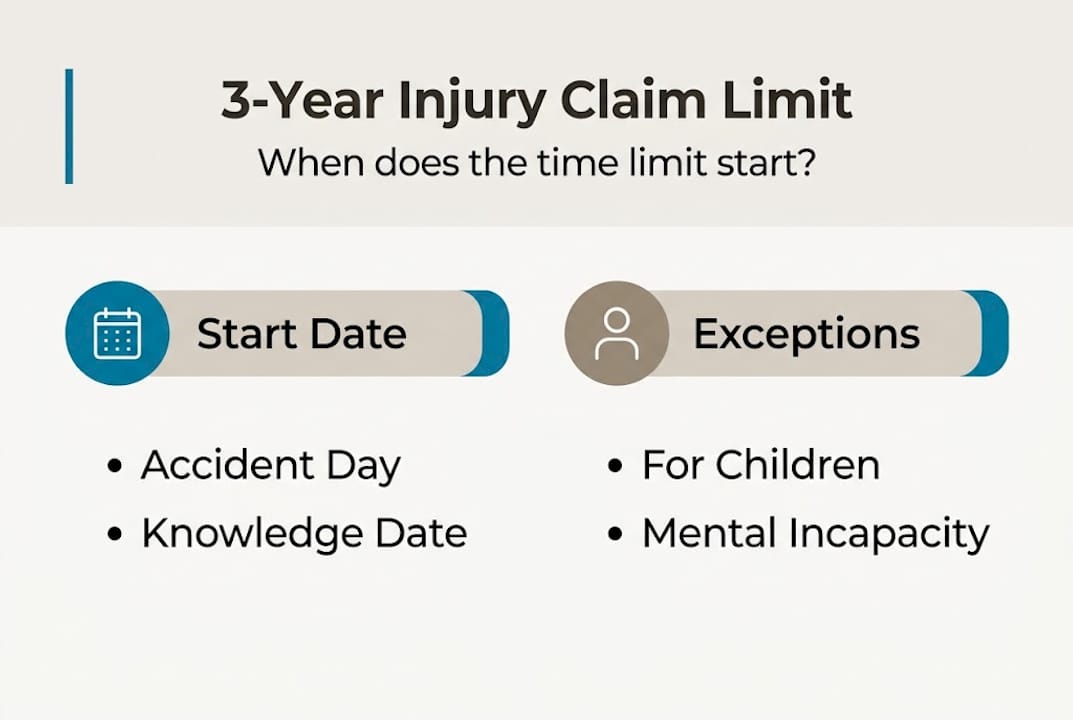
- The clock starts either on the injury date or when you reasonably knew about the injury and its cause.
- Exceptions are limited, such as for children and those with incapacity, and courts rarely grant extensions.
Many injury victims in Scotland assume they have plenty of time to act, only to discover that their window for compensation has already closed. Missing the claim time limit is one of the most common and devastating reasons people lose their right to pursue justice. This guide cuts through the confusion by explaining exactly how long you have to make a personal injury claim in Scotland, how your deadline is calculated, what exceptions exist, and what practical steps to take right now. Whether you were hurt recently or believe you may have left it too late, understanding these rules could make all the difference to your case.
Table of Contents
Key Takeaways
| Point |
Details |
| Three-year rule |
You typically have three years to make an injury claim in Scotland. |
| Some exceptions exist |
Exceptions apply for children, incapacity, or cases of delayed knowledge. |
| Extensions are rare |
Courts seldom grant more time, so act as soon as possible. |
| Check your date |
The deadline depends on when you were injured or became aware of the injury. |
| Get expert advice fast |
If you’re unsure or close to the limit, seek specialist support immediately. |
What is a claim time limit and why does it exist?
A claim time limit is the maximum period in which you are legally permitted to start a compensation claim following a personal injury. Miss this window, and in most circumstances, your claim is permanently barred, regardless of how strong your evidence might be. That is not a technicality you can negotiate around. It is the law.
In Scotland, the standard period for personal injury claims is three years. This deadline is not arbitrary. Sections 17 and 18 of the Prescription and Limitation (Scotland) Act 1973 govern this three-year limitation period, and the legislation exists for clear reasons:
- Fairness to defendants: Witnesses’ memories fade, evidence deteriorates, and it would be unjust to hold someone liable for an incident from many years ago.
- Legal certainty: Both individuals and organisations need to know at some point that a potential claim is no longer live.
- Encouraging prompt action: The law incentivises claimants to act while evidence is fresh and the facts are clear.
- Court efficiency: Limiting the age of claims helps the court system manage its caseload responsibly.
Imagine you slipped in a supermarket in March 2023 and suffered a back injury. You felt it was not serious enough to pursue at the time, but by 2026 your condition has worsened. If you did not start your claim before March 2026, you would almost certainly be time-barred, regardless of your ongoing pain.
Understanding why deadlines matter in injury claims goes beyond simply knowing the number three. It is about recognising that the clock starts whether you are ready or not.
“The time bar is one of the most unforgiving aspects of Scottish personal injury law. Genuine injuries, real suffering, and clear liability can all count for nothing if a claim is started one day too late.”
Pro Tip: Do not wait until you feel “ready” to speak to a lawyer. Even a free initial consultation early on preserves your options without committing you to anything.
With the basics set, let us explore how these time limits apply in practice across different types of claims.
How is the three-year deadline calculated?
Knowing that three years is the limit is only part of the story. Knowing when those three years begin is where most people run into difficulty.
In straightforward cases, the clock starts on the date of the accident. If you were injured in a road traffic collision on 10 April 2023, your limitation date is 10 April 2026. Simple. But many injury cases are not straightforward at all.

Scottish law also recognises the date of knowledge as the starting point. This matters enormously in cases involving industrial disease, repetitive strain injuries, or conditions where symptoms only emerge gradually. Under sections 17 and 18 of the Prescription and Limitation (Scotland) Act 1973, the period can run from the date you first knew, or should reasonably have known, that your injury was significant and that it was attributable to someone else’s act or omission.
| Scenario |
Start of three-year period |
| Road traffic accident |
Date of the accident |
| Industrial disease (e.g., asbestosis) |
Date of medical diagnosis or date of knowledge |
| Child injured in an accident |
Child’s 16th birthday |
| Adult with mental incapacity |
Date incapacity ends or court appoints a guardian |
| Delayed symptom onset |
Date symptoms were first linked to the incident |
Here is how to calculate your own limitation date step by step:
- Identify the incident date. When did the accident or harmful event occur?
- Consider date of knowledge. Did you know straight away what had happened and who was responsible? If not, when did you find out?
- Determine the earlier starting point. Your three-year period runs from whichever date is legally applicable to your situation.
- Count forward three years. That date is your deadline. Mark it clearly.
- Account for exceptions. Check whether any exceptions (see the next section) shift your deadline.
One common mistake is assuming the clock starts when symptoms worsen rather than when they first appeared or when you first became aware of the link to an event. Another error is confusing the date you instructed a solicitor with the date a claim was formally raised in court, as it is the latter that matters legally.
Pro Tip: If you are unsure about your starting date, seek advice from a specialist injury lawyer as soon as possible. Understanding the accident claim process early on helps you avoid these costly miscalculations. And remember, acting promptly after an accident is always in your interest.
Are there any exceptions or extensions to claim time limits?
Once you know your deadline, you might wonder whether exceptions apply or if it is ever possible to get more time. The short answer is: occasionally yes, but do not rely on it.
Scottish courts do have limited discretion under the 1973 Act to allow a claim to proceed outside the standard three-year period, but this is the exception rather than the rule. The main recognised exceptions are:
- Children: The three-year period does not begin until the child turns 16. A child injured at age 10 therefore has until their 19th birthday to raise a claim.
- Adults with incapacity: Where a claimant lacks legal capacity due to mental illness or disability, the time limit is suspended until capacity is regained or a legal guardian is appointed.
- Delayed awareness: As discussed above, where the claimant genuinely could not have known earlier about the injury or its cause, the courts may accept a later start date.
| Situation |
Standard deadline |
Exception applies? |
| Adult road accident |
3 years from accident date |
No |
| Child injured at age 12 |
3 years from age 16 (age 19) |
Yes |
| Asbestos-related illness |
3 years from date of knowledge |
Yes |
| Mental incapacity |
Suspended during incapacity |
Yes |
| Deliberate delay by claimant |
No extension granted |
No |
What the courts will not do is extend time simply because you were busy, distressed, or hoped the matter would resolve itself. In a notable case highlighted by the Sheriff Appeal Court refusing an extension, a medical negligence claim was refused despite arguments about delay, because the claimant had received advice and failed to act on it. The court found that the sheriff had not erred in refusing to exercise discretion.
This is a sobering reality. Even where significant harm has occurred, the courts are reluctant to override the time bar unless the circumstances are genuinely exceptional. If you are concerned about a denied or time-barred claim, understanding your options around appealing a denied claim is a sensible next step.
Practical steps: What to do if you’re close to or past the deadline
Whether you are approaching your deadline or fear you may have missed it, proactive steps are crucial. Do not assume the worst without getting specialist advice first.
If you believe you are within the three-year window but time is running short, here is what to do immediately:
- Contact a specialist injury lawyer today. Even with days to spare, a solicitor can raise a protective court action to stop the clock while your case is assessed properly.
- Gather all available evidence. Medical records, photographs, witness details, and accident reports become critical when time is tight.
- Write down your recollection of events. Memory fades quickly. A written account, even a rough one, is valuable.
- Do not sign any settlement offer from an insurer without legal advice. Accepting an early settlement may waive your right to future claims.
- Check your date of knowledge if the incident involved a gradual condition rather than a single event, as your clock may have started later than you think.
A common injury claim mistake is assuming that because time has passed, nothing can be done. Sometimes the date of knowledge provisions genuinely shift your deadline. A specialist can assess this for you quickly.
If you fear you have already passed the deadline, do not simply give up. Speak to a lawyer. There are rare circumstances where courts exercise discretion, and only a professional assessment will tell you whether any avenue remains open. You can review guidance on starting your injury claim to understand exactly what steps are involved once you decide to act.
Pro Tip: The three-year rule under the Prescription and Limitation (Scotland) Act 1973 is strict, but date of knowledge provisions mean your situation may be more nuanced than you think. Always get a professional view before concluding your claim is too late.
Why waiting rarely pays off: Lessons from the front lines
We see a pattern repeat itself far too often. Someone suffers a genuine, serious injury. They feel uncertain, overwhelmed, or simply believe the matter will sort itself out. Months pass, then years. By the time they seek advice, the time bar has closed and no amount of sympathy from the courts changes the outcome.
The legal system’s strict stance is illustrated clearly by the Sheriff Appeal Court’s refusal to extend time in cases where claimants were given advice and simply did not act on it. The message from the courts is consistent: valid reasons for delay are very narrowly defined.
What is perhaps less understood is how early legal advice actually strengthens a case. Evidence is preserved. Witnesses are easier to trace. Medical records are more complete. The opposing party has less opportunity to challenge the narrative. From our experience helping injury victims across Scotland, those who understand their personal injury rights and act early recover better outcomes, both legally and personally. Waiting for “the perfect moment” to pursue a claim is a myth. The best moment is always as soon as possible.
How Scotland Claims can help you act in time
If you are worried about a looming deadline or unsure whether you still have a valid claim, Scotland Claims is here to help. We offer urgent, no-obligation consultations for time-critical cases, giving you a clear picture of where you stand without any upfront cost. Our injury lawyers in Scotland specialise in assessing limitation dates quickly and accurately. You can also use our compensation calculator to get an initial estimate of what your claim could be worth. And with our No Win No Fee claim support, you pay nothing unless your case succeeds. Do not let the clock run out on a claim you deserve to win.
Frequently asked questions
What is the claim time limit for personal injury in Scotland?
The standard time limit for personal injury claims in Scotland is three years, running from the date of the accident or the date you became aware of your injury, as governed by sections 17 and 18 of the Prescription and Limitation (Scotland) Act 1973.
Can the three-year claim time limit be extended?
Extensions are rare and only granted in truly exceptional circumstances, such as mental incapacity. As shown by the Sheriff Appeal Court ruling on refusing to extend the time bar, courts are highly reluctant to allow claims outside the standard period.
Does the time limit apply to children’s claims?
For children, the three-year limitation period under the 1973 Act begins on their 16th birthday, giving them until their 19th birthday to formally raise a claim.
What if I only discovered my injury years after the event?
The time limit runs from when you knew, or should reasonably have known, that you were injured and who was responsible. This date of knowledge provision is a key part of the 1973 Act and can shift your deadline significantly.
Recommended