
Table of Contents
Slip and Trip Claim Process Scotland: A Step-by-Step Guide
Last Updated: July 16, 2026
What Is a Slip, Trip and Fall Claim?
A slip and trip claim is the legal mechanism by which individuals injured in accidents on someone else's property can seek compensation. These claims arise when property owners or occupiers fail in their duty of care, resulting in preventable accidents. Whether you've slipped on a wet floor in a Glasgow supermarket, tripped on uneven paving, or fallen due to poor maintenance, understanding this process is essential to protecting your rights.
The distinction between slips, trips, and falls matters legally. A slip occurs when your foot loses traction on a surface, typically due to wet floors or loose rugs. A trip happens when your foot catches on an obstacle, such as broken flooring or debris. A fall may result from either, or from hazards like missing handrails or inadequate lighting. All three can form the basis of a personal injury claim if negligence can be proven. 🏥
Key Takeaway
A slip and trip claim involves proving that the property occupier breached their duty of care, causing your injury and resulting losses. Success requires evidence, medical documentation, and often legal representation.
Understanding Occupiers' Liability in Scotland
The foundation of slip and trip claims in Scotland rests on the Occupiers' Liability (Scotland) Act 1960, which establishes the legal duty owed by property occupiers to visitors. Unlike some jurisdictions, Scottish law applies a single standard of care to all visitors, without distinction between invitees, licensees, and trespassers.
Under the Act, occupiers must take reasonable care to ensure their premises are safe for visitors. This includes maintaining floors, stairs, and outdoor areas; removing hazards promptly; providing adequate lighting; and warning of dangers that cannot be immediately removed. A property owner in Edinburgh who leaves a broken step unrepaired, or a shop manager in Glasgow who fails to clean up spilled liquid, may be liable if someone is injured as a result.
The test is whether a reasonable person, in the occupier's position, would have foreseen the risk and taken steps to prevent injury. This is not about absolute safety, but about reasonable precautions. A single wet floor in a busy shopping centre may require immediate action, whilst a minor damp patch in a rarely-used storage area might not.
Watch Out
Many people assume they have no claim if they partially contributed to their accident. Scottish law allows claims even where you bear some responsibility; the compensation is simply reduced proportionally. This is called comparative negligence.
The 3-Year Limitation Period for Slip and Trip Claims
Time is critical when pursuing a slip and trip claim. The law imposes a strict three-year limitation period from the date of your accident. If you fail to raise a court action within this timeframe, your right to claim is extinguished entirely, regardless of the strength of your case.
For claims involving children, the three-year period typically begins when the child reaches age 18, giving them until age 21 to pursue their claim. For individuals with legal incapacity, the clock may not start until that capacity is restored.
The limitation period applies to civil court proceedings, not to the claims process itself. You can notify the property owner's insurance company at any point, but if settlement negotiations fail and you need to raise a court action, you must do so within three years. Many solicitors recommend acting within 12 months, because evidence degrades, witness memories fade, and CCTV footage is often retained for only 30-90 days.
Pro Tip
Don't wait until year three to instruct a solicitor. Evidence gathered within weeks of an accident is far stronger than evidence gathered years later. Witness statements taken immediately carry more weight than those obtained from memory months or years on.
What to Do in the First 60 Minutes After an Accident
The moments immediately following a slip, trip, or fall are crucial for building a strong claim. Once you're stable, document everything. Take photographs of the hazard that caused your fall, the wet floor, broken step, or obstacle you tripped on. Photograph the wider scene to show context: lighting conditions, signage, or the absence of warning notices.
Speak to anyone who witnessed your fall and ask for their names and contact details. Even one credible witness significantly strengthens your claim. If staff were present, ask them to complete an accident report book and request a copy. This formal documentation creates a contemporaneous record that courts value highly.
Notify the property owner or occupier of your accident in writing within 24-48 hours. Send a brief letter or email describing what happened, when, where, and how you were injured. Keep a copy. This written notification preserves evidence and gives the occupier notice of potential liability.
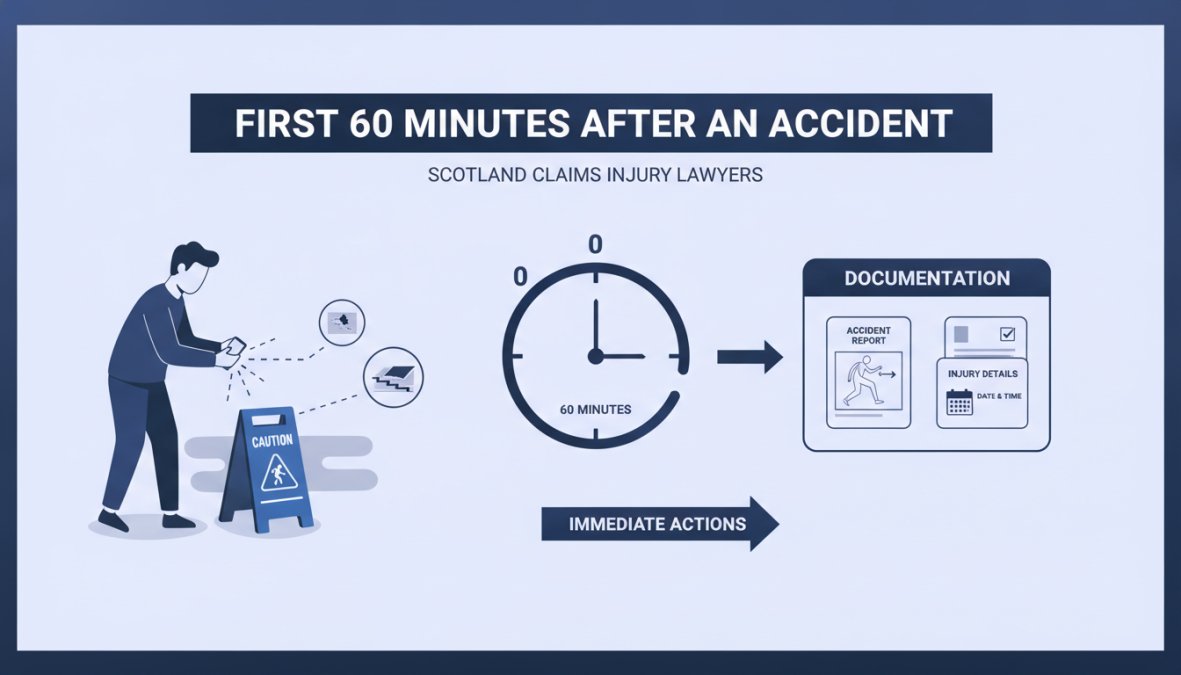 Person taking photographs of a wet floor with a hazard sign in a public space, showing documentation of an accident scene
Seeking medical attention
Do not delay in seeking medical assessment, even if your injuries seem minor. Some injuries, particularly head injuries or soft-tissue damage, may not be immediately apparent. Visiting your GP or attending an accident and emergency department creates a medical record linked to the date and time of your accident, which is essential evidence.
When you see a healthcare professional, describe your accident clearly and completely. Request copies of all medical records, examination notes, and any imaging or test results. Keep detailed records of all medical treatment: appointments, diagnoses, prescribed medications, physiotherapy sessions, and any time off work. Photograph any visible injuries in good lighting.
Evidence Required for a Successful Slip and Trip Claim in Scotland
Gathering witness statements and documentation
A successful claim depends heavily on evidence. Witness statements are among the most valuable forms of evidence you can obtain. An independent person who saw your accident and the conditions that caused it provides credible, third-party corroboration of your account.
Request written statements from witnesses as soon as possible after the accident. A formal signed statement is preferable to an informal email. Include the witness's full name, address, contact details, and occupation. Courts are more persuaded by witnesses with no connection to the claimant and no financial interest in the outcome.
Obtain copies of any accident report book entries, incident logs, or internal communications related to your fall. If the premises have CCTV, request footage immediately. Many systems overwrite footage after 30-90 days, so prompt action is essential. Send a formal request to the property owner or manager asking them to preserve all CCTV footage, maintenance records, and incident reports.
Gather photographs or video of the scene taken shortly after your accident, showing the hazard, lighting, signage, and the general condition of the premises. Photographs taken immediately after the accident are more valuable than those taken later, though both can be useful for showing the layout and typical conditions.
Medical reports and accident records
Medical evidence is fundamental to any personal injury claim. Your GP's records, hospital discharge summaries, and any specialist reports form the clinical foundation of your case. These documents establish the link between the accident and your injuries.
For claims involving significant injuries, instruct a medical expert, typically an orthopaedic surgeon or physiotherapist, to examine you and prepare a detailed report. This expert report should describe your injuries, their likely cause, your current condition, prognosis, and any ongoing treatment required. The expert's opinion on causation is particularly valuable.
Maintain a detailed personal injury diary documenting your symptoms, pain levels, mobility limitations, and how your injuries affect your daily life. This diary provides a contemporaneous account of your recovery and is admissible as evidence. It's particularly valuable for demonstrating the impact of your injuries on work, hobbies, and family life.
Collect all receipts and invoices for medical treatment, prescriptions, travel to appointments, and any aids or equipment purchased due to your injuries. These form the basis of your special damages claim.
Pro Tip
Expert medical reports carry significant weight in settlement negotiations and court proceedings. If your claim involves substantial injuries or ongoing disability, investing in an expert report early often leads to faster, higher settlements.
Proving Negligence and Liability in Your Claim
To succeed in a slip and trip claim, you must prove that the property occupier owed you a duty of care, breached that duty, and caused your injuries and losses.
Duty of care is established by the Occupiers' Liability (Scotland) Act 1960. Occupiers owe a duty to keep their premises reasonably safe for visitors.
Breach of duty requires showing that the occupier failed to take reasonable steps to prevent the hazard that caused your fall. Was the floor wet without warning signs? Was a step broken and left unrepaired? Did the occupier know, or ought they to have known, of the hazard? Evidence such as witness statements, photographs, maintenance records, and expert reports all contribute to proving breach.
Causation requires demonstrating that the occupier's breach directly caused your accident and injuries. Your medical evidence supports this link.
Quantifiable loss means you must have suffered injury, financial loss, or both. Medical evidence establishes the injury; receipts and records establish financial losses.
Courts also consider whether the occupier took reasonable precautions. Did they have cleaning schedules? Did they inspect the premises regularly? Did they have warning signs in place? Occupiers who can demonstrate reasonable systems and procedures may argue they took all reasonable steps, even if an accident occurred.
The Slip and Trip Claim Process in Scotland: Step by Step
Step 1: Consult a solicitor
The first formal step is to consult a solicitor specialising in personal injury law. At Scotland Claims Injury Lawyers, the initial consultation is typically free and without obligation. A solicitor will review the circumstances of your accident, assess the strength of your claim, and explain your options.
During this consultation, you'll discuss the accident, your injuries, medical treatment, and any evidence you've gathered. The solicitor will advise whether you have a viable claim, what compensation you might expect, and what the claims process involves. They'll explain the no win no fee arrangement, meaning you pay nothing if your claim is unsuccessful and retain all compensation if it succeeds.
Instruct your solicitor promptly. Early involvement allows them to gather evidence while it's fresh, preserve CCTV footage and witness statements, and advise on medical assessment and expert reports.
Step 2: Pre-Action Protocol notification
The Personal Injury Pre-Action Protocol governs how personal injury claims are handled before court proceedings begin. Your solicitor will send a detailed letter of claim to the property owner's insurer, setting out the facts of the accident, your injuries, the basis of liability, your losses, and a request for compensation.
The insurer typically has 30 days to respond. They may accept liability and begin settlement negotiations, admit partial liability, or deny liability entirely. This stage often leads to settlement without the need for court proceedings.
If the insurer denies liability, your solicitor will advise whether to proceed to court. The decision depends on the strength of your evidence, the likely value of your claim, and the costs of litigation.
Step 3: Settlement negotiation or court proceedings
Most slip and trip claims settle during the pre-action protocol phase or shortly thereafter. Your solicitor will present evidence, medical reports, witness statements, photographs, and expert opinions to support a settlement figure.
If settlement cannot be reached, your solicitor will raise a court action. In Scotland, personal injury claims are typically raised in the Sheriff Court (for claims under £100,000) or the Court of Session (for larger claims). The court process involves pleadings, disclosure of evidence, submission of witness statements and expert reports, and a proof hearing where evidence is presented and the judge makes a decision.
Court proceedings can take 18-36 months from raising the action to final judgment. Most claims settle before reaching proof, however, because both parties recognise the cost and uncertainty of litigation.
No Win No Fee Agreements for Slip and Trip Claims in Scotland
Many solicitors in Scotland, including Scotland Claims Injury Lawyers, offer no win no fee agreements for personal injury claims. Under this arrangement, you pay no solicitor's fees if your claim is unsuccessful. If your claim succeeds, the solicitor recovers their fees from the compensation awarded or from the other party's liability insurer.
This arrangement removes the financial risk from pursuing a claim. However, you should understand the precise terms of any no win no fee agreement before instructing a solicitor. Some agreements include a success fee (a percentage uplift on the solicitor's normal hourly rate, payable from your compensation if you win), after-the-event insurance (covering the opposing party's legal costs if your claim fails), and expenses such as court fees and expert reports.
Scotland Claims Injury Lawyers does not charge a success fee; you keep 100% of your compensation when you win. This is a significant advantage compared to many competitors who charge success fees of 20% or more. Clarify all costs before instructing a solicitor.
Key Takeaway
No win no fee agreements make justice accessible by removing upfront costs. However, compare the terms carefully, as some solicitors charge success fees that significantly reduce your net compensation, whilst others do not.
What Compensation Can You Claim for a Slip and Trip Accident?
General damages for pain and suffering
General damages compensate you for pain, suffering, and loss of amenity resulting from your injuries. This includes physical pain, emotional distress, and reduced quality of life during your recovery. General damages are assessed based on the nature and severity of your injuries, your age, and your prognosis.
Courts use guidelines published by the Judicial College to assess general damages. A minor sprain or bruise might attract £1,000-£3,000; a moderate fracture might attract £5,000-£15,000; and a serious injury causing long-term disability might attract significantly more. General damages are calculated from the date of injury until you reach maximum medical improvement, or indefinitely if your injuries are permanent.
Special damages for financial losses
Special damages compensate you for quantifiable financial losses caused by your accident, including medical costs, lost earnings, travel costs, aids and equipment, care costs, and future losses. Special damages must be quantified precisely with receipts, invoices, payslips, and other documentation.
| Loss Type |
Evidence Required |
Example |
| Medical costs |
Receipts and invoices |
Physiotherapy: £50 × 12 sessions = £600 |
| Lost earnings |
Payslips and employer letter |
4 weeks at £400/week = £1,600 |
| Travel costs |
Receipts and mileage records |
20 appointments × £8 petrol = £160 |
| Equipment |
Invoices and receipts |
Orthopaedic shoes: £200 |
| Care costs |
Invoices or time records |
2 hours/week × £15/hour × 26 weeks = £780 |
Common Mistakes to Avoid in Your Slip and Trip Claim
Many claimants inadvertently weaken their claims by making preventable mistakes. Delaying medical assessment is critical; if you don't seek medical attention promptly, insurers may argue your injuries weren't serious or weren't caused by the accident. Failing to gather evidence at the scene, photographs of the hazard, witness names, and accident reports, undermines your claim significantly.
Posting about your accident on social media can damage your claim. Insurers monitor social media and may use posts suggesting you're recovering faster than medical evidence indicates. Accepting an early settlement offer without legal advice is risky; insurers often make low initial offers hoping claimants will accept without understanding the true value of their claims.
Failing to preserve evidence such as CCTV footage or maintenance records can be fatal to your claim. Not instructing a solicitor promptly means evidence is lost and witness memories fade. Exaggerating your injuries or providing inconsistent accounts undermines your credibility. Underestimating your losses by failing to claim all financial costs means you recover less compensation. Finally, ignoring the limitation period is catastrophic; missing the three-year deadline extinguishes your right to claim entirely.
Pursuing a slip and trip claim requires prompt action, careful evidence gathering, and professional legal representation. The three-year limitation period means time is your enemy; delays cost you evidence and increase the risk of missing the deadline entirely. Scotland Claims Injury Lawyers specialises in helping accident victims navigate this process, gathering evidence, negotiating with insurers, and maximising compensation. With a no win no fee arrangement and no success fees charged, you can pursue your claim without financial risk. Contact Scotland Claims Injury Lawyers today for a free consultation and impartial advice on your claim.
Frequently Asked Questions
What is the time limit for making a slip and trip claim in Scotland?
In Scotland, you generally have three years from the date of your accident to make a slip and trip claim. This is the limitation period under Scottish law. However, if you were a child at the time of the accident, the three-year period begins when you reach 16 years of age. It is crucial to act within this timeframe, as claims submitted after the limitation period has expired will typically be rejected by the court.
What evidence do I need for a slip and trip claim in Scotland?
Essential evidence for a slip and trip claim includes witness statements from people who saw the accident, photographs of the hazard or defective flooring, medical reports documenting your injuries, accident report book entries from the location, and records of any treatment received. Additionally, gather CCTV footage if available, written accounts of what happened, and proof of financial losses such as medical bills or lost wages. The stronger your evidence, the more likely your claim will succeed.
Do I need a solicitor for a slip and trip claim in Scotland?
Whilst you can make a claim independently, instructing a solicitor significantly improves your chances of success. A solicitor understands Scottish law, the Personal Injury Pre-Action Protocol, and how to prove negligence under the Occupiers' Liability (Scotland) Act 1960. Many solicitors work on a no win no fee basis, meaning you pay nothing upfront and only if your claim succeeds. This removes financial risk from pursuing your claim.
What kind of compensation can I get for a slip and trip accident in Scotland?
Compensation for slip and trip claims typically includes general damages for pain, suffering, and loss of amenity, plus special damages covering financial losses such as medical expenses, lost earnings, and travel costs. The quantum of damages depends on the severity of your injury, how long recovery takes, and the impact on your quality of life. Your solicitor will assess your circumstances to estimate what compensation you may receive based on similar cases.