Understanding injury valuation in Scotland: 2026 guide

Many people assume compensation amounts after an accident follow a simple formula, but injury valuation in Scotland involves a nuanced assessment of both financial losses and personal suffering. The process combines evidence-based calculations with legal precedents to determine fair awards. Understanding how injury lawyers in Scotland value your claim empowers you to navigate the compensation process with confidence and realistic expectations about potential outcomes.
Table of Contents
Key Takeaways
| Point |
Details |
| Damage categories |
Valuation separates patrimonial and non patrimonial damages to reflect financial losses and pain and suffering. |
| Future losses discounted |
Future losses are discounted to present value using the Personal Injury Discount Rate under the Damages Act 1996. |
| Evidence and precedent |
The process blends evidence based calculations with legal precedents to determine fair awards in Scotland. |
| Professional guidance |
Legal advice helps claimants navigate valuation accurately and challenge inadequate offers. |
What is injury valuation and why does it matter?
Injury valuation is the systematic process of assessing total damages from accident injuries to establish the compensation you deserve. This assessment forms the foundation of every personal injury claim in Scotland, determining whether your award adequately covers the true impact of your injuries. The valuation process examines two distinct categories of harm: patrimonial damages covering quantifiable financial losses, and non-patrimonial damages addressing pain, suffering, and loss of amenity.
Understanding injury valuation matters because it directly influences the size of your compensation award under Scottish law. Many claimants underestimate the full extent of their losses, accepting settlements that fail to reflect ongoing medical needs or future earning capacity. The valuation process differs fundamentally from the compensation claim procedure itself. Valuation determines what you should receive, whilst the claim process involves proving liability and negotiating with insurers to secure that amount.
Key aspects of injury valuation include:
- Assessment of immediate and long-term financial consequences
- Evaluation of physical pain and psychological distress
- Calculation of care requirements and lifestyle adaptations
- Projection of future losses based on medical prognosis
- Application of legal frameworks and precedent awards
Pro Tip: Document every aspect of how your injury affects daily life, from missed work hours to emotional struggles. These details strengthen your valuation by providing concrete evidence of non-financial losses that might otherwise be overlooked.
Knowing how valuation works helps you recognise fair offers and challenge inadequate ones. Insurers often present initial settlements that fail to account for future complications or ongoing care needs. When you understand the components of proper valuation, you can advocate effectively for compensation that truly reflects your circumstances and supports your recovery journey.
How are damages calculated in injury valuation?
Damages in Scottish injury claims fall into two main categories: patrimonial damages covering measurable financial losses and non-patrimonial damages compensating for pain and suffering. Patrimonial damages encompass past and future lost earnings, medical expenses, care costs, travel expenses for treatment, and necessary home adaptations. Each element requires specific evidence, from wage slips and employment contracts to medical reports and care assessments. Future losses are discounted to present value using the Personal Injury Discount Rate set under the Damages Act 1996 as amended.

The Personal Injury Discount Rate (PIDR) reflects the principle that compensation received today can be invested to generate returns, so future losses must be adjusted downward. Scottish ministers set this rate based on inflation indices and wage growth projections, ensuring valuations remain fair as economic conditions change. The current methodology uses real wage growth data and considers how claimants might reasonably invest their awards. This technical adjustment significantly impacts large claims involving lifelong care or permanent disability.
| Damage category |
Calculation basis |
Evidence required |
| Past lost earnings |
Actual wages missed |
Payslips, employment records |
| Future lost earnings |
Projected career trajectory |
Expert employment reports |
| Medical costs |
Treatment expenses incurred and anticipated |
Bills, consultant opinions |
| Care costs |
Hours and rates for assistance needed |
Care assessments, local rate surveys |
| Travel expenses |
Mileage and public transport for treatment |
Receipts, journey logs |
How evidence is gathered and applied in valuation follows a structured sequence:
- Medical experts assess injury severity and prognosis, establishing the foundation for all other calculations
- Employment specialists evaluate lost earning capacity based on your career path and injury limitations
- Care experts determine the level and duration of assistance required for daily activities
- Financial analysts project future costs and apply the discount rate to calculate present values
- Legal professionals compile all evidence and apply precedent awards to determine appropriate compensation
- The final valuation combines patrimonial calculations with non-patrimonial awards based on comparable cases
The discount rate methodology ensures that compensation awards reflect realistic investment returns whilst protecting claimants from inflation erosion, balancing fairness to both injured parties and defendants responsible for damages.
Pro Tip: Maintain meticulous records of every expense related to your injury, no matter how small. Taxi fares to appointments, prescription costs, and even parking fees contribute to your patrimonial damages total and can add thousands to your final award.
Non-patrimonial damages require a different approach, drawing on precedent cases with similar injuries to establish appropriate compensation for pain, suffering, and loss of amenity. Judges consider injury severity, recovery duration, and long-term impact on quality of life. Whilst these awards lack the mathematical precision of patrimonial calculations, they follow established ranges that provide consistency across Scottish courts. Your solicitor will reference comparable cases to argue for an award at the appropriate point within the relevant bracket.
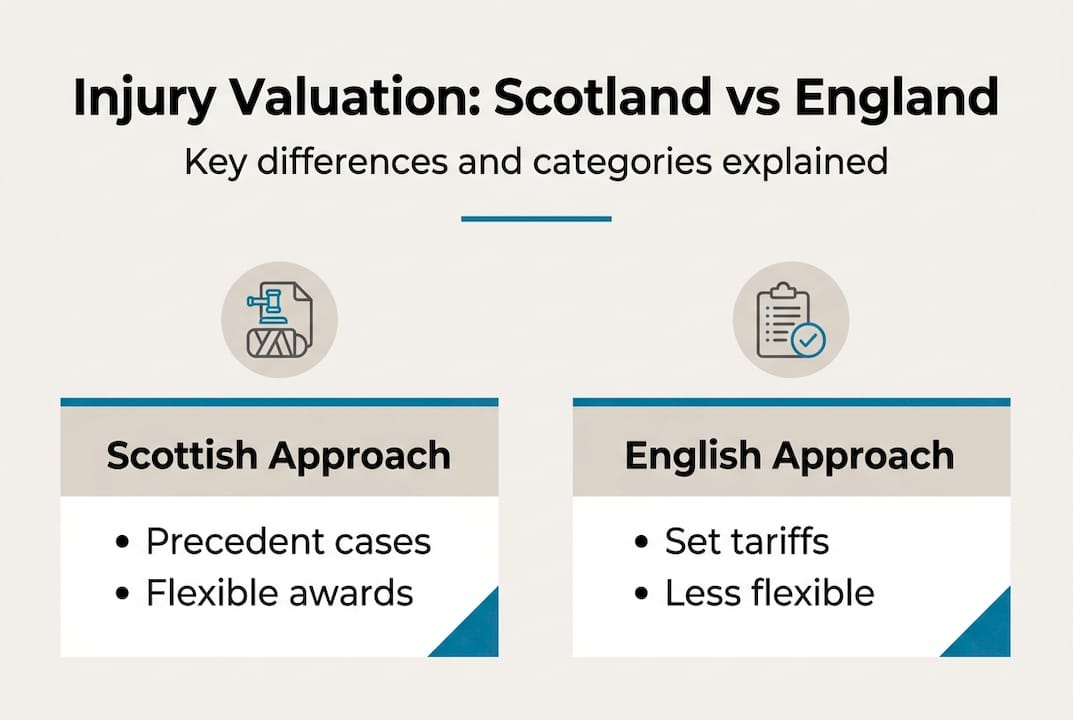
Scotland’s approach to injury valuation differs markedly from England’s system, offering greater flexibility through precedent-driven case law rather than rigid guidelines. Whilst English courts rely heavily on Judicial College Guidelines providing specific compensation brackets for each injury type, Scottish courts examine previous decisions in similar cases to determine appropriate awards. This precedent-based method allows judges to consider unique circumstances more fully, though it can create less predictability for claimants estimating potential compensation.
Recent reforms have updated several aspects of Scottish injury valuation. The government has revised the methodology for calculating the Personal Injury Discount Rate, incorporating more sophisticated economic modelling. Changes to relative care rates ensure that compensation for care costs reflects current market realities. Time limits for certain claim types have been adjusted, and awards for children’s injuries now follow updated principles recognising the long-term impact of early-life harm.
| Aspect |
England |
Scotland |
| Primary framework |
Judicial College Guidelines with set brackets |
Precedent-driven case law analysis |
| Flexibility |
Limited discretion within brackets |
Broader judicial discretion |
| Predictability |
Higher due to defined ranges |
Lower but allows case-specific fairness |
| Non-patrimonial awards |
Standardised by injury category |
Determined by comparable precedents |
| Legal system |
Common law with statutory overlay |
Scots law with distinct principles |
Reform impacts affecting current claims include:
- Ongoing debates about discount rate adjustments in response to economic volatility
- Recognition that wage inflation may outpace general inflation, affecting future earnings calculations
- Enhanced consideration of psychological injury alongside physical harm
- Greater emphasis on rehabilitation costs and life-long care planning
- Improved provisions for interim payments to support claimants during lengthy proceedings
These changes reflect Scotland’s commitment to fair compensation that adapts to societal and economic developments. However, they also underscore the importance of current legal knowledge when pursuing claims. Rates and methodologies that applied two years ago may not reflect today’s framework, potentially affecting your award significantly. Understanding these nuances helps you evaluate settlement offers against the most recent precedents and rate adjustments.
The flexibility of Scotland’s precedent-driven system offers advantages for claimants with unusual circumstances that don’t fit neatly into predetermined categories. If your injury has unique aspects or your losses follow an atypical pattern, Scottish courts can examine your specific situation more thoroughly than a rigid bracket system allows. This flexibility requires strong evidence presentation to distinguish your case and justify departures from typical awards.
How to apply injury valuation knowledge to your claim
Applying injury valuation principles to your compensation claim starts with comprehensive documentation from the moment your injury occurs. Record every financial impact, from lost wages and medical bills to travel costs and household help expenses. Photograph your injuries, keep appointment records, and maintain a daily journal describing pain levels and activity limitations. This evidence forms the foundation for accurate patrimonial damage calculations and supports non-patrimonial awards by demonstrating genuine suffering.
Expert medical and financial evidence proves essential for substantive claims. Medical reports from consultants establish injury severity, prognosis, and treatment needs, directly influencing both patrimonial and non-patrimonial valuations. For significant injuries, employment experts assess lost earning capacity whilst care specialists determine ongoing assistance requirements. Financial analysts project lifetime costs and apply discount rates correctly. Legal advice ensures these experts provide reports that meet evidential standards and address all relevant valuation components.
Practical steps for preparing your injury claim:
- Gather all medical records, including GP notes, hospital reports, and specialist assessments
- Compile financial documents showing earnings, benefits, and injury-related expenses
- Obtain witness statements from family members describing how your injury affects daily life
- Research precedent cases with similar injuries to understand typical compensation ranges
- Use compensation calculators for preliminary estimates, recognising they provide rough guides rather than precise predictions
- Consult specialist injury lawyers who understand Scottish valuation principles and current rates
Choosing legal representation requires finding solicitors with specific Scottish personal injury experience. Look for firms demonstrating knowledge of recent precedents, familiarity with current discount rates, and established relationships with medical and care experts. No win no fee arrangements eliminate upfront costs, making quality representation accessible regardless of financial circumstances. Your solicitor should explain how valuation principles apply to your specific injuries and provide realistic expectations about potential compensation.
Pro Tip: Start your claim promptly after injury to preserve evidence quality and meet legal deadlines. Fresh medical assessments carry more weight, witnesses remember details more accurately, and you’ll have better documentation of immediate impacts that might fade from memory over time.
Understanding valuation empowers you during settlement negotiations. When insurers present offers, you can evaluate whether they adequately cover all patrimonial damages and reflect appropriate non-patrimonial awards based on precedent. Low initial offers often omit future care costs or undervalue long-term earning capacity losses. Armed with valuation knowledge, you can identify these shortfalls and instruct your solicitor to challenge inadequate proposals. The claim process becomes less intimidating when you understand how your compensation should be calculated and can recognise fair treatment.
Compensation calculators provide useful starting points for understanding potential claim values, but they cannot replace professional valuation. These tools use average awards and simplified assumptions that may not reflect your unique circumstances. Complex injuries involving multiple body systems, psychological trauma, or permanent disability require individualised assessment that considers your specific losses and applies current Scottish precedents accurately. Use calculators for general guidance, then seek expert advice for definitive valuations.
Get expert help with your injury claim in Scotland
Navigating injury valuation and securing fair compensation requires specialist knowledge of Scottish personal injury law and current precedents. Scotland Claims connects you with experienced injury lawyers who understand the nuances of valuation calculations and fight for maximum awards. Our no win no fee arrangements mean you pay nothing upfront and keep 100% of your compensation if successful, eliminating financial barriers to quality representation.
Our compensation calculator provides instant estimates based on your injury type and circumstances, helping you understand potential claim values. Whether you’ve suffered back injuries, road traffic accidents, or workplace harm, our specialist solicitors apply current valuation principles to build compelling cases. Contact us today for personalised advice that transforms injury valuation knowledge into concrete compensation results.
Frequently asked questions
What is injury valuation?
Injury valuation is the process of calculating total compensation owed for personal injury by assessing both financial losses like medical costs and lost earnings, plus non-financial harm including pain and suffering. Scottish courts use evidence and precedent cases to determine fair award amounts.
How long does injury valuation take in Scotland?
Valuation timelines vary based on injury complexity and evidence requirements. Simple cases with clear liability may be valued within months, whilst severe injuries requiring long-term prognosis assessments can take one to two years. Your solicitor expedites the process by gathering evidence efficiently.
Can I challenge an injury valuation?
Yes, you can challenge valuations that underestimate your losses or fail to apply current precedents correctly. Your solicitor can obtain additional expert reports, present comparable cases demonstrating higher awards, and negotiate with insurers or argue before courts for appropriate compensation reflecting your true damages.
What happens if my injuries worsen after valuation?
Scottish law allows provisional damages awards when future deterioration is possible, enabling you to return to court for additional compensation if specified conditions develop. Alternatively, settlements can include clauses addressing potential complications, though these require careful negotiation to protect your interests adequately.
Do I need a solicitor for injury valuation?
Whilst not legally required, professional representation significantly improves valuation accuracy and claim outcomes. Solicitors understand complex discount rate calculations, know current precedents, instruct appropriate experts, and negotiate effectively with insurers who have their own legal teams protecting their interests.
Recommended