Why witness statements matter in personal injury claims

TL;DR:
- Witness statements are crucial in Scottish personal injury claims, as they establish factual accounts that courts heavily rely on.
- They must be written in the witness’s own words, signed as true, and based on personal knowledge to be credible evidence.
A witness statement is a written account of what a person personally saw, heard, or experienced, and it is often the most critical evidence in a personal injury case in Scotland. Courts rely on witness statements in over 90% of contested civil litigation cases to establish facts that documents alone cannot prove. That figure tells you something important: without a strong witness statement, even a legitimate claim can struggle to succeed. Understanding why witness statements matter gives you a real advantage when pursuing compensation.
Why witness statements matter as legal evidence
Witness statements are the factual foundation of personal injury claims. They translate what happened at the scene into a formal, court-accepted record that solicitors, insurers, and judges can rely on. The role of evidence in injury claims in Scotland is broad, covering photographs, medical reports, and accident records, but witness statements carry unique weight because they provide a human account of events as they unfolded.
Judges consider witness reliability, the witness’s opportunity to observe events, and the consistency of their account. A well-prepared statement gives the court a clear, credible picture of what occurred. Without that picture, liability becomes harder to establish, and your claim becomes harder to win.
Witness statements are also described by legal practitioners as the “unsung heroes” of legal evidence. That phrase captures something real. They rarely make headlines, but they quietly determine whether a claimant walks away with full compensation or nothing at all.
What makes a witness statement legally reliable in Scotland?
A witness statement must meet specific legal standards to be accepted as credible evidence in Scottish courts. Getting these standards right is not optional. A statement that fails on any of the following points risks being excluded or discredited.
The core requirements are:
- Written in the witness’s own words. Courts reject statements that read as if a lawyer drafted them. The account must sound like the person who witnessed the event.
- Signed statement of truth. Every statement must include a formal declaration that the contents are true. False or embellished statements risk contempt of court, including fines and imprisonment.
- Based on personal knowledge only. Hearsay, meaning information the witness heard from someone else rather than observed directly, is excluded by UK courts. Including hearsay reduces the evidential weight of a statement significantly.
- Submitted before court deadlines. Missing a procedural deadline can result in the witness being excluded entirely, regardless of how strong their evidence is.
- Structured with numbered paragraphs. Courts expect a clear, organised format. Exhibits, such as photographs or documents the witness refers to, must be properly labelled and attached.
Pro Tip: Ask the witness to write their account in their own words before a solicitor reviews it. This protects the statement’s authenticity and reduces the risk of it being challenged as legally drafted rather than genuinely personal.
The standard is high because the stakes are high. A statement that fails these requirements does not just weaken one piece of evidence. It can undermine the credibility of the entire claim.
How do witness statements influence the outcome of a claim?
Witness statements shape personal injury claims at every stage, from early settlement negotiations through to trial. Their influence is direct and often decisive.
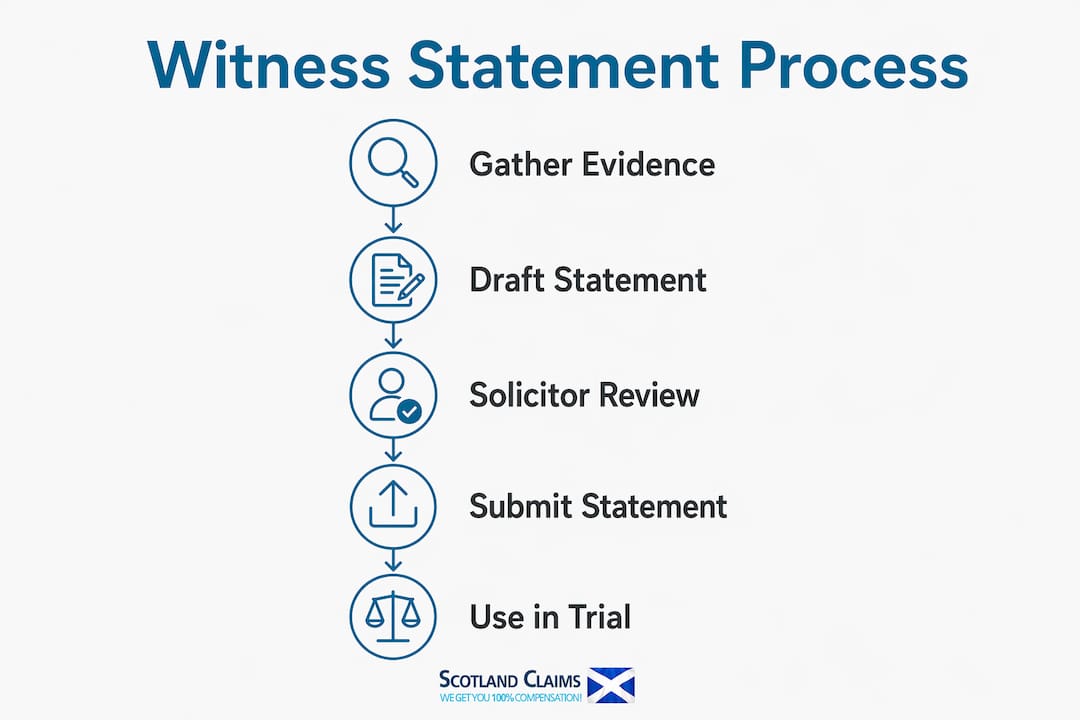
At trial, a witness statement serves as evidence-in-chief, replacing the witness’s oral opening narrative. The judge reads the statement as the witness’s primary account. Cross-examination then focuses strictly on what the statement contains. Any detail missing from the statement is extremely difficult to introduce later. This is why completeness matters as much as accuracy.

The impact on settlement is equally significant. Consistent witness evidence from multiple independent accounts strengthens the claimant’s version of events and makes it harder for the defence to challenge. When insurers see corroborating statements that align with the claimant’s account, they are far more likely to settle early and fairly rather than risk a trial.
Pro Tip: If more than one person witnessed the accident, gather statements from all of them. Consistent accounts from independent witnesses carry considerably more weight than a single statement.
The key factors courts use to evaluate witness statements include:
- Reliability of the witness. Did they have a clear view of events? Were they close enough to observe accurately?
- Consistency. Does the statement align with other evidence, such as photographs or medical records?
- Credibility. Is the account plausible and free from exaggeration?
- Opportunity to observe. Courts assess whether the witness was genuinely positioned to see what they claim to have seen.
Credibility is the currency of witness statements. Inconsistencies, even minor ones, give the opposing side ammunition during cross-examination and can damage the entire case.
Common pitfalls and best practices when preparing a statement
Preparing a witness statement well requires discipline. The most common mistakes are avoidable, and avoiding them can be the difference between a strong claim and a failed one.
- Stick to facts, not opinions. Including opinions or legal conclusions leads to parts of the statement being struck out. A witness should describe what they saw, not who they think was at fault.
- Use plain, clear language. Legal jargon weakens a statement. The account should read naturally, as if the witness is explaining events to a friend.
- Cover the 5 Ws. Who was involved, what happened, where it occurred, when it took place, and why the witness was present. Do not speculate on liability.
- Use cautious phrasing for uncertain memory. Phrases like “I recall” or “I believe” protect the witness when memory is not completely certain. Witnesses who overstate certainty can be impeached during cross-examination if their account is later challenged.
- Draft the statement as soon as possible. Memory degrades over time and can be contaminated by later conversations or media coverage. Early statements act as memory anchors, preserving the accuracy of the account for proceedings that may take place months or years later.
- Review for gaps and inconsistencies. Read the statement against other available evidence, such as photographs or accident reports, before submitting it.
- Seek legal advice before finalising. A solicitor can identify weaknesses without altering the witness’s own words. This is a critical step that many claimants skip.
Pro Tip: Write the statement within 48 hours of the accident if possible. The detail and accuracy available in the first two days will not be available six months later, no matter how significant the event felt at the time.
Avoiding common injury claim mistakes at this stage protects the integrity of your evidence and keeps your claim on solid ground.
How witness statements fit into the wider evidence picture
Witness statements do not stand alone. They work alongside medical reports, photographs, accident records, and expert evidence to build a complete case. Understanding how they interact with other evidence types helps you see why gathering them promptly and correctly matters so much.
Solicitors use witness statements alongside medical and photographic evidence to construct a coherent factual narrative. A photograph shows the condition of a road surface. A medical report confirms the injuries sustained. A witness statement explains how the accident happened and who was present. Each piece of evidence supports the others.
The table below shows how witness statements compare with other common evidence types in personal injury claims:
| Evidence type |
Primary function |
Limitation |
| Witness statement |
Establishes factual narrative of events |
Dependent on witness credibility and memory |
| Medical report |
Confirms nature and extent of injuries |
Does not describe how the accident occurred |
| Photographs |
Documents scene conditions |
Cannot explain sequence of events |
| Accident report |
Records official account at the time |
May be incomplete or disputed |
In no win no fee claims, where the claimant pays nothing upfront and retains 100% of their compensation, the quality of evidence is especially important. Scotland Claims Injury Lawyers charges no success fee, meaning every penny of your settlement stays with you. Strong witness evidence helps build the case that supports that outcome. Building a strong injury case in Scotland depends on assembling all evidence types together, with witness statements as a central pillar.
Court procedural rules in Scotland set strict timelines for submitting evidence. Solicitors manage these deadlines and co-ordinate witness evidence with the rest of the case file. Attempting to manage this without legal support significantly increases the risk of procedural errors that could exclude critical evidence.
Key takeaways
Witness statements are the single most reliable tool for establishing what actually happened in a personal injury claim, and their quality directly determines whether a claim succeeds or fails.
| Point |
Details |
| Statements are primary evidence |
Courts use witness statements in over 90% of contested civil cases to establish facts. |
| Legal standards are strict |
Statements must be in the witness’s own words, signed as true, and free from hearsay. |
| Timing is critical |
Drafting statements early preserves memory accuracy and protects evidence integrity. |
| Consistency strengthens claims |
Multiple corroborating statements make early settlement far more likely. |
| Solicitor support matters |
Legal guidance helps prepare statements that meet court standards without altering the witness’s account. |
The unsung heroes: a practitioner’s view on witness evidence
Witness statements are, without question, the most underestimated tool in a personal injury claimant’s arsenal. I have seen cases with compelling medical evidence and clear photographs still struggle at the settlement stage because the witness statements were vague, delayed, or riddled with opinion rather than fact.
The mistake I see most often is treating a witness statement as an opportunity to argue the case. It is not. It is a factual record. The moment a witness starts writing about who was “clearly negligent” or what “should have been done,” the statement loses credibility. Courts are not interested in a witness’s legal conclusions. They want to know what the witness saw, heard, and experienced, nothing more.
What I find genuinely striking is how often claimants underestimate the value of bystander witnesses. A colleague who saw a colleague fall on a wet floor, or a pedestrian who watched a car run a red light, can provide the independent corroboration that transforms a disputed claim into a settled one. These witnesses have no stake in the outcome. That neutrality makes their accounts extraordinarily persuasive.
My strongest advice is this: act fast, stay factual, and get legal support before the statement is finalised. The window for accurate, uncontaminated memory is short. A solicitor who understands Scottish personal injury procedure will protect that window and make sure the statement works as hard as possible for your claim.
— Roger: AI Legal Content Assistant
Scotland Claims Injury Lawyers: no success fee, full support
Scotland Claims Injury Lawyers helps personal injury claimants across Scotland gather, prepare, and present witness evidence as part of a complete legal strategy. Expert solicitors co-ordinate witness statements with medical reports and photographic evidence to build the strongest possible case on your behalf. Every claim is handled on a no win no fee basis, with no success fee deducted from your compensation. That means you keep 100% of what you are awarded. Other solicitors charge up to 20% of your settlement as a success fee. Scotland Claims Injury Lawyers charges nothing. Contact injury lawyers in Scotland today to discuss your claim and get the support your case deserves.
FAQ
What is a witness statement in a personal injury claim?
A witness statement is a written, signed account of what a person personally saw, heard, or experienced in relation to an accident. It serves as primary evidence in personal injury claims and, at trial, replaces the witness’s oral opening narrative.
How soon should a witness statement be taken after an accident?
A witness statement should be drafted as soon as possible after the accident, ideally within 48 hours. Early statements preserve memory accuracy and act as reliable anchors for proceedings that may follow months or years later.
Can a witness statement be used against me in court?
Yes. If a witness statement contains inconsistencies or unverifiable claims, the opposing side can use it during cross-examination to challenge the witness’s credibility and weaken the overall case.
Does hearsay affect the value of a witness statement?
Hearsay, meaning information the witness heard from someone else rather than observed directly, is excluded by UK courts and reduces the evidential weight of a statement significantly. Statements must be based strictly on personal knowledge.
Do I need a solicitor to prepare a witness statement in Scotland?
Legal advice is not legally required, but it is strongly recommended. A solicitor can identify gaps and weaknesses in a statement without altering the witness’s own words, protecting both credibility and compliance with court procedural rules.
Recommended