Digby Brown success fee: what the 20% means for you

TL;DR:
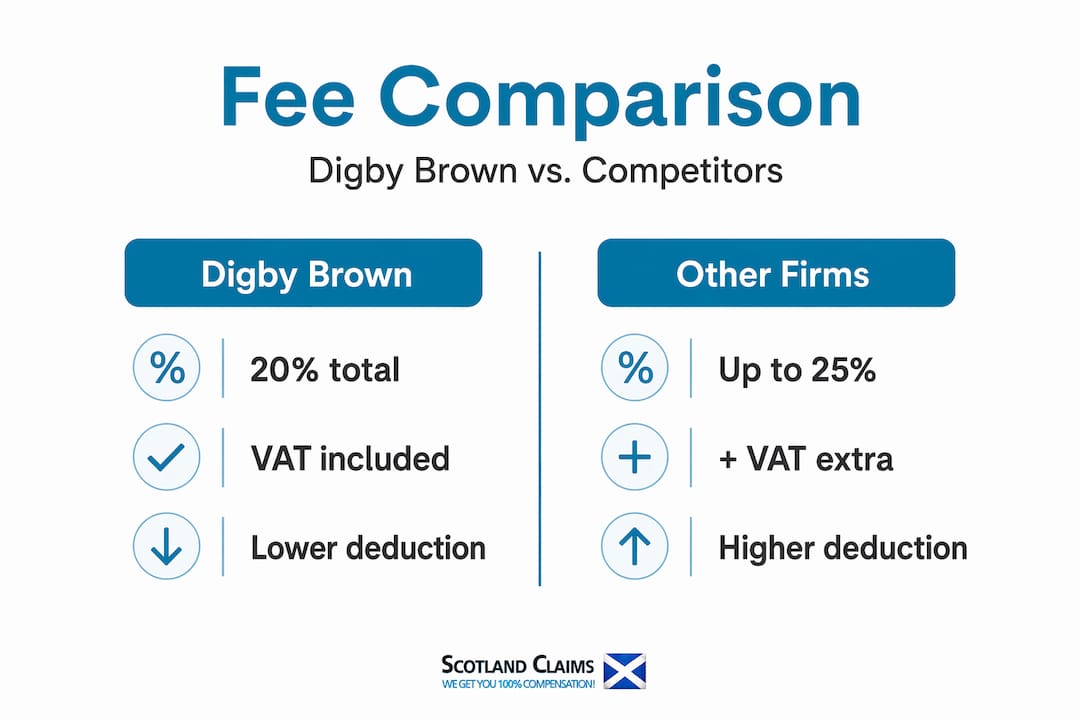
- In Scotland, Digby Brown caps its success fee at 20% including VAT, deducted only if the claim succeeds. This fee covers all lawyer-related work, and the actual amount retained depends on the size and complexity of the case. Compared to other firms charging up to 25% plus VAT, Digby Brown’s structure offers a more competitive and transparent option for claimants.
If you’ve been injured in Scotland and are weighing up your legal options, you’ve likely come across the Digby Brown success fee 20 percent figure and wondered what it actually means for your pocket. A success fee, known formally as a “contingency fee” or “uplift fee” in Scottish legal practice, is the percentage a solicitor takes from your compensation if your claim wins. Digby Brown caps this at 20% including VAT. That sounds straightforward, but the real question is whether 20% is competitive, fair, and what you actually receive in your hand once the fee is deducted.
Table of Contents
Key takeaways
| Point |
Details |
| Digby Brown’s fee cap |
The success fee is capped at 20% including VAT, deducted only if your claim succeeds. |
| No upfront costs |
You pay nothing to start your claim. The fee comes from your compensation, not your own funds. |
| Fee varies by complexity |
Simpler claims may attract a lower percentage within the 0 to 20% range. |
| Competitors charge more |
Many large Scottish personal injury firms charge 20 to 25% plus VAT, making Digby Brown comparatively lower. |
| Better alternatives exist |
Scotlandclaims charges a maximum of 15% for serious injuries, and nothing at all for whiplash or RTA claims. |
Understanding Digby Brown’s success fee structure
A success fee is the payment your solicitor receives for taking on the financial risk of your claim. If the claim fails, you pay nothing. If it succeeds, the solicitor takes a percentage of your awarded compensation as their fee. This is the foundation of every no win no fee arrangement in Scotland.
Digby Brown applies a success fee capped at 20% including VAT. That 20% is deducted from your compensation at the point of settlement. You never receive a bill separately. The money simply comes out of what you are awarded before the remainder is transferred to you.
What does that 20% actually cover? Quite a lot, in practice.
- Solicitor time spent reviewing your case and gathering evidence
- Negotiations with the defendant’s insurers or legal team
- Preparation of court documents and medical reports
- Representation at hearings, if required
- Administrative and case management work throughout the process
The success fee covers the solicitor’s full scope of work on your claim. It is not a separate charge layered on top of other fees. For most claimants, this all-in structure removes the anxiety of unexpected legal bills appearing after settlement.
One thing worth understanding is the VAT element. VAT is included within that 20% figure at Digby Brown, not added on top of it. This is an important distinction because some firms quote a base percentage and then add 20% VAT on top, which inflates the real cost significantly.
Pro Tip: Always ask any solicitor whether their quoted success fee percentage includes or excludes VAT. The difference between “20% plus VAT” and “20% including VAT” is roughly 3.3 percentage points of your compensation.
The fee can also vary within the 0 to 20% range depending on case complexity. A straightforward claim with clear liability and a cooperative insurer may attract a lower percentage than a contested case requiring expert witnesses or court proceedings.
How Digby Brown’s 20% compares to other Scottish firms
Understanding a fee in isolation tells you very little. Context is everything. So how does Digby Brown’s Digby Brown fee structure actually measure up against the broader market in Scotland?
Most large personal injury solicitors in Scotland charge between 20 and 25% plus VAT on their success fees. Once VAT is added to a 25% base fee, the effective deduction from your compensation reaches 30%. That is a meaningful difference when you are talking about a £20,000 settlement.
Here is a practical comparison of how different fee structures affect a claimant’s net compensation:
| Firm type |
Success fee |
VAT included? |
Effective deduction on £20,000 |
| Digby Brown |
20% |
Yes |
£4,000 |
| Typical large Scottish firm |
20 to 25% |
No (added on top) |
£4,800 to £6,000 |
| Scotlandclaims (serious injury) |
Max 15% |
Yes |
Max £3,000 |
| Scotlandclaims (whiplash/RTA) |
0% |
N/A |
£0 |
The figures above make the difference tangible. On a £20,000 award, a claimant using a firm charging 25% plus VAT would receive £14,000. The same claimant using Scotlandclaims for a serious injury claim would receive at least £17,000. That is a £3,000 difference in your pocket, not in the solicitor’s.

Digby Brown’s position in the market is genuinely competitive compared to many larger rivals. The firm recovered £215 million in damages for clients in 2025/26, which reflects both volume and capability. But volume and capability do not automatically mean the best fee deal for you.
Pro Tip: When comparing firms, ask for the total deduction from your compensation in pounds, not just the percentage. A percentage figure can obscure the real financial impact until settlement day.
You can read a detailed fee comparison between Digby Brown and alternative Scottish firms to see how the numbers stack up across different claim types.
How the success fee affects your actual payout
The practical impact of a success fee depends almost entirely on the size of your award. Smaller claims feel the percentage more acutely. Larger awards involve bigger absolute deductions but the same proportional hit.
Consider these examples based on Digby Brown’s 20% including VAT structure:
| Compensation awarded |
20% success fee |
Amount you receive |
| £5,000 |
£1,000 |
£4,000 |
| £15,000 |
£3,000 |
£12,000 |
| £30,000 |
£6,000 |
£24,000 |
| £75,000 |
£15,000 |
£60,000 |
A common misconception is that “no win no fee” means you keep 100% of your compensation in every case. That is not accurate for most claim types. The no win no fee arrangement means you pay nothing upfront and owe nothing if you lose. But if you win, the success fee is deducted from your award.
There is an important exception. For whiplash injuries and road traffic accident claims where you were not at fault, 100% of your compensation is paid to you with no deduction at all. This applies specifically to those claim types and reflects the straightforward liability involved.
To maximise your net compensation, consider the following:
- Choose a firm whose fee percentage is capped at or below 20% including VAT
- Confirm whether any additional disbursements (such as medical report fees) are charged separately
- Ask whether the defendant’s legal costs are recovered in addition to your compensation, which would not affect your award
- Understand whether your claim type qualifies for a zero-deduction arrangement
Additional factors that shape the fee experience
The percentage figure is only part of the picture. Several other factors influence how the success fee feels in practice and what you actually get from the client relationship.
Claim complexity genuinely matters. A straightforward road traffic accident with clear CCTV evidence and an admitting insurer may settle quickly at a lower fee percentage. A disputed workplace accident requiring expert engineering reports, occupational health evidence, and a court hearing will sit closer to the 20% cap. The fee varies with complexity, and that is fair. More complex work justifies a higher fee within the agreed cap.
Client experience factors worth considering include:
- Speed of communication and case updates
- Clarity of fee agreements from the outset
- Whether you have a dedicated solicitor or are passed between handlers
- How disputes or delays are managed
- Whether the firm has specialist expertise in your specific injury type
Transparency in fee agreements is one of the clearest signals of a trustworthy solicitor. If a firm is reluctant to put the exact fee percentage in writing before you sign anything, that is a warning sign worth heeding.
Choosing a solicitor based on success fees
Fee percentage alone should not decide your choice of solicitor. But it should be a serious part of the conversation. Here is a practical checklist to guide your decision:
- Ask for the success fee percentage in writing, including whether VAT is included or added on top.
- Confirm whether any disbursements or additional charges apply beyond the success fee.
- Ask what happens if your claim is unsuccessful. You should pay nothing.
- Request an estimate of how long your claim type typically takes to resolve.
- Ask about the firm’s personal injury success rate for claims similar to yours.
- Compare the net compensation you would receive, not just the headline percentage.
- Check whether your specific injury type qualifies for a reduced or zero success fee.
The personal injury success rate of a firm matters alongside the fee. A firm that settles 95% of claims at a 20% fee will serve you better than one settling 70% of claims at 15%. Both numbers belong in your evaluation.
Digby Brown’s client-first reputation and transparent fee cap make it a credible option for Scottish claimants. But credible is not the same as optimal. Knowing your options puts you in a stronger position before you sign any agreement.
My honest take on the 20% fee debate
I’ve spoken with a lot of people in Scotland who were genuinely confused about what they’d actually receive after their claim settled. Many assumed “no win no fee” meant they’d keep every penny. The moment they learned a success fee would be deducted, it felt like a betrayal, even when the solicitor had been completely upfront about it.
In my experience, the problem is rarely the fee itself. It’s the timing and framing of the conversation. When a solicitor explains the fee clearly at the start, clients accept it as a fair trade for risk-free representation. When it surfaces at settlement, it stings regardless of the percentage.
What I find genuinely impressive about Digby Brown is the cap. A hard 20% ceiling including VAT is more honest than the “up to 25% plus VAT” structures that exist elsewhere in the Scottish market. The firm’s scale and track record suggest the fee buys real capability.
That said, 20% is not the lowest available. For serious injuries, Scotlandclaims charges a maximum of 15%. For whiplash and road traffic accidents where you were not at fault, the deduction is zero. That is a meaningful difference, and I think claimants deserve to know it exists before they commit.
My advice: do not choose a solicitor based on the lowest fee alone. But do not ignore the fee either. Ask the question directly, get the answer in writing, and compare what you’d actually receive in hand. That number is the one that matters.
— Roger
Get the most from your personal injury claim
If you’ve been injured in Scotland and want to understand your options before committing to any firm, Scotlandclaims offers some of the most competitive fee structures available. For whiplash and road traffic accident claims where you were not at fault, you keep 100% of your compensation with no deduction at all. For more serious injuries including slips, trips, and workplace accidents, Scotlandclaims charges a maximum of 15%, the lowest in Scotland and well below the 20 to 25% charged by many larger firms. Speak to the team at Scotlandclaims today through their injury lawyers Scotland page to get clear, honest advice on your claim and what you could receive.
FAQ
What is Digby Brown’s success fee?
Digby Brown’s success fee is capped at 20% including VAT, deducted from your compensation only if your claim is successful. You pay nothing if your claim does not succeed.
Does the 20% success fee include VAT?
Yes. Digby Brown’s 20% figure includes VAT, which means the effective cost is lower than firms quoting 20% and then adding VAT on top.
How does Digby Brown’s fee compare to other Scottish firms?
Most large Scottish personal injury firms charge between 20 and 25% plus VAT, making Digby Brown’s all-in 20% cap comparatively competitive. Scotlandclaims charges a maximum of 15% for serious injuries.
Will I always pay a success fee on my personal injury claim?
Not necessarily. For whiplash injuries and road traffic accident claims where you were not at fault, 100% compensation is paid with no solicitor deduction. Other claim types are subject to the agreed success fee percentage.
Can the success fee be lower than 20% with Digby Brown?
Yes. The fee varies between 0 and 20% depending on the complexity of your case. Simpler claims with clear liability may attract a lower percentage within that range.
Recommended