What Happens After Making a Claim – Steps and What to Expect

Suffering an injury after an accident can leave you uncertain about what steps to take next, especially when dealing with insurers and the risk of mounting costs. Knowing how a personal injury claim unfolds gives you confidence as you seek answers and support. This guide breaks down the entire process, highlights the importance of strong evidence, and shows how a No Win No Fee arrangement in Scotland opens the door to expert legal help without upfront risk.
Table of Contents
Key Takeaways
| Point |
Details |
| Understand the Process |
Familiarise yourself with the stages of a personal injury claim to alleviate anxiety and ensure thorough preparation. |
| Gather Evidence Promptly |
Collect all necessary documentation immediately following the incident to strengthen your case and avoid delays. |
| Engage a Specialist Solicitor |
Consult with a dedicated personal injury solicitor to navigate the complexities of your claim effectively. |
| Know Your Compensation Rights |
Be aware of what compensation may cover, including medical expenses, lost wages, and suffering damages, and consider a No Win No Fee arrangement for financial security. |
Personal injury claim process explained
A personal injury claim is your legal avenue to recover compensation when someone else’s negligence or wrongdoing causes you harm. Personal injury claims arise from events like road traffic accidents, workplace injuries, or slips and trips—situations where another party bears responsibility for your injuries.
Understanding the process removes much of the anxiety. You’re not navigating this alone, especially with a specialist injury solicitor by your side.
How the process works
The journey from injury to compensation follows a clear structure:
-
Report the incident – Notify the responsible party’s insurer as soon as possible, providing details of what happened.
-
Gather evidence – Collect police reports, medical records, witness statements, and photographs of the scene or your injuries.
-
Contact a solicitor – Get professional legal guidance to assess your claim’s strength and advise on next steps.
-
Submit your claim – Your solicitor formally notifies the insurer and begins negotiations on your behalf.
-
Await assessment – The insurer reviews your evidence and decides whether to accept or contest liability.
-
Settle or proceed to court – Most claims resolve through settlement; if not, your case may go to court.
Each stage has specific requirements. Filing a claim requires detailed documentation—police reports, medical evidence, and receipts for expenses—along with meeting strict deadlines to avoid delays or rejections.
Here’s a summary comparing key stages of a personal injury claim and what each entails:
| Stage |
Main Activity |
Typical Duration |
Key Documents Required |
| Reporting |
Notify insurer and responsible party |
Same day to 1 week |
Incident report, photos |
| Evidence Gathering |
Collect proof and records |
2–8 weeks |
Medical notes, witness statements |
| Solicitor Engagement |
Appoint a specialist solicitor |
1–2 weeks |
Claim form, correspondence |
| Claim Submission |
Formally file with insurer |
1 week |
Claim letter, supporting evidence |
| Insurer Assessment |
Case review and liability check |
2–4 weeks |
All collected documentation |
| Settlement/Negotiation |
Negotiate offer or proceed to court |
Weeks to months |
Updated medical, expense records |
| Court Proceedings (if any) |
Judge reviews evidence and decides |
12–24 months extra |
Trial bundles, expert reports |
What compensation covers
Successful claims typically recover:
- Medical expenses (treatment, rehabilitation, ongoing care)
- Lost wages from time unable to work
- Pain and suffering damages
- Travel costs and care assistance
- Equipment or property damage
The amount depends on injury severity, financial losses, and impact on your quality of life. Using a No Win No Fee arrangement means you pay nothing unless your claim succeeds - you keep 100% of your compensation.
Most personal injury claims in Scotland settle before reaching court, typically within 12-18 months when professionally handled.
Timeline expectations
Simpler claims might resolve in 6-12 months. Complex cases involving multiple injuries or disputed liability can take 2-3 years. Your solicitor keeps you updated throughout, so you always know where things stand.
Pro tip: Keep meticulous records of everything—medical appointments, expenses, lost earnings, and all communications with insurers—as this documentation strengthens your claim significantly.
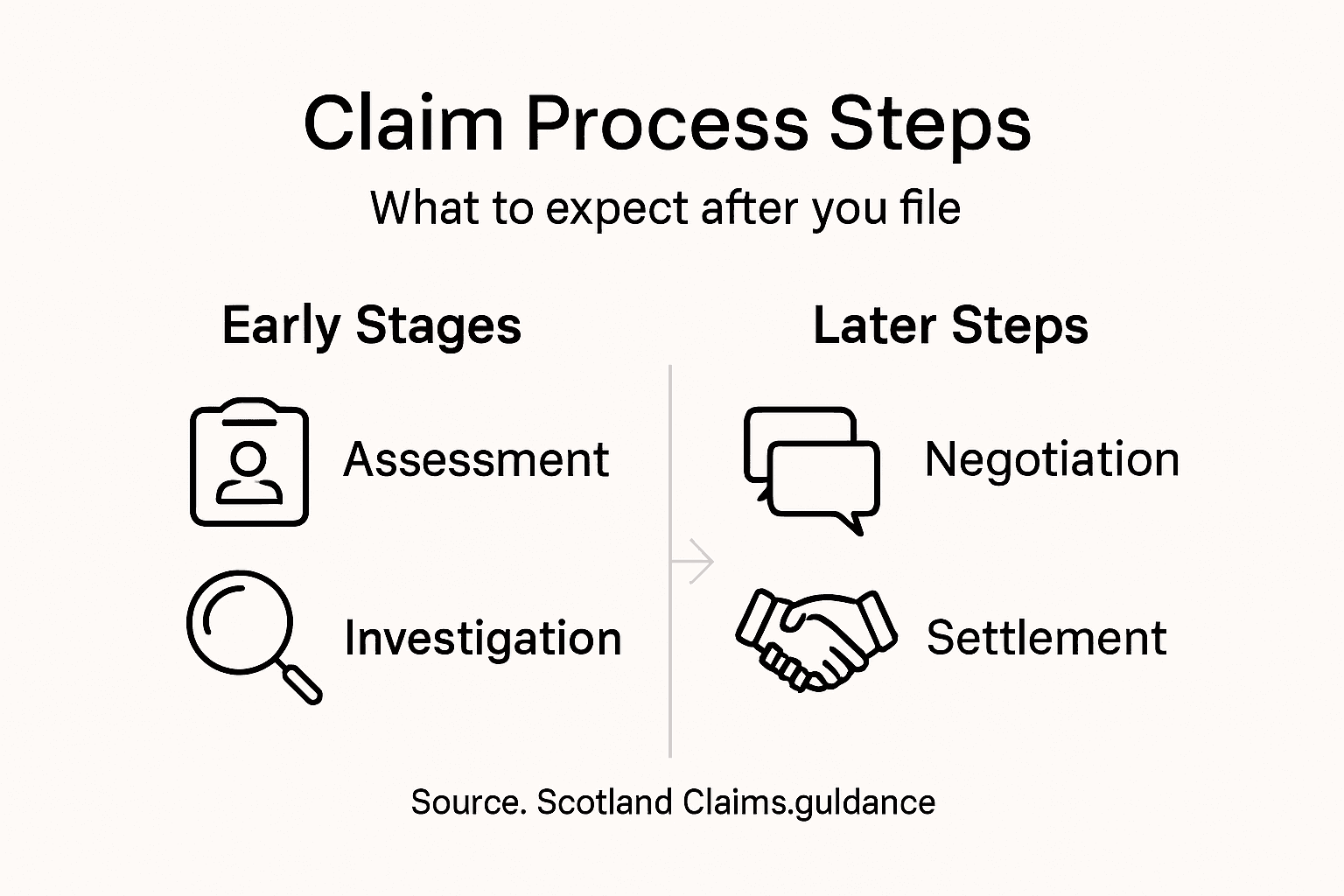
Stages after submitting your injury claim
Once you submit your claim, the real work begins for your solicitor and the insurer. This is where patience becomes your ally—claims don’t resolve overnight, but understanding each stage helps you stay calm and informed throughout the process.
Initial assessment phase
After submission, the insurer assigns a claims handler to your case. They assess liability and coverage by reviewing all documentation you’ve provided. This stage typically takes 2-4 weeks, depending on case complexity.
Your solicitor may receive requests for additional evidence during this time. Common requests include:
- Further medical reports or specialist assessments
- Additional witness statements
- Photographs or CCTV footage
- Proof of expenses or lost earnings
- Details about ongoing treatment plans
Respond promptly to these requests—delays here can stall your entire claim.
Investigation and negotiation
If the insurer doesn’t immediately accept liability, they may conduct their own investigation. They might appoint an adjuster to review evidence or even visit you for a medical examination. This is standard practice and nothing to worry about.
Your solicitor handles negotiations on your behalf. They’ll challenge any attempts to reduce compensation and present evidence supporting your claim. This back-and-forth can take several months for complex cases.
Most injury claims settle during negotiation without reaching court, saving time and stress.
Settlement or court proceedings
When both sides agree on compensation amount, you receive a settlement offer. Your solicitor reviews this to ensure it fairly covers your losses and future needs.

If you reject the offer or the insurer refuses to negotiate fairly, your case proceeds to court. Your solicitor represents you throughout, and a judge determines the final award.
What happens with your money
Once settled, compensation is transferred to your solicitor’s client account. They deduct any legitimate costs (court fees, medical report fees) and their success fee if applicable, then transfer your funds within days.
With No Win No Fee arrangements, you keep 100% of your compensation—no hidden charges or surprise deductions.
Pro tip: Request monthly updates from your solicitor and maintain a file documenting all communications, as this helps you track progress and ensures nothing slips through the cracks.
How liability and evidence are assessed
Liability determines who bears legal responsibility for your injuries. The insurer won’t pay unless they’re convinced the other party’s actions caused your harm. This is why evidence matters so much—it’s the foundation of your entire claim.
Understanding liability
Liability in personal injury claims is commonly based on negligence, strict liability, or intentional wrongdoing. Most claims rely on negligence, which requires proving three things:
- The other party owed you a duty of care
- They breached that duty through careless or reckless behaviour
- Their breach caused your injuries and financial losses
For example, a shop owner has a duty to keep floors safe. If they leave a wet floor unmarked and you slip, they’ve breached that duty. If you’re injured as a result, you have grounds for a claim.
What evidence proves your case
Liability investigations collect evidence such as witness statements, expert opinions, and physical proof. Strong evidence includes:
- Witness statements from people who saw the accident happen
- Expert reports (medical, engineering, or accident reconstruction)
- Physical evidence like photographs, CCTV footage, or damage reports
- Documentation proving your losses—medical records, payslips, receipts
- Police reports from road traffic accidents
- Professional assessments of how the incident occurred
Your solicitor collects this evidence methodically, building a narrative that shows clear fault.
How the assessment works
The insurer reviews all evidence to determine whether their client is legally responsible. They’ll question causation—did their client’s actions actually cause your injuries, or could another factor be responsible?
This is where expert evidence becomes invaluable. Medical reports confirm your injuries match the accident. Accident reconstruction reports show how the incident happened. These experts carry significant weight in assessment decisions.
Strong evidence transforms your claim from a dispute into a factual case the insurer struggles to deny.
Percentage liability
Sometimes both parties share responsibility. Scottish law applies comparative negligence—if you were 20% at fault, your compensation reduces by 20%. Your solicitor fights to minimise your percentage and maximise the other party’s responsibility.
Pro tip: Gather evidence immediately after your accident—witness contact details fade from memory, CCTV footage gets deleted, and crime scenes change, so swift action preserves crucial proof.
Negotiation, settlement, and going to court
Most injury claims never reach a courtroom. Instead, they settle through negotiation—a process where your solicitor and the insurer’s representatives discuss compensation amounts and reach agreement. Understanding what happens if negotiation fails is equally important.
The negotiation process
Once the insurer has reviewed your evidence, your solicitor opens discussions about compensation. This isn’t a casual conversation; it follows formal procedures with written offers and counter-offers.
Your solicitor will:
- Present your evidence and calculate fair compensation
- Respond to insurer challenges or liability denials
- Submit revised figures if initial offers seem too low
- Explain why your claim justifies the amount requested
Negotiations typically last weeks or months. Some resolve quickly; others involve multiple rounds of back-and-forth discussion before both sides find middle ground.
Settlement conferences
Settlement conferences are meetings facilitated by judges or mediators to help parties resolve disputes outside court. Your solicitor attends with you, presenting your position to a neutral evaluator.
The process works like this:
- Both sides present their case to the mediator
- The mediator gives their honest assessment of claim strength
- Private conversations (called caucuses) occur between each party and the mediator
- Negotiations intensify with this neutral perspective guiding discussions
Many cases settle at these conferences. The mediator’s realistic assessment often convinces insurers to improve their offers significantly.
When cases proceed to court
If negotiation fails, your case goes to trial. Civil cases begin with filing and discovery, then proceed to trial where evidence is presented and a judge or jury decides the outcome.
Scottish courts handle personal injury claims through:
- Preliminary procedures where both sides exchange evidence and documents
- Witness statements and expert testimony presented in court
- Final arguments where your solicitor summarises why you deserve compensation
- Judge’s decision determining liability and award amount
Court cases take 12-24 months longer than settlements. However, judges sometimes award higher compensation than negotiated settlements, and your solicitor will advise whether pursuing court is worthwhile.
The vast majority of Scottish injury claims settle before trial, with negotiation proving faster and less stressful than courtroom proceedings.
After settlement or judgment
Once you’ve reached settlement or received a court judgment, compensation is transferred within weeks. Your solicitor handles all administrative tasks, ensuring no delays in getting your money.
Pro tip: Ask your solicitor for realistic settlement estimates early on, as understanding likely compensation helps you make informed decisions about accepting offers or pursuing court action.
Costs, timeframes, and No Win No Fee details
Cost concerns often stop people from pursuing legitimate injury claims. You might worry about solicitor fees eating into compensation or legal bills mounting if your case drags on. The No Win No Fee model eliminates this anxiety entirely—you pay nothing unless you win.
How No Win No Fee works
No Win No Fee agreements mean clients pay attorney fees only if the case is won or settles favourably, usually as a percentage of the recovery amount. This removes financial risk from pursuing your claim.
With this arrangement:
- You pay zero upfront costs
- You keep 100% of your compensation if your claim succeeds
- The solicitor’s fee comes from their success fee percentage
- You owe nothing if your claim fails
Scotland Claims operates on this principle exclusively. Your financial security comes first—we only profit when you do.
What costs might you encounter
Whilst solicitor fees are covered under No Win No Fee, other legitimate costs may apply. These include:
- Court filing fees
- Medical report charges from specialists
- Expert witness fees for investigations or reconstruction
- Police report requests
- CCTV footage recovery
Your solicitor discusses these costs upfront and manages them carefully. Often, court fees are recovered from the other party’s insurance as part of settlement, so you don’t pay them from your compensation.
Timeline expectations
Personal injury lawsuit timelines vary widely depending on injury severity, clarity of liability, and court schedules. Minor claims settle in months; complex cases take years.
Typical timeframes:
- Simple claims: 6-12 months from submission to settlement
- Moderate complexity: 12-18 months with investigation and negotiation
- Complex cases: 2-3 years or longer if court proceedings occur
- Court trials: Add 12-24 months beyond settlement negotiations
Delays happen. Insurance companies sometimes employ delaying tactics. Court backlogs extend timelines. Your solicitor keeps pressure on proceedings to minimise unnecessary delays.
Below is a comparison of typical personal injury timelines by claim complexity:
| Claim Complexity |
Expected Duration |
Influencing Factors |
| Simple |
6–12 months |
Clear liability, minor injury |
| Moderate |
12–18 months |
Some dispute, multiple losses |
| Complex |
2–3 years or longer |
Severe injury, disputed liability |
| Court Involvement |
Adds 12–24 months |
Court schedule, expert evidence |
Understanding success fees
Success fees under No Win No Fee typically range from 20% of your compensation. A solicitor handling your case will clearly explain their specific percentage before you proceed.
No Win No Fee removes financial barriers to justice—you access specialist legal representation without risking your savings or compensation.
Getting a settlement estimate
Use a compensation calculator to understand potential payout ranges based on your injury type and severity. This gives you realistic expectations before claiming.
Your solicitor refines this estimate after reviewing your evidence and the other party’s position.
Pro tip: Ask your solicitor for a written cost breakdown and timeline estimate at the start, covering solicitor fees, court costs, and expected settlement timescale—clarity prevents surprises later.
Take Control After Making Your Personal Injury Claim
Navigating the steps after submitting your personal injury claim can feel overwhelming and uncertain. The key challenges include understanding insurer assessments, managing requests for evidence, negotiating settlements, and knowing when taking your case to court might be necessary. You want expert support to ensure your claim progresses smoothly and that your rights are protected every step of the way, especially when dealing with complex procedures like liability investigations and settlement conferences.
At Scotland Claims, we specialise in guiding you through exactly what happens after making a claim. Our team connects you with specialist injury solicitors who work on a No Win No Fee basis. This means you face no upfront costs and keep 100% of your compensation if successful. By partnering with us, you gain trusted legal representation that handles all negotiations and paperwork, so you can focus on your recovery without added stress.

If you want to understand more about how your claim will progress or need professional help to maximise your settlement, start with our No Win No Fee service overview. Use our compensation calculator to get an estimate tailored to your injury type and severity. Don’t wait while valuable evidence risks being lost. Visit Scotland Claims now and take the first step towards securing the compensation you deserve.
Frequently Asked Questions
What should I expect after submitting my personal injury claim?
After submitting your claim, the insurer will assign a claims handler who will review your documentation to assess liability and coverage. This typically takes 2-4 weeks.
How can I support my personal injury claim after submission?
You can support your claim by promptly responding to any requests for additional evidence from your solicitor or the insurer. This may include further medical reports, witness statements, or proof of your expenses and lost earnings.
What happens if the insurer contests liability for my claim?
If the insurer contests liability, they may conduct their own investigation, which could involve appointing an adjuster to review evidence or arranging a medical examination. Your solicitor will negotiate on your behalf throughout this process.
How long does it typically take to settle a personal injury claim?
The duration to settle a personal injury claim varies: simple claims can be resolved in 6-12 months, while more complex cases may take 2-3 years. The timeline can be influenced by the clarity of liability and the complexity of your injuries.
Recommended
Article generated by BabyLoveGrowth