Step-by-step legal advice for injury claims in Scotland

TL;DR:
- In Scotland, personal injury claims must be initiated within three years of the accident or injury discovery, with exceptions for minors. Proper evidence collection, prompt reporting, and legal guidance significantly increase the chances of a successful, cost-free claim. Working with an experienced solicitor improves compensation outcomes and streamlines the process, ensuring injured individuals receive their entitled compensation.
Suffering an injury through someone else’s fault is distressing enough on its own. Then come the questions: Do I qualify for compensation? Will it cost me anything? Where do I even begin? For many people in Scotland, this uncertainty stops them from taking action altogether, and that means they miss out on money they are genuinely entitled to. The good news is that making a personal injury claim in Scotland does not have to be confusing or expensive. With the right guidance and a clear process, you can pursue what you are owed without risking a single penny upfront.
Table of Contents
Key Takeaways
| Point |
Details |
| Know your eligibility |
Check if your injury, evidence, and accident date meet Scottish legal requirements before claiming. |
| Follow a clear process |
Taking logical, documented steps and acting swiftly maximises your claim success. |
| Get expert support |
Partnering with an experienced solicitor gives you the best chance of risk-free, full compensation. |
| Stay proactive |
Monitor your claim closely and prepare evidence early to avoid avoidable delays. |
Understanding legal requirements and eligibility in Scotland
Now that you are ready to take action, begin by ensuring you meet the basic legal standards. Before anything else, you need to know whether your situation qualifies for a claim. Not every injury automatically leads to compensation, so understanding the eligibility rules from the start will save you time and disappointment later.
In Scotland, as across the UK, personal injury claims are governed by strict time limits and legal standards. The most critical rule is the three-year limitation period. In most cases, you must start your claim within three years of the date of the accident or injury. Miss that window, and your right to compensation is almost certainly gone. There are exceptions, such as when the injured person is a child (the three years begin when they turn 16) or when the injury only became apparent later, but these are narrow and specific.
The injury claim eligibility rules in Scotland cover a wide range of scenarios. Common qualifying situations include:
- Road traffic accidents where another driver was at fault
- Workplace accidents caused by employer negligence
- Slips, trips, or falls on poorly maintained public or private property
- Injuries caused by defective products
- Medical negligence or clinical errors
- Assaults where criminal injury compensation applies
To build a viable claim, you will also need to demonstrate that someone else owed you a duty of care, that they breached it, and that their breach directly caused your injury. This is known as establishing liability and causation, and it forms the backbone of every personal injury case.
Here is a summary of the core eligibility requirements:
| Factor |
Detail |
| Time limit |
Three years from date of accident or knowledge of injury |
| Who can claim |
Anyone injured through another’s negligence in Scotland |
| Under 16 claimants |
Three-year period begins at age 16 |
| Key documents |
Medical records, accident report, witness details, photographs |
| Proof required |
Liability, causation, and quantifiable loss |
| No Win No Fee |
Available for most qualifying claims |
Pro Tip: Start gathering evidence as soon as possible after your accident. Photographs, witness contact details, and a written account of what happened will all strengthen your case significantly, especially if your claim reaches a dispute stage many months later.
Essential steps to start your claim
With eligibility in hand, it is time to chart the precise actions you will need to take. Starting a personal injury claim can feel overwhelming, but breaking it down into clear steps makes the process far more manageable. Each action builds on the last, and skipping steps is one of the most common reasons claims are delayed or rejected.
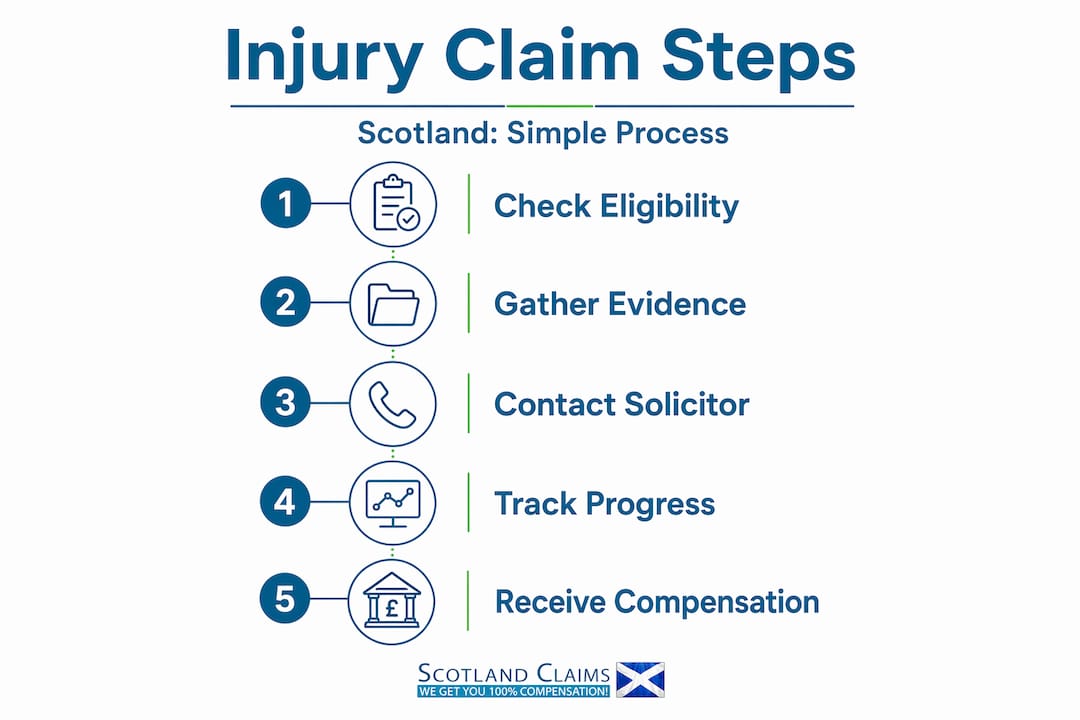
Here is the recommended sequence for starting your injury claim in Scotland:
- Seek medical attention immediately. Your health comes first, but getting prompt treatment also creates an official medical record that forms a critical part of your evidence.
- Report the incident. Whether it is a road accident (report to the police), a workplace injury (log it in the employer’s accident book), or a slip on public property (notify the owner or local council), an official report is essential.
- Document everything. Take photographs of the scene, your injuries, any damaged property, and any hazards that contributed to the accident. Note the date, time, location, and weather conditions.
- Collect witness information. Names and contact details of anyone who saw the incident can make a significant difference if liability is disputed.
- Keep a financial record. Note every cost you incur as a result of the injury, including travel to medical appointments, medication, and any lost earnings. Keep receipts wherever possible.
- Contact a specialist solicitor. Once you have gathered initial information, reach out to a personal injury solicitor who practises in Scotland. They will assess your case and advise on next steps, usually at no cost to you.
- Submit your claim. Your solicitor will prepare and file the formal claim documents on your behalf, ensuring all claim forms guidance is followed correctly and deadlines are met.
Important warning: Failing to report the incident promptly, missing key deadlines, or submitting incomplete paperwork are the three most common reasons personal injury claims fail before they even begin. Your solicitor can help you avoid these pitfalls, but only if you involve them early in the process.
When it comes to preparing evidence for a Scottish claim, quality matters as much as quantity. A single clear photograph of a wet floor with no warning sign is worth more than ten blurry images taken days later. The same applies to witness statements: a detailed account taken shortly after the event carries far more weight than a vague recollection months down the line.
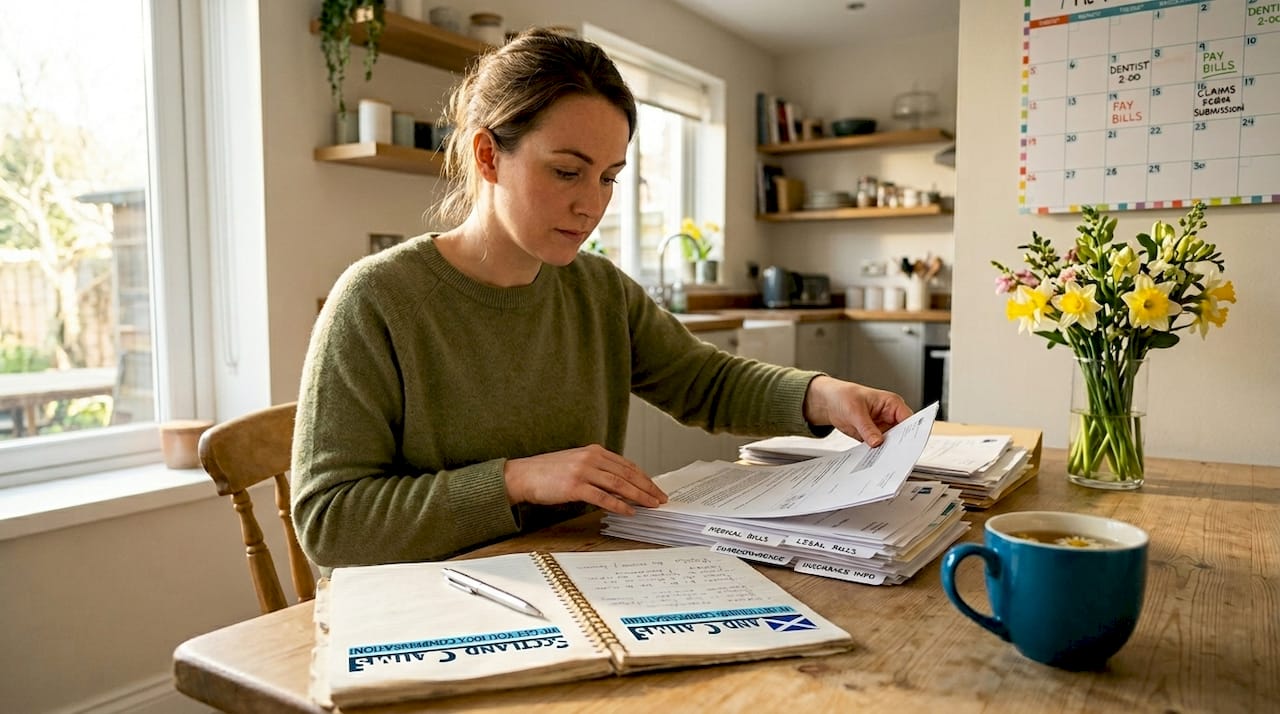
Pro Tip: Before your first meeting with a solicitor, assemble everything in one place. A timeline of events, all relevant photographs, your medical documents, any correspondence with the responsible party, and a note of your financial losses will make the consultation far more productive and help your solicitor assess your case accurately from the outset.
Working with your solicitor: What to expect and how to succeed
Once you have started the process, the right solicitor can be a powerful partner in your claim. Many people worry that working with a lawyer will be expensive, formal, or confusing. In practice, a good personal injury solicitor makes the process straightforward, handles the complexity on your behalf, and communicates clearly at every stage.
The role of solicitors in personal injury claims in Scotland is substantial. They assess liability, gather additional evidence, instruct medical experts, negotiate with the defendant’s insurers, and represent your interests if the case goes to court. They also handle all the legal paperwork, which in Scotland follows different procedural rules from England and Wales, making local expertise genuinely important.
One of the most important decisions you will make is whether to handle the claim yourself or use a solicitor. Here is an honest comparison:
| Aspect |
DIY claim |
Solicitor-led claim |
| Success rate |
Lower, especially for complex cases |
Significantly higher |
| Compensation amount |
Often undervalued |
Maximised through expert negotiation |
| Time investment |
High: you manage all steps |
Low: solicitor manages most steps |
| Legal knowledge required |
High |
Provided by solicitor |
| Financial risk |
Possible costs if case fails |
Covered by No Win No Fee |
| Stress level |
High |
Considerably lower |
Before signing up with any solicitor, ask the right questions for your lawyer to ensure they are the right fit:
- Do you specialise in personal injury claims under Scottish law?
- Are you offering a genuine No Win No Fee agreement?
- What percentage of cases like mine do you win?
- How will you communicate with me throughout the process?
- Who specifically will be handling my case?
- What costs might I face even if the claim succeeds?
The claimant representatives guide also highlights the importance of staying engaged throughout your claim. Respond promptly to requests for information, attend all medical appointments your solicitor arranges, and keep your solicitor updated if your condition changes. Claimants who stay involved consistently achieve better outcomes. For broader context on how the compensation process comparison works in similar legal settings, the core principles of preparation and expert representation apply across claim types.
Calculating compensation and tracking progress
After engaging a solicitor, your focus should shift to what your claim is truly worth and how the process unfolds. Compensation in Scottish personal injury claims is not arbitrary. It is calculated using established legal frameworks and broken down into two main categories: general damages and special damages.
General damages cover pain, suffering, and the impact the injury has had on your quality of life. These figures are guided by the Judicial College Guidelines, which set recommended value ranges for different types and severities of injury. Special damages, on the other hand, are the concrete financial losses you have suffered, including lost earnings, medical costs, care expenses, and any adaptations made to your home or vehicle.
The key factors that affect valuing your compensation include:
- The severity and permanence of the injury
- The impact on your ability to work, now and in the future
- Any ongoing medical treatment or rehabilitation costs
- The psychological effects of the injury
- How much your daily life and hobbies have been disrupted
- Any care provided by family or friends on an unpaid basis
To understand the full picture of compensation payout details, it helps to look at specific injury categories. For example, whiplash compensation claims are governed by specific tariff guidelines introduced in 2021, which set fixed amounts based on the duration of symptoms. More serious injuries, such as spinal damage or head trauma, attract much higher compensation figures that are assessed individually.
Statistic to note: According to legal sector data, the majority of straightforward personal injury claims in Scotland are resolved within 12 to 18 months, with many simpler cases concluding far sooner if liability is not disputed.
To keep your claim moving efficiently, stay on top of communication. Reply to your solicitor’s requests quickly, attend all medical examinations without delay, and make sure your financial records remain up to date throughout the process. If your claim is delayed or an insurer disputes your case, do not panic. Your solicitor can request a case review, introduce additional expert evidence, or escalate to formal court proceedings if necessary.
Getting real results: What most guides don’t tell you
Here is something the polished legal advertisements rarely say outright: even claims that look simple on the surface can become complicated very quickly. A slip in a supermarket might seem straightforward until the store’s legal team produces CCTV footage they claim shows no hazard existed. A road accident claim might be disputed when the other driver’s insurer argues you were partly at fault. These are not rare edge cases. They happen regularly, and they are precisely why professional legal support matters.
There is also a misconception worth addressing about No Win No Fee. It is a genuine, legally binding agreement, not a marketing trick. But not all No Win No Fee agreements are identical. Some solicitors charge a success fee from your compensation at the end of the case. Others recover their costs directly from the defendant. Understanding what you are agreeing to before you sign is essential. Ask specifically: “If I win, will any of my compensation be deducted, and if so, how much?”
The biggest obstacle most claimants face is not legal complexity. It is a lack of preparation combined with passivity. People who treat their claim as something happening to them, rather than something they are actively managing, tend to get worse results. Stay involved. Keep records. Follow up. The claimants who achieve the best outcomes are the ones using practical claims advice consistently and treating their claim like the financial and legal matter it genuinely is.
The other reality is that going it alone almost always means leaving money on the table. Insurers employ experienced negotiators whose job is to settle claims for as little as possible. A specialist solicitor knows what your case is genuinely worth and will push back on low offers. That expertise typically far outweighs any deduction from a success fee arrangement.
Take the next step with risk-free support
If reading this guide has made one thing clear, it is that you do not have to face the personal injury claim process alone, and you certainly should not have to pay anything upfront to get expert help. At Scotland Claims, we connect injured people across Scotland with specialist solicitors who work entirely on a No Win No Fee claims basis, meaning there is zero financial risk to you. Whether you have suffered a back injury claims situation that has affected your ability to work, or you need guidance on knee injury claims following a workplace accident, our team can help. Use our compensation calculator today to get an instant estimate of what your claim could be worth, then take the next step with a free, no-obligation consultation.
Frequently asked questions
How long do I have to make a personal injury claim in Scotland?
You usually have three years from the date of the accident to start your claim, with limited exceptions for children and cases where the injury was not immediately apparent.
Do I need a solicitor for a personal injury claim in Scotland?
While it is possible to claim without one, a solicitor greatly improves your chances of both success and a higher compensation payout, particularly when liability is disputed.
What evidence is most important for my claim?
The most valuable evidence includes medical records, photographs, witness statements, and an official incident report, all gathered as promptly as possible after the accident.
Is No Win No Fee available for all types of claims?
Most personal injury claims in Scotland qualify for a No Win No Fee arrangement, which means you pay nothing if your case is unsuccessful.
What should I do if my claim is denied or delayed?
Consult your solicitor for a review of the situation; delays and disputes can often be resolved by introducing additional evidence or entering formal negotiation with the opposing party’s insurers.
Recommended