Why documenting accident evidence matters for your claim

After an accident, many people feel overwhelmed and uncertain about what to do next. You might wonder whether taking photographs or collecting witness details truly makes a difference to your claim. The truth is that immediate evidence collection can fundamentally shape the outcome of your personal injury case. Good documentation strengthens your position, helps prove liability, and significantly increases your chances of securing fair compensation. This guide explains what evidence you need, why it matters under Scottish law, and how to gather it effectively to protect your legal rights.
Table of Contents
Key Takeaways
| Point |
Details |
| Early evidence collection |
Photographs and witness details should be gathered promptly to shape the claim and protect your legal rights. |
| Evidence proves liability |
Solid documentation helps identify who was responsible, the injuries sustained, and the real impact of the accident. |
| Scottish pre action protocols |
In Scotland, pre action protocols require disclosure of evidence to facilitate resolution. |
| Independent expert witnesses |
Experts must be independent and impartial so their evidence is admissible. |
| Quality evidence matters |
High quality documentation increases the chances of a fair settlement and higher compensation. |
Why documenting accident evidence matters for your claim
Evidence forms the backbone of every successful personal injury claim. Without solid proof, even legitimate cases can fail because you cannot demonstrate what happened or how it affected you. When you gather comprehensive evidence, you create a clear narrative that shows who was responsible, what injuries you sustained, and how the accident impacted your life.
The role of evidence in injury claims Scotland extends beyond simply supporting your version of events. Courts and insurers rely on documented proof to make decisions about liability and compensation. Strong evidence helps establish:
- The circumstances surrounding the accident and how it occurred
- The identity of responsible parties and their negligent actions
- The nature and severity of injuries you sustained
- The financial losses and ongoing impact on your daily life
- The credibility of your account compared to opposing claims
Expert witnesses often play a crucial role in personal injury cases, particularly for medical evidence or technical matters. However, skilled witnesses must be independent and impartial, with evidence admissible only when judges cannot decide matters alone. These experts owe duties to the court rather than to you, including providing timely updates and avoiding advocacy for either side.
Pro Tip: Take photographs from multiple angles immediately after an accident, even if injuries seem minor initially. Conditions change rapidly, and early documentation captures details that disappear within hours.
Weak or incomplete evidence creates doubt about your claim’s validity. Insurers may argue that injuries were pre-existing, that you contributed to the accident, or that your losses are exaggerated. Without concrete proof to counter these arguments, you risk receiving reduced compensation or having your claim rejected entirely. The quality of evidence you gather in those first hours and days after an accident often determines whether you achieve a fair settlement or face a prolonged legal battle.
“Evidence quality directly correlates with claim success rates. Well-documented cases settle 40% faster and for significantly higher amounts than poorly evidenced claims.”
Types of accident evidence you should collect
Knowing exactly what to gather after an accident removes guesswork and ensures you capture everything needed to support your claim. Different types of evidence serve distinct purposes, and collecting a comprehensive range strengthens your position considerably.
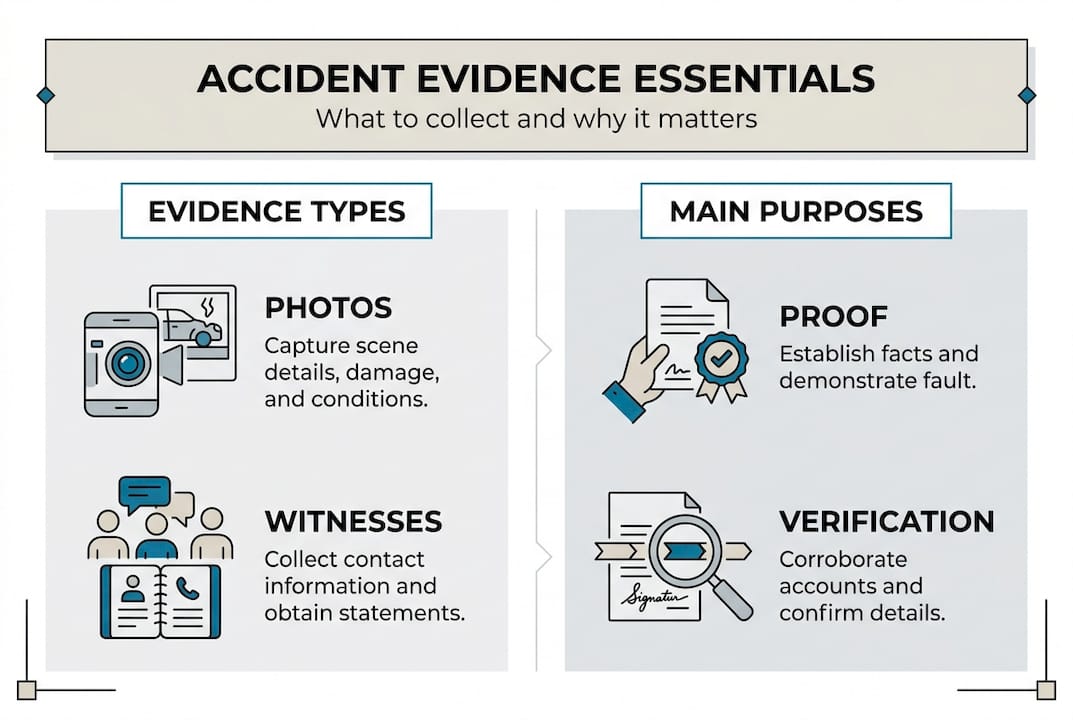
Photographic and video evidence provides visual proof that is difficult to dispute. Capture the accident scene from various perspectives, showing hazards, damage, weather conditions, and surrounding context. Photograph your injuries immediately and document their progression through healing. Include timestamps where possible to establish when evidence was collected.
Witness information adds independent verification to your account. Collect full names, addresses, phone numbers, and email contacts from anyone who saw the accident. Ask witnesses to provide brief written statements whilst events remain fresh in their memories. Remember that under Scotland’s legal framework, witnesses must remain impartial to provide credible testimony.
Official documentation creates formal records that carry significant weight. Police reports, incident forms from employers or property owners, and accident books all provide contemporaneous accounts. These documents often include details you might overlook and demonstrate that proper reporting procedures were followed.
Medical records establish the link between the accident and your injuries. Attend A&E or your GP promptly after the accident, even for seemingly minor injuries. Request copies of all medical notes, diagnostic reports, treatment plans, and follow-up appointments. These records prove injury severity and demonstrate that you sought appropriate care.
Financial documentation substantiates your claim for losses and expenses. Keep receipts for:
- Prescription medications and medical supplies
- Travel costs to medical appointments
- Replacement or repair costs for damaged property
- Lost earnings statements from your employer
- Care or assistance expenses resulting from injuries
Pro Tip: Create a dedicated folder (physical or digital) immediately after your accident to store all evidence in one accessible location. This organisation saves time later and ensures nothing gets lost.
In Scotland, the compulsory pre-action protocol for claims £25,000 or less encourages early evidence disclosure, with failure to comply risking court sanctions. Understanding why acting quickly after an accident Scotland matters helps you prioritise evidence collection when it has maximum impact.
| Evidence type |
Collection timing |
Primary purpose |
| Scene photographs |
Immediately |
Preserve accident conditions |
| Witness statements |
Within 24-48 hours |
Capture fresh recollections |
| Medical records |
Ongoing |
Document injury progression |
| Financial receipts |
As incurred |
Prove actual losses |
How Scotland’s legal rules affect evidence gathering and disclosure
Scotland’s legal system imposes specific requirements on how you handle evidence in personal injury claims. These rules differ from other UK jurisdictions and carry real consequences if you fail to comply properly.

The pre-action protocol applies to claims valued at £25,000 or less and mandates early, comprehensive disclosure of evidence before court proceedings begin. This protocol aims to encourage settlement and reduce unnecessary litigation by ensuring both parties understand the strength of each case early on.
Under this framework, you must:
- Disclose all relevant evidence within specified timeframes
- Provide copies of documents supporting your claim
- Respond promptly to evidence requests from the other party
- Update disclosed evidence if new information emerges
- Comply with procedural steps before initiating court action
Non-compliance with these requirements can result in court sanctions that seriously damage your case. Judges may impose cost penalties, strike out parts of your claim, or draw negative inferences about evidence you failed to disclose properly. These sanctions apply even if your underlying claim has merit, making procedural compliance essential.
Pro Tip: Consult a solicitor before disclosing evidence to ensure you meet protocol requirements without inadvertently weakening your position through premature or incomplete disclosure.
The comparison between pre-action and court-phase evidence handling reveals important differences:
| Stage |
Disclosure timing |
Formality level |
Consequences of non-compliance |
| Pre-action protocol |
Early, within set deadlines |
Structured but flexible |
Cost sanctions, adverse inferences |
| Court proceedings |
Strict court timetables |
Highly formal |
Case dismissal, contempt findings |
Understanding these procedural requirements helps you navigate the claims process effectively. Many claimants benefit from professional guidance to ensure they meet disclosure obligations whilst protecting their interests. Familiarising yourself with accident claim forms Scotland guide provides additional context about documentation requirements throughout the claims process.
Practical steps for documenting and preserving accident evidence
Taking systematic action immediately after an accident ensures you capture crucial evidence before it disappears. Follow these practical steps to build a comprehensive evidence file that supports your claim effectively.
-
Create a detailed written account as soon as possible after the accident. Record what happened in chronological order, including times, locations, people involved, and environmental conditions. Note your immediate symptoms and how you felt physically and emotionally. Update this log regularly as new symptoms develop or circumstances change.
-
Use your smartphone strategically to document visual evidence. Take wide-angle shots showing the overall scene, then close-ups of specific hazards, damage, or injuries. Record short videos that capture movement, sounds, or conditions that photographs cannot convey. Enable location and timestamp features to verify when and where you captured evidence.
-
Secure witness contact information immediately before people leave the scene. Ask for multiple contact methods in case one becomes outdated. Request brief written statements or voice recordings if witnesses are willing. Explain that their account might help establish what happened, emphasising the importance of accuracy over supporting any particular version.
-
Store digital evidence safely using multiple backup methods. Upload photographs and documents to cloud storage, create copies on external drives, and keep original files on your device. Organise files with clear naming conventions and dates. Never edit original images, as modifications can undermine their credibility as evidence.
-
Consult a solicitor early for guidance on evidence requirements specific to your case. Legal professionals understand what evidence carries most weight and can advise on collection methods that comply with Scotland’s pre-action protocol requirements. Early consultation prevents common mistakes that weaken claims unnecessarily.
Pro Tip: Set calendar reminders to photograph healing injuries at regular intervals. This progression documentation proves injury severity and recovery timelines more effectively than single snapshots.
These steps work together to create a comprehensive evidence package that addresses all aspects of your claim. The effort you invest in proper documentation pays dividends throughout the claims process, from initial negotiations through potential court proceedings. Learning how to start an injury claim Scotland step by step helps you understand how evidence fits into the broader claims timeline.
How Scotland Claims can help you document and use accident evidence
Navigating evidence requirements whilst recovering from injuries can feel overwhelming. Scotland Claims connects you with specialist injury lawyers who understand exactly what evidence your case needs and how to present it effectively. Our no win no fee claims Scotland arrangement means you pay nothing upfront and keep 100% of your compensation if successful.
Our network of injury lawyers in Scotland provides expert guidance on gathering, organising, and disclosing evidence in compliance with Scottish legal requirements. They handle complex procedural matters whilst you focus on recovery. Use our compensation calculator Scotland to estimate your potential claim value based on your injuries and circumstances, giving you realistic expectations before proceeding.
Frequently asked questions
How soon should I start documenting evidence after an accident?
You should begin collecting evidence immediately after the accident or as soon as you can safely do so. Conditions change rapidly, witnesses disperse, and memories fade within hours. Prompt documentation captures details at their most accurate and credible. Even if injuries seem minor initially, early evidence collection protects your position if complications develop later. Understanding why acting quickly after an accident Scotland matters helps you prioritise evidence gathering when it has maximum impact on your claim’s success.
Can witness statements be used as evidence in my claim?
Yes, witness statements provide valuable independent verification of your account and can significantly strengthen your claim. However, witnesses must be independent and impartial to ensure their evidence carries weight. Courts scrutinise witness credibility carefully, particularly if witnesses have personal relationships with parties involved. The most persuasive witness statements come from neutral observers who have no stake in the outcome and provide factual accounts without embellishment or advocacy.
What happens if I don’t disclose evidence early in my claim?
Failure to disclose evidence promptly can result in court sanctions under Scotland’s pre-action protocol, particularly for claims valued at £25,000 or less. Courts may impose cost penalties, strike out portions of your claim, or draw adverse inferences that weaken your position. These sanctions apply regardless of your claim’s underlying merit, making compliance with disclosure requirements essential. Judges expect parties to engage constructively during pre-action phases, and non-compliance suggests bad faith or attempts to hide unfavourable evidence. Early consultation with a solicitor ensures you meet disclosure obligations properly whilst protecting your interests throughout the claims process.
Recommended