Claims management in Scotland: your guide to injury compensation

TL;DR:
- Claims management companies assist with initial assessment and referral but cannot offer legal advice or court representation.
- Most personal injury claims in Scotland settle within 12 to 18 months, with strict three-year time limits to claim.
- Going directly to a solicitor often results in higher compensation retention and fewer expenses than involving a CMC.
Many people in Scotland assume that pursuing compensation after an accident means drowning in legal paperwork alone. That assumption costs people money and time. Claims management refers to services provided by Claims Management Companies (CMCs) that assist individuals in pursuing compensation claims, particularly for personal injuries. Whether you’ve been hurt in a road accident, a workplace incident, or a slip on a wet floor, understanding how the claims management system works puts you in control, not the insurers. This guide covers definitions, how the process unfolds, what fees to expect, and how to choose the right kind of help for your situation.
Table of Contents
Key Takeaways
| Point |
Details |
| CMCs explained |
CMCs help connect injury victims to solicitors and manage initial claim steps in Scotland. |
| No Win No Fee basics |
Most claimants pay fees only if their claim succeeds, keeping the bulk of their compensation. |
| Act fast |
You have three years to start most Scottish injury claims, so gather evidence and seek advice early. |
| Specialists mean more |
Selecting a specialist solicitor can secure up to 30% more compensation than the general route. |
What is claims management and who provides it?
Claims management, at its simplest, means getting professional help to pursue your right to compensation after an injury. You don’t navigate the process alone. Instead, a company or solicitor guides you through identifying whether you have a valid claim, gathering the right information, and pursuing the right parties.
CMCs are businesses that specialise in helping injured people access the claims system. Their core services typically include:
- Assessing whether your injury qualifies for compensation
- Advising you on the strength of your case
- Referring you to a solicitor who can handle the legal work
- Managing initial paperwork and documentation
- Communicating with insurers on your behalf at the early stage
CMCs assist with seeking, referring, and advising on personal injury claims, but they cannot provide formal legal advice or represent you in court. That distinction matters, and we’ll return to it shortly.
In Scotland, CMCs are authorised and regulated by the Financial Conduct Authority (FCA). This means any CMC you deal with must follow strict conduct rules, treat you fairly, and not charge hidden fees. Always check that a CMC holds valid FCA authorisation before sharing your personal details.
So how do CMCs differ from solicitors? The table below gives a clear comparison:
| Feature |
CMC |
Direct solicitor |
| Legal advice |
No |
Yes |
| Court representation |
No |
Yes |
| Regulated by |
FCA |
Law Society of Scotland |
| Fee model |
Usually % of compensation |
No Win No Fee or fixed fee |
| Best for |
Initial referral and assessment |
Complex or high-value claims |
If your claim is straightforward, a CMC can be a useful first port of call. For anything more complex, working directly with injury lawyers in Scotland from the outset usually produces a stronger result and avoids the extra layer of cost.
How the personal injury claims process works in Scotland
Now that you know who’s involved, let’s walk through what actually happens after an injury and how your claim might progress.
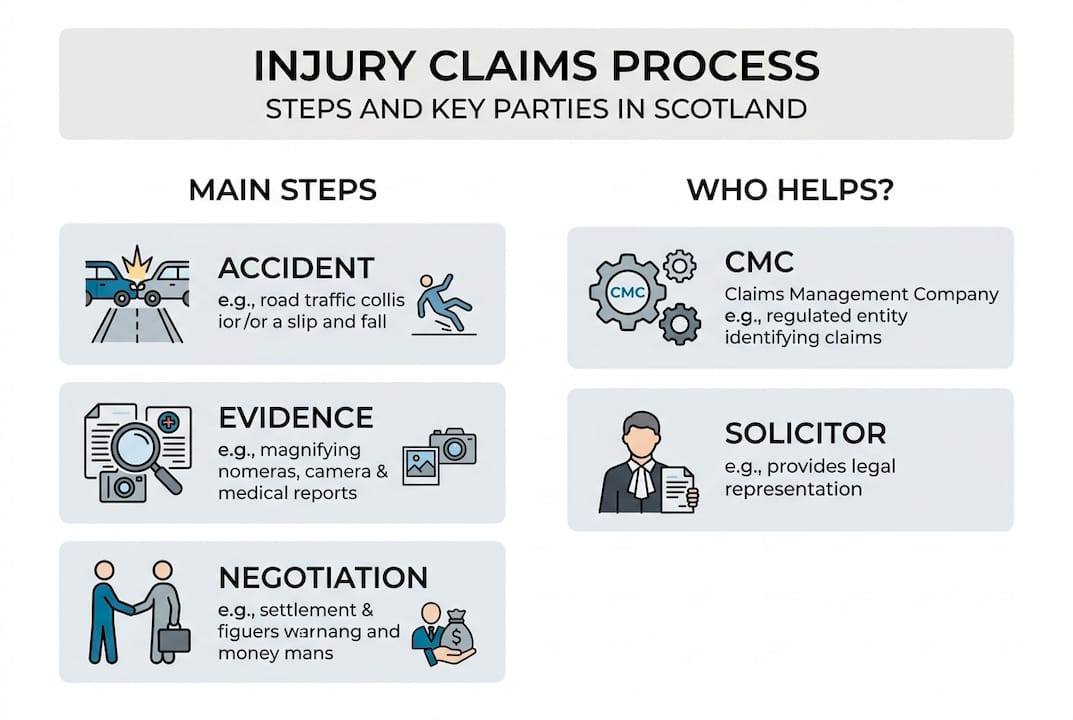
The journey from accident to settlement usually follows a clear sequence:
- Initial enquiry: You contact a CMC or solicitor and describe your accident, injury, and circumstances. They assess whether your claim has merit.
- Evidence gathering: Medical records, photographs, witness statements, and police or accident reports are collected. This stage is critical.
- Referral or instruction: A CMC refers your case to a specialist solicitor. If you contact a solicitor directly, they take full instruction at this point.
- Intimation to defenders: Your solicitor formally notifies the at-fault party (or their insurer) of your claim.
- Negotiation: Most cases are resolved through negotiation between solicitors and insurers, without ever setting foot in a courtroom.
- Settlement or court: A compensation figure is agreed upon, or in rare cases, the matter proceeds to court for a judge to decide.
Here’s something many claimants find reassuring. Most claims settle in 12 to 18 months, with around 90% resolved through negotiation rather than court proceedings. That figure tells you that the system is designed to reach practical solutions, not drag you through a lengthy legal battle.
Time limits are non-negotiable in Scotland. You generally have three years from the date of the accident, or from when you first became aware of your injury, to start a claim. Missing that window almost always means losing your right to compensation entirely. Follow our injury claim step-by-step guide to ensure you take the right steps at the right time, and never underestimate the role of evidence from day one.
Fees, No Win No Fee models, and what you keep
Knowing the process, people often worry about cost, so here’s exactly what to expect when it comes to fees and what you receive.
The good news is that most personal injury claims in Scotland operate on a No Win No Fee basis. This means you pay nothing upfront and nothing at all if your claim is unsuccessful. When your claim succeeds, fees are deducted from your compensation award rather than billed separately.

Here’s where CMCs and solicitors differ in cost terms. A typical CMC fee is 20% including VAT of the compensation you recover. That’s before solicitor fees are applied if the CMC refers you onwards. Solicitors operating under No Win No Fee agreements typically charge a success fee capped by law, but this varies case by case.
The practical impact of that extra layer is visible in the table below:
| Compensation awarded |
CMC fee (20% inc. VAT) |
Solicitor success fee (est.) |
Amount you keep |
| £5,000 |
£1,000 |
£500 |
~£3,500 |
| £10,000 |
£2,000 |
£800 |
~£7,200 |
| £20,000 |
£4,000 |
£1,200 |
~£14,800 |
These are illustrative figures. Real outcomes depend on your agreement and case specifics. Always read your fee agreement carefully before signing anything.
Pro Tip: Contacting a specialist solicitor directly, rather than through a CMC, removes one layer of fees entirely. You deal with one firm from start to finish, which often means you retain more of your final award. Read our full breakdown of No Win No Fee explained to understand exactly how this works, and see our guide on understanding No Win No Fee before committing to any arrangement.
Key rules, time limits, and the importance of evidence
With fees in mind, it’s just as important to understand your responsibilities and key legal rules to protect your right to compensation.
Scottish personal injury law has several important features every claimant should know:
- Three-year limitation period: The 3-year time limit runs from the date of the accident or the date you first knew your injury was linked to someone else’s fault. Special rules apply for children and fatal accident cases.
- Children’s claims: If the injured person is under 16, the three-year period doesn’t begin until their 16th birthday, giving more time to act.
- Fatal accident claims: Relatives of someone who died due to another’s negligence have three years from the date of death or from the date of knowledge.
- QOCS protection: Qualified One-Way Costs Shifting (QOCS) means that if you lose your claim, you’re generally protected from having to pay the other side’s legal costs. This significantly reduces financial risk.
- Pre-action protocols: Before raising court action, both sides must follow structured steps for disclosure of information, which can speed up settlement.
Evidence is what turns a valid claim into a successful one. Courts and insurers don’t accept your word alone. Strong evidence includes photographs taken at the scene, medical records documenting your injuries, witness contact details, CCTV footage where available, and any correspondence with the responsible party.
Pro Tip: Gather evidence immediately after an accident, before anything is cleaned up, repaired, or forgotten. A single photograph taken at the right moment can be worth thousands of pounds to your claim. Learn more about preparing your evidence and the role of claims representatives in Scotland who can support you through this stage.
Should you use a CMC or go direct to a solicitor?
Armed with practical rules, you now need to decide the best route, so here’s a guide to picking between a CMC and a direct solicitor.
When a CMC might suit you:
- You’re unsure whether your situation qualifies as a valid claim
- You want a quick, informal first assessment with no commitment
- You need someone to point you toward the right legal help
- Your claim is relatively low in value and straightforward
When to go direct to a solicitor:
- Your injuries are serious or involve long-term consequences
- Your claim involves multiple parties or disputed liability
- You want to retain the maximum possible share of your award
- You need formal legal advice or anticipate court proceedings
The research is clear on one important point:
Specialists secure up to 25 to 30% more compensation than general solicitors. CMCs serve as access points but solicitors offer end-to-end handling.
That gap is significant. A £15,000 claim handled by a specialist could realistically yield £18,000 to £19,500 versus a general approach. The CMC route adds an administrative layer that costs you money while offering no legal protection.
There are also things CMCs simply cannot do. They cannot advise you on the legal merits of your case in a formal sense, cannot draft legal documents for court, and cannot represent you before a judge. Understanding the full comparison between solicitors vs CMCs helps you make a genuinely informed decision. If you’re not sure where to start, free legal advice is available and costs you nothing.
The hard truths about Scottish claims management most miss
Stepping back, here’s a perspective you won’t always hear from the industry. CMCs exist for a reason and can genuinely help someone who doesn’t know where to start. But they’re a gateway, not a destination. The moment your case moves beyond a simple referral, the CMC’s usefulness effectively ends, while their fee continues.
From what we see, most injured people who contact a specialist solicitor directly from day one get faster responses, higher settlements, and fewer surprises. Insurance companies know when a claimant has strong legal representation. They settle more quickly and for more money because delay and negotiation risk is greater for them.
Another truth: insurers routinely make early low offers to unrepresented claimants or those with minimal legal backing. Accepting a first offer without specialist input is one of the most expensive mistakes an injury victim can make. Evidence’s role in claims is rarely discussed enough either. The claimants who gather thorough, well-organised evidence early are the ones who settle faster and for more. You are not just a passive participant in this process. You have real influence over the outcome, and the choices you make in the first 48 hours after an accident can shape everything that follows.
How Scotland Claims can help you move forward
With expert advice in mind, here’s how you can get practical, trustworthy support on your claims journey.
At Scotland Claims, we connect injured people across Scotland with specialist injury lawyers who handle cases from first contact through to settlement, all under a No Win No Fee claims arrangement. You pay nothing upfront and nothing if your claim is unsuccessful. Our approach cuts out unnecessary middlemen so you keep the maximum share of your award. Use our compensation calculator to get an instant estimate of what your injury could be worth, then speak with a specialist who can turn that estimate into real action. Getting started takes minutes and puts you firmly in control.
Frequently asked questions
Is there a time limit for starting a personal injury claim in Scotland?
Yes, you must usually start your claim within three years of the accident or from when you became aware of your injury. Acting promptly protects your right to compensation.
Will I pay any fees if my claim is unsuccessful?
No, under most No Win No Fee agreements in Scotland, you will not pay legal fees if your claim is lost. QOCS protects claimants from being liable for the other side’s costs in most personal injury cases.
What’s the difference between a CMC and a solicitor?
A CMC helps assess and refer claims, but only a solicitor can provide legal advice and handle court proceedings in Scotland. Solicitors offer full legal representation, CMCs do not.
How much of my compensation will I keep after fees?
If using a CMC, expect to retain around 80% after their typical 20% fee including VAT. Going direct to a solicitor often means you keep a greater share, so always review your fee agreement carefully before proceeding.
Recommended