Road accident injury workflow: your Scotland claims guide

TL;DR:
- Following a road traffic accident in Scotland requires strict evidence gathering within a three-year deadline to secure full compensation.
- Working with a no success fee solicitor helps claimants navigate the process efficiently and retain 100% of their settlement.
The road accident injury workflow is the sequence of steps you must follow to file a personal injury claim after a road traffic accident in Scotland. Getting this sequence right determines whether you receive full compensation or risk losing your claim entirely. Under the Prescription and Limitation (Scotland) Act 1973, you have a strict three-year window, known as the triennium, to initiate court proceedings. Scotland Claims Injury Lawyers helps claimants navigate every stage of this process without charging a success fee, meaning you keep 100% of your compensation.
What is the road accident injury workflow in Scotland?

The personal injury workflow after a road accident covers everything from the moment of impact to the final settlement. Legal professionals refer to this as the personal injury claims process, and it follows a defined sequence that Scottish courts and insurers both expect. Skipping steps or acting out of order weakens your position significantly. The workflow begins at the accident scene and ends only when compensation is paid and agreed.
Most claimants are surprised to learn that the process is not just about proving you were hurt. Road traffic accident claims require proof of negligence, causation, and quantifiable loss. Each of those three elements needs its own evidence trail, which is why the workflow matters so much.
The actions you take in the first hours after a collision directly affect the strength of your claim. Essential immediate actions include contacting emergency services, documenting the scene thoroughly, securing witness details, and preserving all medical records. Courts treat this early evidence as the foundation of your case.
Follow these steps as soon as it is safe to do so:
- Call 999 if anyone is injured and request police attendance. A police report creates an official record of the incident.
- Photograph everything. Capture vehicle positions, road conditions, tyre marks, traffic signs, and any visible injuries before vehicles are moved.
- Exchange details with all other drivers: name, address, vehicle registration, and insurance information.
- Collect witness information. Names and contact numbers from independent witnesses carry significant weight with insurers and courts.
- Seek medical attention immediately, even if you feel fine. Whiplash and soft tissue injuries often present hours or days later, and a medical record dated close to the accident is far harder to dispute.
- Report the accident to your insurer within 24 hours, even if you do not intend to claim through them.
Pro Tip: Take a short video of the scene rather than relying solely on photographs. Video captures context, such as road layout and traffic flow, that static images miss.
Proving fault in a road accident claim depends heavily on this early evidence. Witness statements, police reports, and medical records are the three pillars that establish both negligence and causation. The sooner you gather them, the stronger your position.
Once the immediate scene is dealt with, the formal injury assessment workflow begins. This stage involves notifying the relevant insurer, instructing a solicitor, and building the medical evidence that supports your claim.
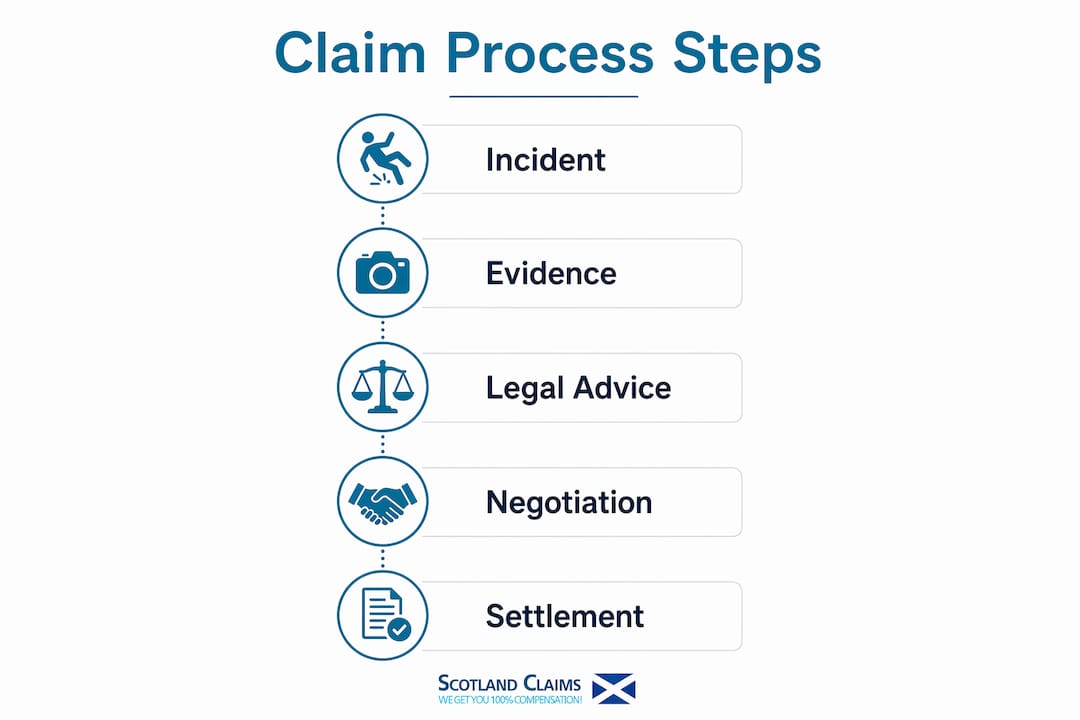
The typical progression looks like this:
- Instruct a solicitor as early as possible. Early engagement improves outcomes and reduces the risk of evidence degrading.
- Notify the at-fault driver’s insurer of your intention to claim. Your solicitor handles this formally.
- Attend a medical assessment with an independent expert. This report documents your injuries, their cause, and their likely duration.
- Gather supporting evidence. This includes GP records, hospital notes, physiotherapy reports, and any specialist referrals.
- Submit the formal claim. Your solicitor presents the evidence to the insurer or, if necessary, raises court proceedings.
- Negotiate settlement. Most claims resolve through negotiation rather than a full court hearing.
Most personal injury claims in Scotland resolve through negotiation within 12 to 18 months, though complex cases involving serious injuries or disputed liability can take considerably longer.
That 12 to 18 month timeframe surprises many claimants who expect a faster resolution. Delays arise from court availability, the time needed to obtain expert medical reports, and the pace at which the defending insurer cooperates.
The three-year limitation period under the Prescription and Limitation (Scotland) Act 1973 is the most critical deadline in the entire process. Miss it and your claim is almost certainly lost. Discretionary extensions under section 19A of the 1973 Act are rare and not guaranteed. Do not rely on them.
Pro Tip: Start your claim as early as possible, even if you are still receiving treatment. Your solicitor can issue protective proceedings to stop the clock while your medical position continues to develop.
What types of compensation can you expect from a Scottish road accident claim?
A road accident injury claim typically divides compensation into two categories: general damages and special damages. Understanding both helps you ensure nothing is left off your claim.
General damages cover the non-financial impact of your injuries:
- Pain and suffering experienced from the date of the accident onwards
- Loss of amenity, meaning activities you can no longer enjoy or participate in
- Future pain and suffering if your injuries are expected to persist
Special damages cover your actual financial losses:
- Medical costs, including private treatment, physiotherapy, and prescription charges
- Travel expenses to and from medical appointments
- Lost earnings if you were unable to work during recovery
- Care costs if you needed assistance at home
- Vehicle repair or replacement costs
Detailed documentation of every loss strengthens your claim considerably. Keep receipts, payslips, mileage records, and invoices for every expense connected to your injury. Use the compensation calculator from Scotland Claims Injury Lawyers to get an early estimate of what your claim may be worth.
The role of a neuropsychologist or other specialist expert can significantly affect the value of a claim, particularly where head injuries or cognitive effects are involved. Expert medical evidence shapes both the general damages figure and the court’s understanding of long-term impact.
Common mistakes that damage road accident injury claims
The injury aftermath workflow fails most often not because of legal complexity, but because of avoidable errors made in the days and weeks after the accident.
The most damaging mistakes are:
- Delaying medical attention. Gaps between the accident and your first medical record give insurers grounds to argue your injuries were not caused by the collision.
- Accepting an early settlement. Insurers sometimes offer quick, low settlements before the full extent of your injuries is known. Accepting one closes your claim permanently.
- Failing to document losses. Without receipts and records, special damages are difficult to prove and easy for insurers to dispute.
- Missing the three-year deadline. Delays in seeking legal advice frequently result in weaker evidence and a higher risk of claims being time-barred entirely.
- Relying on informal agreements. A verbal agreement with the other driver or their insurer carries no legal weight and can undermine your formal claim.
Legal experts advise against leaving claims to the last moment. Courts strictly enforce the three-year limit, and early advice is the single most effective way to protect your position.
Understanding how to prove fault in a road accident is central to avoiding these pitfalls. Negligence claims require evidence of a breach of duty and a direct link to your injury. Without that chain of evidence, even a legitimate claim can fail.
How to choose the right legal help for your claim in Scotland
Choosing the right solicitor is as important as gathering the right evidence. The wrong choice can cost you a significant portion of your compensation before you even receive it.
Look for these qualities when selecting a solicitor:
- Specialisation in Scottish personal injury law. Scottish civil procedure differs from English law. You need a solicitor who practises specifically within the Scottish legal system.
- A genuine no win no fee arrangement. This means no upfront costs and no fees if your claim is unsuccessful.
- No success fee deducted from your compensation. Many solicitors charge up to 20% of your settlement as a success fee. Scotland Claims Injury Lawyers charges no success fee at all, so you receive 100% of your awarded compensation.
- Clear communication on timelines. A good solicitor sets realistic expectations from the outset and keeps you informed throughout.
- Experience with accident report analysis and medical evidence. The ability to interpret and challenge expert reports is a core skill in personal injury litigation.
Pro Tip: Ask any solicitor directly: “Will you deduct a success fee from my compensation?” If the answer is yes, or if they hesitate, look elsewhere. You are entitled to keep every penny of what you are awarded.
The step-by-step claims guide from Scotland Claims Injury Lawyers walks you through the full filing process for 2026, including current procedural requirements and what to expect at each stage.
Key takeaways
The road accident injury workflow in Scotland requires prompt action, thorough evidence gathering, and specialist legal support to secure 100% of the compensation you are entitled to.
| Point |
Details |
| Act immediately at the scene |
Photograph, gather witness details, and seek medical attention before evidence degrades. |
| Know your deadline |
The three-year triennium under the Prescription and Limitation (Scotland) Act 1973 is strictly enforced. |
| Claim both damage types |
General damages cover pain and suffering; special damages cover all financial losses and expenses. |
| Avoid early settlements |
Insurers’ initial offers rarely reflect the full value of your injuries and losses. |
| Choose a no success fee solicitor |
Scotland Claims Injury Lawyers deducts nothing from your compensation, unlike solicitors charging up to 20%. |
What I have learned from watching clients navigate this process
After years of observing how road accident claims unfold in Scotland, one pattern stands out above all others: the clients who do best are not the ones with the most serious injuries. They are the ones who acted quickly and kept records of everything.
The 12 to 18 month timeline shocks almost everyone. People expect a few weeks. When I explain that a straightforward whiplash claim can take over a year to settle, the reaction is almost always disbelief. Managing that expectation early makes the entire process far less stressful. Clients who understand the timeline from day one are calmer, more cooperative, and ultimately better witnesses to their own experience.
The success fee issue genuinely troubles me. The idea that a solicitor takes 20% of your compensation after you have already suffered an injury and endured a lengthy legal process feels deeply unfair. Scotland Claims Injury Lawyers takes nothing. That is not a marketing line. It is a structural difference that puts real money back in the pockets of people who need it.
My strongest advice is this: do not wait until you feel “ready” to make a claim. The three-year clock starts on the date of the accident, not the date you decide to act. Evidence fades, witnesses move on, and CCTV footage is routinely deleted within weeks. The best time to start is the day after the accident. The second best time is today.
— Roger
Scotland Claims Injury Lawyers: no fees, full compensation
Scotland Claims Injury Lawyers specialises in road traffic accident claims across Scotland on a genuine no win no fee basis. You pay nothing upfront, and if your claim is unsuccessful, you pay nothing at all. Unlike solicitors who deduct up to 20% of your settlement as a success fee, Scotland Claims Injury Lawyers takes no success fee, so every penny of your compensation stays with you.
Whether you have suffered whiplash, a back injury, or more serious harm, the team handles the full claims process from initial assessment to final settlement. Contact Scotland Claims Injury Lawyers today for a free, no-obligation assessment of your claim through the injury lawyers Scotland page.
FAQ
How long do I have to make a road accident claim in Scotland?
You have three years from the date of the accident to initiate court proceedings. This period is called the triennium and is set out in the Prescription and Limitation (Scotland) Act 1973.
How long does a road accident injury claim take to settle?
Most claims in Scotland resolve within 12 to 18 months through negotiation. Complex cases involving serious injuries or disputed liability can take longer.
What evidence do I need for a road accident injury claim?
You need a police report, photographs of the scene, witness statements, and medical records that document your injuries and link them directly to the accident.
Will I have to pay a success fee on my compensation?
With Scotland Claims Injury Lawyers, no success fee is deducted from your compensation. You receive 100% of your awarded settlement, unlike solicitors who charge up to 20%.
Can I claim if I was a passenger in the accident?
Yes. Passengers who are not at fault are entitled to claim full compensation for their injuries and financial losses through the same personal injury workflow as drivers.
Recommended