Claim packs in Scotland explained: what you need to know

TL;DR:
- A claim pack is a structured set of documents that formally initiates personal injury claims in Scotland.
- Properly preparing and submitting a complete, accurate pack greatly influences the success and speed of your claim.
- Expert legal guidance enhances the quality of your claim pack and improves your chances of a favorable outcome.
Claim packs in Scotland explained: what you need to know
Most people assume a claim pack is just a single form you fill in and post off. That assumption costs claimants time, money, and in some cases, their entire case. A claim pack is actually a structured bundle of documents that formally opens your personal injury case in Scotland, and getting it right from the start is one of the most decisive things you can do. Whether you were hurt in a road traffic collision, a workplace accident, or a slip in a public place, understanding exactly what a claim pack contains and how to use it correctly can be the difference between a successful payout and a prolonged, frustrating process.
Table of Contents
Key Takeaways
| Point |
Details |
| Claim packs explained |
A claim pack is a bundle of key documents required to start a personal injury claim in Scotland. |
| Contents matter |
Accurate, complete evidence and forms improve your chances of a successful claim. |
| Submit early and accurately |
Timely, thorough claim packs avoid delays and strengthen your case from the outset. |
| Seek expert support |
Experienced solicitors can guide you through every step and help maximise your compensation. |
Understanding a claim pack: definition and purpose
A claim pack is not a single sheet of paper. It is not a quick online form. And it is certainly not something you can guess your way through without preparation. A claim pack is a structured set of documents required to start most personal injury proceedings in Scotland, and each element within it serves a specific legal function.
Think of it as your formal introduction to the legal process. The claim pack tells the other side, whether that is an insurer, an employer, or a public body, exactly who you are, what happened to you, and why you are entitled to compensation. Without it, your case cannot formally begin.
Claim packs are used across a wide range of personal injury scenarios in Scotland, including:
- Road traffic accidents, where the pack helps establish fault and extent of injury
- Workplace injuries, where employer negligence must be clearly documented
- Slips, trips, and falls, which require precise details about the location and conditions
- Medical negligence claims, where clinical records and expert evidence form the core
- Public liability cases, such as injuries caused by poorly maintained public property
For anyone pursuing a no win no fee arrangement, the claim pack is especially important. Solicitors operating under this model take on financial risk themselves, which means they need to see a well-prepared pack before they can commit fully to your case. A weak or incomplete pack can make even a valid claim look uncertain.
The solicitors’ role in preparing this bundle is not just administrative. They assess whether the documents are consistent, whether they support your version of events, and whether they meet the legal standards required under Scottish civil procedure.
‘The claim pack is the formal beginning of your compensation journey.’
Every stage that follows, negotiation, medical assessment, possible court proceedings, is shaped by what you put in the pack at the outset. Treat it as a foundation, not just a formality.
Pro Tip: Gather all accident details before requesting the pack. Write down exactly what happened, where, at what time, and who was present. This information will need to be consistent across every document you submit.
What’s inside a Scottish claim pack?
Now that you understand what a claim pack is and why it matters, let’s look at what it actually contains. A standard claim pack may include a claim form, medical evidence, incident statements, and legal representation information. But each of these elements deserves closer inspection, because how well each document is prepared directly affects your claim’s strength.
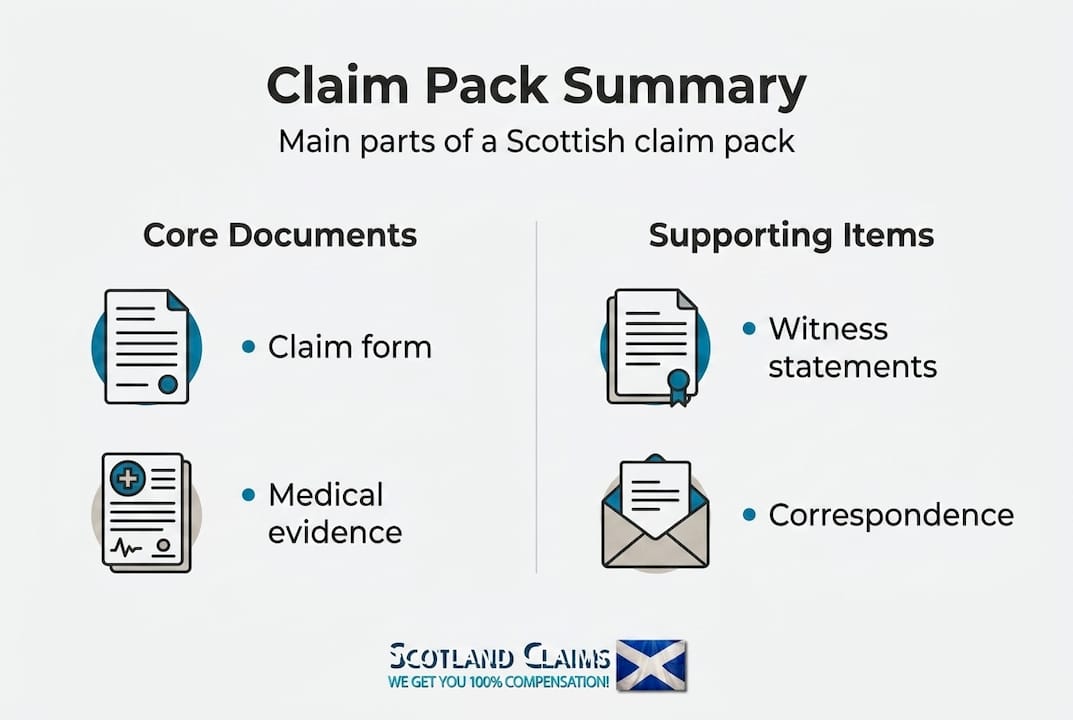
Here is a breakdown of the core documents you are likely to encounter:
| Document |
Purpose |
| Claim form (or N1 form in some cases) |
Formal notice of your intention to claim compensation |
| Accident or incident report |
Contemporaneous record of how the injury occurred |
| Medical evidence and records |
Proof of the nature, extent, and cause of your injuries |
| Witness statements |
Independent accounts that support your version of events |
| Photographs or physical evidence |
Visual documentation of the scene, injuries, or hazard |
| Proof of financial losses |
Receipts, payslips, or records showing expenses and lost income |
| Legal representation details |
Confirmation of your solicitor and any CFA (Conditional Fee Agreement) |
The claim form is the spine of the whole pack. It must clearly identify you, the defendant (the person or organisation responsible), and the nature of your claim. Any vagueness here creates openings for the other side to challenge your case.

Medical evidence is arguably the most powerful document in the pack. It should come from a qualified medical professional who has examined you specifically in relation to the accident. A general GP’s note is rarely sufficient on its own. An independent medical expert’s report carries considerably more weight.
Witness statements are often underestimated. Many people assume that if there were no bystanders, they have no witnesses. But colleagues, paramedics, or even CCTV operators can sometimes provide useful supporting information. Check the full document list to ensure you have covered every required item for your specific type of claim.
Proof of financial losses should be thorough and itemised. This covers not just lost wages but also travel costs to medical appointments, care costs, prescription charges, and any equipment you had to purchase as a result of your injury.
Accuracy matters across every single document. A discrepancy between what you write on the claim form and what appears in a witness statement, even a minor one, can be used to undermine your credibility. Read the accident claim form guidance carefully before completing anything.
- Keep all financial receipts from the date of the accident
- Request an official copy of any accident book entry made at the time
- Ask your GP to note the connection between your injury and the incident explicitly
- Secure witness contact details as quickly as possible after the event
How and when are claim packs used?
Knowing what goes into a claim pack is only part of the picture. Understanding when and how to use it in the Scottish claims process gives you much greater control over your case.
The claim pack is typically submitted at the outset of a legal claim, initiating negotiations or proceedings with the responsible party. Here is how that process typically unfolds:
- Instruct a solicitor who will assess your case and advise on whether you have grounds to claim
- Gather your evidence including medical reports, financial records, and any witness contact information
- Complete each document in the pack carefully, ensuring consistency and accuracy throughout
- Your solicitor reviews the full pack before submission, checking for errors, omissions, or inconsistencies
- Submit the pack to the defendant or their insurer, formally triggering the pre-action protocol
- Await acknowledgement, which typically must arrive within a set timeframe under Scottish civil procedure rules
- Respond to any requests for additional evidence, which are common and should be handled promptly
- Enter into negotiations or, if necessary, court proceedings depending on how the defendant responds
The phrase pre-action protocol is worth understanding. It refers to the agreed procedure both sides must follow before a case goes to court. In Scotland, this involves formal notification to the defendant, giving them an opportunity to investigate and respond before litigation begins. A properly submitted claim pack satisfies this requirement and puts you in a strong legal position from day one.
Once the pack is submitted, it is reviewed by insurance adjusters and legal teams acting for the defendant. They are looking for weaknesses. Vague descriptions, missing documents, or inconsistencies are all opportunities for them to delay, reduce, or deny your claim.
Learn more about what comes after submission so you are prepared for the next stages. Also, understanding managing your claim effectively once the process is underway will help you stay ahead of any challenges.
Pro Tip: Always keep a complete copy of everything you submit. If the other side denies receiving a document or disputes what you sent, your copies are your protection. Store them securely in both physical and digital formats.
Common pitfalls and key tips for completing your claim pack
Even people with strong, legitimate claims can find their cases stalling or collapsing because of avoidable errors in their claim pack. Omitting supporting evidence or submitting incomplete forms may lead to claims being delayed or refused. Knowing the most common mistakes in advance gives you a clear advantage.
Here are the pitfalls that most frequently cause problems for claimants in Scotland:
- Missing signatures: Unsigned forms are invalid. Every document that requires a signature must be signed, dated, and in some cases witnessed
- Vague accident descriptions: Writing ‘I slipped at work’ is not enough. Include the exact location, date, time, surface conditions, footwear, and what you were doing immediately before the incident
- Incomplete medical evidence: Failing to obtain a proper independent medical report, or submitting only a basic GP note, significantly weakens your claim
- Not listing all losses: Many claimants forget to include travel expenses, care provided by family members, or the cost of aids and adaptations
- Late filing: Scotland’s personal injury limitation period is generally three years from the date of the accident. Missing this can invalidate your claim entirely
- Ignoring requests for additional information: Once your pack is submitted, the other side may request further documents. Failing to respond promptly can stall your case indefinitely
- Inconsistencies between documents: If your statement says one thing and a witness says another, expect challenges
Most delays in Scottish injury claims are caused by missing or unclear supporting documents rather than disputes about fault.
Understanding your rights as an injury victim is equally important. Knowing what you are entitled to under Scottish law helps you push back if the other side attempts to minimise your claim. Explore your options through resources on knowing your injury rights in Scotland.
It is also worth understanding the role that insurance adjusters play once your pack reaches the other side. Adjusters are trained to identify weaknesses and reduce payouts. Learning about the role of adjusters in Scottish injury claims will help you anticipate their tactics and prepare accordingly.
Pro Tip: Before sending your claim pack, go through every document with your solicitor line by line. Ask them to confirm that the medical evidence explicitly links your injury to the incident, that all financial losses are documented, and that every form carries the correct signatures.
Deadlines in personal injury law are absolute. A missed limitation date means your claim is almost certainly finished, regardless of how strong the evidence is. Mark key dates in your calendar from the moment you decide to pursue a claim, and act on them without delay.
Why the claim pack is more powerful than you think
Most guides focus on the mechanics of the claim pack: what goes in it, how to fill it in, where to send it. That is all useful, but it misses something more important. The quality of your initial submission does not just open your case. It actively shapes how the other side treats you throughout the entire process.
Insurers and adjusters make instant assessments when a claim pack arrives. A thorough, consistent, professionally prepared pack signals that the claimant is serious, well-advised, and unlikely to be deterred. A weak or disorganised pack signals the opposite, and experienced adjusters will exploit that impression to delay proceedings and push for lower settlements.
The contrarian reality is that most claimants underestimate the strategic value of a strong initial submission. They see the claim pack as an administrative hurdle rather than a negotiating tool. But the solicitor’s approach to building that pack, the language used, the structure of the evidence, the precision of the financial schedules, communicates credibility before a single conversation takes place.
‘A robust claim pack isn’t just paperwork — it sets the terms for everything that follows.’
The claimants who get the best outcomes are rarely those with the most dramatic injuries. They are the ones whose cases are best documented from day one. Invest the time and care in your claim pack, and you are investing in every negotiation, every assessment, and every potential court appearance that follows.
Get expert help with your claim pack in Scotland
Putting together a claim pack that genuinely supports your case is not something you should attempt without guidance. A single missing document or poorly worded statement can slow your claim by months or cost you thousands in reduced compensation. Whether you are pursuing a back injury claim after a workplace accident or seeking knee injury claim support following a road traffic collision, specialist legal support makes a measurable difference. Scotland Claims connects you with experienced personal injury solicitors who work on a no win no fee basis, meaning you pay nothing upfront and nothing at all if your case is unsuccessful. Request a free case assessment today and let a specialist take the complexity out of your claim.
Frequently asked questions
Is a claim pack required for all personal injury claims in Scotland?
Most injury claims will involve a claim pack to start formal compensation proceedings, although the exact documents depend on your case. Most personal injury proceedings in Scotland require a structured set of documents to begin formally.
What happens if I submit an incomplete claim pack?
Incomplete or missing documents can result in delays or rejection of your claim, so ensure all required evidence and details are included. Submitting incomplete forms may lead to your claim being delayed or refused by the insurer.
How quickly should I send my claim pack?
Claim packs should be submitted promptly as delays can affect the outcome, but always confirm all necessary information is included before sending. Submission at the outset of your legal claim initiates negotiations and sets the process in motion.
Can I get help compiling my claim pack?
Yes, solicitors and claims advisors can guide you through each document to ensure it meets legal standards for Scottish injury claims. Solicitors can play a vital role in preparing and checking your claim pack for completeness and accuracy.
Recommended