Claiming for an accident at work in Scotland: your guide

TL;DR:
- Getting injured at work can disrupt your life with physical pain and financial stress, but Scotland offers clear protections and No Win No Fee options for full compensation without upfront costs. It is essential to act early, gather evidence, and seek legal advice within the three-year window to maximize your claim’s success, even if you were partially responsible. Working with experienced solicitors ensures a smoother process, lower success fees, and better outcomes for injured employees.
Getting hurt at work turns your life upside down fast. Beyond the physical pain, you face lost income, medical appointments, and a legal system that feels designed for solicitors rather than workers. Claiming for an accident at work does not have to be this overwhelming, though. Scotland has clear rules that protect injured employees, and a No Win No Fee arrangement means you can pursue full compensation without spending a penny upfront. This guide walks you through everything you need to know, from understanding your legal rights to building a strong case and choosing the right solicitor.
Table of Contents
Key Takeaways
| Point |
Details |
| Strict time limits |
You have three years from injury to start your claim, making early action essential. |
| Duty of care |
Compensation is available if your employer failed in their legal duty to keep you safe. |
| Gather evidence |
Collect medical records, accident reports, witness info, and photos immediately after the accident. |
| No win no fee |
Legal help can often be secured with no upfront cost, paying fees only if you win compensation. |
| Low fees advantage |
Choosing solicitors with lower fees means you keep more of your compensation. |
Understanding your rights and eligibility for a work accident claim
Before anything else, you need to know whether your situation actually supports a claim. The short answer is: if your employer failed to keep you reasonably safe and you were injured as a result, you very likely have a valid case.
The two legal concepts that matter most here are duty of care and negligence. Every employer in Scotland has a legal duty of care towards their staff. When they fail to meet that duty and someone gets hurt, that failure is negligence. Eligibility depends on fault, typically via employer negligence or breach of duty of care, and those two ingredients together are what makes an accident at work claim possible.
What does employer negligence actually look like in practice? Common examples include:
- Providing faulty or poorly maintained equipment
- Failing to train employees on safe working procedures
- Not supervising staff adequately, particularly in higher-risk environments
- Ignoring known hazards such as wet floors, unguarded machinery, or poor lighting
- Pressuring workers to skip safety protocols to meet deadlines
Employers must provide safe workplaces, along with proper equipment, training, and supervision, and falling short on any of these opens the door to a valid claim.
One of the most persistent myths is that you can only claim if the accident was entirely your employer’s fault. That is not true. If you were partially responsible, say you ignored a warning sign or took a shortcut, you may still receive compensation. The award is simply reduced in proportion to your share of the blame. This is called contributory negligence, and it is far more common than people realise. Do not assume a partial responsibility automatically ends your claim before it begins.
Evidence is what transforms a valid claim into a successful one. Without documentation proving the employer’s failure, even a clear-cut case can fall apart. Gathering that evidence early and preserving it carefully is the single biggest thing you can do to support your case.

Preparing your claim: key steps and evidence gathering
Speed matters enormously here. Start early because it may take around six months of preparatory work before court proceedings can even begin, and you have a three-year window from the date of injury. That window closes faster than most people expect.
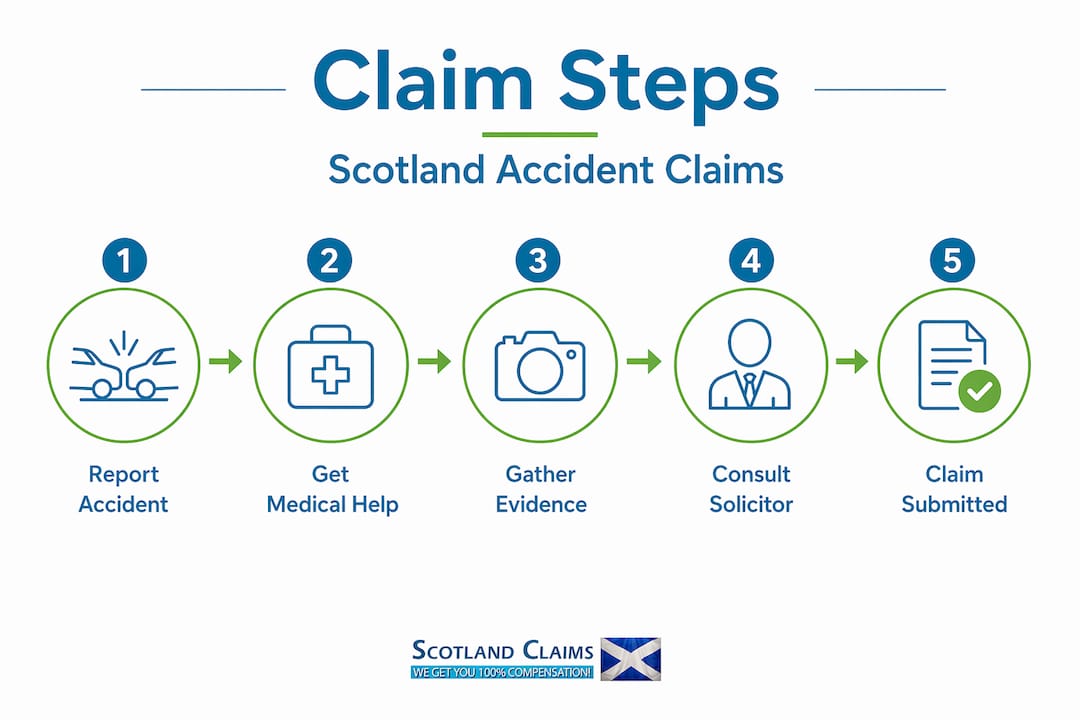
Follow these steps immediately after the accident:
- Report the accident to your manager or supervisor without delay. Ensure it is recorded in the workplace accident book.
- Seek medical attention the same day, even if injuries feel minor. Ask your doctor to note the accident location and circumstances explicitly in their records.
- Photograph the scene before anything is cleaned up or altered. Capture hazards, equipment, warning signs (or their absence), and your injuries.
- Collect witness details including names and contact numbers of anyone who saw what happened.
- Start a recovery diary noting daily symptoms, pain levels, treatments received, and any expenses incurred because of the injury.
Gather medical records from all treatments and keep copies of accident reports to build the strongest possible foundation. These documents do not just support your claim; they become its backbone during negotiations.
The role of evidence in injury claims cannot be overstated. A solicitor reviewing your case will immediately look for medical records linking your injury to the accident, workplace documentation confirming the incident was reported, and any photographs or witness statements that establish what conditions were like at the time.
Top three preparatory tasks at a glance:
| Task |
Why it matters |
When to do it |
| Report the accident officially |
Creates a formal record the employer cannot dispute |
Immediately |
| Attend medical appointment |
Establishes the injury on record with accident details |
Same day or next day |
| Begin an expenses and recovery diary |
Proves financial loss and ongoing impact |
From day one |
Pro Tip: Keep every receipt related to your injury, including travel to medical appointments, prescription costs, and any equipment you had to purchase. These out-of-pocket losses are recoverable and are easily overlooked when you focus only on the injury itself.
Understanding the claim time limits in Scotland early on will help you avoid one of the most damaging mistakes injured workers make: assuming they have plenty of time.
Navigating the claims process: from solicitor consultation to settlement
Once your evidence is in order, the formal claims process begins. Most people imagine this as an immediate court battle. In reality, the vast majority of workplace injury claims settle without a judge ever getting involved.
Here is how the process typically unfolds:
- Free initial consultation with a specialist solicitor who assesses your case at no cost to you.
- Letter of claim sent formally to your employer notifying them that you intend to seek compensation.
- Medical examination arranged by your legal team to independently assess the extent and prognosis of your injuries.
- Evidence exchange between your solicitor and the employer’s insurer.
- Negotiation and settlement offer from the employer’s insurer, which your solicitor will advise you to accept or reject.
- Court proceedings if no fair settlement is reached, though this stage is reached only in a minority of cases.
Engaging solicitors early ensures your case is prepared well within the three-year legal deadline and helps preserve evidence that could degrade or disappear over time.
The comparison between settling and going to court is worth understanding:
| Factor |
Settling out of court |
Court proceedings |
| Speed |
Usually faster, often within months |
Can take a year or more |
| Cost |
Lower overall legal costs |
Higher costs, though covered by No Win No Fee |
| Certainty |
Agreed amount is guaranteed |
Judge decides; outcome less predictable |
| Stress |
Lower for most claimants |
More demanding and time-consuming |
Most claims settle without going to court, but you should still be prepared for medical examinations, meetings with your legal team, and the possibility of a hearing.
No Win No Fee arrangements are particularly valuable here. You pay nothing unless you win. There are no upfront legal fees, no financial risk, and no guessing about whether you can afford to pursue justice. Understanding the role of solicitors in guiding you through each stage makes the entire process feel far less daunting.
Pro Tip: Be completely honest with your solicitor from the very start, including about any role you may have played in the accident. Inconsistencies discovered later can seriously damage credibility during negotiations or in court.
Common challenges and practical advice for accident at work claims
Even strong claims run into obstacles. Knowing what they are and how to handle them puts you well ahead of most claimants.
The biggest challenges workers face:
- Delaying the claim: Many workers wait until they have fully recovered before seeking legal advice. This is a costly mistake. Waiting for full recovery before starting legal steps eats directly into your three-year window, since preparatory work alone can take six months.
- Fear of employer retaliation: Claiming while still employed feels risky, but the law protects you. Dismissing or penalising an employee for making a legitimate claim is unlawful, and many workers successfully pursue claims without damaging their working relationship.
- Underestimating contributory negligence: If your employer argues you were partly to blame, partial fault reduces compensation proportionally rather than eliminating it. Know this in advance so it does not come as a shock during negotiations.
- Poor communication with the employer: Emotional or aggressive correspondence can be used against you. Keep all written communication factual, polite, and brief.
“Do not wait until you feel better to start your claim. The legal process begins long before any courtroom appearance, and the three-year clock is already running from the day of your accident.”
Reviewing common claim mistakes made by other claimants in Scotland can save you from repeating them. Understanding the 3-year injury claim limits as early as possible is equally important.
Pro Tip: If you are still employed and worried about how your employer will react, ask your solicitor to handle all formal communication on your behalf. It removes you from direct confrontation and ensures every message is legally sound.
A fresh perspective on claiming for accidents at work in Scotland
Here is something most legal guides will not tell you plainly: the conventional advice to wait for maximum medical recovery before pursuing a claim is genuinely bad advice for most people in Scotland.
The logic sounds sensible. Surely you should know the full extent of your injuries before valuing a claim? But in practice, waiting for complete recovery means your solicitor is racing against the injury claim deadlines with half the time already gone. Evidence fades. Witnesses move on. Employers update their records. The entire evidentiary picture gets murkier with every passing month.
What the best-positioned claimants do instead is start legal consultations within weeks of the accident, while continuing to document their recovery. A good solicitor will factor in projected long-term medical impact. Independent medical examiners contribute professional assessments of future prognosis. You do not need to be fully healed to receive compensation that accounts for ongoing suffering.
The other thing worth saying directly: not all No Win No Fee arrangements are equal. Some firms take up to 20% including VAT of your final settlement as their success fee. On a £30,000 award, that is up to £6,000 leaving your pocket. Scotland Claims deducts no success fee whatsoever on any claim type, meaning you keep 100% of your compensation. That is not a minor detail - it is a meaningful financial decision that directly affects how much you actually keep.
Keep a daily recovery diary throughout your claim. Not just the physical symptoms, but how the injury affects your work capacity, your sleep, your relationships, and your mental wellbeing. Courts and insurers respond to specific, detailed accounts far more than to general descriptions of pain. The claimant who writes “I could not lift my daughter for six weeks” is more persuasive than the one who writes “I had ongoing discomfort.”
The workers who come out of this process with the best outcomes are not the ones with the most dramatic injuries. They are the ones who started early, documented everything, and chose legal representation that was genuinely working for them rather than optimising for a quick, lower settlement.
Get expert no win no fee legal help for your accident at work claim
Scotland Claims connects injured workers with specialist solicitors who understand Scottish law, workplace claims, and how to maximise what you recover. There are no upfront costs, no financial risk, and no fees at all unless your claim succeeds. With no win no fee claims through Scotland Claims, there is no success fee deducted on any claim type - you keep 100% of your compensation, while most larger firms charge up to 20% including VAT.
The injury lawyers Scotland team handles a full range of workplace injuries, including back injury claims and knee injury claims, as well as injuries involving slips, falls, and faulty equipment. A free initial consultation gives you honest, personalised advice with no obligation to proceed.
Pro Tip: Before your first consultation, gather your accident report, any medical correspondence, and a written timeline of events. Arriving prepared means your solicitor can assess your case more accurately from the very first conversation.
Frequently asked questions
How long do I have to claim after an accident at work in Scotland?
You generally have three years from the date of your injury to begin court proceedings in Scotland, but since preparatory work can take up to six months, seeking legal advice as early as possible is essential.
Can I claim compensation if I was partly at fault for the accident?
Yes. Partial fault reduces compensation proportionally under contributory negligence rules but does not bar you from claiming entirely, provided your employer also bears some responsibility.
Do I need to quit my job before making a claim for an accident at work?
No. Filing while still employed is entirely common, and a specialist solicitor can manage all formal communication with your employer to protect the working relationship throughout the process.
What is a No Win No Fee arrangement?
It means you pay your solicitor only if your claim succeeds; there are no upfront legal fees and no financial risk if the case does not win.
How much will solicitors typically take from my compensation?
Scotland Claims solicitors never deduct a success fee on any claim type, so you keep 100% of your compensation. Most other large firms charge up to 20% including VAT.
Recommended