Essential steps to prepare injury evidence for Scottish claims

Poor evidence is the single biggest reason injury claims in Scotland fail to reach their full potential. You might have suffered a genuine injury through someone else’s negligence, yet walk away with far less compensation than you deserve simply because your documentation was incomplete or gathered too late. Scottish courts and insurers scrutinise every detail, and a weak evidence file can mean the difference between a fair settlement and a disappointing one. This guide walks you through exactly what counts as injury evidence under Scottish law, how to gather and organise it properly, and the common mistakes that cost claimants thousands of pounds each year.
Table of Contents
Key Takeaways
| Point |
Details |
| Quality matters most |
Well-organised evidence has more impact than large quantities of unclear documentation. |
| Timing is critical |
Start gathering evidence as soon as possible to meet Scotland’s strict three-year deadline. |
| Expert help boosts success |
Solicitors and independent experts can strengthen your case with professional reports and guidance. |
| Documentation is diverse |
Collect all types of proof, from medical records to photos, to cover every aspect of your injury. |
Understanding what counts as injury evidence in Scotland
Scottish personal injury law requires claimants to prove, on the balance of probabilities, that the defender (the party at fault) caused their injury. Evidence is the foundation of that proof, and not all evidence carries equal weight. Understanding the different categories is your first practical step.
The main types of injury evidence recognised under Scottish law include:
- Medical records and reports: GP notes, hospital discharge summaries, specialist assessments, and physiotherapy records all document the nature and severity of your injury.
- Accident records: Employer accident books, police reports, and incident logs from public bodies create an official record of what happened and when.
- Photographs and video: Images of the scene, your injuries, and any hazards involved provide visual proof that is difficult to dispute.
- Witness statements: Written accounts from people who saw the accident or its aftermath add independent corroboration to your version of events.
- Digital evidence: CCTV footage, dashcam recordings, and even timestamped mobile phone photos can be decisive.
A critical distinction exists between physical evidence (photographs, damaged clothing), digital evidence (CCTV, emails), and testimonial evidence (witness statements). Scottish courts value independence and objectivity, so evidence from neutral third parties consistently carries more weight than your own account alone.
The medico-legal link is particularly important. It is not enough to show you were injured; you must connect that injury directly to the accident. Expert medical evidence is crucial, requiring prompt treatment, full medical records, and independent expert reports that explicitly link your injury to the incident in question.
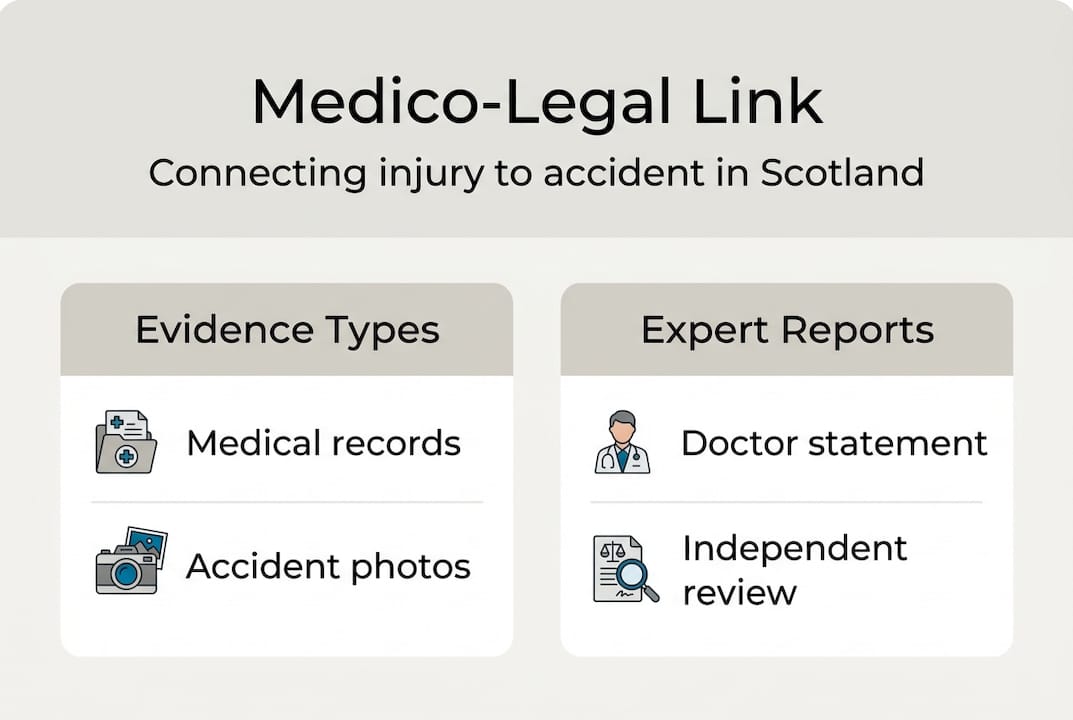
Pro Tip: Commission an independent medico-legal report from a specialist who has not previously treated you. Scottish courts view these as more objective than reports from your own GP, and they often carry significantly more weight during negotiations or at proof (trial).
Familiarise yourself with the injury claim documents required for Scottish claims, and understand the broader role of evidence in injury claims before you begin assembling your file. The claims advisory guide from MDDUS also provides useful context on Scottish procedures.
What you need before starting: evidence and requirements checklist
Before you contact a solicitor or submit any paperwork, you should have a clear picture of what you already hold and what still needs to be gathered. The table below summarises the core evidence categories and their purpose.
| Evidence type |
Purpose |
Priority |
| Medical records |
Prove injury severity and treatment |
Essential |
| Accident/incident report |
Establish when and where it happened |
Essential |
| Photographs of scene and injuries |
Visual corroboration |
High |
| Witness contact details |
Independent testimony |
High |
| Receipts and financial records |
Prove financial losses |
Important |
| Expert medico-legal report |
Link injury to accident |
Essential |
| Police or employer reports |
Official record of incident |
Important |
As noted, expert medical evidence must explicitly link your injury to the accident, which is why an independent specialist report sits at the top of the priority list.
Scottish courts use the Judicial College (JC) Guidelines to assess solatium, which is the legal term for compensation for pain, suffering, and loss of amenity. Additional heads of claim cover services under sections 8 and 9 of the Administration of Justice Act 1982, such as care provided by a family member. Scottish courts apply JC Guidelines for solatium and services claims, so gathering full details of how your injury has affected your daily life is just as important as the medical records themselves.
Documents that claimants frequently overlook include:
- CCTV footage (request it promptly as it is often deleted within 28 to 31 days)
- Email or text message correspondence with employers or property owners about the hazard
- Treatment invoices and prescription costs
- Travel receipts for medical appointments
- A personal injury diary recording daily pain levels and functional limitations
Understanding the importance of documenting evidence from the outset will help you avoid gaps that insurers routinely exploit to reduce settlement offers.
Step-by-step guide to preparing injury evidence
With your checklist ready, follow this sequence to build a legally sound evidence file.
- Seek medical attention immediately. Visit your GP or A&E on the same day if possible. A contemporaneous medical record created close to the accident date is far stronger than one made weeks later.
- Report the accident officially. Notify your employer, the local authority, or the relevant property owner in writing. Request a copy of any incident report completed.
- Photograph everything. Capture the scene, any hazards, your visible injuries, and any damaged property. Ensure your device records timestamps automatically.
- Collect witness details. Obtain full names, addresses, and phone numbers from anyone who witnessed the accident or its immediate aftermath.
- Preserve digital evidence. Write to any business or local authority holding CCTV footage, requesting preservation within days of the accident.
- Keep all financial records. Retain every receipt related to treatment, travel, medication, and any adaptations made to your home or vehicle.
- Commission an independent expert report. Ask your solicitor to instruct a medico-legal expert who can formally link your injury to the accident.
Important: The time limit is generally three years from the date of the accident or from when you first became aware of your injury. Acting quickly also preserves perishable evidence such as CCTV recordings.
For claims up to £25,000, a compulsory pre-action protocol applies in Scotland, requiring early disclosure of evidence before court proceedings begin. This means your evidence file must be substantially complete before you even issue a formal claim.
| Evidence preparation level |
Typical outcome |
| Standard (own account only) |
Higher risk of reduced or disputed settlement |
| Good (medical records plus photos) |
Reasonable prospect of fair settlement |
| Best practice (full file, independent expert, financial records) |
Strongest position for maximum compensation |
Pro Tip: Date and timestamp every document as you collect it. Create a simple folder on your phone or computer labelled with the accident date, and save everything there immediately. Lost or undated evidence is one of the most avoidable reasons claims are weakened.
Read more about acting quickly after an accident and how the role of evidence in claims shapes your final outcome.
Common mistakes and how to avoid them
Even well-intentioned claimants make errors that significantly reduce their compensation. Knowing what to avoid is just as valuable as knowing what to do.
The most damaging mistakes include:
- Delaying medical treatment. Gaps between the accident and your first medical visit give insurers grounds to argue your injury was not serious or was caused by something else.
- Relying solely on your own account. Your testimony matters, but without corroborating evidence, it is your word against the defender’s.
- Failing to obtain independent medical reports. Prompt treatment and independent expert reports linking injury to accident are essential; without them, the medico-legal connection is weak.
- Incomplete claim forms. Missing fields or vague descriptions of your injury and its impact give insurers room to undervalue your claim.
- Losing or discarding receipts. Financial losses form a significant part of many claims; without receipts, these heads of damage are difficult to prove.
- Ignoring the pre-action protocol. Failing to disclose evidence at the required stage can result in cost penalties or a weakened negotiating position.
- Missing the three-year deadline. This is the most severe error of all.
The three-year time limit is rigid under Scottish law. Late claims are almost always refused, and courts have very limited discretion to extend it. Do not assume you have plenty of time; CCTV footage disappears within weeks, witnesses’ memories fade, and physical evidence degrades.
For practical strategies on maximising compensation and understanding how compensation is calculated in Scotland, review these resources before finalising your evidence file.
Verifying your evidence: ensuring readiness for Scottish courts
Once you have gathered your evidence, the final stage is verifying that it will withstand legal scrutiny. Follow this process before any settlement discussions or court proceedings.
- Review your file with a solicitor. A specialist personal injury solicitor will identify gaps, inconsistencies, or documents that need updating before your case proceeds.
- Check all evidence is dated and signed. Undated photographs or unsigned witness statements carry significantly less weight in Scottish proceedings.
- Confirm the medico-legal link is explicit. Your expert report must state clearly that your injury was caused by or materially contributed to by the accident in question.
- Assess financial loss documentation. Every head of financial claim should be supported by a receipt, invoice, or payslip. Estimates without backing documents are routinely challenged.
- Consider multi-disciplinary expert input. For complex injuries, reports from multiple specialists (orthopaedic surgeon, neurologist, occupational therapist) build a fuller picture of your losses.
| Evidence check |
Ready? |
| Medical records obtained |
Yes / No |
| Independent expert report commissioned |
Yes / No |
| All documents dated and signed |
Yes / No |
| Financial loss receipts collected |
Yes / No |
| Witness statements in writing |
Yes / No |
| CCTV or digital evidence preserved |
Yes / No |
Specialist solicitors can help obtain missing evidence, instruct expert witnesses, and navigate Scottish-specific procedures such as the All Scotland Personal Injury Court. Do not wait until the eve of a hearing to seek this support.
For further guidance on what to expect financially, review compensation payout guidance and the personal injury rights guide for Scotland.
Why most injury claims falter: our hard-won lessons on evidence
Here is something the standard guides rarely say plainly: more documents do not automatically mean a stronger claim. We see claimants arrive with folders stuffed with printouts, yet their case still struggles because the evidence lacks independence, clarity, or a coherent legal narrative.
Scottish courts are not impressed by volume. They are impressed by precision. A single well-written independent medico-legal report that explicitly connects your injury to the accident will outperform a dozen GP letters that simply describe your symptoms.
DIY claims without expert input frequently underperform not because claimants are dishonest, but because they do not know which questions the evidence must answer. The defender’s insurer does know, and they will probe every gap. The claimants who achieve the best outcomes are those who treat evidence preparation as a legal exercise, not an administrative one.
Organisation and early legal review make the largest difference. Reviewing the vital evidence for claims with a specialist before submitting anything is the single most effective step you can take.
Take the next step with expert guidance
Preparing injury evidence correctly is genuinely complex, and the stakes are high. A specialist Scottish solicitor can review your existing evidence, identify what is missing, and instruct the right experts to strengthen your case before you enter any settlement negotiation. Scotland Claims connects you with experienced injury lawyers in Scotland who understand the specific procedures of Scottish courts. You can also use our compensation calculator to get an early estimate of what your claim may be worth. All of our services operate on a No Win No Fee basis, meaning you pay nothing upfront and keep 100% of your compensation if your claim succeeds.
Frequently asked questions
What is the time limit for preparing injury evidence in Scotland?
The legal time limit is three years from the date of the accident or from when you first became aware of your injury. Acting early also protects perishable evidence such as CCTV footage.
Do I need independent medical reports for my claim?
Independent medical or expert reports are strongly recommended because expert reports linking injury to accident carry far greater weight with Scottish courts and insurers than standard GP letters alone.
Can a solicitor help if I’m missing evidence?
Scottish solicitors can obtain missing evidence, instruct expert witnesses, and guide you through procedures such as the All Scotland Personal Injury Court to strengthen your claim.
What happens if I miss the three-year deadline?
Claims submitted after the three-year limit are almost always refused by Scottish courts, and judicial discretion to extend the period is extremely limited, so early action is essential.
Recommended