Loss of society Scotland: how to claim and what to expect
If someone close to you has died as a result of another party’s negligence, you have the right to claim for loss of society under section 4(3) of the Damages (Scotland) Act 2011. This covers the grief, distress, anxiety and loss of companionship or guidance you have suffered as a direct result of that wrongful death. Unlike the capped bereavement awards available elsewhere in the UK, Scotland imposes no statutory ceiling on these awards, meaning the sum you recover depends on the strength of your evidence and the closeness of your relationship with the deceased.
The key facts at a glance:
- Statutory right: Section 4(3) of the Damages (Scotland) Act 2011 creates the right to claim for non-financial loss following a wrongful death.
- What it covers: Distress and anxiety suffered before the death, grief and sorrow after it, and the loss of the deceased’s society and guidance.
- Who can claim: Spouses, civil partners, cohabitees, parents, grandparents, children, grandchildren, and those treated as family, including step-relatives and adopted relatives.
- No fixed tariff: Courts assess each claim individually; awards in close relationships have historically ranged from tens of thousands to over £100,000.
- Key cases: Manson v Henry Robb [2017] CSOH 126 and Paterson v Lanarkshire Health Board [2023] CSOH 1 both illustrate how courts weigh closeness and evidence.
- Practical next step: Contact a specialist Scottish personal injury solicitor for a free assessment. Scotland Claims Injury Lawyers operates on a No Win No Fee basis, meaning you pay nothing upfront and keep 100% of your compensation if successful.
As Lexology’s guidance on loss of society claims confirms, the right to claim follows a wrongful death caused by negligence, and the award compensates non-financial harm rather than attempting to place a monetary value on a life.
Key takeaways
Loss of society claims in Scotland are governed by section 4(3) of the Damages (Scotland) Act 2011, and the award you receive depends almost entirely on the quality of evidence you present about the closeness of your relationship with the deceased.
| Point |
Details |
| Statutory basis |
Section 4(3) of the Damages (Scotland) Act 2011 creates the right to claim for grief, distress and loss of society. |
| Who can claim |
Immediate family and those treated as family, including step-relatives, cohabitees and adopted relatives. |
| No fixed tariff |
Awards range from token sums for estranged relatives to over £100,000 for close partners or parents, depending on evidence. |
| Evidence is decisive |
Witness statements, contemporaneous messages, photos and medical records directly shape the size of the award. |
| Scotland Claims Injury Lawyers |
Handles fatal accident claims across Scotland with No Win No Fee and zero success fee, so clients keep 100% of their compensation. |
Table of Contents
Who can bring a loss of society claim in Scotland?
The Damages (Scotland) Act 2011 sets out the categories of relative entitled to claim. The list is broader than many people expect.
Statutory categories include:
- Spouse or civil partner of the deceased
- A person who lived with the deceased as a spouse or civil partner for at least two years immediately before the death
- Parent or grandparent
- Child or grandchild
- Brother or sister
- Uncle or aunt
- Nephew or niece
The Act also extends to adopted relatives, step-relatives, and anyone who was treated as a relative in practice, provided that closeness can be evidenced. A step-parent who raised a child from infancy, for example, may recover a comparable award to a biological parent if the relationship was genuinely close. Courts look at the substance of the relationship, not just the legal label.
The right to claim depends on liability being established. Loss of society is not a standalone remedy. The deceased must have had a valid personal injury claim at the time of death, and that liability must be proved before any award is made. Where liability is disputed, the claim will need to be litigated or negotiated on that basis first.
Special situations worth knowing:
- Children under 16 can claim through a guardian or the executor of the estate.
- Estranged relatives fall within the statutory categories but typically receive lower awards, sometimes token sums, reflecting limited contact and reduced closeness.
- Cohabitees must demonstrate they lived with the deceased as a spouse or civil partner for at least two years immediately before the death.
Recent Law Society of Scotland commentary confirms that courts examine closeness and the role of the deceased in the claimant’s life rather than simply checking a legal category. Being on the statutory list gets you through the door; the quality of your evidence determines what you recover.
Pro Tip: Before instructing a solicitor, write down the names of everyone who lived with the deceased, who they treated as family, and who had regular contact with them. This initial list often reveals claimants who did not realise they were entitled to bring a claim.
What does loss of society compensate for, and how do courts value it?
Section 4(3) of the 2011 Act identifies four distinct heads of non-patrimonial loss:
- Distress and anxiety suffered in contemplation of the deceased’s suffering before death
- Grief and sorrow caused by the death itself
- Loss of society and guidance — the companionship, moral support and practical guidance the deceased provided
- Loss of non-patrimonial benefits the claimant would have received from the relationship
Courts do not need to apportion an award between these sub-heads. The total sum reflects the overall impact on the claimant’s life.
How courts assess value
There is no fixed tariff in Scotland, which is both a challenge and an opportunity. The Law Society of Scotland has noted historical inconsistency between jury and judicial awards, and stresses that detailed, evidence-based presentations of family dynamics are what drive valuation. Juries have historically awarded more than judges sitting alone, but recent judicial decisions show that substantial awards are achievable in court without a jury.
Factors courts weigh:
- Closeness and quality of the relationship
- The role the deceased played in the claimant’s daily life (caregiver, breadwinner, confidant)
- Age and life expectancy of the deceased at the time of death
- Age and dependency of the claimant
- Frequency and nature of contact
- Whether the claimant suffered a diagnosable psychological injury as a result
A younger deceased person with a long expected life ahead generally produces a higher award than an elderly person whose life expectancy was already limited. That said, the grief of losing an elderly parent is still compensable; the award simply reflects the shorter period of future society lost.
Illustrative award ranges
Practitioners have historically cited indicative brackets when advising clients. These are not binding and every case turns on its own facts, but they give a realistic starting point.
| Relationship |
Illustrative range (indicative only) |
| Spouse or civil partner |
tens of thousands to over £100,000 |
| Child of the deceased |
tens of thousands to over £100,000 |
| Parent of the deceased |
tens of thousands |
| Grandparent or grandchild |
Lower; case-specific |
| Estranged sibling |
Token to modest sum |
These figures come from practitioner advice notes cited in Law Society of Scotland guidance and should be treated as illustrative only. The actual award in your case could be higher or lower depending on the evidence you present.
Key point: Scotland has no statutory cap on loss of society awards, unlike the fixed bereavement award available in England and Wales. The ceiling is set by the evidence, not the legislation.
What evidence do you need to prove closeness of relationship?
The evidence you gather in the weeks after a death can make a material difference to the award you receive. Courts do not take family titles at face value. A solicitor will build a narrative of the relationship from the ground up, and the more granular the detail, the stronger the claim.
Core evidence checklist:
- Witness statements from family members, friends, neighbours or colleagues who observed the relationship directly
- Contemporaneous messages — text messages, WhatsApp conversations, emails and social media exchanges that show the frequency and warmth of contact
- Photographs and videos documenting shared activities, family occasions and everyday moments together
- Diary entries or personal letters written by either party
- Medical or counselling records showing the psychological impact of the bereavement on the claimant
- School or childcare records where the deceased played a parenting or guardianship role
- Financial and household records where the deceased provided practical guidance or support (utility bills, joint accounts, shared tenancy agreements)
Practitioners build strong claims from behavioural evidence rather than relying on formal family titles. Frequency of contact, household roles, caregiving tasks and digital messages all help reframe a relationship in concrete terms. A claimant who can show weekly Sunday dinners, daily phone calls and a pattern of practical support will recover more than one who simply asserts they were close.
Using witnesses effectively: Ask people who knew both you and the deceased, not just those who knew the deceased alone. A good witness statement describes specific incidents, regular routines and the emotional texture of the relationship. Vague statements that simply say “they were very close” carry little weight.
Pro Tip: Preserve digital evidence immediately. Screenshot text message threads with timestamps, download email chains as PDFs and save social media posts to a secure folder. Platforms delete accounts and message histories after a period of inactivity, and once that evidence is gone, it cannot be recovered.
When a claimant has suffered a diagnosable condition such as complicated grief disorder or post-traumatic stress, a psychiatric or psychological expert report can significantly increase the award. Solicitors will advise whether this is appropriate based on the claimant’s circumstances.
A Fatal Accident Inquiry may run alongside or before a civil claim. The evidence and findings from that process can be used to support the civil case, so it is worth preserving all documentation from any inquiry proceedings.
How does a loss of society claim progress in Scotland?
The process follows a broadly predictable sequence, though the timeline varies considerably depending on whether liability is disputed and how many claimants are involved.
-
Initial enquiry and evidence gathering. You contact a solicitor, provide details of the death and your relationship to the deceased, and begin collecting the evidence described above. A good solicitor will give you a clear list of what to gather at this first meeting.
-
Liability investigation. The solicitor investigates whether the death was caused by another party’s negligence. This may involve obtaining accident reports, medical records, witness accounts and expert engineering or medical opinions. This stage can take several months in complex cases.
-
Letter of claim. Once liability evidence is assembled, the solicitor sends a formal letter of claim to the defender or their insurer. The defender has a set period to respond and investigate.
-
Negotiation or court proceedings. Many claims settle at this stage through negotiation. If the defender disputes liability or the quantum of loss, the solicitor will raise court proceedings in the Court of Session or Sheriff Court, depending on the value and complexity of the claim.
-
Proof or jury trial. If the case proceeds to a hearing, it will be decided either by a judge alone (a proof) or by a jury of 12 in the Court of Session. Jury trials have historically produced higher awards, though the choice of forum involves strategic considerations your solicitor will advise on.
-
Award and enforcement. Once judgment is granted or a settlement agreed, the award is paid. Funeral expenses and other patrimonial losses are recovered alongside the loss of society award. You can read more about how compensation payouts are structured in Scottish injury claims to understand how these elements fit together.
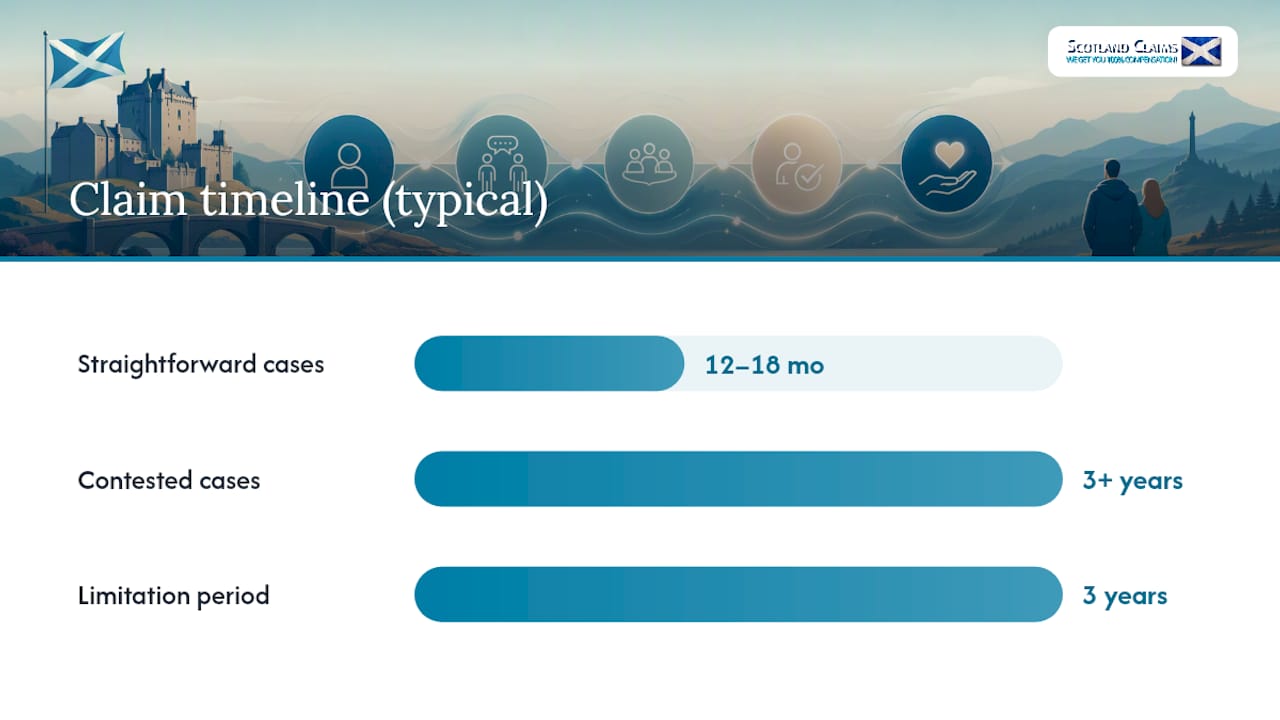
Time limits. Fatal accident claims in Scotland are subject to a three-year limitation period running from the date of death or, in some cases, from the date the claimant became aware that negligence caused the death. Missing this deadline will ordinarily bar the claim entirely. If you are approaching the three-year mark, seek legal advice immediately.
Straightforward cases where liability is admitted can settle within 12 to 18 months. Contested cases involving complex medical evidence or multiple claimants can take three years or more. Starting early gives your solicitor time to build the strongest possible case.
What the case law tells us about how courts value these claims
Two decisions stand out for claimants trying to understand how Scottish courts approach loss of society awards.
Manson v Henry Robb [2017] CSOH 126
This case addressed the effect of reduced life expectancy on the award. The court’s reasoning made clear that where the deceased’s life expectancy was already shortened before the negligent act, the award for loss of future society must reflect the period of life that was actually lost to the negligence, not the full natural lifespan. The practical lesson: if the deceased had a pre-existing condition, the solicitor must carefully establish what life expectancy would have been with and without the negligent act, and present that evidence clearly. Failing to do so risks a lower award than the facts justify.
Paterson v Lanarkshire Health Board [2023] CSOH 1
This decision is particularly instructive because it shows the range of awards within a single family following one death. The court’s judgment awarded the deceased’s mother £100,000, each of the children £70,000, and estranged siblings only £5,000 each. The difference was not the legal category of relative but the quality of the evidence about closeness and the nature of the relationship. The estranged siblings were on the statutory list; they simply could not demonstrate the depth of relationship that commands a substantial award.
Lessons from both cases:
- Life expectancy evidence must be precise and properly sourced from medical experts.
- Closeness is proved, not assumed. A sibling who lived abroad and had minimal contact will recover far less than one who spoke to the deceased daily.
- Estrangement does not bar a claim, but it substantially reduces the award.
- The gap between a well-evidenced and a poorly evidenced claim in the same family can be £65,000 or more, as Paterson demonstrates.
Solicitors who understand this variability will often prepare alternative quantification schedules covering a best-case, likely and modest outcome, then test these in early negotiations to anchor insurer offers before any court hearing.
How a specialist solicitor improves your chances
A specialist Scottish personal injury solicitor does far more than fill in forms. In a loss of society claim, the solicitor’s work directly shapes the award you receive.
Core tasks a specialist handles:
- Investigating liability and gathering technical evidence (accident reconstruction, medical causation opinions)
- Identifying all eligible claimants within the family and coordinating their individual claims
- Preparing detailed witness statements and coaching witnesses on what the court needs to hear
- Instructing psychiatric or psychological experts where a diagnosable condition is present
- Drafting court pleadings that frame the relationship evidence in the most persuasive terms
- Negotiating with insurers using alternative quantification schedules to maximise the settlement offer
- Advising on the strategic choice between a proof before a judge and a jury trial
Funding. Scotland Claims Injury Lawyers operates on a No Win No Fee basis. No success fee is deducted from your award.
What to bring to your first appointment:
- The deceased’s full name, date of birth and date of death
- A brief account of how the death occurred and who you believe was responsible
- Details of your relationship to the deceased (how long you knew them, how often you were in contact, what role they played in your life)
- Any documents you have already gathered (death certificate, accident reports, correspondence from insurers)
- Contact details for any witnesses who knew the relationship well
The first meeting is a free assessment. You are not committing to anything. The solicitor will tell you whether the claim has merit, what evidence is needed and what the realistic range of outcomes looks like. Use the compensation calculator to get an initial sense of the figures before you call.
Why evidence is the difference between a modest award and a just one
Placing a monetary value on the loss of someone you loved is an uncomfortable exercise. The law does not pretend that money replaces a person. What section 4(3) of the Damages (Scotland) Act 2011 does is recognise that the grief, the absence of guidance and the loss of daily companionship are real harms that deserve real recognition.
What strikes me most, having followed Scottish fatal accident litigation closely, is how often the outcome turns not on the law but on the story. The statutory framework is clear. The categories are defined. What separates a £100,000 award from a £35,000 one is the granularity of the evidence: the text messages that show daily contact, the neighbour who can describe the deceased dropping everything to help, the diary entry written the week before the accident. Courts respond to specificity because specificity is credible.
Insurers know this too. A claim backed by detailed contemporaneous evidence and a well-prepared witness statement is harder to undervalue in negotiation. A claim that rests on a bare assertion of closeness is easy to discount. The Law Society’s own guidance on valuing loss of society makes this point plainly: detailed, evidence-based presentations of family dynamics are what drive consistent, fair outcomes.
The No Win No Fee model matters here too. Removing the financial barrier to specialist representation means claimants are not forced to accept an early, undervalued offer simply because they cannot afford to press on. That changes the negotiating dynamic entirely.
Start your loss of society claim with Scotland Claims Injury Lawyers
Losing someone to a preventable death is devastating. Getting the compensation you are legally entitled to should not add to that burden. Scotland Claims Injury Lawyers handles personal injury and fatal accident claims across Scotland on a No Win No Fee basis. You pay nothing upfront, and if your claim succeeds, you keep every penny of your award. No success fee. No deductions.
To start, you can submit an online claim form, request a callback or speak directly with a specialist. Have the deceased’s details, a brief account of the circumstances and any documents you have already gathered ready when you call. The initial assessment is free and carries no obligation.
Speak with a specialist today via Scotland Claims Injury Lawyers or use the compensation calculator to get an initial estimate of what your claim may be worth.
Sources
The following primary sources and commentary are cited throughout this guide. They are provided for reference; practical advice on your specific circumstances should come from a qualified Scottish solicitor.
This article is general information, not a substitute for advice from a qualified lawyer. Consult a qualified legal professional about your own circumstances before acting on anything here.
FAQ
What are the requirements for making a loss of society claim in Scotland?
You must be within the statutory categories of relative set out in the Damages (Scotland) Act 2011, the death must have been caused by another party’s negligence, and you must bring the claim within three years of the date of death. Evidence of the closeness of your relationship with the deceased is central to the value of the award.
How is the value of a loss of society award assessed?
There is no fixed tariff. Courts consider the closeness of the relationship, the role the deceased played in the claimant’s life, the age and life expectancy of the deceased, and the quality of the evidence presented. Indicative practitioner ranges run from around £35,000 for a parent to over £100,000 for a spouse or civil partner, but every case turns on its own facts.
The Act covers spouses, civil partners, cohabitees of at least two years, parents, grandparents, children, grandchildren, siblings, aunts, uncles, nephews and nieces. Step-relatives, adopted relatives and those treated as family in practice are also included, provided closeness can be evidenced.
Can an estranged relative still bring a loss of society claim?
Yes, but the award will typically be much lower. As Paterson v Lanarkshire Health Board [2023] illustrates, estranged siblings in the same family as close relatives received £5,000 each while the mother received £100,000. Being on the statutory list is not enough; the court examines the actual quality and frequency of the relationship.
Recommended