What is a fatal accident inquiry in Scotland?

TL;DR:
- A fatal accident inquiry in Scotland investigates death circumstances without assigning blame or liability. The process, focusing on facts and systemic improvements, involves families’ participation and is separate from civil claims. Recent reforms aim to reduce delays and offer free legal aid, helping families seek justice and understanding.
Losing someone unexpectedly is devastating. Then, just when you think you understand what comes next, a letter arrives mentioning a fatal accident inquiry, and suddenly the legal process feels completely alien. Understanding what is a fatal accident inquiry matters because most people assume it works like a criminal trial, with blame, verdicts, and punishment. It does not. A fatal accident inquiry (FAI) is a fact-finding court proceeding held in Scotland that investigates the circumstances of certain deaths, with no criminal or civil liability attached to its findings.
Table of Contents
Key takeaways
| Point |
Details |
| No blame is assigned |
An FAI investigates how a death occurred without attributing criminal or civil fault to anyone. |
| Some FAIs are mandatory |
Deaths in custody, secure accommodation, or workplace accidents automatically trigger an FAI. |
| Families can participate |
Bereaved families have the right to be legally represented and to engage with the inquiry process. |
| Recommendations carry real weight |
A sheriff’s recommendations are not legally binding but frequently lead to significant reforms in public systems. |
| Free legal aid now available |
Since April 2025, families in custody death FAIs can access non-means-tested legal aid at no personal cost. |
When and why an FAI is held
Scotland holds around 50 to 60 FAIs each year. The legal framework governing this process sits within the Inquiries into Fatal Accidents and Sudden Deaths etc. (Scotland) Act 2016, which replaced older legislation and clarified when an inquiry must or may be held.
Some FAIs are mandatory. The law requires them in these specific circumstances:
- A death that occurs while someone is in legal custody, such as in prison or a police cell
- A death that occurs in secure accommodation for children or young people
- A death caused by a workplace accident, where the deceased was engaged in their employment at the time
Beyond mandatory cases, the Lord Advocate decides whether a discretionary FAI should be held. This decision is based on whether it is in the public interest to investigate, taking into account the circumstances of the death, whether it was sudden or unexplained, and whether systemic questions about safety remain unanswered.
An FAI is not the same as a public inquiry. Public inquiries are broader, typically government-commissioned investigations into events of significant national concern. An FAI is a court-based process presided over by a sheriff, focused on the specific facts of an individual death. Understanding this distinction helps families approach the process with the right expectations and avoids unnecessary confusion about what outcomes are possible.
How the FAI process works
The fatal accident inquiry process begins long before anyone sets foot in court. The Procurator Fiscal and their specialist units conduct an initial investigation, gathering evidence from medical records, witness statements, expert reports, and site inspections. This can take months, sometimes longer, particularly where deaths involve complex medical or technical questions.
The inquiry itself is inquisitorial in character. That word matters. Unlike an adversarial court case where opposing sides fight to win, an inquisitorial process is designed to get to the truth through open examination of evidence. No one is on trial. No one faces a finding of guilt.
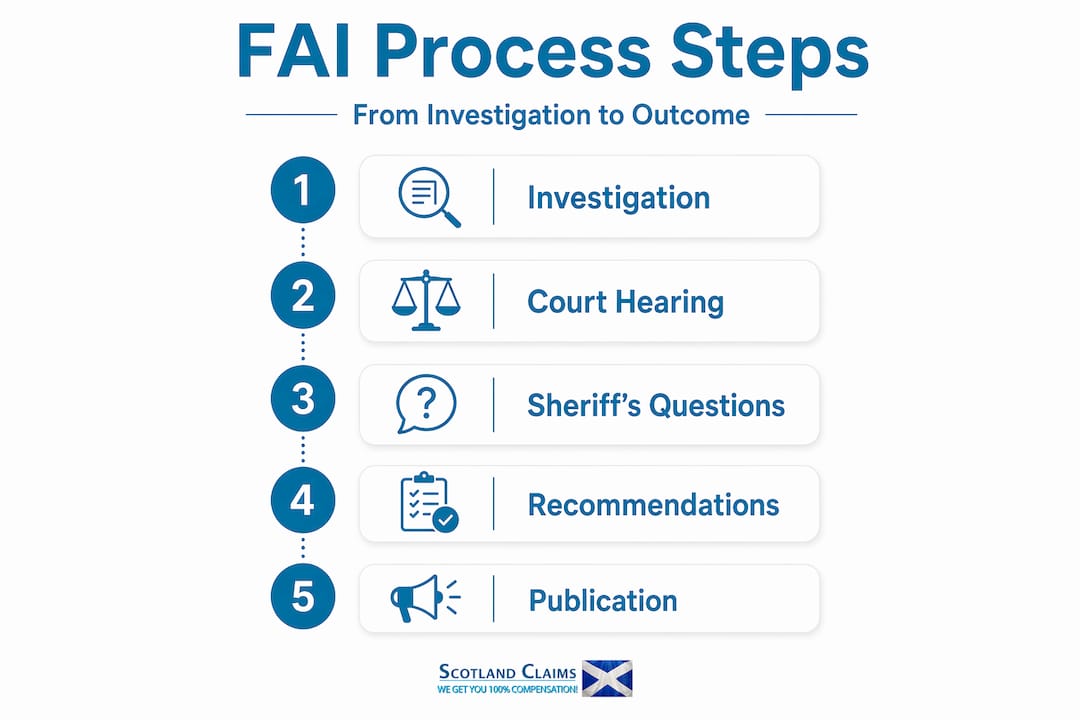
Here is the sequence a typical FAI follows:
- The Procurator Fiscal lodges a petition with the sheriff court and notifies interested parties, including close family members.
- Preliminary hearings are held to agree the scope of the inquiry, the witnesses to be called, and the documents to be lodged.
- The main hearing takes place, during which witnesses give evidence and are questioned by the sheriff and legal representatives.
- The sheriff issues a written determination, which must address five specific statutory questions.
Those five questions are: when the death occurred, where the death occurred, what caused it, whether any reasonable precaution could have prevented it, and whether any defect in a system of working contributed to the death. The sheriff may also add recommendations to prevent future deaths.
Pro Tip: The sheriff’s determination is a public document. Once published, it can be reviewed by families, legal advisers, and anyone considering a related civil claim, so it is worth obtaining and reading carefully with a solicitor.
Those recommendations, while not legally binding, carry genuine moral and political weight. Government bodies, prisons, NHS trusts, and employers routinely accept and implement them, because ignoring a sheriff’s recommendations after a public FAI carries serious reputational consequences.
For many years, bereaved families described the FAI experience as deeply difficult. The Scottish Human Rights Commission found that families used words like “brutal” and “traumatising” to describe their involvement. The legalistic atmosphere, combined with long delays and a perceived lack of compassion, left many feeling invisible in a process supposedly held in the interest of the public good.

That feedback triggered significant change. In 2026, an independent review produced 34 recommendations to transform how FAIs operate, with a particular focus on reducing delays, improving communication with families, and embedding trauma-informed practices at every stage of the process.
The most immediate practical change came in April 2025. Since that date, families of those who died in custody now have access to free, non-means-tested legal aid for their FAI. This means your financial situation is irrelevant. You are entitled to legal representation regardless of your income, and you pay nothing for it.
“Engagement of families in FAIs requires careful balancing of legal requirements with trauma-informed support, an area undergoing significant reform since 2025.” — Scottish Human Rights Commission
Pro Tip: Awareness of the April 2025 legal aid change remains low. If your loved one died in custody and you have not yet been told about this entitlement, contact the Scottish Legal Aid Board directly or speak to a solicitor who specialises in fatal accident inquiries.
These reforms reflect a broader recognition that the fatal accident inquiry process exists to serve families and the public, not just the legal system. The shift toward genuinely trauma-informed care is long overdue, and the 2026 review gives real grounds for optimism.
What notable FAIs have achieved
Looking at specific cases helps illustrate the genuine impact the FAI process can have. The 2025 joint FAI determination into the deaths of Martyn Smith and John White at HMP Polmont is one of the most instructive recent examples.
The HMP Polmont inquiry identified systemic and environmental failings across multiple areas. The sheriff’s determination found that ligature points within the prison environment had contributed to the deaths, that information sharing between agencies was inadequate, and that staff had not received sufficient training to identify and respond to risk.
| FAI example |
Key findings |
Reforms recommended |
| HMP Polmont (2025) |
Ligature points; poor agency communication; staff training gaps |
Audit prison environment; improve information sharing; strengthen staff training |
| Multiple custody death FAIs |
Inadequate risk assessment systems across the prison estate |
Systemic review of monitoring and care protocols |
Those recommendations were accepted and form part of ongoing prison reforms in Scotland. This is the practical value of the FAI process. It does not punish anyone for the deaths of Martyn Smith and John White. What it does is demand that their deaths mean something, that systems are changed so others do not face the same fate.
Beyond prisons, FAI findings have influenced NHS practice, workplace safety regulations, and emergency service protocols. The inquiry into fatal accidents across these sectors often reveals patterns that no single organisation would have spotted alone, and the sheriff’s public determination gives those findings a legitimacy and visibility that internal reviews rarely achieve.
How families can engage with an FAI
If you are a close relative of someone whose death is subject to an FAI, you are an interested party. That is a formal legal status, and it entitles you to do several things that many families do not realise they are allowed to do.
- You will be notified when the inquiry is to be held and given details of the preliminary hearings.
- You can instruct a solicitor to represent you throughout the process, asking questions of witnesses on your behalf.
- You can review the evidence lodged with the court, including post-mortem reports and expert statements.
- You can submit a personal statement about your loved one, humanising the inquiry beyond its legal framework.
- You can attend all hearings, including the final determination, and receive a copy of the sheriff’s written findings.
The FAI is entirely separate from any civil compensation claim you may wish to pursue. The two processes can run alongside each other, and findings from an FAI can sometimes provide useful evidence to support a subsequent claim. That said, the three-year time limit for personal injury and death claims in Scotland applies regardless of whether an FAI is ongoing, so you should not wait for the inquiry to conclude before taking legal advice on compensation.
Pro Tip: Gather and preserve all documentation connected to the death from the outset, including medical records, correspondence with employers or institutions, and any communications from the Procurator Fiscal. This evidence can support both your engagement with the FAI and any separate claim.
Understanding your right to document evidence carefully from the beginning can make a considerable difference to how well-prepared you feel going into hearings.
My perspective on the FAI system
I have seen enough families approach the FAI process with completely the wrong expectations, and it costs them dearly in terms of emotional preparation and strategic decisions. The most common mistake is assuming the inquiry will deliver justice in the way a criminal trial might. It will not. It cannot.
What I have come to respect about the inquisitorial model is that it creates space for the truth to emerge without witnesses or institutions going into defensive mode. When people are not facing criminal sanction, they are more likely to be honest about what went wrong. That honesty, when it comes, is often what families actually need most, even if they did not know it going in.
Where the system has genuinely failed, in my view, is not in its structure but in its execution. Delays of two or three years before an FAI concludes are not unusual. For families, that is two or three years without closure, without answers, often without adequate legal support. The 2025 legal aid reform and the 2026 review recommendations are meaningful steps. Whether they translate into real change depends entirely on implementation.
My advice to any family entering this process is to get legal representation early, even if you feel reluctant to add more formality to an already difficult situation. You are not there to fight anyone. You are there to understand what happened to someone you loved. A good solicitor will make sure the process serves that purpose.
— Roger
How Scotland Claims Injury Lawyers can help after a fatal accident
If your family is dealing with the aftermath of a fatal accident, understanding the FAI process is only one part of the picture. A separate and equally significant question is whether you are entitled to compensation for your loss. At Scotlandclaims, our specialist injury lawyers in Scotland work with bereaved families to assess whether a claim for damages can be pursued alongside or after an FAI.
We operate on a no win no fee basis, meaning you pay nothing upfront and face no financial risk. For serious injuries and fatal accident claims, we keep 100% of your compensation intact - we never deduct a success fee on any claim type, meaning you receive every penny awarded. Most large and national firms charge up to 20% including VAT, so our commitment to zero deductions puts significantly more money in your pocket. If your case is unsuccessful, you pay nothing at all. Contact Scotland Claims Injury Lawyers today to speak with a specialist who understands both the inquiry process and your rights to compensation.
FAQ
What is the purpose of a fatal accident inquiry?
A fatal accident inquiry is a Scottish court proceeding that investigates the circumstances of certain deaths. Its purpose is to establish the facts, not to assign criminal or civil blame to any individual or organisation.
Who decides if a fatal accident inquiry is held?
Mandatory FAIs are required by law for deaths in custody, secure accommodation, and workplace accidents. For all other cases, the Lord Advocate decides whether it is in the public interest to hold one.
Can families attend and participate in an FAI?
Yes. Close relatives are classified as interested parties and can instruct a solicitor to represent them, attend hearings, review evidence, and receive the sheriff’s written determination.
Are the sheriff’s recommendations legally enforceable?
No. The sheriff’s recommendations are not legally binding, but they carry significant weight and public bodies frequently implement them to avoid reputational and political consequences.
Can I claim compensation as well as being involved in an FAI?
Yes. The FAI is entirely separate from a civil compensation claim. Both can proceed at the same time, and Scotland’s three-year claims deadline applies from the date of death, regardless of whether an FAI is underway.
Recommended