How to claim lost wages in Scotland: injury guide

TL;DR:
- Claiming lost wages in Scotland requires proof of negligence causing injury and wage loss.
- Gathering thorough documentation like payslips, employer letters, medical records, and witness statements is essential.
- Most claims are settled through negotiation; professional legal advice helps maximize compensation.
After an accident leaves you unable to work, the financial pressure can feel just as painful as the injury itself. Many people in Scotland are unaware that they may be entitled to reclaim every penny of earnings lost while recovering, provided another party was at fault. In Scots law, lost wages are recoverable as patrimonial loss under a personal injury claim. This guide walks you through eligibility, the evidence you need, how to calculate your losses, and what the claims process actually looks like from start to finish.
Table of Contents
Key Takeaways
| Point |
Details |
| Check eligibility |
Negligence and documented wage loss are required for a claim in Scotland. |
| Gather strong evidence |
Payslips, medical records, and employer notes are essential for substantiating lost wage claims. |
| Calculate future loss |
If your injury affects your earnings long-term, use Ogden Tables to calculate future compensation. |
| Negotiate for best outcome |
Most claims are resolved out of court, so negotiation skills and expert legal advice are critical. |
| Get legal guidance |
Solicitors can help handle complex claims and maximise your compensation for lost wages. |
Understanding eligibility for lost wage claims
Before anything else, you need to confirm whether your situation qualifies. Not every injury automatically entitles you to compensation. The foundation of any successful claim rests on proving that another party owed you a duty of care, breached that duty through negligence, and that their negligence directly caused your injury and resulting wage loss.
In Scotland, lost wages are claimed as patrimonial loss, which is the legal term for financial losses caused by someone else’s wrongdoing. This sits alongside solatium, which covers pain and suffering. The two are separate heads of claim, meaning you can recover both.
The types of accidents that commonly qualify include:
- Road traffic accidents where another driver was at fault
- Workplace accidents caused by an employer’s failure to maintain safe conditions
- Slips, trips, and falls on poorly maintained public or private premises
- Assaults where a third party is liable
- Medical negligence resulting in time off work
To confirm your claim eligibility in Scotland, you must show a clear causal link between the negligent act and your inability to work. For example, if a rear-end collision gave you whiplash and your GP signed you off for six weeks, those six weeks of missed pay are directly attributable to the other driver’s negligence.
A common misconception is that minor wage losses are not worth pursuing. That is simply not true. Even if your solatium award is modest because the physical injury was relatively minor, your patrimonial loss claim can still be substantial if you missed several weeks of well-paid work.
“Patrimonial loss covers all financial consequences of an injury, including lost earnings, regardless of the size of the solatium award.”
Pro Tip: Even if you returned to work quickly, keep a record of any reduced hours, overtime missed, or sick pay shortfall. These all count towards your patrimonial loss.
Preparing your claim: documents and evidence needed
Once you have confirmed eligibility, the quality of your evidence will largely determine the strength of your claim. Insurers and courts rely on documentation to verify that your wage loss is genuine and accurately calculated. Weak evidence leads to reduced offers or outright rejection.

Gathering the right paperwork early saves time and stress later. Documentation and evidence are the backbone of any injury-related wage claim, and the more thorough your file, the harder it is for an insurer to dispute your figures.
Here is what you need to collect:
- Payslips covering at least three months before the accident and the period of absence
- A letter from your employer confirming dates of absence and any sick pay received
- Medical records and GP fit notes showing the injury and recovery timeline
- The accident report or police report if one was filed
- Bank statements showing the drop in income during recovery
- Witness statements from colleagues, bystanders, or anyone who saw the accident
| Document type |
Purpose |
| Payslips (pre and post injury) |
Establishes your normal earnings baseline |
| Employer confirmation letter |
Verifies absence and sick pay details |
| GP fit notes and medical records |
Links injury to time off work |
| Accident report |
Establishes fault and circumstances |
| Witness statements |
Corroborates your account of events |
| Bank statements |
Demonstrates actual financial impact |
For a full breakdown of what to gather, the documents needed for injury claims resource covers every category in detail. Understanding the role of evidence in injury claims can also help you prioritise what matters most.
Pro Tip: Create a dedicated folder, physical or digital, from the day of your accident. Drop every receipt, letter, and medical note into it immediately. Disorganised evidence is one of the most common reasons claims take longer than necessary.
Calculating past and future wage loss
Knowing what you are owed requires careful arithmetic. Lost wage claims in Scotland split into two categories: past loss and future loss. Getting both right is essential to recovering the full amount you deserve.
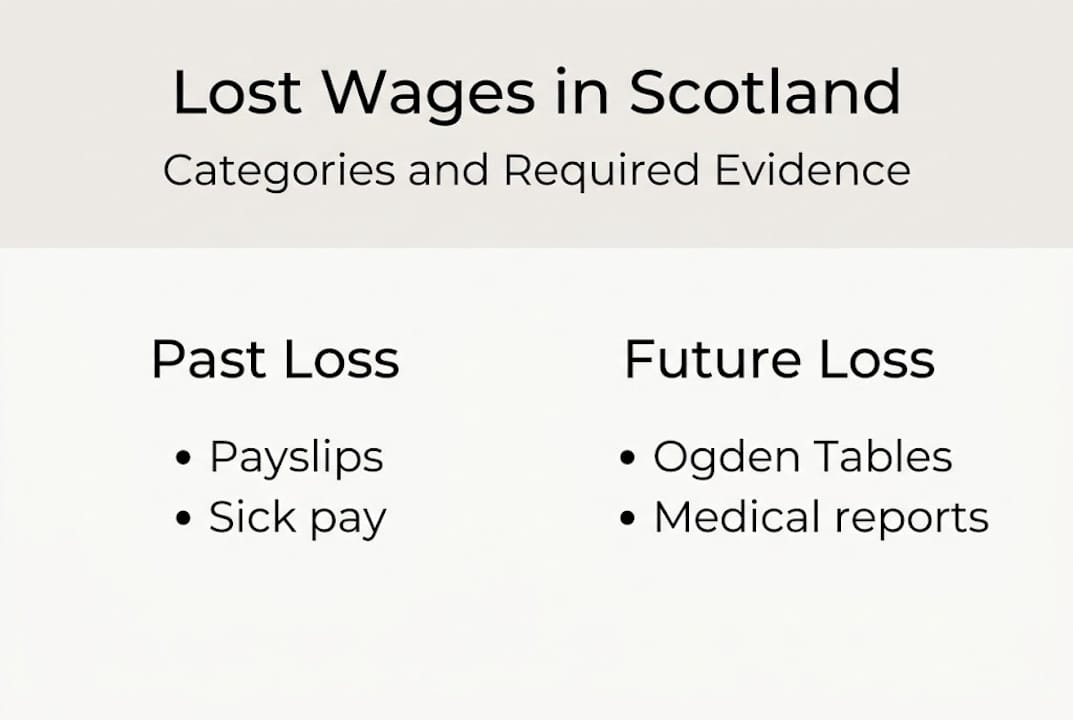
Past wage loss is straightforward. It covers the earnings you actually missed between the date of your accident and the date of settlement or trial. You calculate it by multiplying your net weekly wage by the number of weeks you were unable to work, then deducting any sick pay or state benefits already received.
Here is a simple example:
| Weekly net wage |
Weeks off work |
Gross loss |
Sick pay received |
Net past loss |
| £600 |
10 |
£6,000 |
£1,200 |
£4,800 |
| £800 |
16 |
£12,800 |
£2,000 |
£10,800 |
| £1,000 |
26 |
£26,000 |
£3,500 |
£22,500 |
Future wage loss is more complex. It applies when your injury has a lasting impact on your earning capacity. Future losses use Ogden Tables and are calculated using a multiplicand multiplied by a multiplier.
Here is how to approach the calculation:
- Calculate the multiplicand: your annual net loss of earnings going forward
- Select the correct multiplier: drawn from the Ogden Tables, based on your age, gender, and employment status
- Apply the discount rate: currently set at plus 0.5% in Scotland, which adjusts the lump sum to reflect investment returns
- Deduct any residual earning capacity: if you can still work in a reduced capacity, this reduces the future loss figure
- Review with your solicitor: Ogden Table calculations are sensitive to small errors and should always be verified professionally
For guidance on calculating compensation in Scotland, specialist tools and solicitor advice will give you the most accurate figures.
Pro Tip: In serious injury cases, future wage loss can easily exceed the solatium award by a factor of five or more. Never accept an early settlement offer without first calculating your full future loss.
Taking action: claim process and negotiation
With your documentation assembled and your figures calculated, you are ready to begin the formal claim. The process is more structured than most people expect, and understanding each stage helps you avoid costly mistakes.
Follow these steps to progress your claim:
- Report the accident: ensure it is formally recorded, whether with your employer, the police, or the relevant authority
- Seek medical attention: obtain a formal diagnosis and keep all medical correspondence
- Instruct a solicitor: a specialist personal injury solicitor will draft your claim letter and handle communications
- Submit the claim: your solicitor notifies the at-fault party or their insurer, triggering a formal response period
- Negotiate the settlement: most cases are resolved at this stage through negotiation rather than proceeding to court
- Accept or litigate: if a fair offer is not forthcoming, your solicitor can raise court proceedings
For a detailed walkthrough, the injury claim step-by-step guide covers each stage clearly. If your injury occurred at work, workplace injury claims in Scotland provides specific guidance for employer liability cases. It is also worth noting that some injuries affect mental health as much as physical capacity, and workplace injuries and mental health explains how psychological harm is factored into claims.
Common mistakes that weaken claims include:
- Failing to keep a record of every day missed from work
- Accepting the first offer without calculating future loss
- Missing the three-year limitation period for raising a claim in Scotland
- Underestimating overtime, bonuses, or commission lost during recovery
“Most lost wage claims in Scotland settle through negotiation with insurers, meaning the majority of claimants never see the inside of a courtroom.”
Negotiation is where your solicitor earns their value. Insurers are experienced at minimising payouts, and having professional representation levels the playing field considerably.
What most guides miss: real-world wage claim challenges
Most articles on this subject present the process as a neat checklist. In reality, the subtleties are where claims are won or lost. Solicitors, not official guides, are relied upon precisely because the nuances of negotiation and calculation require genuine expertise.
One area that catches claimants off guard is future loss documentation. Many people focus entirely on what they have already lost and overlook the long-term earning impact of a serious injury. A back injury that limits your ability to perform your trade for the rest of your working life is worth far more than a few weeks of missed pay.
Negotiation is another area where inexperience costs money. Insurers routinely make early, low offers hoping claimants will accept before they understand the full value of their claim. Understanding why legal support matters is not just about convenience. It is about ensuring you do not leave significant money on the table.
“Future losses can dwarf solatium for serious cases, yet many claimants settle early without ever calculating them properly.”
Pro Tip: Always instruct a solicitor before engaging with an insurer. Even a single conversation with an insurer without legal advice can compromise your position.
Connect with expert solicitors to help claim your lost wages
If you have been injured and lost income as a result, taking the right next step matters enormously. At Scotland Claims, we connect you with specialist injury solicitors who understand the full scope of patrimonial loss and will fight to recover every pound you are owed. Our no win no fee claims arrangement means you pay nothing upfront and nothing at all if your case is unsuccessful. Use our compensation calculator to get an initial estimate of what your claim could be worth, then speak to our injury lawyers in Scotland who are ready to guide you through every stage.
Frequently asked questions
What counts as ‘lost wages’ under Scottish law?
Lost wages in Scotland are claimed as patrimonial loss under delict law, covering all earnings missed due to an injury caused by another party’s negligence. This includes salary, overtime, bonuses, and commission.
How do I prove lost earnings for a claim?
You will need payslips, medical reports and accident details, and a written statement from your employer confirming your absence and any sick pay received.
Can I claim for future lost wages after a severe injury?
Yes. Future losses use Ogden Tables and are calculated by multiplying your annual net loss by the appropriate multiplier, adjusted for the current discount rate of plus 0.5%.
Will I need to go to court for a lost wages claim?
Most claims settle through negotiation with the at-fault party’s insurer, with your solicitor managing the process so you rarely need to appear in court.
Recommended