How to appeal denied claims in Scotland: 3-year limit

TL;DR:
- Denied personal injury claims can often be challenged through appeals or negotiations in Scotland.
- Strict deadlines, including 28 days for court appeals and a 3-year claim limit, must be met.
- Legal support through no win no fee solicitors improves chances of success and prevents procedural errors.
Having a personal injury claim denied is genuinely gutting, especially when you are already dealing with pain, financial pressure, and the aftermath of someone else’s negligence. The good news is that a denial does not always mean the end of the road. Whether your claim was rejected by an insurer or dismissed by a Sheriff Court, there are clear, structured steps you can take to challenge that decision in Scotland. This guide covers your appeal rights, the evidence you need, the exact forms to file, and how to get the right legal support so you can move forward with confidence and the best possible chance of success.
Table of Contents
Key Takeaways
| Point |
Details |
| Appeals follow court refusal |
In Scotland, you can only appeal after a Sheriff Court decision, not just insurer denial. |
| Act within strict deadlines |
You have 28 days to appeal a court judgment, and usually three years from injury to start any claim. |
| Legal support is crucial |
Using a specialist solicitor increases your chances of a successful appeal and avoids costly mistakes. |
| No win no fee is low-risk |
You can often access expert support with no money upfront or hidden costs if using no win no fee solicitors. |
| Evidence strengthens appeals |
Gather all denial documents, correspondence, and reports to build a solid challenge. |
Understanding your denial and appeal rights
Before you can mount a challenge, you need to understand exactly what kind of denial you are dealing with. Not all rejections are the same, and the route you take depends entirely on who said no and at what stage.
An insurer denial happens during the negotiation stage, before any court action. The insurer simply refuses your claim or disputes liability. This is not a formal court decision, so there is no legal appeal process as such. Instead, you can challenge it through continued negotiation, by gathering stronger evidence, or by raising a court action against the other party. A court refusal, on the other hand, is a formal judgment issued by a Sheriff. Personal injury rights in Scotland make clear that only a court judgment can be formally appealed through the Scottish court system.
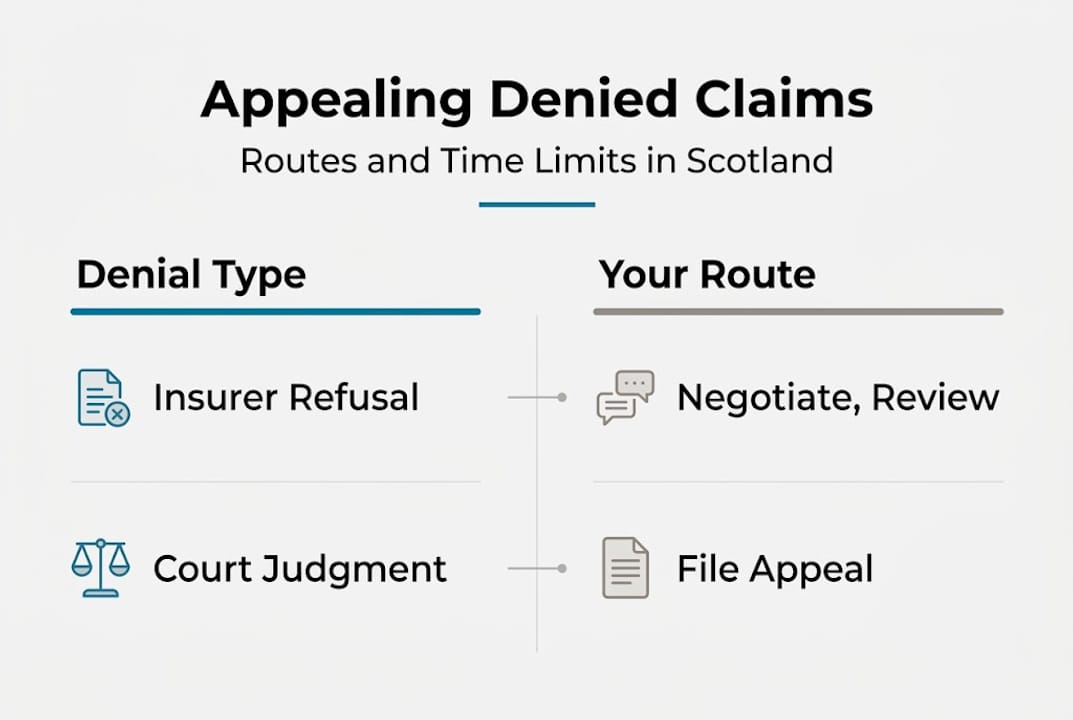
As the court process in Scotland confirms, claims can only be appealed after a court judgment, not following an insurer denial. This distinction matters enormously because it changes your entire strategy.
One of the most important things to know is the time limit. The 3-year time bar applies to almost all personal injury claims in Scotland, running from the date of the accident or the date you became aware of your injury. Extensions are rare and courts are reluctant to grant them, so acting promptly is essential.
Common reasons claims are denied include:
- Missing or weak evidence such as no medical records, witness statements, or accident reports
- Late submission beyond the three-year time limit
- Disputed liability where the other party denies responsibility
- Exaggerated losses that undermine the credibility of the whole claim
- Procedural errors in how the claim was filed or presented
If your claim was for a criminal injury, note that the Criminal Injuries Compensation Authority (CICA) runs a completely separate process with its own review and appeal stages, distinct from the Sheriff Court route.
Know your grounds. A realistic appeal is one based on a clear legal error, a procedural mistake by the court, or a factual misunderstanding that materially affected the outcome. Appeals based purely on disagreement with the result rarely succeed.
Taking time to read the denial letter carefully and identify the specific grounds for refusal is the single most important first step. Many people skip this and jump straight into action without understanding what they are actually challenging. That is a costly mistake. You can also explore common injury claim myths that may have affected how your original claim was handled.
| Denial type |
Who decides |
Your route forward |
| Insurer denial |
Insurance company |
Negotiation or raise court action |
| Sheriff Court refusal |
Sheriff |
Formal appeal to Sheriff Appeal Court |
| CICA denial |
Government body |
Internal review then First-tier Tribunal |
Preparing to appeal: essentials, evidence, and timeframes
Having established your right to an appeal, it is crucial to prepare with the correct evidence and paperwork before you do anything else. Rushing in without the right documents is one of the most common reasons appeals fail.

The 28-day window is critical. After receiving the written court decision (called an interlocutor), you have just 28 days to lodge a Note of Appeal with the Sheriff Appeal Court. The Sheriff Appeal Court requires appeal within 28 days using the correct form, and missing this deadline is almost always fatal to your case.
The form you need is Form 6.2, known as the Note of Appeal. This is different from simply writing a letter to the insurer. It is a formal legal document submitted to the Sheriff Appeal Court, and it must clearly set out your grounds for appeal.
Here is what to gather before you lodge anything:
- The original denial letter or court interlocutor (written judgment)
- All correspondence with the insurer, solicitors, and the court
- Medical reports, GP records, and any specialist assessments
- Photographs, accident reports, and witness statements from the original claim
- Your original claim documents and any legal advice received
- Evidence of financial losses such as payslips, invoices, or receipts
| Document |
Why it matters |
| Court interlocutor |
Triggers the 28-day appeal window |
| Form 6.2 |
The formal Note of Appeal for Sheriff Appeal Court |
| Medical reports |
Establishes injury severity and causation |
| Financial loss evidence |
Supports quantum (the amount of compensation) |
For guidance on what strong preparation looks like, compensation claim preparation tips offer a useful framework. If cost is a concern at this stage, exploring free legal advice options in Scotland is a sensible early move.
Pro Tip: Never exaggerate your losses or submit documents that have not been verified. Courts and insurers scrutinise appeal submissions closely, and any inconsistency can destroy your credibility and your case.
Step-by-step guide: appealing a denied claim in Scotland
Once you have gathered all your essentials, here is how to lodge and proceed with your appeal through the Sheriff Appeal Court.
- Obtain the written interlocutor from the Sheriff Court and note the date it was issued. Your 28-day clock starts here.
- Complete Form 6.2 (Note of Appeal), clearly stating your grounds. Vague grounds will not be accepted.
- Pay the court fee at the point of lodging. Fee waivers may be available if you qualify for legal aid.
- Submit the form and supporting documents to the Sheriff Appeal Court in Edinburgh.
- Intimate (formally notify) the other parties in the case, usually the defender or their insurer’s solicitor.
- Await the court’s response, which will confirm whether the appeal is accepted and set out next steps.
Once lodged, the Sheriff Appeal Court process may involve either a single appeal sheriff or a bench of three, depending on the complexity and value of the case. A hearing may or may not be required.
Possible outcomes include:
- Decision upheld: the original judgment stands and your appeal fails
- Decision reversed: the appeal succeeds and you may be awarded compensation
- Case remitted: sent back to the Sheriff Court for a fresh hearing
It is worth knowing that over 90% of personal injury claims settle before reaching court at all. Appeals are therefore relatively uncommon and courts expect them to be based on solid legal or procedural grounds, not simply dissatisfaction with the outcome.
For criminal injury cases, the route is entirely different. You would apply for a review through the CICA and, if still unsatisfied, escalate to the criminal injuries scheme tribunal. Do not use the Sheriff Appeal Court route for CICA matters. If you are unsure which route applies to you, reviewing the injury-specific appeal process can help clarify your options.
Getting legal help: no win no fee, legal aid, and seeking advice
Making a strong appeal is much easier with proper support and advice. Going up against an insurer’s experienced legal team without representation is a significant disadvantage, and the statistics reflect that.
Here are your main options for legal support in Scotland:
- No win no fee solicitors: You pay nothing upfront and nothing at all if the appeal fails. As confirmed by avoiding common appeal mistakes, the no win no fee model removes financial risk entirely, making it accessible regardless of your financial situation.
- Scottish Legal Aid Board: If you meet the financial eligibility criteria, civil legal aid can cover your solicitor’s fees and court costs. It is means-tested, so not everyone qualifies, but it is worth checking early.
- Law Society of Scotland directory: A searchable register of qualified Scottish solicitors, including those who specialise in personal injury.
- Citizens Advice Scotland: Can provide initial guidance on your rights and signpost you to appropriate legal help at no cost.
Solicitors do far more than just fill in forms. They handle intimation of court documents, manage correspondence with the insurer’s legal team, identify weaknesses in the original judgment, and advise on whether your grounds are strong enough to justify the cost and effort of an appeal. Without that expertise, it is easy to miss procedural requirements that can sink your case before it even gets heard.
You can explore the no win no fee option in detail or find solicitors in Scotland who specialise in exactly this kind of work.
Pro Tip: Contact a specialist solicitor the moment you receive a denial, not after you have tried to handle it yourself. Early involvement means fewer mistakes, better evidence gathering, and a much stronger foundation for any challenge.
Why acting fast and getting expert advice is your winning strategy
Here is an uncomfortable truth that most guides will not tell you plainly: the wait-and-see approach kills more claims than bad evidence does. People receive a denial, feel overwhelmed, and assume they have time to think it over. They do not. The 28-day appeal window and the 3-year overall time limit are strict, and courts are not sympathetic to those who simply did not act in time.
Insurers and courts are process-driven institutions. They respond to evidence, procedure, and legal argument, not to frustration or moral outrage. A DIY appeal, however heartfelt, rarely holds up against a solicitor who handles these cases every week. The swift solicitor involvement can genuinely be the difference between compensation and nothing at all.
The conventional wisdom that you should try everything yourself before getting legal help is simply wrong in this context. Expert input from the outset prevents lost documents, missed deadlines, and poorly framed grounds. Getting personal injury rights advice early is not a luxury. It is the strategy that works.
Connect with trusted Scottish injury solicitors for guidance
If your personal injury claim has been denied, do not let uncertainty or cost concerns stop you from taking action. Scotland Claims connects you with specialist Scottish solicitors who understand the appeal process inside out and are ready to assess your case without any upfront commitment. The no win no fee support model means you take on zero financial risk: if the appeal does not succeed, you pay nothing. Whether you are at the very start of understanding your options or ready to start your appeal today, expert legal help is just one step away. Act quickly and give your case the best possible chance.
Frequently asked questions
Can I appeal if my claim was denied by the insurer, not a court?
You cannot formally appeal an insurer denial through the courts, but you can challenge an insurer refusal through negotiation or by raising a new court action against the responsible party.
What if I missed the 28-day deadline to appeal a Sheriff Court judgment?
The strict appeal deadlines leave very little room: courts grant extensions only in exceptional circumstances, so you should act immediately upon receiving the written judgment.
How do I get no win no fee legal help for my appeal?
Many Scottish injury solicitors offer no win no fee agreements, meaning you pay nothing unless your appeal succeeds and compensation is awarded.
What are the strongest grounds for a successful appeal?
The most successful appeals are built on legal or procedural mistakes made during the original hearing, such as a Sheriff misapplying the law or a serious error in how evidence was assessed.
Does the 3-year time limit apply to all injury claims?
Almost all Scottish personal injury claims must begin within three years of injury or the date you first became aware of it, with very limited exceptions.
Recommended