Injury claim eligibility in Scotland explained 2026

After an accident or injury, many people in Scotland feel uncertain whether they qualify for compensation. You might wonder if your workplace injury counts, whether a road traffic accident gives you grounds to claim, or if partial fault disqualifies you entirely. Understanding eligibility to claim requires proof of negligence causing injury, including workplace and road accidents, and knowing the legal framework helps you make informed decisions. This guide clarifies the specific criteria, procedural protections, and practical steps for pursuing injury claims in Scotland during 2026, so you can assess your situation confidently and take appropriate action.
Table of Contents
Key takeaways
| Point |
Details |
| Negligence proof required |
You must demonstrate the other party owed and breached a duty of care, directly causing your injury. |
| Contributory negligence reduces payout |
Sharing some blame lowers compensation proportionally but rarely blocks claims entirely. |
| Pre-action protocol mandatory |
Claims under £25,000 must follow structured negotiation steps before court proceedings. |
| QOCS protects claimants |
Qualified One-Way Costs Shifting shields you from paying defender costs in most scenarios. |
| Special cases extend eligibility |
Child allurement and self-employed worker protections broaden who can claim successfully. |
Understanding injury claim eligibility in Scotland
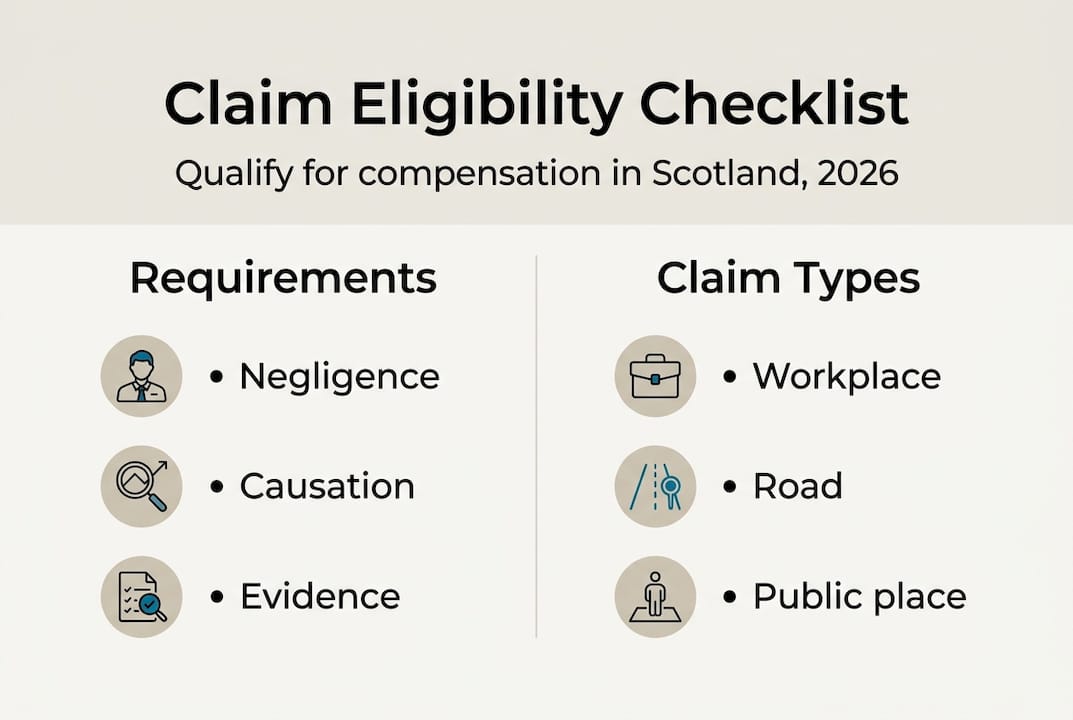
To qualify for compensation, you must establish that another party’s negligence directly caused your injury. Negligence means someone owed you a duty of care, breached that duty, and the breach resulted in harm. This applies to diverse situations including workplace accidents, road traffic collisions, and public liability incidents. Scottish law recognises physical injuries, psychological trauma, and financial losses stemming from these events as claimable damages.
Causation links the negligent act to your injury. If you slipped on an unmarked wet floor at work, you need evidence showing the employer failed to maintain safe conditions and that failure caused your fall. Medical records, witness statements, and photographic evidence strengthen causation arguments. Without clear causation, even obvious negligence may not support a successful claim.
Claimable injuries span a wide spectrum. Workplace injuries include repetitive strain, machinery accidents, exposure to hazardous substances, and slips or trips on employer premises. Road traffic accidents cover collisions involving cars, motorcycles, bicycles, and pedestrians. You can also claim for injuries on public property, in shops, or during leisure activities if negligence is proven. Self-employed individuals and agency workers retain eligibility provided they can demonstrate another party’s fault, expanding protection beyond traditional employment relationships.
Special circumstances modify standard eligibility rules. The principle of allurement applies when children are attracted to hazardous situations, increasing the foreseeability duty on property owners. If a child enters a construction site drawn by interesting equipment and suffers injury, the site owner may bear greater responsibility than for an adult trespasser. Understanding these nuances helps you recognise valid claims that might initially seem questionable. For comprehensive guidance, explore your personal injury rights in Scotland to understand the full scope of protections available.
Key eligibility factors include:
- Duty of care owed by the defendant to you
- Breach of that duty through action or omission
- Direct causation linking breach to injury
- Quantifiable harm or loss suffered
- Claim filed within legal time limits
The role of contributory negligence and compensation adjustments
Contributory negligence reduces compensation proportionally but is not an absolute bar to claims. If you share some responsibility for your accident, courts assign a percentage of fault and reduce your award accordingly. This doctrine recognises that accidents often involve multiple contributing factors, and claimants sometimes fail to exercise reasonable care for their own safety.

Common contributory negligence scenarios include pedestrians crossing roads without looking properly, workers ignoring safety equipment, or individuals walking through areas with visible hazards. If you trip on a pothole you knew existed and regularly walked around, a court might find 25% contributory negligence, reducing your £10,000 claim to £7,500. The reduction reflects your failure to take reasonable precautions despite awareness of the danger.
Compensation adjustments vary based on circumstances. Child claimants typically receive lower contributory negligence percentages because courts recognise children’s limited capacity to assess risk. A seven year old running into traffic might face 30% reduction, whilst an adult in identical circumstances could see 60% or higher. Age, experience, and the obviousness of danger all influence percentage assignments.
Courts rarely dismiss claims entirely unless the claimant bears 100% responsibility. Even substantial contributory negligence, such as 70%, still yields 30% of the assessed compensation. This approach balances accountability with the recognition that defendants who breach duties must face consequences. The system encourages safer practices by both parties whilst ensuring injured people receive proportionate support.
| Scenario |
Typical contributory negligence |
Impact on £20,000 claim |
| Known hazard ignored |
30-50% |
£10,000-£14,000 awarded |
| Partial inattention |
10-25% |
£15,000-£18,000 awarded |
| Child pedestrian accident |
20-40% |
£12,000-£16,000 awarded |
| Safety equipment not used |
40-60% |
£8,000-£12,000 awarded |
Pro Tip: Document your actions and the accident scene immediately after an incident. Photographs, witness details, and contemporaneous notes significantly strengthen your position when defending against contributory negligence allegations. Detailed evidence makes it harder for defenders to inflate your share of blame, protecting your compensation amount.
Understanding these principles helps you assess realistic outcomes. If you recognise some fault on your part, don’t assume you lack eligibility. Consult specialists who can evaluate the likely reduction and whether pursuing the claim remains worthwhile. Many successful claimants recover substantial sums despite acknowledged contributory negligence. Learn more about your personal injury rights in Scotland to navigate these complexities effectively.
Navigating the claims process and legal protections in 2026 Scotland
Pre-action protocol is mandatory for claims up to £25,000 with QOCS protecting claimants from costs. This structured process aims to resolve disputes without court proceedings, reducing legal expenses and delays. Following the protocol correctly is essential, as failure to comply can result in cost penalties or case dismissal.
The pre-action protocol involves several sequential steps. First, you notify the potential defender of your claim, providing basic details about the accident, injuries, and alleged negligence. The defender then investigates, gathering evidence and assessing liability. You obtain medical evidence documenting your injuries, prognosis, and treatment costs. Both parties exchange information transparently, enabling informed negotiation. If settlement proves impossible, you may proceed to court, but most claims resolve during this phase.
Qualified One-Way Costs Shifting revolutionised Scottish personal injury litigation by protecting claimants from paying defender costs if they lose. Before QOCS, the risk of substantial legal bills deterred many legitimate claims. Now, unsuccessful claimants generally avoid cost liability unless they behave unreasonably or fraudulently. This protection levels the playing field between individuals and well-resourced defenders like insurance companies or large employers.
QOCS reshapes access to justice but has led to more low-merit claims
The All-Scotland Sheriff Personal Injury Court handles claims exceeding £5,000, centralising expertise and promoting consistency. Established to streamline personal injury litigation, ASPIC applies specialised procedures and experienced sheriffs to these cases. Claims under £5,000 proceed through standard sheriff court processes. Understanding which court has jurisdiction helps you prepare appropriately and set realistic timelines.
Most claims settle out of court through negotiation or alternative dispute resolution. Settlements offer certainty, lower costs, and faster resolution compared to trials. However, litigation rates are rising as QOCS reduces financial risk for claimants, leading some defenders to adopt more aggressive strategies. If your case proceeds to court, expect thorough preparation, expert evidence, and potentially lengthy timescales.
The claims process typically follows these stages:
- Initial consultation with a solicitor to assess eligibility
- Notification to the defender under pre-action protocol
- Investigation period where both parties gather evidence
- Medical examination to document injuries and prognosis
- Negotiation phase attempting settlement without court
- Court proceedings if settlement fails, with QOCS protection
Timescales vary significantly. Simple claims with clear liability may settle within months, whilst complex cases involving disputed facts or serious injuries can take years. Staying organised, responding promptly to requests, and maintaining realistic expectations helps you navigate the process successfully. For detailed guidance on initiating your claim, visit starting injury claim in Scotland for step-by-step instructions tailored to 2026 requirements.
Special eligibility cases and expert insights for Scottish claimants
Special cases like allurement extend foreseeability and eligibility beyond simple negligence. The landmark Hughes v Lord Advocate case established that property owners must anticipate children being attracted to interesting or unusual features, even when trespassing. If a child suffers injury exploring such features, the owner’s duty of care expands beyond what applies to adults. This principle recognises children’s natural curiosity and limited risk assessment abilities.
Self-employed workers and agency staff often question their eligibility, assuming only traditional employees can claim. Scottish law protects anyone injured through another’s negligence, regardless of employment status. If you work as a contractor on a construction site and scaffolding collapses due to poor maintenance, you can claim against the site owner or scaffolding company. The key is proving negligence and causation, not demonstrating an employment relationship.
QOCS increases low-merit claims; jury trials remain rare but awards can be higher. Whilst QOCS encourages more people to pursue legitimate claims without financial fear, it also enables some speculative cases that previously would not proceed. Courts scrutinise claims carefully, dismissing those lacking merit despite cost protections. Jury trials, though uncommon in Scottish personal injury cases, occasionally produce higher awards than sheriff decisions, particularly when injuries evoke strong sympathy.
Compensation benchmarks vary dramatically based on injury severity, impact on life, and individual circumstances. Minor soft tissue injuries might yield £1,000 to £3,000, whilst severe spinal damage causing paralysis can exceed £300,000. Loss of earnings, care costs, and adaptation expenses add substantially to general damages for pain and suffering. Understanding typical ranges helps you assess whether settlement offers represent fair value.
Expert legal advice proves invaluable when navigating these complexities. Solicitors specialising in Scottish personal injury law understand local precedents, sheriff preferences, and effective negotiation strategies. They assess your case objectively, advising whether to accept settlement offers or proceed to court. Their expertise maximises your compensation whilst minimising stress and uncertainty.
Special considerations affecting eligibility include:
- Child claimants benefit from extended time limits and allurement principles
- Self-employed and agency workers retain full eligibility despite non-traditional employment
- Pre-existing conditions do not bar claims if negligence worsened them
- Psychological injuries qualify equally with physical harm when properly documented
- Fatal accident claims allow dependants to seek compensation for their losses
Pro Tip: Consult solicitors who specialise in Scottish personal injury law and regularly handle cases in ASPIC. Local expertise matters significantly because Scottish law differs from English law in important respects, and sheriffs develop individual approaches to evidence and valuation. Choosing the right representation substantially improves your outcome. Explore no win no fee injury claims Scotland to understand how specialist solicitors can support your case without upfront costs.
Make your injury claim with expert Scotland solicitors
Now that you understand eligibility criteria, contributory negligence, and the claims process, taking action becomes straightforward with the right support. Specialist solicitors assess your situation accurately, gathering evidence, managing negotiations, and maximising compensation. Working on a no win no fee basis eliminates financial risk, ensuring you pay nothing unless your claim succeeds and retain 100% of your compensation.
Experienced injury lawyers in Scotland handle diverse claims including workplace accidents, road traffic collisions, and public liability incidents. Popular claims like back injury compensation achieve high success rates when properly documented and presented. Whether your injury seems straightforward or involves complex liability questions, expert guidance ensures you navigate pre-action protocols, QOCS protections, and court procedures effectively. Prompt action preserves evidence, meets legal deadlines, and demonstrates seriousness to defenders, improving settlement prospects and final awards.
Frequently asked questions about injury claim eligibility in Scotland
What makes me eligible to claim injury compensation in Scotland?
You qualify if another party’s negligence caused your injury and you can prove duty of care, breach, causation, and quantifiable harm. This applies to workplace accidents, road traffic collisions, and public liability incidents. Even partial fault rarely disqualifies you entirely, though contributory negligence reduces compensation proportionally.
How does contributory negligence affect my claim?
Contributory negligence reduces your compensation by your percentage of fault but does not eliminate eligibility. If you bear 30% responsibility, you receive 70% of the assessed award. Courts consider factors like age, experience, and hazard obviousness when assigning percentages, with children typically receiving more favourable treatment than adults.
What is the pre-action protocol and why does it matter?
The pre-action protocol is a mandatory structured process for claims under £25,000, requiring notification, investigation, medical evidence, and negotiation before court proceedings. Following it correctly avoids cost penalties and demonstrates good faith. Most claims settle during this phase, saving time and legal expenses compared to litigation.
How long does an injury claim take in Scotland?
Timescales vary from months to years depending on complexity, injury severity, and liability disputes. Simple cases with clear fault and minor injuries often settle within six to twelve months. Complex claims involving serious injuries, disputed facts, or multiple parties can extend beyond two years, particularly if court proceedings become necessary.
Can self-employed workers claim injury compensation?
Yes, self-employed individuals and agency workers have full eligibility if they can prove another party’s negligence caused their injury. Employment status does not determine claim validity; the key factors are duty of care, breach, and causation. Contractors, freelancers, and temporary staff all retain protection under Scottish personal injury law.
Should I accept the first settlement offer?
Rarely accept initial offers without consulting a solicitor, as they typically undervalue claims significantly. Insurers aim to minimise payouts, and early offers often ignore future losses, ongoing treatment costs, or full pain and suffering impacts. Expert assessment ensures you understand fair compensation ranges before making decisions. Acting quickly after an accident preserves evidence and strengthens your position, so learn why acting quickly after an accident in Scotland matters for successful claims.
Recommended