What is vicarious liability? A guide for Scotland

TL;DR:
- Vicarious liability holds employers responsible for wrongful acts committed by employees during employment, regardless of fault. The law requires proving a qualifying relationship and a close connection between the role and the harmful act for employer liability to arise. Recent case law broadens the scope, including contractors, interns, and volunteers, making claims more accessible without proving employer fault.
Vicarious liability is defined as the legal principle that holds an employer responsible for wrongful acts committed by an employee during the course of their employment, even if the employer was not personally at fault. This principle is central to personal injury law in Scotland and across the UK. It means that if you were harmed by someone acting in their work capacity, you can claim compensation from their employer rather than pursuing the individual directly. Understanding what is vicarious liability, and how it applies to your situation, could be the difference between receiving full compensation and receiving nothing at all.
What is vicarious liability in Scottish tort law?
Vicarious liability is a strict liability principle, meaning the employer’s own conduct is irrelevant. What matters is the relationship between the wrongdoer and the organisation, and whether the harmful act occurred within the scope of that relationship. In Scots law, as in English law, this doctrine sits within the law of delict, which is the Scottish equivalent of tort law in England and Wales.

The practical effect is significant. Employers are financially liable for wrongs during the course of employment, shifting the burden from individuals to parties better placed to pay. This matters enormously for claimants in Scotland, because individual employees rarely have the financial resources to meet a compensation award. Targeting the employer makes justice accessible.
The doctrine has ancient roots but has evolved considerably through recent UK Supreme Court decisions. Cases such as Trustees of Barry Congregation of Jehovah’s Witnesses v BXB [2023] have refined how courts assess whether a relationship and a wrongful act meet the required legal threshold. These rulings affect every personal injury claim in Scotland where an employer’s worker caused the harm.
What legal tests determine if vicarious liability applies?
Courts in Scotland and across the UK apply a two-stage test to establish vicarious liability. Both stages must be satisfied before an employer can be held responsible.
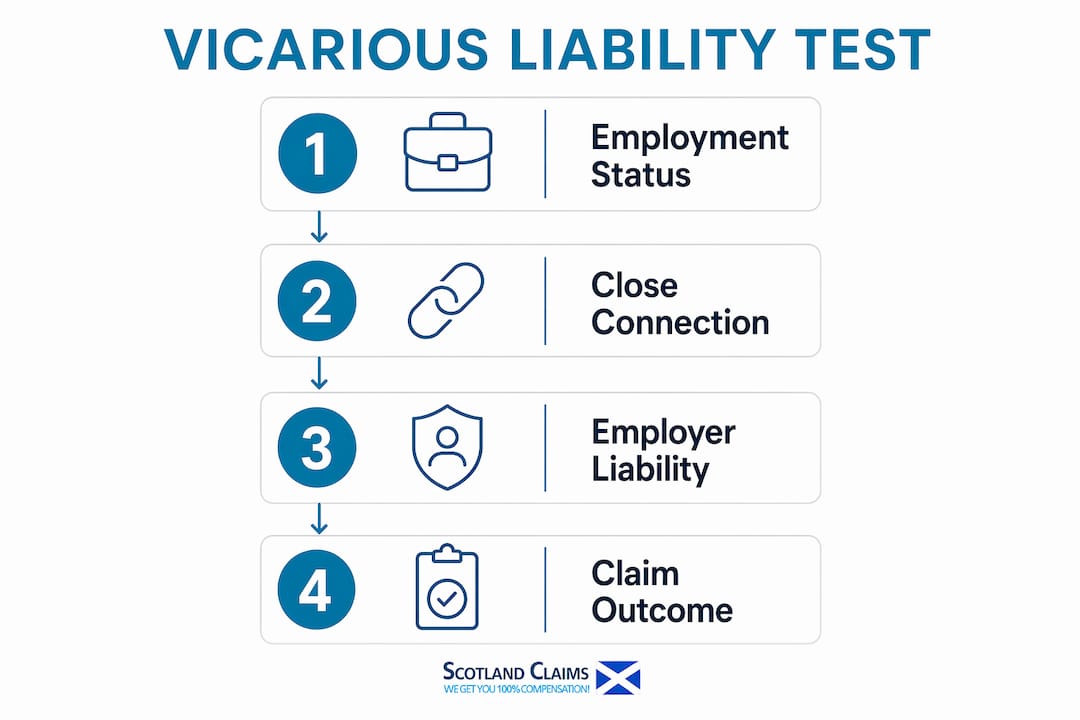
Stage one: a qualifying relationship
The first question is whether the relationship between the wrongdoer and the defendant organisation qualifies. Traditionally this meant a standard employment contract. Courts now look beyond that, asking whether the relationship is “akin to employment.” The factors considered include:
- The degree of control the organisation exercises over the individual’s work
- How integrated the individual is into the organisation’s operations
- Whether the organisation derives an economic benefit from the individual’s activities
- Whether the individual works exclusively or predominantly for the organisation
Stage two: close connection to the role
The second question is whether the wrongful act is closely connected to the employment role. Courts ask whether it is fair and just to hold the employer liable given the nature of the job and the risk it created. A security guard who assaults a visitor, for example, is performing a role that involves physical control of others. That connection is strong enough to engage vicarious liability even though the assault itself was not authorised.
Pro Tip: If you are unsure whether the person who harmed you was an employee or a contractor, do not assume your claim is blocked. Courts increasingly look at the substance of the working relationship, not just the label on the contract.
The definition of employee is broadening in case law, with volunteers, interns, and certain contractors now treated as akin to employment where control and integration are present. This expansion directly benefits claimants in Scotland who might otherwise have been told their case had no target defendant.
What types of wrongful acts does vicarious liability cover?
Vicarious liability covers a wide range of torts, not just physical accidents. In personal injury and workplace contexts, the following categories are all potentially covered:
- Physical injury caused by a colleague’s negligence, such as a forklift accident in a warehouse
- Workplace assaults, including those by supervisors or security personnel
- Bullying and harassment campaigns carried out by managers
- Discrimination on grounds of race, sex, disability, or age
- Data protection breaches where an employee misuses personal information
- Sexual abuse in institutional settings where the role created the opportunity
Vicarious liability can extend to non-physical torts like harassment or data breaches involving misuse of an employee’s position. This is a point many claimants miss. The harm does not need to leave a visible mark to be compensable.
When a claim succeeds, the types of compensation available to the victim typically include:
| Category of loss |
What it covers |
| General damages |
Pain, suffering, and loss of amenity |
| Special damages |
Medical expenses, travel costs, care costs |
| Lost earnings |
Wages lost during recovery or permanently |
| Future losses |
Ongoing care needs or reduced earning capacity |
Employers can be liable for damages such as medical expenses and lost wages in successful claims. This means a claimant who suffered a serious back injury at work, for instance, can recover not just for the immediate pain but for every financial consequence that flows from it.
Vicarious liability vs direct liability: what is the difference?
Many people confuse vicarious liability with direct employer liability. They are distinct legal concepts and the distinction matters when building your claim.
Direct employer liability involves employer fault or negligence, such as failing to maintain safe equipment, failing to train staff properly, or ignoring known risks. The employer’s own conduct is what caused the harm. Vicarious liability, by contrast, does not depend on employer fault at all. It imposes liability based purely on the employment relationship and the connection to the tort.
| Feature |
Direct liability |
Vicarious liability |
| Requires employer fault? |
Yes |
No |
| Based on relationship? |
No |
Yes |
| Covers intentional acts? |
Rarely |
Yes, if closely connected |
| Claimant must prove negligence? |
Yes |
No, only relationship and connection |
The practical advantage for claimants is clear. Vicarious liability enables claimants to bypass proving employer fault, focusing instead on the relationship and connection to the wrongful act. This is a lower and more achievable evidential threshold for most people.
A persistent myth is that using an independent contractor insulates an employer from liability. Courts increasingly hold employers liable for contractors if their roles are akin to employment or involve non-delegable duties. A construction firm that labels its site workers as self-employed contractors but controls every aspect of their work may still face vicarious liability when one of those workers injures a colleague.
Pro Tip: Do not accept an employer’s claim that a worker was “just a contractor” as the end of the matter. The legal test looks at the reality of the working relationship, not the paperwork.
How can individuals in Scotland pursue a vicarious liability claim?
Pursuing a personal injury claim involving vicarious liability in Scotland follows a clear process, though the specifics depend on the nature of the harm and the relationship involved. The key steps are:
- Identify the wrongdoer and their employer. Gather evidence of who caused the harm and confirm their working relationship with the organisation you intend to claim against.
- Establish the qualifying relationship. Collect evidence of control, integration, and economic benefit. Employment contracts, payslips, rotas, and communications all help.
- Demonstrate close connection. Show that the harmful act was connected to the role the individual was performing. Witness statements, CCTV footage, and incident reports are valuable here.
- Quantify your losses. Medical records, wage slips, and receipts for expenses form the backbone of your special damages claim.
- Instruct a specialist solicitor. Personal injury solicitors with experience in employer liability claims know how to frame the relationship and connection arguments that courts require.
No Win No Fee agreements in Scotland are common, enabling claimants to pursue vicarious liability claims without upfront costs. This support helps victims access compensation even when financial resources are limited. You can check your claim eligibility before committing to any legal process.
Recent Supreme Court rulings have shifted the test focus towards fairness and enterprise risk, potentially including intentional torts if closely connected to employment duties. This means the scope of claims that succeed under vicarious liability is, if anything, growing. Claimants in Scotland who were harmed by deliberate acts, such as an assault by a colleague, should not assume their case falls outside the doctrine.
Key takeaways
Vicarious liability is a strict liability doctrine that holds employers responsible for employee wrongdoing during employment, requiring claimants to prove only the qualifying relationship and close connection, not employer fault.
| Point |
Details |
| Strict liability principle |
Employers are liable without personal fault if the relationship and connection tests are met. |
| Two-stage legal test |
Courts assess qualifying relationship first, then close connection between the act and the role. |
| Broader than most expect |
Contractors, volunteers, and interns may qualify as akin to employment under current case law. |
| No need to prove negligence |
Claimants bypass the employer fault requirement, making claims more achievable. |
| No Win No Fee access |
Scottish claimants can pursue these claims without upfront costs through specialist solicitors. |
Why the close connection test matters more than most people realise
I have seen claimants walk away from strong cases because they were told the employer “didn’t do anything wrong.” That framing misunderstands the entire point of vicarious liability. The employer’s conduct is not the question. The question is whether the organisation created the conditions in which the harm became possible.
The close connection test is now the real battleground in these cases. Courts look at whether the job role itself generated the risk that materialised into harm. A care worker who abuses a vulnerable resident is doing something their employer never sanctioned. But the employer placed that worker in a position of trust and authority over the resident. That connection is what makes the employer liable.
What I find most instructive from recent case law is the shift towards enterprise risk thinking. Organisations that profit from deploying people in roles carrying inherent risks cannot simply disclaim responsibility when those risks eventuate. That is a principle worth understanding before you accept any employer’s denial of responsibility.
The other point I would press is the contractor myth. I have encountered situations where employers have confidently asserted that a worker was self-employed, expecting that to end the conversation. It rarely does, once you examine the actual working arrangements. If the organisation controlled the work, provided the tools, and integrated the person into its operations, the label on the contract is largely irrelevant.
Seek specialist advice promptly. Limitation periods apply in Scotland, and evidence degrades quickly. The sooner a solicitor examines the relationship and the circumstances, the stronger your position.
— Roger
How Scotland Claims Injury Lawyers can help with your claim
If you were injured by someone acting in the course of their employment, Scotland Claims Injury Lawyers connects you with specialist injury lawyers in Scotland who understand how to build vicarious liability claims from the ground up. For road traffic accidents where you were not at fault, the success fee is capped at 18% including VAT. For workplace injuries, slips, and trips, Scotland Claims Injury Lawyers applies the same 18% cap on every claim type, while most other large firms charge the full 20% including VAT. Use the compensation calculator to get an early estimate of what your claim may be worth, then request a callback with no upfront cost and no obligation.
FAQ
What is the simplest vicarious liability definition?
Vicarious liability is the legal rule that makes an employer responsible for harm caused by an employee during the course of their work, even if the employer did nothing wrong personally.
Who is liable in a vicarious liability claim?
The employer or organisation is held liable, not the individual employee who caused the harm. This gives claimants a financially viable defendant to pursue.
Does vicarious liability apply to independent contractors?
Not automatically, but courts increasingly treat contractors as akin to employees where the organisation exercises significant control and integration over their work. The contract label alone does not determine the outcome.
What examples of vicarious liability arise in Scottish personal injury cases?
Common examples include a warehouse worker injured by a negligent colleague, a care home resident assaulted by a member of staff, and an office worker harassed by a manager. In each case the employer can be held liable under vicarious liability principles.
How does vicarious liability work with No Win No Fee agreements?
A specialist solicitor takes on your case at no upfront cost. If the claim succeeds, a capped percentage is deducted from the compensation. If the claim fails, you pay nothing.
Recommended