How to check accident claim eligibility in Scotland

TL;DR:
- Checking accident claim eligibility in Scotland requires verifying timing, fault, injury, and causation within strict legal timeframes. The three-year limitation period begins from the injury date or the date of knowledge, with exceptions for children and late-discovered injuries, making early legal advice crucial. Most claims succeed by acting promptly, gathering proper documentation, and consulting specialists to ensure claim validity and maximize compensation.
Checking accident claim eligibility means determining whether you have a valid personal injury claim under Scottish law, based on your injury, the circumstances of your accident, and when it occurred. Scotland operates under the Prescription and Limitation (Scotland) Act 1973, which sets strict legal timeframes for raising court proceedings. Getting this right from the start is the difference between receiving compensation and losing your right to claim entirely. This guide explains the exact criteria, time limits, and practical steps you need to verify your eligibility with confidence.
How to check accident claim eligibility: time limits that apply in Scotland
The single most critical factor in any accident claim eligibility check is timing. Personal injury claims in Scotland are governed by a three-year limitation period known as the “triennium.” This means you must raise court proceedings within three years of the date you were injured. Miss that window and your claim is almost certainly gone.
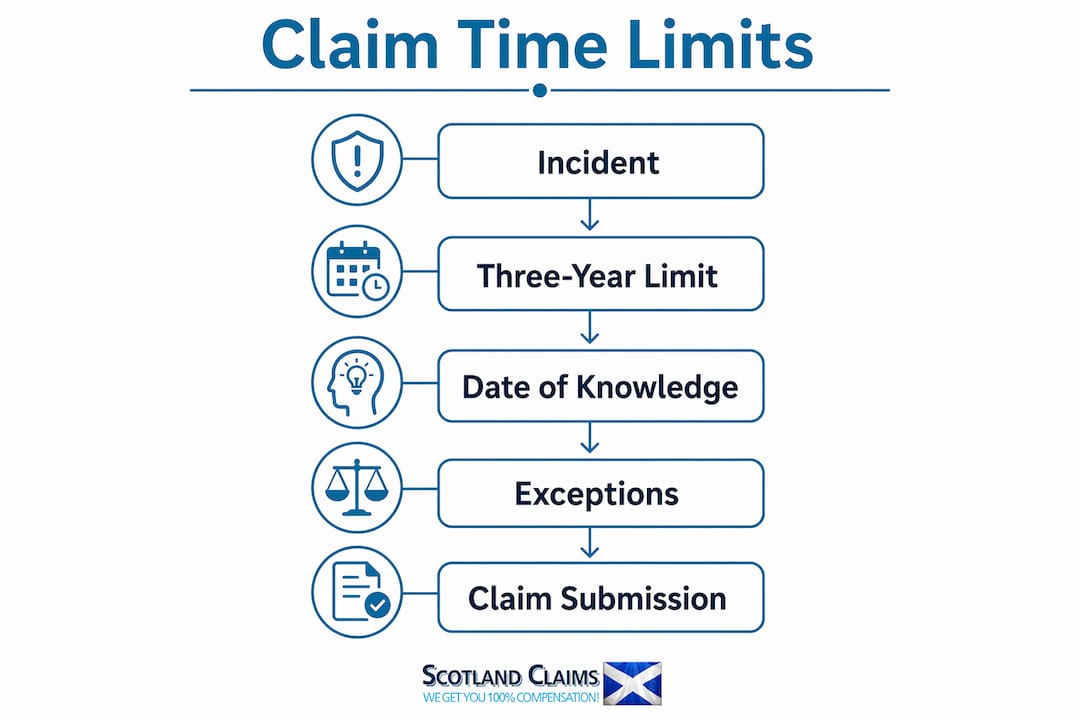
However, the triennium is not always as straightforward as it sounds. The main challenge is not whether there is a claim, but knowing exactly when the time limit starts based on your awareness of the injury. This is where the “date of knowledge” rule becomes critical.
The date of knowledge rule
The date of knowledge rule allows the three-year clock to start from the date you first became aware of your injury and its cause, rather than the date the accident occurred. This matters enormously for conditions that develop gradually. For example, industrial hearing loss or asbestos-related diseases have the time limit run from diagnosis, not from the years of exposure that caused the condition. This can extend eligibility by years in the right circumstances.
There are also important exceptions you should know:
- Children injured in Scotland: The time limit does not begin until the child turns 16, meaning a claim can be raised any time before their 19th birthday.
- Claimants lacking legal capacity: The triennium is suspended while a person lacks the mental capacity to manage their own affairs.
- Late-discovered injuries: Conditions like occupational diseases or delayed-onset injuries may qualify under the date of knowledge rule even if the accident happened years ago.
Missing the deadline has severe consequences. Claims submitted after the time limit are declared time-barred and generally rejected unless a court grants permission in exceptional circumstances. Courts rarely do. The safest approach is to treat the three-year limit as absolute and act well before it expires.
Pro Tip: If you are unsure when your time limit started, check the claim time limits in Scotland guide from Scotland Claims Injury Lawyers before assuming you are out of time. The date of knowledge rule catches many people by surprise.
Does your accident and injury qualify for a claim?
Not every accident automatically qualifies for compensation. To evaluate claim eligibility properly, you need to establish three things: that someone else was at fault, that you suffered a genuine injury, and that a causal link exists between the two. Scottish courts require all three to be present before a claim can succeed.
The types of accidents most commonly covered include:
- Road traffic accidents: Drivers, passengers, cyclists, and pedestrians injured through another party’s negligence. For whiplash or any road traffic injury where you are not at fault, you receive 100% of your compensation with nothing deducted.
- Workplace accidents: Injuries caused by an employer’s failure to provide a safe working environment, adequate training, or appropriate equipment.
- Slips, trips, and falls: Accidents on public or private premises caused by a hazard the occupier knew about or should have known about.
- Accidents in public places: Injuries in supermarkets, car parks, pavements, or other public areas where a duty of care was owed and breached.
Fault and liability are distinct concepts worth understanding. Fault refers to who caused the accident. Liability refers to who is legally responsible for paying compensation. In some cases, such as accidents involving uninsured drivers, the Motor Insurers’ Bureau holds liability even when the at-fault driver cannot be traced. Understanding this distinction helps you understand claim eligibility more accurately.
The severity of your injury also matters, though there is no minimum threshold. Soft tissue injuries, fractures, psychological trauma, and chronic conditions are all compensable provided they are documented by a medical professional. Undocumented injuries are extremely difficult to claim for, which is why seeking medical attention immediately after any accident is not optional. It is the foundation of your case.
For a thorough breakdown of how Scottish courts assess qualifying injuries, the injury claim eligibility guide from Scotland Claims Injury Lawyers covers the legal criteria in detail.
Verifying your accident claim eligibility requires more than a rough recollection of events. The accuracy and completeness of your documentation directly affects whether your claim is accepted and how much compensation you receive. Think of this stage as building the factual foundation of your case.

| Document or information |
Why it matters |
| Accident date, time, and location |
Establishes the starting point for the time limit calculation |
| Medical records and diagnosis dates |
Proves the injury occurred and links it causally to the accident |
| Witness details and statements |
Corroborates your account of how the accident happened |
| Photographs or CCTV footage |
Provides objective evidence of the hazard or conditions |
| Insurance and policy details |
Identifies the liable party’s insurer for claim notification |
| Accident report or incident log |
Creates an official record, particularly for workplace or public accidents |
Beyond documents, two practical tools help you assess eligibility before speaking to a solicitor. A compensation calculator uses simple questions about your injury type and circumstances to generate an initial estimate of what your claim may be worth. This is not a legal opinion, but it gives you a realistic sense of whether pursuing a claim is worthwhile. Online eligibility checkers work similarly, using your answers to identify potential to claim based on the key criteria.
Eligibility verification is not simply a matter of confirming you have insurance coverage. It involves checking the benefit design, network, authorisation requirements, and applicable limits, all of which control claim payment and timing. This complexity is precisely why early legal advice matters.
Pro Tip: Gather your documents before using any online eligibility checker. The more accurate the information you input, the more reliable the output. Guessing dates or injury details produces misleading results.
What are the practical steps to verify your accident claim eligibility?
Following a clear process removes the guesswork from your eligibility assessment. Here are the five steps that Scotland Claims Injury Lawyers recommends for anyone in Scotland wanting to check their position:
-
Gather all relevant accident and injury details. Write down the date, time, location, and circumstances of the accident while they are fresh. Note the names of any witnesses and the details of any other parties involved. Collect your medical records, GP notes, and any diagnosis letters.
-
Establish your specific time limit. Do not assume the standard three-year rule applies without checking. If your injury was gradual, late-discovered, or if you were a child at the time, your time limit may be calculated differently. Use the why act quickly guide to understand the urgency specific to your situation.
-
Use an online compensation calculator or eligibility checker. Run your details through a tool like the Scotland Claims Injury Lawyers compensation calculator to get an initial estimate. This step takes minutes and gives you a concrete starting point before committing to a formal legal process.
-
Consult a solicitor who specialises in Scottish personal injury law. Online tools provide estimates, not legal opinions. Early legal advice clarifies complex eligibility factors and significantly improves claim outcomes. A specialist solicitor will assess fault, liability, and the strength of your evidence in a way no calculator can replicate.
-
Understand and avoid common pitfalls. The most frequent mistakes are waiting too long to act, failing to seek medical attention promptly, and accepting an early settlement offer before the full extent of the injury is known. Each of these can reduce or eliminate your compensation.
Key takeaways
Checking accident claim eligibility in Scotland requires confirming fault, injury, causation, and timing under the Prescription and Limitation (Scotland) Act 1973 before any claim can proceed.
| Point |
Details |
| Three-year time limit |
Court proceedings must be raised within three years of the injury or date of knowledge. |
| Date of knowledge exception |
The clock starts when you became aware of the injury, not necessarily when the accident occurred. |
| Children’s extended limit |
Injured children have until their 19th birthday to raise a claim in Scotland. |
| Documentation is foundational |
Medical records, accident reports, and witness details directly determine claim strength. |
| Early legal advice improves outcomes |
A specialist solicitor interprets complex eligibility factors that online tools cannot assess. |
Why I think most people misunderstand the eligibility question
Most people who contact Scotland Claims Injury Lawyers ask the wrong question first. They ask, “Do I have a claim?” when the more precise question is, “When did my time limit start?” That distinction matters more than almost anything else in Scottish personal injury law.
I have seen cases where someone assumed they were out of time because three years had passed since their accident, only to discover the date of knowledge rule applied and they still had a valid window to act. I have also seen the reverse: people who believed they had plenty of time and left it too late because they miscalculated from the wrong date. The triennium is unforgiving once it expires.
The other misunderstanding I encounter regularly is around fees. Many people assume that pursuing a claim means handing over a large slice of their compensation to a solicitor. At Scotlandclaims, road traffic accident and whiplash claims are handled on a 100% compensation basis. You keep everything. For every claim type — including slips, trips, and workplace accidents - Scotland Claims deducts no success fee at all, so you keep 100% of your compensation. Most other large firms charge up to 20% including VAT. That gap is real money in your pocket.
Acting quickly, getting the right legal advice, and understanding your specific time limit are the three things that most reliably determine whether a claim succeeds. Everything else follows from those.
— Roger
How Scotland Claims Injury Lawyers can help you check and pursue your claim
If you have been injured in an accident in Scotland and want to know whether you qualify for compensation, Scotland Claims Injury Lawyers offers a straightforward, risk-free way to find out. The firm operates on a no win no fee basis, meaning you pay nothing upfront and nothing at all if your claim is unsuccessful. For road traffic accidents and whiplash injuries where you are not at fault, you receive 100% of your compensation. For every claim type, including slips, trips, and workplace accidents, Scotland Claims deducts no success fee - you keep 100% of your compensation, while most other large firms charge up to 20% including VAT. Use the compensation calculator to get an initial estimate, then request a callback to speak with a specialist injury lawyer.
FAQ
What is the time limit for accident claims in Scotland?
The standard time limit is three years from the date of injury, known as the triennium. Exceptions apply for children, late-discovered injuries, and cases where the date of knowledge rule extends the starting point.
Can I still claim if I only recently discovered my injury?
Yes. The date of knowledge rule means the three-year period can start from when you first became aware of the injury and its cause, not necessarily the date of the accident itself.
What types of accidents qualify for a compensation claim in Scotland?
Road traffic accidents, workplace injuries, and slips or trips on public or private premises are the most common qualifying accident types, provided another party’s negligence caused your injury.
Do I need a solicitor to check my accident claim eligibility?
You can use online tools like a compensation calculator for an initial assessment, but a solicitor is needed to interpret complex eligibility factors, confirm fault and liability, and advise on the strength of your evidence.
How much of my compensation will I keep with Scotlandclaims?
For road traffic accident and whiplash claims where you are not at fault, you keep 100% of your compensation. For every claim type, Scotland Claims Injury Lawyers deducts no success fee at all - you keep 100% of your compensation on all claims. Most other large firms charge up to 20% including VAT.
Recommended