Product liability claims in Scotland: your rights explained

TL;DR:
- Product liability claims in Scotland are based on strict liability, not negligence.
- Anyone injured by a defective product can claim, regardless of purchase involvement.
- Acting quickly and consulting Scottish specialists increases chances of a successful claim.
Many Scots wrongly assume that to claim compensation for an injury caused by a faulty product, they must prove the manufacturer was careless. This misunderstanding stops thousands of valid claims before they even begin. In reality, product liability claims operate under strict liability principles, meaning you do not need to prove negligence at all. Scottish law places the burden squarely on producers to ensure their products are safe. This guide explains exactly how product liability works in Scotland, who can claim, and what steps to take to protect your right to full compensation.
Table of Contents
Key Takeaways
| Point |
Details |
| Strict liability applies |
You don’t need to prove the manufacturer’s negligence to claim for defective products under Scottish law. |
| Wide eligibility rules |
Anyone injured by a defective product can claim, not just the person who bought it. |
| Specialist advice is vital |
Early help from a Scottish No Win No Fee solicitor maximises your chances of success. |
| Act promptly |
There are time limits for claims, so gather evidence and seek advice as soon as possible. |
What is a product liability claim?
A product liability claim is a legal action you bring when a defective product causes you personal injury, illness, or significant property damage. Unlike many other personal injury routes, you are not required to show that anyone was careless or reckless. The law simply asks: was the product defective, and did that defect cause your harm?
Under the Consumer Protection Act 1987, strict liability applies across Scotland and the rest of the UK. This means no need to prove negligence, only that the product was defective and caused your loss. The Act covers personal injury, death, and property damage exceeding £275.
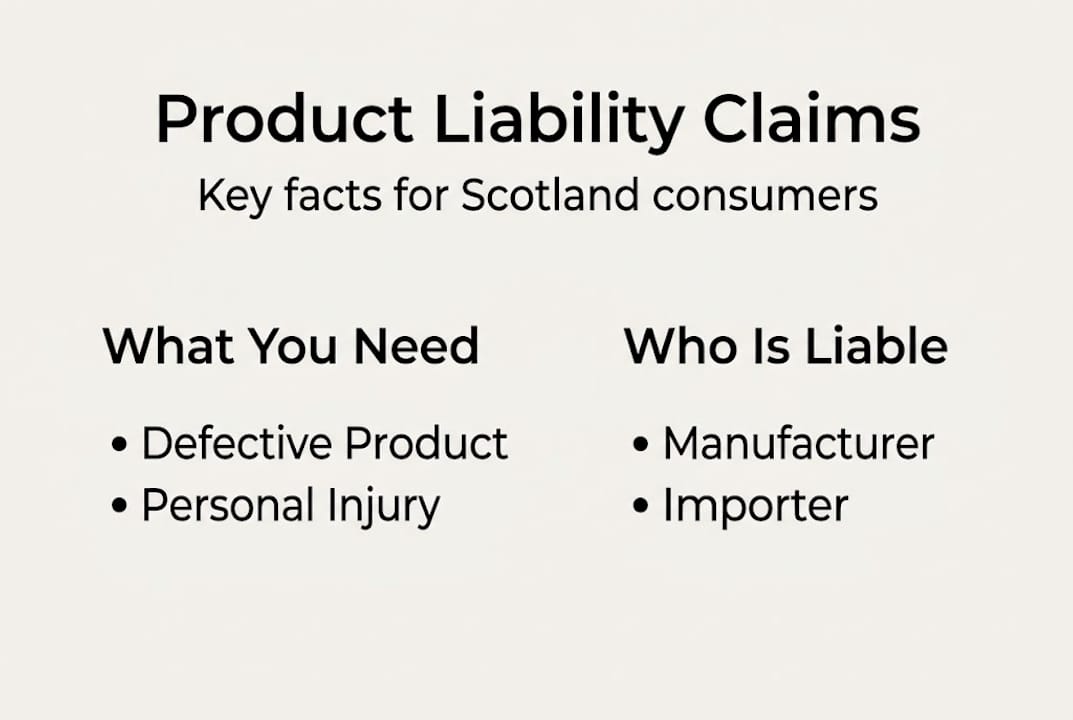
Three main categories of parties can be held responsible:
- Manufacturers who designed or produced the faulty item
- Importers who brought the product into the UK from outside
- Suppliers such as retailers who placed it in the market
This matters because, in practice, a manufacturer may be based overseas and difficult to pursue. Scottish law allows you to target the importer or supplier instead, which opens up far more realistic routes to compensation.
Understanding the product liability basics before you speak to a solicitor helps you frame your situation clearly from the start.
“A product liability claim is a legal action where an individual seeks compensation for injury, illness, or death caused by a defective product, holding the manufacturer, importer, or supplier responsible under strict liability principles.”
Here is a quick reference for what counts as a valid claim:
| Element |
Requirement |
| Type of harm |
Personal injury, death, or property damage |
| Minimum property damage |
Over £275 |
| Proof of negligence needed |
No |
| Who can be liable |
Manufacturer, importer, or supplier |
| Time limit to claim |
Generally three years from date of injury |
Scottish campaigners and legal commentators have raised concerns about the current regime reform analysis, arguing that despite strict liability, claimants still face significant practical hurdles. Knowing these hurdles exist is the first step to overcoming them.
How strict liability works in Scotland
Strict liability is one of the most powerful legal tools available to injured consumers. It removes the need to show that a manufacturer acted carelessly. Instead, you only need to establish that the product was defective and that the defect caused your injury or loss.

Contrast this with a standard negligence claim, where you must prove the defendant owed you a duty of care, breached it, and that the breach caused your harm. That is a much heavier burden. Strict liability cuts through much of that complexity.
However, the UK product liability regime is still claimant-unfriendly in several ways, particularly compared to updated EU consumer protection frameworks. Claimants must still demonstrate what the defect actually was and establish a clear causal link between that defect and their injury. This is harder than it sounds.
Here is how strict liability compares to negligence in practice:
| Factor |
Strict liability |
Negligence claim |
| Prove carelessness |
No |
Yes |
| Prove product was defective |
Yes |
Yes |
| Prove harm caused by defect |
Yes |
Yes |
| Complexity for claimant |
Moderate |
High |
| Typical success rate |
Higher |
Lower |
To build a strong strict liability case, you generally need to:
- Identify the specific defect in the product
- Obtain medical evidence linking your injury to that defect
- Preserve the product and any packaging as physical evidence
- Report the incident to the supplier or manufacturer promptly
- Instruct a solicitor who understands the CPA 1987 explained in a Scottish context
The Scottish legal system has its own procedural rules, and the role of Scottish solicitors in guiding claimants through these nuances is genuinely significant. A solicitor who practises only in England and Wales may not be the right fit for your case.
Pro Tip: Contact a Scottish specialist solicitor as early as possible. Evidence degrades, witnesses forget details, and products get discarded. Early advice is not just helpful; it can be the difference between a successful claim and a failed one.
Who can make a product liability claim in Scotland?
One of the most common misconceptions is that only the person who purchased the faulty product can claim. This is simply not true. Anyone directly injured by the product can bring a claim, provided the damage exceeds £275 and there is a clear link to the defect.
This opens up claims for a wide range of people, including:
- Users who operated the product but did not buy it
- Bystanders who were nearby when the product failed
- Household members injured by a product bought by someone else
- Employees harmed by faulty equipment supplied to their workplace
- Friends or guests who used a product at someone else’s home
Consider a few real-world scenarios. A child burns their hand on a faulty electric kettle bought by a parent. A colleague is struck by a component that flies off a defective power tool. A guest at a dinner party suffers food poisoning from a contaminated pre-packaged ingredient. In each case, the injured person has a potential claim, even though they never purchased the product themselves.
The key requirements remain consistent regardless of who you are:
- The product must have been defective at the time it left the producer’s control
- The defect must have directly caused your injury or property damage
- The damage must meet the minimum threshold where property is involved
For guidance on who can formally represent a claim on behalf of another person, the claimant representatives guide is a useful starting point, particularly for claims involving children or vulnerable adults.
Pro Tip: From the moment you are injured, start documenting the connection between the product and your harm. Photographs, medical records, and a written account of events are all valuable. Do not wait until you have decided whether to claim before gathering this material.
Key steps: making a product liability claim in Scotland
Once you know you are eligible, the process of making a claim follows a clear sequence. Acting promptly at each stage significantly improves your chances of success.
- Preserve the evidence. Keep the product, its packaging, and any instructions or receipts. Do not repair or dispose of anything. This physical evidence is often central to proving the defect.
- Seek medical attention. Get your injuries assessed and treated immediately. Medical records form a crucial part of your claim and establish the nature and extent of your harm.
- Document everything. Photograph your injuries, the product, and the scene. Write down exactly what happened while it is fresh. The role of evidence in Scottish injury claims cannot be overstated.
- Report the defect. Notify the supplier or manufacturer in writing. This creates a formal record and may trigger their own investigation, which can support your case.
- Instruct a specialist solicitor. Look for a Scottish personal injury solicitor with product liability experience. Specialist Scottish injury lawyers understand the procedural rules that apply specifically in Scotland.
- Explore No Win No Fee. Most Scottish solicitors handling product liability cases offer no win no fee claims, meaning you pay nothing upfront and nothing if your claim is unsuccessful.
- Act within the time limit. The standard legal claim time limit is three years from the date of injury or the date you became aware of the defect. Missing this deadline almost always ends your claim.
The injury claim process can feel daunting, but with the right solicitor, most of the complexity is handled on your behalf. Seeking early advice from a Scottish specialist maximises your chances of recovering full compensation.
Pro Tip: Never throw away the product or its packaging, even if it looks undamaged. Forensic analysis of the item itself is sometimes the only way to prove a manufacturing defect.
What most guides miss about Scottish product liability claims
Most articles on product liability present the law as though strict liability makes claiming straightforward. It does not. The reality is that while you do not need to prove negligence, you still face the challenge of identifying precisely what the defect was and demonstrating scientifically or technically that it caused your specific injury. Manufacturers often employ expert witnesses to dispute this link, and without your own specialist evidence, claims can collapse.
The Scottish legal context adds another layer. Procedural rules differ from those in England and Wales, and courts here have their own expectations around how evidence is presented. A solicitor unfamiliar with Scottish practice can inadvertently weaken a strong case.
The most commonly overlooked mistake is waiting too long to seek legal advice. People spend weeks researching their rights online when they should be speaking to a solicitor who can immediately identify the case evidence pitfalls specific to their situation. Every day of delay risks evidence being lost or memories fading. In our experience, the claims that succeed are almost always the ones where the claimant acted quickly and sought Scottish-specific legal support from the outset.
Get expert help with your Scottish product liability claim
If a faulty product has left you injured, you deserve proper support and full compensation. At Scotland Claims, we connect you with specialist Scottish injury lawyers who understand both the law and the local procedural landscape. Every case starts with a free review, and all claims are handled on a no win no fee basis, so you pay nothing unless you win. Want to know what your claim could be worth? Use our compensation calculator for an instant estimate. Take the first step today and let our experienced team guide you towards the outcome you deserve.
Frequently asked questions
What products are covered by Scottish product liability law?
Almost any consumer product, from appliances and toys to medicines and vehicles, is covered if a defect causes injury or damage exceeding £275 under the Consumer Protection Act 1987.
Do I need to have bought the product myself to make a claim?
No, anyone directly injured by a defective product can claim, even if they did not purchase it, as long as there is a clear link between the defect and the harm suffered.
How long do I have to start a product liability claim in Scotland?
You generally have three years from the date of injury or from when you first discovered the defect, and acting promptly significantly improves your chances of a successful outcome.
What if the product was made outside the UK?
You can claim against importers or suppliers based in the UK if the manufacturer, importer or supplier cannot be pursued directly, ensuring you still have a realistic route to compensation.
Is No Win No Fee available for product liability claims in Scotland?
Yes, most Scottish injury solicitors offer No Win No Fee arrangements, and seeking specialist advice early maximises your chances of recovering the full compensation you are entitled to.
Recommended