What is negligence at work in Scotland? A clear 2026 guide

Many injured workers assume any workplace accident proves their employer was negligent. That’s not how Scottish law works. Negligence is a precise legal concept requiring specific proof of duty, breach, causation, and damage. This guide explains what workplace negligence actually means under Scottish law, how to prove it, and the practical steps to claim compensation if your injury resulted from employer failings.
Table of Contents
Key takeaways
| Point |
Details |
| Legal definition |
Negligence requires proving duty of care, breach of that duty, causation linking breach to injury, and actual damage suffered. |
| Evidence standards |
Claims need thorough documentation including accident reports, witness statements, medical records, and proof of employer failings. |
| Common scenarios |
Negligence often involves poor equipment maintenance, inadequate training, ignored hazard reports, or unsafe work systems. |
| No win no fee |
Conditional fee agreements eliminate upfront costs and financial risk for claimants pursuing workplace injury compensation. |
| Time limits |
Scottish law requires negligence claims to be filed within three years from the injury date or discovery of harm. |
Understanding negligence at work in Scotland
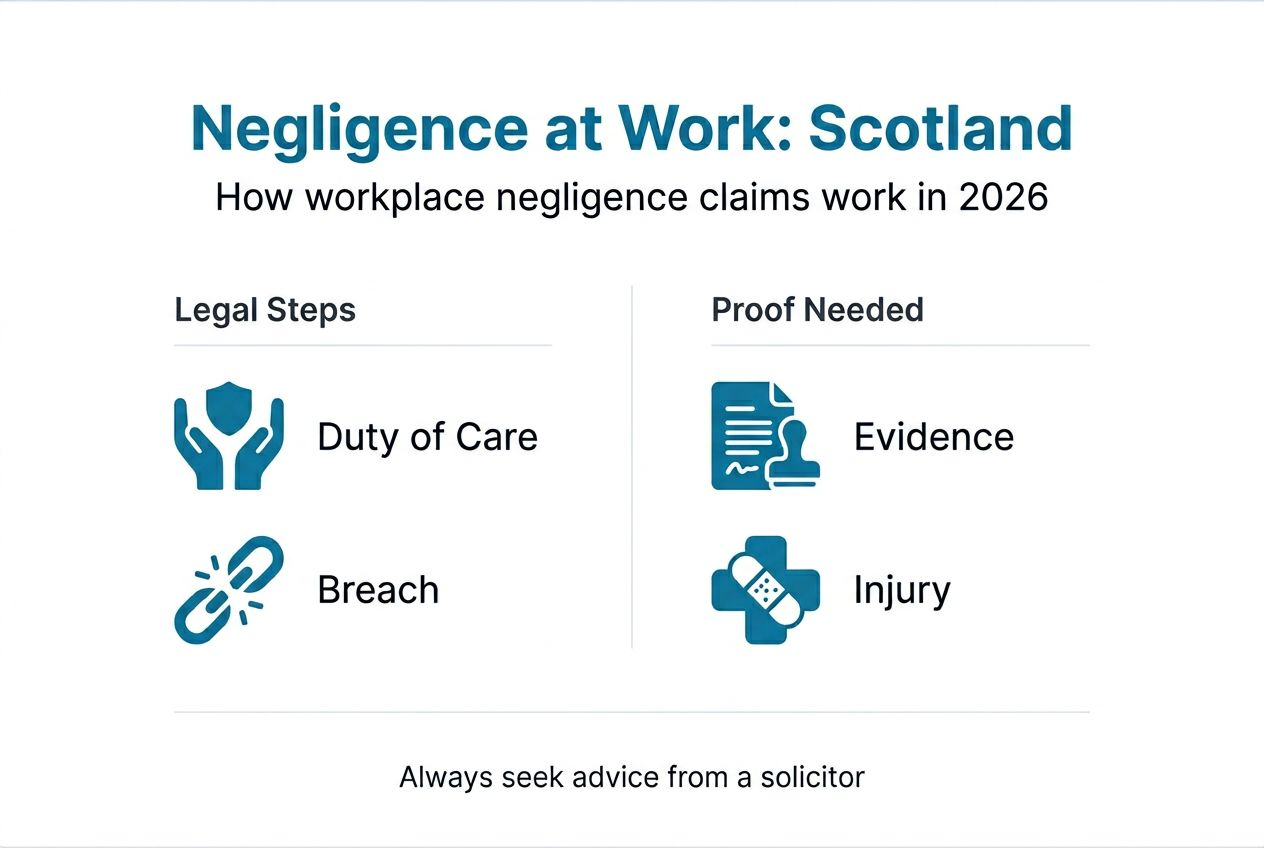
Negligence in Scottish workplace injury claims has four essential legal elements. You must establish all four to succeed.
First, your employer owed you a duty of care. Employers in Scotland have a statutory duty under the Health and Safety at Work Act 1974 to ensure, so far as reasonably practicable, the health, safety, and welfare of their employees. This creates the foundational legal relationship.
Second, your employer breached that duty. The breach must involve failing to meet the standard expected of a reasonable employer in similar circumstances. Simple mistakes don’t always constitute breach.
Third, causation links the breach directly to your injury. You must prove the employer’s failing caused your harm, not just that both events occurred. This is called material causation in Scottish courts.
Fourth, you suffered actual damage. This includes physical injury, financial losses, or psychological harm resulting from the breach. Without demonstrable damage, no claim exists regardless of how serious the breach was.
The key differences between ordinary workplace accidents and legal negligence centre on foreseeability and prevention:
- Accidents from unforeseeable events beyond employer control typically don’t constitute negligence
- Injuries from known hazards the employer failed to address usually do constitute negligence
- The reasonable employer test asks whether a competent employer would have prevented the harm
How negligence is proven in Scottish workplace injury claims
Negligence claims require satisfying the legal test of duty, breach, causation and damage to succeed in Scottish courts. Each element demands specific evidence and legal analysis.
-
Establishing duty of care: Document your employment relationship and the specific safety obligations your employer owed you. This includes statutory duties under health and safety legislation, contractual obligations, and common law duties arising from the employment relationship.
-
Proving breach of duty: Demonstrate your employer fell below the reasonable employer standard. Compare their actual conduct against industry standards, safety regulations, risk assessments, and what competent employers in similar situations would do. Evidence includes inspection reports, training records, maintenance logs, and expert testimony.
-
Demonstrating causation: Link the breach directly to your injury using medical evidence, accident reconstruction, and expert analysis. Scottish courts apply the “but for” test: but for the employer’s breach, would you have suffered this injury? You must prove causation on the balance of probabilities.
-
Quantifying damage: Document all losses including medical expenses, lost earnings, future income loss, rehabilitation costs, and pain and suffering. Medical reports, wage records, and expert economic assessments support damage claims.
| Legal Element |
Evidence Required |
Burden of Proof |
| Duty of care |
Employment contract, statutory obligations, workplace policies |
Balance of probabilities |
| Breach |
Safety reports, witness statements, expert testimony, regulation violations |
Balance of probabilities |
| Causation |
Medical records, accident analysis, expert opinions on injury mechanism |
Balance of probabilities |
| Damage |
Medical bills, wage statements, psychological assessments, future loss projections |
Balance of probabilities |
The balance of probabilities standard means you must show it’s more likely than not (over 50% probability) that each element exists. This is lower than criminal law’s beyond reasonable doubt standard but still requires convincing evidence.
Pro Tip: Gather evidence immediately after your injury. Photographs of hazards, witness contact details, and contemporaneous notes strengthen your case significantly. Memories fade and evidence disappears over time, so early documentation is crucial.
Common workplace scenarios that constitute negligence
Certain employer failings repeatedly appear in successful Scottish workplace injury claims. Recognising these patterns helps identify potential negligence.
Machinery and equipment failures demonstrate negligence when employers:
- Fail to maintain equipment according to manufacturer specifications or industry standards
- Ignore reported faults or defects that pose known risks to workers
- Provide defective personal protective equipment or safety devices
- Allow continued use of machinery after safety inspections identify hazards
Training and supervision inadequacies constitute negligence when employers:
- Assign workers to tasks without proper instruction on safe procedures
- Fail to update training when introducing new equipment or processes
- Provide insufficient supervision for inexperienced or newly trained staff
- Don’t verify workers understand and can implement safety protocols
Hazard management failures show negligence when employers:
- Ignore risk assessments identifying specific dangers requiring control measures
- Fail to act on employee reports of unsafe conditions or near misses
- Don’t implement reasonably practicable measures to eliminate or reduce known risks
- Allow unsafe working practices to continue despite awareness of the dangers
Real cases demonstrate these principles. A factory worker injured by unmaintained machinery successfully claimed when inspection records showed overdue servicing. A construction worker who fell from height won compensation after proving inadequate safety harness training. These outcomes reinforce that preventable injuries from known hazards typically constitute negligence.

Common misconceptions about negligence claims
Several widespread misunderstandings prevent injured workers from accurately assessing their legal position. Correcting these myths is essential.
Misconception one: every workplace accident proves negligence. This is false. Accidents from truly unforeseeable events or despite all reasonable precautions don’t establish legal negligence. The employer must have failed to meet the reasonable employer standard, not merely been present when an accident occurred.
Misconception two: any health and safety breach automatically means negligence. Not quite. While regulatory violations provide strong evidence of breach, you must still prove causation and damage. A minor paperwork breach unrelated to your injury won’t support a claim.
Misconception three: contributory negligence bars all compensation. Wrong. If you were partly at fault, your compensation reduces proportionally but isn’t eliminated entirely. Scottish courts apportion liability based on relative fault percentages.
Misconception four: claims are straightforward without legal help. Dangerous assumption. Proving negligence requires understanding complex legal tests, gathering admissible evidence, and countering employer defences. Professional legal advice dramatically improves success rates.
Avoid these claim-destroying mistakes:
- Waiting too long to seek legal advice, allowing evidence to disappear
- Accepting employer settlement offers without independent legal review
- Failing to document the accident scene and injuries immediately
- Not reporting the injury through official channels, creating gaps in evidence
Pro Tip: Even if you think you were partly responsible for your accident, consult a solicitor. Many workers underestimate their employer’s share of fault and overestimate their own contribution.
The negligence claim process and no win no fee explained
Pursuing a workplace negligence claim in Scotland follows a structured legal process with strict timeframes. Understanding each stage helps you take effective action.
The statutory time limit for negligence claims in Scotland is three years from injury date. This deadline is absolute except in exceptional circumstances like when injury effects emerge gradually. Missing this limit usually bars your claim permanently.
-
Seek immediate medical attention: Create official medical records documenting your injuries and their severity. These records form crucial evidence linking your condition to the workplace incident.
-
Report the accident formally: Notify your employer through proper channels and ensure the incident appears in the accident book. Written records prevent later disputes about whether the accident occurred.
-
Gather comprehensive evidence: Photograph the accident scene, identify witnesses, obtain contact details, and preserve any physical evidence like defective equipment or safety gear.
-
Consult a specialist solicitor: Early legal advice helps you understand your claim’s strength, avoid procedural mistakes, and begin building your case whilst evidence is fresh.
-
Allow investigation and negotiation: Your solicitor investigates liability, obtains expert reports, and typically attempts settlement negotiation before court proceedings.
-
Proceed to litigation if necessary: If settlement fails, your solicitor issues court proceedings and represents you through the litigation process.
No win no fee agreements make claims accessible:
- You pay nothing upfront for legal representation
- If your claim fails, you owe your solicitor nothing
- If you win, the solicitor’s fee comes from your compensation as an agreed percentage
- You retain the majority of your compensation even after legal fees
These conditional fee arrangements eliminate financial barriers to justice. They also motivate solicitors to accept only claims with genuine merit, as they invest their time and resources without guaranteed payment.
Why early legal advice matters: solicitors spot evidence needs you might miss, prevent procedural errors that could invalidate claims, and begin building your case whilst witnesses remember details clearly. Delayed claims face stronger employer defences and weaker evidence.
What compensation can you expect for workplace negligence injuries?
Successful negligence claims in Scotland typically result in compensation covering multiple loss categories. Understanding these helps set realistic expectations.
General damages compensate for:
- Pain and suffering from your physical injuries
- Psychological distress and emotional trauma
- Loss of amenity affecting quality of life
- Reduced life expectancy in severe cases
Scottish courts use standardised guidelines to assess general damages based on injury severity, recovery time, and long term effects. More serious injuries attracting higher awards.
Special damages compensate quantifiable financial losses:
- Lost earnings from time off work during recovery
- Future income loss if injuries reduce earning capacity permanently
- Medical treatment costs not covered by NHS, including private therapy
- Rehabilitation expenses including physiotherapy and occupational therapy
- Travel costs for medical appointments and legal proceedings
- Care costs if you need assistance with daily activities
- Property damage like torn clothing or broken personal items
| Injury Type |
Typical Compensation Range |
Recovery Time |
| Minor soft tissue injuries |
£1,000 to £3,000 |
Weeks to months |
| Moderate fractures |
£3,000 to £15,000 |
Several months |
| Severe permanent disabilities |
£50,000 to £200,000+ |
Lifelong impact |
| Psychological trauma |
£3,000 to £50,000 |
Varies significantly |
Actual awards depend on your specific circumstances. A 35 year old tradesperson with permanent back injury preventing manual work receives substantially more than someone with temporary injury making full recovery. The law aims to restore you financially to the position you would have occupied but for the negligence.
Understanding potential compensation helps you evaluate settlement offers and make informed decisions about pursuing claims.
Get expert help with your workplace injury claim in Scotland
If you’ve suffered a workplace injury through employer negligence, professional legal support maximises your compensation and removes financial risk. Scotland Claims connects you with specialist injury lawyers in Scotland who understand the complexities of negligence claims and work exclusively on no win no fee terms. This means you pay nothing unless your claim succeeds, and you keep 100% of your compensation after agreed legal fees. Our initial consultations are free, allowing you to discuss your situation without obligation. Use our compensation calculator to estimate your claim’s potential value, then speak with an experienced solicitor who can assess your case and explain your options clearly.
Frequently asked questions
Can I claim negligence if I was partly at fault for my workplace injury?
Yes, partial fault doesn’t prevent claims under Scottish law. Your compensation reduces proportionally based on your percentage of responsibility. Courts assess contributory negligence by comparing your actions against what a reasonable employee would have done, then apportion liability accordingly.
What evidence do I need to prove employer negligence in Scotland?
You need proof of all four negligence elements: duty, breach, causation, and damage. Gather accident reports, witness statements, photographs of hazards, medical records, safety inspection documents, and employment contracts. Expert testimony often supports complex technical claims about equipment failures or industry standards.
How long do I have to make a negligence claim after a workplace injury?
Scottish law requires claims within three years from injury date. This deadline applies strictly except in exceptional circumstances like gradual onset injuries where the limitation period starts when you reasonably should have known about the harm. Seek legal advice promptly to avoid missing this crucial deadline.
Recommended