Full compensation entitlement for personal injuries: your rights

TL;DR:
- Full compensation in Scotland aims to restore claimants to their pre-accident financial position through proven losses.
- Calculating damages involves documenting past losses, projecting future harm, and applying the Personal Injury Discount Rate.
- Proper evidence gathering and expert legal advice are key to securing every eligible loss and maximizing claim outcomes.
Many people assume that making a personal injury claim automatically means every single loss gets reimbursed in full. The reality under Scottish law is more precise than that. Full compensation entitlement is a legal standard, not a blanket promise, and understanding what it actually covers can be the difference between a fair outcome and a significant shortfall. This article explains exactly what full compensation entitlement means in Scotland, how it is calculated, what losses are included or excluded, and the practical steps you can take to ensure you receive every penny you are owed.
Table of Contents
Key Takeaways
| Point |
Details |
| Full compensation defined |
It means reimbursing every loss you can prove, not just set amounts. |
| Losses must be evidenced |
Payslips, medical bills, and receipts are crucial for your claim. |
| Personal Injury Discount Rate matters |
PIDR impacts future loss calculations, so check the latest rate for Scotland. |
| Practical steps improve outcomes |
Careful record-keeping and legal help maximise your true entitlement. |
What does full compensation entitlement really mean?
The phrase ‘full compensation entitlement’ sounds straightforward, but its legal meaning is specific. Under Scottish law, the guiding principle is that an injured person should be returned, as closely as possible, to the financial position they would have been in had the accident never happened. This is sometimes called the restitutio in integrum principle, which is Latin for ‘restoration to the original position.’
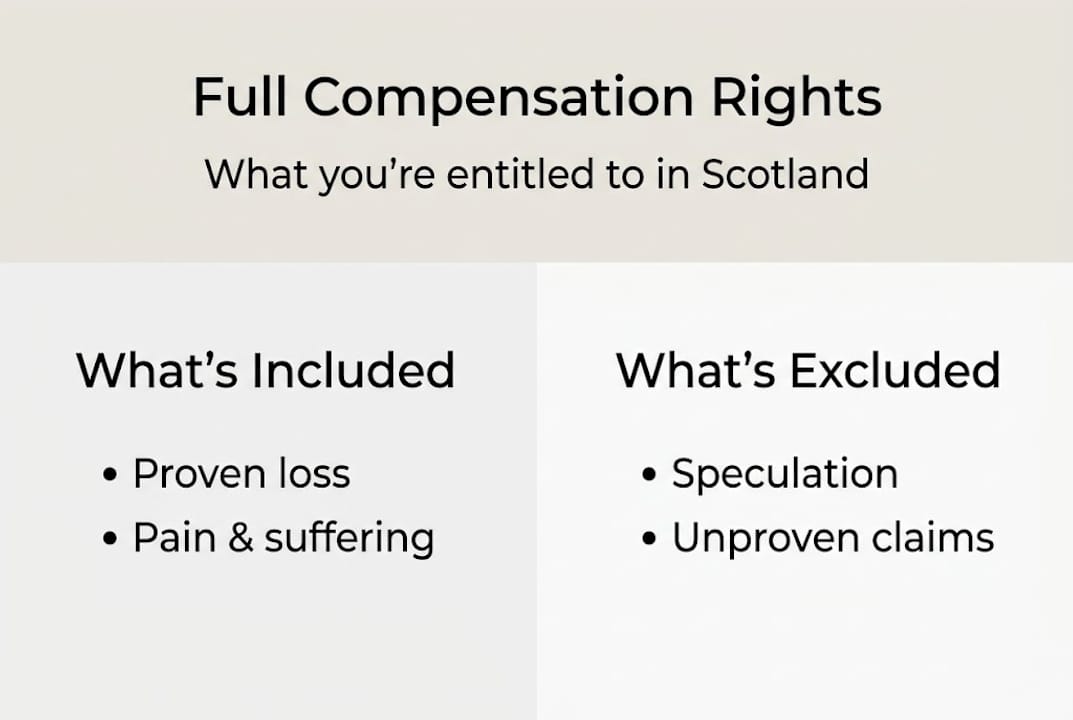
This does not mean you receive an unlimited payout or that every wish is granted. It means that every proven loss, caused directly by the accident, should be compensated. The legal framework behind full compensation meaning in Scottish personal injury cases distinguishes between two main categories of loss.
Solatium covers the pain, suffering, and loss of amenity caused by the injury itself. This is the non-financial element. Patrimonial loss covers the financial consequences, which can include past and future earnings, medical costs, and care expenses.
Common beliefs often fall short of legal reality. People frequently assume that a serious injury automatically results in a large payout, or that emotional distress alone is sufficient grounds for a substantial award. In fact, courts require clear, documented evidence for every head of loss claimed.
Typical losses that can form part of your entitlement include:
- Lost earnings from time off work
- Future loss of earnings if your capacity to work has been reduced
- Medical expenses, including private treatment
- Prescription and travel costs for treatment
- Care and assistance provided by family members or professionals
- Home or vehicle adaptations required because of the injury
- Psychological therapy costs
“The standard for full compensation in Scotland is not about generosity, it is about accuracy. Every item must be proven and causally linked to the accident.”
Understanding injury rights in Scotland helps you recognise that entitlement is earned through evidence, not assumed through suffering alone.
How full compensation is calculated in Scotland
Calculating full compensation is not a single calculation but a structured process that looks at past losses separately from future ones. Scottish courts and solicitors follow a well-established methodology when putting a financial figure on a claim.
Here is how the calculating compensation process typically works:
- Quantify past losses using payslips to establish lost earnings, medical receipts to confirm treatment costs, and care records to show assistance received since the accident.
- Obtain medical evidence that confirms the injury, its severity, and its likely long-term impact on your work and daily life.
- Project future losses based on medical prognosis, including ongoing care needs and reduced earning capacity over the coming years.
- Apply the Personal Injury Discount Rate (PIDR) to convert future financial losses into a lump sum that reflects present-day value.
The PIDR is a critical and often misunderstood element. Because future losses are paid as a lump sum today rather than in instalments over time, the figure must be adjusted to account for investment returns. The official Scottish government guidelines set out the patrimonial damages methodology, including how future losses are projected and discounted using the PIDR. As of 2026, the PIDR in Scotland stands at 0.5%, though this is subject to periodic review and may change.
A lower PIDR means a higher lump sum, because it assumes lower investment returns on the money awarded. This is why staying up to date with rate changes, as detailed in the claim benefits guide, can genuinely affect your final award.

| Loss category |
Example past loss |
Example future loss |
| Lost earnings |
£8,000 (6 months off work) |
£45,000 (reduced capacity for 10 years) |
| Medical treatment |
£2,500 (physio and scans) |
£15,000 (ongoing specialist care) |
| Care and assistance |
£3,000 (family support) |
£20,000 (professional carer) |
| Travel for treatment |
£400 (mileage and parking) |
£1,200 (future appointments) |
Pro Tip: The more evidence you gather from day one, the more thoroughly your entitlement can be demonstrated. Keep every receipt, record every appointment, and log every day you are unable to work or carry out normal activities.
What is included and excluded from full compensation
Knowing how values are assessed, it is important to understand exactly what you can and cannot include in your claim. Scottish personal injury law draws clear lines here, and crossing them can undermine an otherwise strong case.
What is typically included:
- Medical expenses for treatment directly related to the injury
- Travel costs to and from hospital or specialist appointments
- Care costs, whether professional or provided by a family member
- Home adaptations such as ramps, stairlifts, or bathroom modifications
- Aids and equipment, including mobility devices
- Lost earnings, both past and projected future income
- Psychological support costs caused by the accident
What is typically excluded:
- Punitive or exemplary damages (Scottish law does not generally award these in personal injury cases)
- Double recovery, meaning you cannot claim for the same loss twice
- Losses that are too remote or not directly caused by the accident
- Benefits received that overlap with the claimed loss, in certain circumstances
The Scottish government compensation reforms note that ranges are benchmarks from guidelines and precedents, and that outcomes vary by case specifics. No two claims are identical.
| Item |
Included |
Excluded |
| Physio treatment bills |
Yes |
|
| Punitive damages |
|
Yes |
| Carer’s time and costs |
Yes |
|
| Speculative future earnings |
|
Yes (if unproven) |
| Travel to appointments |
Yes |
|
| Duplicate state benefit claims |
|
Yes |
To strengthen what is included in your claim, gather the following evidence:
- GP and hospital records documenting every visit and diagnosis
- Receipts and invoices for all treatment and adaptation costs
- A care diary recording hours of assistance you received
- Written assessments from occupational therapists or care specialists
- Payslips and employer correspondence confirming lost income
Exploring additional claimable benefits can also reveal entitlements you may not have considered, particularly where long-term care needs are involved.
Practical steps to secure your full compensation entitlement
With clear boundaries on what counts for full entitlement, here is how you can make sure you actually receive it.
- Gather all documents immediately. Start collecting payslips, bank statements, medical letters, and receipts from the moment the accident happens. Gaps in records are one of the most common reasons claims fall short.
- Attend all medical assessments. Courts and insurers rely on medical evidence. Missing appointments or declining examinations weakens your case significantly.
- Track every expense, no matter how small. Parking at the hospital, over-the-counter medication, and travel costs all count. These small amounts can add up to thousands over a lengthy recovery.
- Keep a personal injury diary. Write down daily how your injury affects your life, your ability to work, your sleep, and your relationships. This supports your solatium claim.
- Consult a solicitor early. A specialist personal injury solicitor will identify heads of loss you may not have considered and ensure your future losses are accurately projected.
- Stay informed about reforms. Ongoing reforms to benchmarks and discount rates can directly affect how much you recover, making legal advice even more valuable.
Pro Tip: Record every loss, even ones that feel trivial. A missed birthday trip, the cost of a cleaner because you cannot manage the housework, or a gym membership you can no longer use may all be claimable. Small losses become significant when aggregated across months or years.
Learning how to maximise your claim before settlement discussions begin gives you a far stronger negotiating position. Checking your claim eligibility early also avoids time and effort on claims that may not proceed. The role of evidence in building your case cannot be overstated.
A Scottish lawyer’s perspective on full compensation entitlement
From years of working through Scottish personal injury claims, one lesson stands out: most claimants significantly underestimate the value of their future losses. They focus on what has already happened and overlook the years of reduced earnings, care costs, or treatment fees that lie ahead.
Recent reviews of the PIDR and insights on calculating compensation demonstrate why expert advice matters. Even small changes to the discount rate can shift a settlement by tens of thousands of pounds.
Here is the contrarian view worth considering: maximum compensation is not the same as full compensation. Chasing the largest possible number without grounding it in documented evidence often leads to challenges from the defence, delays, and reduced credibility. True entitlement is precise, not inflated. The difference between an average and optimal outcome most often comes down to record-keeping and legal advocacy. A well-evidenced claim, presented clearly, almost always outperforms an aggressive but poorly documented one.
Get help securing your full compensation entitlement
If you are unsure whether your claim covers every loss you are entitled to, the right next step is getting a clear picture of what your case could actually be worth. Use the check your compensation calculator on Scotland Claims for a personalised estimate based on your circumstances. For more complex questions around future losses, care costs, or PIDR calculations, speak to an injury lawyer who specialises in Scottish personal injury law. Scotland Claims connects you with specialist solicitors under a no win no fee support arrangement, meaning you pay nothing upfront and retain 100% of your compensation if your case succeeds.
Frequently asked questions
What does ‘full compensation entitlement’ mean in Scottish law?
It means being returned, as closely as possible, to your pre-injury financial position, covering all proven losses caused by the accident. Every item must be evidenced and directly linked to the incident.
Is there a fixed amount for full compensation entitlement?
No, the amount varies by case. Ranges are benchmarks from guidelines and precedents, but entitlement is always tailored to your specific losses and circumstances.
How is future loss calculated for compensation in Scotland?
Future losses are projected using medical evidence and then discounted to present value using the Personal Injury Discount Rate, currently set at 0.5% in Scotland.
What proof do I need for full compensation?
You will need payslips, medical receipts, care records, and documentation of all accident-related expenses to evidence your losses clearly to the court or insurer.
Recommended