Why deadlines matter in injury claims: protect your rights

Many people assume they can pursue an injury claim whenever they feel ready. That assumption is wrong, and it costs claimants their compensation every year. Once a legal deadline passes, your claim becomes time-barred, meaning the right to compensation is extinguished entirely. Courts apply these rules strictly, with very little room for sympathy or flexibility. In this article, we explain the standard deadlines that apply in Scotland, what happens if you miss them, the narrow exceptions that exist, and the practical steps you can take right now to protect your claim.
Table of Contents
Key Takeaways
| Point |
Details |
| Time limits are strict |
Missing the deadlines usually means you lose your right to compensation in Scotland. |
| Few exceptions exist |
Only rare situations, such as being under 16 or mentally incapacitated, allow more time. |
| Act quickly |
The best way to protect your claim is to seek legal advice without delay. |
| Professional help is crucial |
Specialist solicitors understand the processes and can ensure your deadlines are met. |
Time limits in Scottish injury claims: the basics
Scottish law uses two overlapping concepts to govern how long you have to bring a claim: limitation and prescription. Understanding the difference matters enormously.
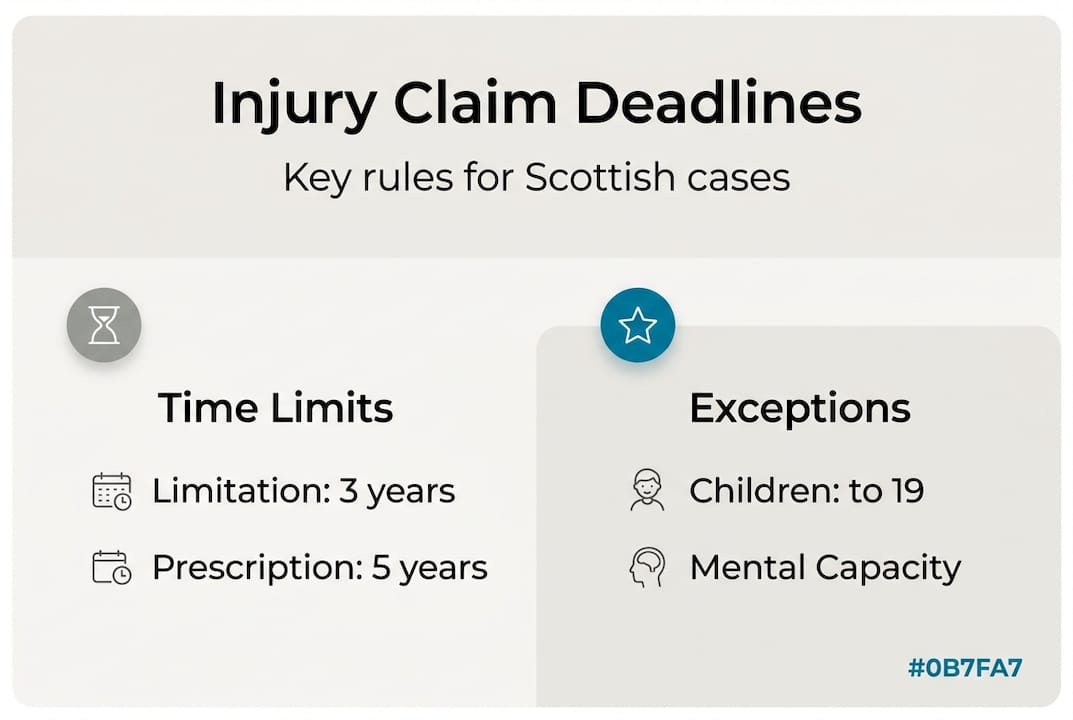
Limitation applies specifically to personal injury claims and sets a three-year window. Prescription is the broader rule, applying to most other civil claims, and runs for five years generally. Once either period expires, the right to claim is extinguished, not merely delayed.
| Type |
Applies to |
Time limit |
| Limitation |
Personal injury claims |
3 years |
| Prescription |
General civil claims |
5 years |
| Minors |
Claims on behalf of under-16s |
From 16th birthday (until age 19) |
| Latent injuries |
Hidden or delayed injuries |
From date of knowledge |
The clock does not always start on the day of the accident. Scotland uses a discoverability test, meaning the three-year period begins from the date you knew, or reasonably ought to have known, about the injury, its cause, and who was responsible. This post-2018 objective test is important for injuries that develop gradually, such as industrial disease or repetitive strain.
Checking your injury claim eligibility early is essential, because the clock may already be running without you realising it. The rules around raising a legal dispute in Scotland are precise, and acting quickly after an accident is one of the most important things you can do.
Key terms to know:
- Limitation period: The window within which a personal injury claim must be raised in court
- Prescription: The broader extinction of legal rights after a set period
- Time-bar: The point at which a claim is legally blocked from proceeding
- Date of knowledge: The date from which the limitation clock starts, based on awareness of the injury
What happens if you miss a deadline?
Missing the deadline is not a procedural inconvenience. It is a legal catastrophe. Once your claim is time-barred, you lose the right to compensation entirely, regardless of how strong your case might have been.
“Missing the deadline results in the claim being time-barred, extinguishing the right to compensation entirely, with courts applying the rules strictly.”
Here is what typically happens, step by step:
- The deadline passes. The three-year limitation period expires without court proceedings being raised.
- The defender raises a time-bar defence. The person or organisation you are claiming against argues the claim is out of time.
- The court upholds the defence. Because courts enforce time limits strictly, the claim is dismissed.
- Compensation is lost. No award is made, regardless of the severity of your injury or the strength of your evidence.
- Legal costs may follow. In some cases, you may face liability for the other side’s legal costs.
The courts are strict for a reason. Defenders need certainty. Witnesses’ memories fade, evidence deteriorates, and businesses cannot be left facing indefinite liability. The rules protect both sides, but they fall hardest on claimants who delay. Following a step-by-step claim guide from the outset, and understanding why swift action matters, can prevent this outcome entirely.

Are there any exceptions to the rules?
Exceptions exist, but they are narrow and should never be relied upon as a safety net.
Children and young people: For anyone injured under the age of 16, the three-year clock starts on their 16th birthday, giving them until age 19 to raise a claim. A parent or guardian can bring a claim on the child’s behalf before that point.
Mental incapacity: If a claimant lacks legal capacity due to a mental health condition, the limitation clock is paused for as long as that incapacity continues.
Latent and hidden injuries: Where an injury was not immediately apparent, the clock starts from the date of knowledge, meaning when you became aware of the injury, its cause, and the identity of the responsible party. Post-2022 reforms tightened this test, requiring objective awareness rather than subjective belief.
| Scenario |
Standard rule |
Exception applies? |
| Adult injured in road accident |
3 years from accident date |
No |
| Child injured at age 12 |
Clock starts at age 16 |
Yes, until age 19 |
| Gradual industrial disease |
3 years from date of knowledge |
Yes |
| Mental incapacity at time of injury |
Clock paused |
Yes |
| Court discretion (s.19A) |
Rarely granted |
Exceptional cases only |
Section 19A of the Prescription and Limitation (Scotland) Act 1973 gives courts a discretionary power to allow a late claim. However, this is genuinely rare. Courts weigh the prejudice to both sides, and in most cases, the balance tips against the claimant. Gathering the right documents for special cases early strengthens any application.
Pro Tip: Even if you believe an exception applies to your situation, do not assume you are protected. Seek specialist legal advice immediately. Relying on an exception without confirmation is one of the most common and costly mistakes claimants make.
How to protect your claim: practical tips and common mistakes
Knowing the rules is only useful if you act on them. Here is what you should and should not do.
Do:
- Contact a specialist solicitor as soon as possible after your injury
- Record the exact date of the accident and any date you first noticed symptoms
- Gather and preserve evidence early, including photographs, medical records, and witness details
- Follow pre-action protocols for claims under £25,000, which require specific steps before court proceedings are raised
- Understand that the role of evidence is critical to the strength of your case
Do not:
- Assume the clock starts only when you decide to claim
- Wait to see whether your injury improves before seeking legal advice
- Assume that instructing a solicitor automatically stops the clock
- Delay because you are unsure whether your injury is serious enough, for example with back injury claims that worsen over time
One of the most misunderstood points in Scottish injury law is this: proceedings must be served on the defender to interrupt the time-bar, not merely issued by the court. Simply lodging paperwork is not enough. The defender must receive the court documents within the limitation period.
Pro Tip: Do not confuse instructing a solicitor with stopping the clock. Only the formal service of court proceedings on the defender interrupts the limitation period. Your solicitor must act promptly, and you must give them enough time to do so.
For claims valued under £25,000, pre-action protocols require both parties to exchange information and attempt resolution before court action. Failing to follow these protocols can result in cost penalties, even if your claim succeeds.
Summary: deadline essentials for Scottish injury claims
The rules around deadlines in Scottish personal injury law are not flexible guidelines. They are hard legal boundaries. Courts have refused to extend time-bars even in medical negligence cases where claimants offered detailed explanations for their delay. The Sheriff Appeal Court has confirmed that s.19A discretion is exercised only in genuinely exceptional circumstances, and the balance of prejudice must clearly favour the claimant.
The three most vital takeaways from this article are:
- Act within three years. For most personal injury claims in Scotland, you have three years from the accident or date of knowledge. This is a firm deadline.
- Do not rely on exceptions. Exceptions for minors, mental incapacity, and latent injuries exist but are narrow. Court discretion is rarely exercised in the claimant’s favour.
- Service, not issue, stops the clock. Court proceedings must be formally served on the defender within the limitation period to interrupt the time-bar.
If you are unsure where you stand, the safest approach is to seek advice now. Understanding how calculating compensation works is useful, but only if your claim is still alive.
Need expert help with your injury claim?
If reading this article has made you realise your deadline may be closer than you thought, now is the time to act. At Scotland Claims, we connect injury victims across Scotland with specialist lawyers who understand the strict rules around time limits and know exactly how to protect your position. Our no win no fee claims arrangement means you pay nothing upfront and keep 100% of your compensation if your case succeeds. Our injury lawyers in Scotland are ready to review your case, advise on your deadline, and take action before your window closes. Do not wait until it is too late.
Frequently asked questions
What is the standard deadline for injury claims in Scotland?
Most personal injury claims must be raised in court within three years of the accident or the date you became aware of the injury. Missing this deadline extinguishes your right to claim.
Are there any exceptions for children in injury claims?
Yes. For children injured under the age of 16, the clock starts at 16, giving them until their 19th birthday to raise a claim in court.
Can the courts extend the deadline for injury claims?
Courts have a discretionary power under s.19A but rarely grant extensions. The threshold is high, and most late applications are refused even with reasonable explanations.
What if I did not realise I was injured right away?
The three-year period starts from the date of knowledge, meaning when you first became aware of the injury, its cause, and who was responsible for it.
Recommended