What is financial compensation? Your guide to claims in Scotland

TL;DR:
- Compensation in Scotland legally acknowledges harm and aims to restore victims financially and emotionally.
- It includes general damages for pain and suffering, and special damages for financial losses.
- No Win No Fee arrangements make claiming accessible without upfront costs or risk of legal fees.
Most people assume financial compensation is simply a pay-out after an accident. In reality, it is far more than that. For injury victims in Scotland, compensation represents legal recognition of harm, a practical lifeline during recovery, and a route to restoring what was lost. Whether you were hurt in a road traffic accident, a workplace incident, or a slip caused by someone else’s negligence, understanding how compensation works is the first step to protecting your rights. This guide covers clear definitions, the types of compensation available, how amounts are calculated, and how a No Win No Fee arrangement makes claiming accessible without financial risk.
Table of Contents
Key Takeaways
| Point |
Details |
| Compensation’s purpose |
Financial compensation aims to restore your quality of life and cover losses after an injury. |
| Types of damages |
You can claim general and special damages, addressing pain, suffering, and financial costs alike. |
| Calculation basics |
Amounts depend on injury severity, financial impact, and supporting evidence. |
| No Win No Fee explained |
No Win No Fee allows you to access legal services without upfront solicitor fees, reducing risk. |
| Expert help boosts claims |
Legal guidance increases your chance of fair compensation and peace of mind. |
What financial compensation really means in Scotland
Financial compensation, in legal terms, refers to damages awarded to an injured person to address the losses caused by another party’s negligence or wrongdoing. The aim is not to punish the person at fault, but to restore you, as far as money can, to the position you were in before the injury occurred. That principle sits at the heart of Scottish personal injury law.
In Scotland, compensation claims are typically resolved in one of two ways: through a negotiated settlement with an insurer, or through a court ruling if agreement cannot be reached. Most cases settle before reaching court, which is often quicker and less stressful for claimants. The compensation payouts explained process outlines how these settlements are structured and what claimants can realistically expect.
Understanding the purpose of compensation matters because it shapes what you can actually claim. It is not a lottery win. It is a structured, evidence-based process designed to address real losses. The Citizens Advice Scotland guidance confirms that compensation is intended to put you back in the financial and physical position you would have been in had the accident not happened.
The two core categories of damages in Scotland are:
- General damages: Awarded for pain, suffering, and loss of amenity. This covers the physical and emotional impact of your injury, including long-term effects on your quality of life.
- Special damages: These cover actual financial losses you have incurred, such as lost wages, medical expenses, travel costs for treatment, and care provided by family members.
Compensation is not just about money. It is about acknowledgement. When a court or insurer awards damages, they are formally recognising that harm was done and that you deserve to be made whole again.
Beyond the financial figures, many claimants report that receiving compensation brings emotional closure. Knowing that your suffering has been formally acknowledged can be a meaningful part of the recovery process, not merely a practical one.
Types of financial compensation in Scottish injury claims
Now that we know what financial compensation covers, let’s see what types actually exist and how they are assessed.
As noted, the two primary categories are general damages and special damages. But within those categories, there is considerable variation depending on the nature of your injury and its consequences. Compensation categories include general and special damages with varying calculations depending on individual circumstances.
| Type of compensation |
What it covers |
Example |
| General damages |
Pain, suffering, loss of amenity |
Chronic back pain after a fall |
| Special damages |
Financial losses directly caused by injury |
Lost wages, medical bills, travel costs |
| Rehabilitation costs |
Physiotherapy, counselling, adaptations |
Post-surgery physiotherapy sessions |
| Future losses |
Ongoing care or reduced earning capacity |
Permanent disability affecting work |
Consider a practical scenario. Suppose you sustain a back injury at work due to inadequate manual handling training. General damages would address the pain you experience and the activities you can no longer enjoy. Special damages would cover your lost income during recovery, any private treatment you needed, and the cost of help around the home. If your injury affects your ability to work long-term, future losses would also form part of your claim.

The Law Society of Scotland notes that the value of each element is assessed on its own merits, which is why detailed evidence is so important.
You can also use a compensation calculator to get an early estimate of what your claim might be worth, based on injury type and the losses you have experienced.
Here are the key losses you may be able to claim:
- Pain and suffering caused by the injury
- Lost earnings during recovery or permanently
- Medical and rehabilitation expenses
- Travel costs related to treatment
- Care provided by friends or family
- Adaptations to your home or vehicle
Pro Tip: Keep a written record of every expense and loss from the moment of your accident. Even small costs add up, and documented evidence strengthens your claim considerably.
How financial compensation is calculated
With types outlined, how are the amounts actually worked out in Scotland?
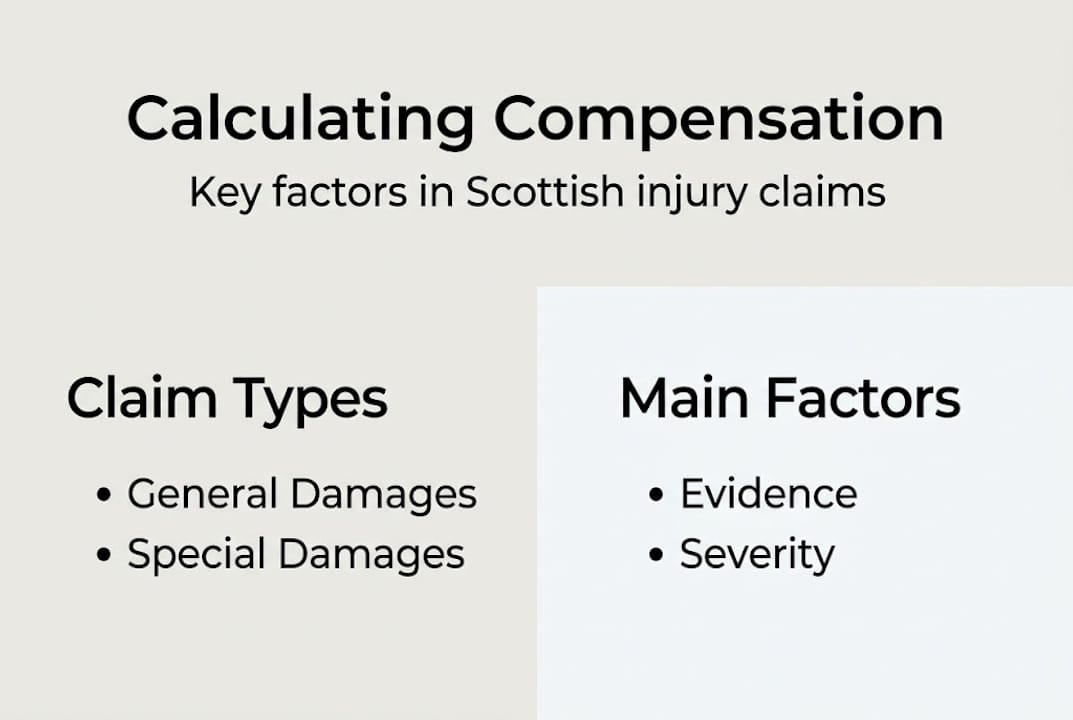
Compensation is calculated based on injury severity, financial losses, long-term impact, and established legal guidelines. There is no single fixed formula, but there are consistent factors that solicitors and courts use to arrive at a figure.
The typical steps a claimant goes through are:
- Report the accident and seek medical attention immediately.
- Gather evidence: photographs, witness details, medical records.
- Instruct a solicitor who assesses liability and the value of your claim.
- Your solicitor obtains a medical report from an independent expert.
- A settlement figure is negotiated with the at-fault party’s insurer.
- If agreement is not reached, the case proceeds to court for a ruling.
The table below illustrates how different injuries and losses might translate into compensation ranges:
| Injury type |
General damages range |
Key factors affecting value |
| Minor whiplash (full recovery) |
£1,000 to £4,000 |
Recovery time, pain severity |
| Moderate back injury |
£10,000 to £30,000 |
Long-term impact, treatment needed |
| Serious leg fracture |
£25,000 to £70,000 |
Permanence, mobility impact |
| Severe psychological injury |
£15,000 to £50,000 |
Duration, effect on daily life |
These figures are indicative. Your actual award depends on the specific facts of your case, the quality of evidence, and the skill of your legal representation. Strategies for maximising compensation include acting quickly, preserving evidence, and working with an experienced solicitor from the outset.
The Scottish Government also provides guidance for victims navigating the justice system, which can help you understand your broader rights during the process.
If you want a quick sense of what your claim might be worth before speaking to a solicitor, you can use a compensation calculator to get an informed starting point.
What is No Win No Fee and how does it affect compensation?
One of the most common questions for Scottish claimants is how legal fees work, especially regarding No Win No Fee.
No Win No Fee lets claimants pursue cases without paying upfront legal fees. In simple terms, your solicitor agrees to take on your case at no initial cost to you. If your claim succeeds, legal fees are recovered from the at-fault party’s insurer. If your claim is unsuccessful, you pay nothing to your solicitor.
This arrangement removes one of the biggest barriers to justice: the fear of being left with a large legal bill if things do not go your way. For many people in Scotland, it is the only realistic way to access specialist legal representation.
Common misconceptions include the belief that No Win No Fee means you receive less compensation. In most cases, your solicitor’s fees are paid by the other side, not deducted from your award. It is important to read your agreement carefully, however, as terms can vary between firms.
Here is a straightforward breakdown of the key points:
- No upfront costs: You do not pay anything to start your claim.
- No fees if you lose: Your solicitor absorbs the cost if the case is unsuccessful.
- Fees paid by the other side: If you win, the at-fault party’s insurer typically covers legal costs.
- You keep your compensation: Your award is not reduced to pay your solicitor in most standard arrangements.
For a fuller picture of what to expect after making a claim, including timelines and communication with your solicitor, it helps to know the process in advance.
The government’s No Win No Fee information also sets out the legal framework for these agreements across the UK, which applies in Scotland too.
Pro Tip: Before signing any No Win No Fee agreement, ask your solicitor to explain exactly what happens to your compensation if the case settles, and whether any success fee applies. Clarity at the start avoids surprises later.
How financial compensation impacts recovery and justice
Here is something that often goes unsaid: many claimants who delay or abandon their claim do so not because they lack a case, but because they do not fully understand their rights. That misunderstanding costs them dearly, both financially and emotionally.
Compensation is not a reward for being unlucky. It is a legal right when someone else’s negligence caused your harm. Treating it as anything less undersells what the law actually offers you. When you claim, you are not being greedy. You are holding someone accountable and recovering what was taken from you.
From our experience supporting injury victims across Scotland, the people who engage early, gather their evidence carefully, and work with a specialist tend to recover more fully. Not just financially, but personally. The process of claiming injury compensation with confidence gives structure to an otherwise chaotic period after an accident.
Waiting too long is the single most damaging thing you can do. Scotland’s three-year time limit sounds generous until life gets in the way and suddenly months have passed. Act early, and the process becomes far more manageable.
Expert support for your financial compensation claim
If you have been injured through no fault of your own, the right legal support can make an enormous difference to the outcome of your claim. Our specialist injury lawyers understand the Scottish legal landscape and work to secure the maximum compensation you are entitled to. They handle insurer negotiations, gather evidence, and guide you through every stage so you are never left wondering what happens next. With No Win No Fee claims help available, there is no financial barrier to getting started. You can also estimate your compensation using our free calculator before you even speak to anyone, giving you a clear sense of what your claim could be worth.
Frequently asked questions
How long does it take to receive financial compensation after an injury claim in Scotland?
Timelines vary considerably depending on complexity. Simple cases may resolve within a few months, while more serious or disputed claims can take a year or more, as outlined in guidance on claim timelines.
What types of losses can be included in a compensation claim?
You can claim for pain and suffering, lost earnings, medical costs, travel expenses, and care provided by others. The full range of recoverable losses depends on the specific facts of your case.
Will I owe anything if my No Win No Fee claim is unsuccessful?
With most No Win No Fee agreements, you pay nothing to your solicitor if your claim does not succeed. The details of solicitor’s fees under these arrangements should always be confirmed in writing before you proceed.
Is there a time limit for making a compensation claim in Scotland?
In most cases, the three-year time limit applies from the date of the accident or from when you first became aware of your injury. Acting promptly protects your right to claim.
Recommended