Maximise your compensation in Scotland: injury claim guide
After an accident, insurers often present a quick settlement figure that sounds reasonable until you realise it barely covers your medical bills, let alone lost wages or ongoing pain. Many Scottish claimants accept these initial offers, unaware they could secure significantly more with the right approach. Understanding how solatium and patrimonial damages work in Scotland, gathering robust evidence, and instructing a specialist No Win No Fee solicitor early can transform a modest payout into full, fair compensation that truly reflects your losses and suffering.
Table of Contents
Key Takeaways
| Point |
Details |
| Act quickly after accidents |
Early evidence collection is essential to maximising your injury claim in Scotland. |
| Use a specialist solicitor |
Expert No Win No Fee lawyers boost compensation through negotiation and evidence handling. |
| Understand Scottish differences |
Solatium and absence of whiplash tariffs mean Scottish claims can be more flexible and generous. |
| Wait for full prognosis |
Settling too soon risks undervaluing your injuries and future losses. |
| Avoid common mistakes |
Never accept the first offer, omit evidence, or miss claim deadlines for best results. |
Understanding Scottish compensation: types and structure
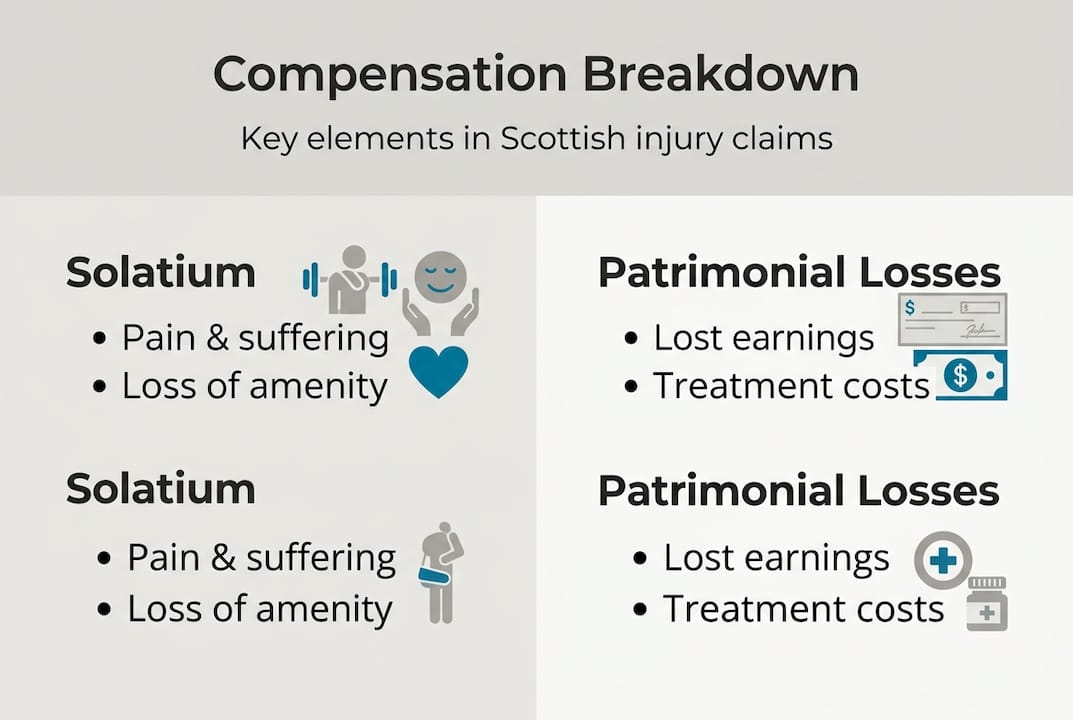
Scottish personal injury claims divide compensation into two distinct categories. Solatium covers non-pecuniary losses like pain, suffering, and loss of amenity, assessed using Judicial College Guidelines alongside medical evidence and prior case law. Patrimonial or special damages address financial losses: lost earnings, medical costs, travel expenses, and care services under sections 8 and 9 of the Administration of Justice Act 1982.
Scotland offers unique advantages. Solatium awards demonstrate greater flexibility than English general damages, and services claims for family care tend to be more generous. Fatal claims under the Damages (Scotland) Act 2011 allow multiple family members to pursue compensation simultaneously. Crucially, Scotland has no whiplash tariff, meaning awards for soft tissue injuries can exceed those south of the border.
| Damage type |
What it covers |
Scottish specificity |
| Solatium |
Pain, suffering, loss of amenity |
More flexible than English awards |
| Patrimonial/special |
Lost wages, medical costs, care services |
Generous family care provisions |
| Fatal claims |
Bereavement, loss of support |
Multi-claimant under 2011 Act |
The Judicial College Guidelines remain persuasive in Scottish courts, providing benchmark ranges for various injuries. However, sheriffs and juries retain discretion to adjust awards based on individual circumstances, medical evidence, and the claimant’s specific losses. This flexibility means well-prepared claims with strong evidence can secure higher compensation than guideline minimums suggest.
For calculating compensation accurately, you need detailed documentation of both solatium and patrimonial elements. Working with injury lawyers in Scotland ensures you understand which losses qualify and how to quantify them properly. Learn more about solatium in Scots law to grasp its unique application.
Gathering robust evidence: your foundation for maximum payout
Strong evidence separates modest settlements from maximum compensation. Comprehensive documentation includes accident scene photographs, injury images, medical records and reports, witness contact details, receipts for all expenses, symptom diaries, and wage documentation like pay slips or P60s. The more thorough your evidence collection, the harder it becomes for insurers to dispute your claim’s value.

Timing matters critically. Accident scenes change, witnesses forget details, and physical evidence disappears. Act within days, not weeks. Photograph injuries immediately and again as they heal to demonstrate progression. Keep every receipt, no matter how small, from taxi fares to prescription costs. These seemingly minor expenses accumulate into substantial patrimonial damages.
Pro Tip: Start a daily symptom diary immediately after your accident. Note pain levels, mobility restrictions, sleep disruption, and how injuries affect daily activities. This contemporaneous record proves invaluable when quantifying solatium months later, especially for injuries with fluctuating symptoms.
Medical appointments require complete honesty and attendance. Missing appointments or downplaying symptoms gives insurers ammunition to reduce offers. Disclose every symptom, even those seeming minor, as some injuries manifest delayed complications. Medical reports form the cornerstone of solatium valuation, so ensure they accurately reflect your experience.
- Photograph the accident scene from multiple angles, capturing hazards, lighting, and surrounding context
- Obtain contact details for all witnesses, including bystanders who may have seen events unfold
- Report the accident formally to relevant parties (employer, property owner, police if applicable) within required timeframes
- Collect medical records from GPs, hospitals, and specialists, ensuring reports detail injury severity and prognosis
- Maintain a dedicated folder for receipts, invoices, and financial documents related to your injury
Scottish reporting requirements vary by accident type. Workplace injuries must be reported under RIDDOR regulations, whilst road traffic accidents may require police notification. Missing these deadlines can complicate claims, so familiarise yourself with obligations specific to your situation.
For detailed guidance on evidence in injury claims, explore how different evidence types strengthen your case. Understanding why documenting accident evidence matters helps you prioritise collection efforts. Review common slip and trip injury examples to see how evidence applies in real scenarios. Additional claim evidence tips provide practical collection strategies.
Expert solicitors and negotiation: leveraging legal expertise
Specialist solicitors maximise compensation through negotiation expertise, insurer resistance knowledge, and evidence handling, with No Win No Fee arrangements removing financial risk through capped success fees. They understand how insurers operate, recognise lowball tactics, and know when to push for higher offers versus when to accept reasonable settlements.
Early settlement poses significant risks. Insurers often present quick offers before full medical prognosis emerges, hoping claimants accept amounts that fail to cover ongoing treatment, future wage loss, or long-term complications. Approximately 90% of claims settle through negotiation rather than court proceedings, making negotiation skills essential. However, settling too early undervalues claims by missing future losses.
No Win No Fee arrangements make expert representation accessible regardless of financial circumstances. You pay nothing upfront, and solicitors only receive fees if your claim succeeds. Success fees are capped by regulation, ensuring you retain the vast majority of your compensation. This structure aligns solicitor incentives with yours: they only profit when you do, motivating them to maximise your award.
Pro Tip: Never accept the first offer without consulting a solicitor. Insurers routinely present initial offers 30-50% below fair value, expecting claimants to negotiate upwards or accept undervalued amounts. A brief consultation costs nothing under No Win No Fee and often reveals your claim’s true worth.
Court proceedings remain rare but possible. Scottish civil courts handle disputed claims, and jury trials occasionally occur in personal injury cases. Juries may award higher solatium due to sympathy factors, though this route carries risks and delays. Most solicitors exhaust negotiation before recommending litigation, as settlement provides faster, more predictable outcomes.
“Instructing a specialist early transforms outcomes. They build evidence systematically, reject inadequate offers confidently, and quantify losses comprehensively. The difference between self-representation and expert guidance often amounts to thousands of pounds in additional compensation.”
For comprehensive No Win No Fee details, explore how these arrangements protect your interests. Understanding injury claim dos and don’ts helps you avoid common negotiation pitfalls.
Calculating damages: awards, benchmarks and Scottish specifics
Scottish courts adapt Judicial College Guidelines to local precedent, creating injury-specific benchmark ranges: minor head injuries typically award £1,675 to £9,700, moderate back injuries £9,500 to £21,100, severe brain injuries exceed £214,000, and whiplash ranges from £1,000 for minor cases to £12,000 plus for chronic conditions. These figures represent solatium only, with patrimonial damages added separately based on individual circumstances.
The absence of a whiplash tariff in Scotland means soft tissue injury awards can significantly exceed English equivalents. Where England caps minor whiplash at fixed amounts, Scottish courts assess each case individually, potentially awarding higher solatium when medical evidence supports greater suffering or prolonged recovery.
| Injury severity |
Typical solatium range |
Common patrimonial additions |
| Minor whiplash |
£1,000 to £2,500 |
Lost wages, physiotherapy costs |
| Moderate back injury |
£9,500 to £21,100 |
Extended sick leave, ongoing treatment |
| Severe brain injury |
£214,000+ |
Lifetime care, lost earning capacity |
| Chronic pain syndrome |
£12,000 to £40,000+ |
Medication, mobility aids, home adaptations |
Future losses require careful calculation using Ogden tables, which convert ongoing losses into lump sum awards. If your injury prevents returning to work or reduces earning capacity, these calculations can dwarf initial medical costs. Solicitors instruct actuarial experts for severe cases to ensure future losses receive proper valuation.
The three-year time limit from accident or date of knowledge applies in Scotland, with exceptions for minors and those lacking capacity. Acting promptly preserves evidence and prevents time-bar, which would forfeit your right to compensation entirely. Court discretion exists to extend deadlines in exceptional circumstances, but relying on this proves risky.
For detailed compensation calculation methods, explore how courts combine solatium and patrimonial elements. Review back injury benchmarks and knee injury benchmarks for specific injury guidance. Use an injury claim calculator to estimate your potential award.
Mistakes to avoid and edge cases in Scottish injury claims
Contributory negligence reduces compensation proportionally when you share fault, but it doesn’t bar claims entirely. If you’re 20% at fault, your award decreases by 20%. Insurers often exaggerate claimant fault to reduce payouts, making legal representation crucial for challenging unfair apportionment.
Multiple injuries require holistic valuation rather than simple addition. A claimant with both back and knee injuries may experience compounded disability exceeding the sum of individual injuries. Solicitors present medical evidence demonstrating how injuries interact, potentially securing higher combined solatium than separate injury guidelines suggest.
Pro Tip: Future losses deserve particular attention in claims involving young claimants or permanent disabilities. A 30-year-old losing earning capacity faces decades of reduced income, potentially worth hundreds of thousands in present value. Never settle without actuarial assessment of long-term financial impact.
Qualified One-Way Cost Shifting (QOCS) protects pursuers from paying defender costs if claims fail, removing financial risk from legitimate claims. This protection encourages claimants to pursue valid cases without fear of bankruptcy from adverse cost awards, though exceptions exist for fraudulent or fundamentally dishonest claims.
- Never accept first offers without independent valuation, as insurers routinely undervalue future costs and ongoing losses
- Avoid inventing figures or exaggerating losses, instead relying on Judicial College Guidelines and comparable case law
- Don’t miss medical appointments or fail to disclose symptoms fully, as gaps in treatment records undermine claim credibility
- Never delay evidence collection, hoping memory will suffice months later when details have faded
- Ensure you identify the correct defendant, as suing the wrong party wastes time and may exceed limitation periods
“Edge cases require specialist knowledge. Jury trials, whilst rare, can produce sympathetic awards exceeding guideline ranges. Ogden table calculations for future losses demand actuarial precision. QOCS protection shields pursuers but requires understanding its limits. These nuances separate adequate representation from truly maximised compensation.”
For comprehensive guidance on injury rights in Scotland, explore your legal protections and entitlements. Understanding the injury claims process helps you navigate each stage confidently.
Get expert help to maximise your Scottish injury compensation
Navigating Scottish personal injury claims alone risks leaving substantial compensation unclaimed. Scotland Claims connects you with specialist solicitors who understand solatium valuation, patrimonial damage quantification, and negotiation tactics that maximise awards. Our No Win No Fee approach means you risk nothing whilst gaining expert advocacy throughout your claim.
Our compensation calculator provides instant estimates based on your injury type and circumstances, helping you understand potential award ranges before committing to representation. Whether you’ve suffered back injuries requiring ongoing treatment or complex cases involving multiple losses, we match you with solicitors experienced in your specific injury type.
The difference between self-representation and expert guidance often amounts to thousands of pounds. Solicitors reject inadequate offers, gather comprehensive evidence, instruct medical experts, and negotiate from positions of strength. They understand when to settle and when to push for more, ensuring you receive every pound you deserve.
Don’t let insurers undervalue your suffering and losses. Contact Scotland Claims today for a free, no-obligation consultation. Our No Win No Fee support ensures you access top-tier legal representation regardless of financial circumstances, with fees only payable from successful awards.
Frequently asked questions
What is the time limit for making a compensation claim in Scotland?
You generally have three years from the accident or date of knowledge to start a claim, with exceptions for minors and those lacking capacity. Court discretion may extend deadlines in exceptional circumstances.
Is it better to settle early or wait for medical prognosis?
Wait for full medical evidence and prognosis before settling, as early agreements often undervalue ongoing impacts and future losses that only become apparent with time.
What is solatium and how does it affect Scottish claims?
Solatium compensates pain, suffering, and loss of amenity, offering more flexibility and potentially higher awards in Scotland compared to English general damages due to judicial discretion.
How do No Win No Fee arrangements work in Scottish injury claims?
No Win No Fee means you pay nothing upfront, with solicitor fees capped and only deducted from successful awards, removing financial risk whilst ensuring expert representation.
Can compensation be reduced if I am partly at fault?
Yes, contributory negligence reduces compensation proportionally based on your fault percentage, but it doesn’t prevent you from claiming entirely.
Recommended