Broken bone compensation claims in Scotland: 2026 guide

TL;DR:
- Even simple fractures caused by negligence can entitle you to significant compensation.
- Scottish law requires claims to be made within three years of injury.
- Acting quickly and choosing experienced Scottish injury lawyers improves your chances of success.
Suffering a broken bone is painful enough without the added stress of wondering whether you can claim compensation. Many people assume only catastrophic or complex injuries qualify for a meaningful payout, but that simply is not true. Even a straightforward fracture caused by someone else’s negligence could entitle you to thousands of pounds in compensation. This guide explains exactly who qualifies, how much you might receive, what the claims process looks like, and how to give your case the best possible chance of success from the very first step.
Table of Contents
Key Takeaways
| Point |
Details |
| Eligibility criteria |
You may claim compensation if your broken bone injury in Scotland resulted from another’s negligence. |
| Compensation range |
The amount awarded depends on the severity, location, and impact of your fracture. |
| Claims process steps |
Gather evidence, start your claim quickly, and use an experienced solicitor for the best outcome. |
| No Win No Fee option |
Most Scottish solicitors offer No Win No Fee agreements for injury claims, reducing your financial risk. |
Understanding broken bone compensation in Scotland
Broken bone compensation is a financial award made to someone who has suffered a fracture as a result of another party’s negligence or a preventable accident. Under Scottish law, you are generally entitled to pursue a claim if your injury would not have occurred but for someone else’s failure to take reasonable care. That could be an employer, a driver, a local council, or a business owner.
Common situations that lead to successful claims include:
- Road traffic accidents where another driver was at fault
- Workplace accidents involving unsafe equipment, inadequate training, or poor maintenance
- Slips, trips, and falls in public places such as supermarkets, pavements, or leisure centres
- Accidents on someone else’s property where the occupier failed to maintain safe conditions
- Assaults where a third party caused your injury
Eligibility for compensation after a broken bone depends on whether the injury was caused by another’s negligence or an accident that could have been avoided. This is the central test in Scottish personal injury law, and it applies regardless of whether your fracture was a clean break or a more complex injury.
One important point: you must act within the legal time limit. In Scotland, you generally have three years from the date of your accident to start a claim. Missing this deadline almost always means losing your right to compensation entirely. There are limited exceptions, such as claims involving children or cases where the injury was not immediately apparent, but do not rely on these.
“The three-year time limit is not a suggestion. It is a legal boundary that, once passed, closes the door on your claim regardless of how strong your case might be.”
If your injury happened at work, workplace injury claims follow the same three-year rule, but there are additional employer liability laws that can strengthen your position. Understanding the specific legal framework that applies to your situation is one reason why specialist legal advice matters so much from the outset.
How much compensation can you claim for a broken bone?
Compensation for a broken bone in Scotland is divided into two categories. General damages cover pain, suffering, and loss of quality of life. Special damages cover financial losses such as lost earnings, medical expenses, travel costs, and the cost of care or assistance you needed during recovery.
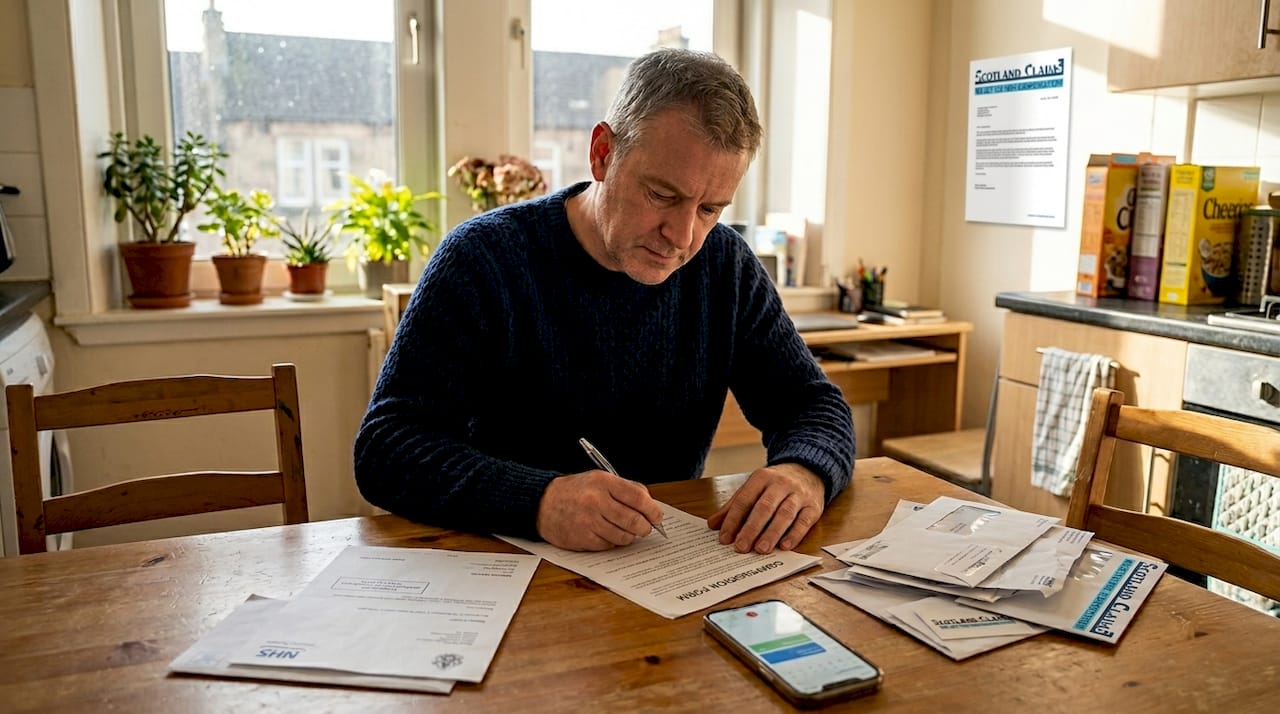
Compensation amounts depend on the location, severity, and recovery time of your broken bone. The table below gives a broad indication of typical general damages awards in Scotland:
| Fracture type |
Typical compensation range |
| Wrist fracture |
£3,500 to £36,000 |
| Ankle fracture |
£12,000 to £46,000 |
| Arm fracture |
£6,000 to £38,000 |
| Leg fracture |
£8,000 to £127,000 |
| Rib fractures |
£3,000 to £21,000 |
These figures reflect general damages only. When you add special damages for lost income, rehabilitation, and ongoing care, the total award can be significantly higher. A severe leg fracture requiring surgery and months off work, for example, could result in a total settlement well into six figures.
Medical evidence plays a central role in determining the value of your claim. A detailed report from an independent medical expert will assess the nature of your fracture, your treatment, your recovery progress, and any long-term effects. The more thoroughly your injuries are documented, the stronger your position when negotiating a settlement.
Pro Tip: Keep a personal injury diary from the day of your accident. Record your pain levels, the activities you cannot do, and how your injury affects your daily life. This contemporaneous record can significantly strengthen the general damages element of your claim.
Solicitors experienced in broken bone claims know how to identify every head of loss and ensure nothing is left off the table. Using a compensation calculator can give you an early estimate, but a specialist will help you understand the full picture, including future losses that are easy to overlook.
The claims process: steps to secure broken bone compensation
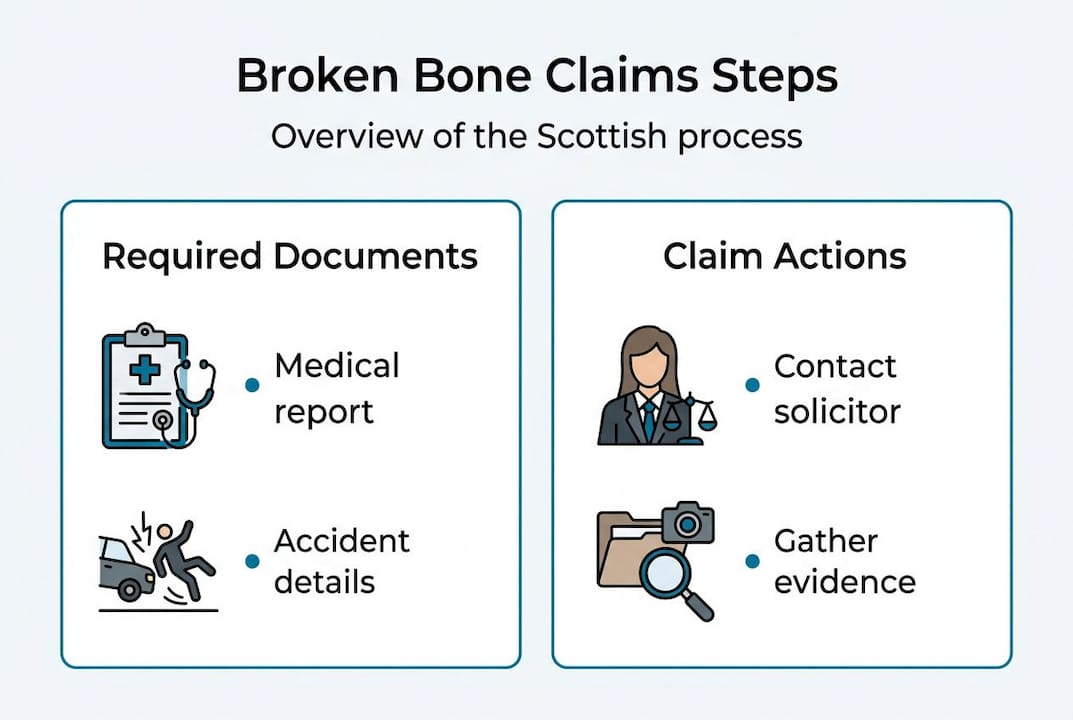
Knowing your potential compensation is only one part. Understanding the process from start to finish will help you prepare and avoid costly mistakes. Here is how a typical broken bone compensation claim progresses in Scotland:
- Seek medical treatment immediately. Your health comes first, and medical records created close to the time of injury are among the most valuable pieces of evidence you will have.
- Report the accident. If it happened at work, ensure it is recorded in the accident book. If it happened in a public place, report it to the relevant authority or business.
- Gather evidence. Photographs of the scene, contact details of witnesses, and any CCTV footage should be collected as soon as possible.
- Instruct a solicitor. A specialist will assess your claim, advise on its merits, and manage the legal process on your behalf.
- Obtain a medical report. Your solicitor will arrange an independent medical examination to formally document your injuries.
- Submit your claim. Your solicitor will notify the responsible party and set out the basis of your claim.
- Negotiate a settlement. Most claims are resolved through negotiation without going to court. If the other side disputes liability or the amount, court proceedings may be necessary.
Gathering strong evidence and acting within the legal time limits significantly improves your claim’s success. One of the most common mistakes people make is waiting too long to start an injury claim, assuming they have plenty of time. Three years sounds like a long time, but evidence fades, witnesses move on, and memories become unreliable.
Pro Tip: Even if you are unsure whether your accident was someone else’s fault, speak to a solicitor before deciding not to claim. Many people discover they have a strong case only after getting proper legal advice. You can also read more about how to prepare injury evidence before your first consultation.
Choosing the right solicitor for your compensation claim
Having reviewed the process, it is vital to ensure you have the right legal support. The solicitor you choose can make a real difference to the outcome of your claim.
Choosing an experienced Scottish injury solicitor greatly increases your chances of a successful settlement. Not all solicitors are equal, and a general practitioner who handles the occasional personal injury case is unlikely to achieve the same results as a specialist who focuses exclusively on this area of law.
Here is what to look for when selecting a solicitor:
- Scottish legal expertise. Scottish law differs from English law in important ways. Your solicitor must be qualified and experienced in Scottish personal injury practice.
- A clear No Win No Fee agreement. Under a No Win No Fee arrangement, you pay nothing upfront and nothing at all if your claim is unsuccessful. This removes the financial risk entirely.
- Transparent communication. You should receive regular updates and clear explanations at every stage.
- Proven track record. Ask about similar cases the firm has handled and the outcomes achieved.
| Factor |
Specialist firm |
General solicitor |
| Scottish injury law expertise |
High |
Variable |
| No Win No Fee availability |
Standard |
Not always offered |
| Medical expert network |
Established |
Limited |
| Settlement negotiation experience |
Extensive |
Limited |
Red flags to watch out for include solicitors who pressure you into accepting early settlements, those who are vague about fees, and any firm that cannot clearly explain how Scottish personal injury law applies to your specific circumstances. Acting quickly and choosing wisely are the two decisions most likely to determine the outcome of your claim.
What most people get wrong about broken bone compensation claims in Scotland
In our experience working with injury claimants across Scotland, the single biggest factor separating successful claims from unsuccessful ones is not the severity of the injury. It is how quickly and thoroughly the claimant acted in the days and weeks after the accident.
People routinely downplay “minor” fractures, assuming a cracked rib or a simple wrist break will not attract meaningful compensation. But a fracture that keeps you off work for two months, disrupts your family life, and causes ongoing discomfort is far from minor in legal terms. The role of evidence in these cases is decisive. Claimants who document everything from day one consistently achieve better outcomes.
The other mistake we see repeatedly is choosing a solicitor based on convenience rather than expertise. Scottish personal injury law has its own distinct rules and procedures. A solicitor who handles conveyancing or family law most of the time is simply not the right choice for a fracture claim. Specialist knowledge is not a luxury here. It is the foundation of a strong case.
How Scotland Claims can help you
If you have suffered a broken bone in an accident that was not your fault, Scotland Claims is here to support you every step of the way. Our specialist Scottish injury lawyers offer a free initial assessment with no obligation, so you can understand your options before committing to anything. All claims are handled on a No Win No Fee basis, meaning you pay nothing unless your claim succeeds and you keep 100% of your compensation. Use our compensation calculator to get an early estimate of what your claim could be worth, then get in touch to speak with a specialist who can guide you through the process with clarity and confidence.
Frequently asked questions
What is the time limit for making a broken bone compensation claim in Scotland?
Time limits for Scottish compensation claims are typically three years from the date of injury, so it is important to act promptly to protect your right to claim.
Do I need medical evidence for a broken bone claim?
Yes, medical evidence is a key requirement for successful compensation claims, as it establishes both the nature of your injury and its impact on your life.
How much compensation can I receive for a broken bone in Scotland?
Compensation amounts vary depending on injury type and how it affects your life, with awards commonly ranging from a few thousand to tens of thousands of pounds once both general and special damages are included.
Can I claim compensation if the accident was partly my fault?
Yes, partial fault may lead to reduced but still valid compensation claims, with your award adjusted to reflect your share of responsibility for the accident.
Are No Win No Fee agreements available for broken bone claims in Scotland?
No Win No Fee is widely available for injury claims in Scotland, meaning you only pay legal fees if your claim is successful and you receive compensation.
Recommended