How to calculate personal injury compensation in Scotland

Calculating fair compensation for a personal injury claim in Scotland can feel overwhelming, especially when you’re recovering from an accident. Many people struggle to understand how courts assess damages, what evidence matters most, and how to avoid undervaluing their claim. This guide breaks down the compensation calculation process into clear, actionable steps tailored to Scottish legal standards. You’ll learn which factors courts consider, how to gather compelling evidence, and what mistakes could cost you thousands. By understanding these principles, you’ll be better equipped to claim what you fairly deserve and navigate the process with confidence.
Table of Contents
Key takeaways
| Point |
Details |
| Compensation structure |
Scottish claims assess general damages for pain and suffering alongside special damages for financial losses |
| Evidence quality matters |
Medical reports, expert testimony, and detailed financial records directly influence your compensation amount |
| Solatium principle |
Courts award solatium to compensate for non-economic losses like pain, suffering, and reduced quality of life |
| Defender challenges |
Insurance companies scrutinise evidence quality, witness credibility, and claim validity to reduce payouts |
| Professional guidance |
Specialist solicitors and compensation calculators help verify your calculations and maximise your claim |
Understanding compensation components in Scotland
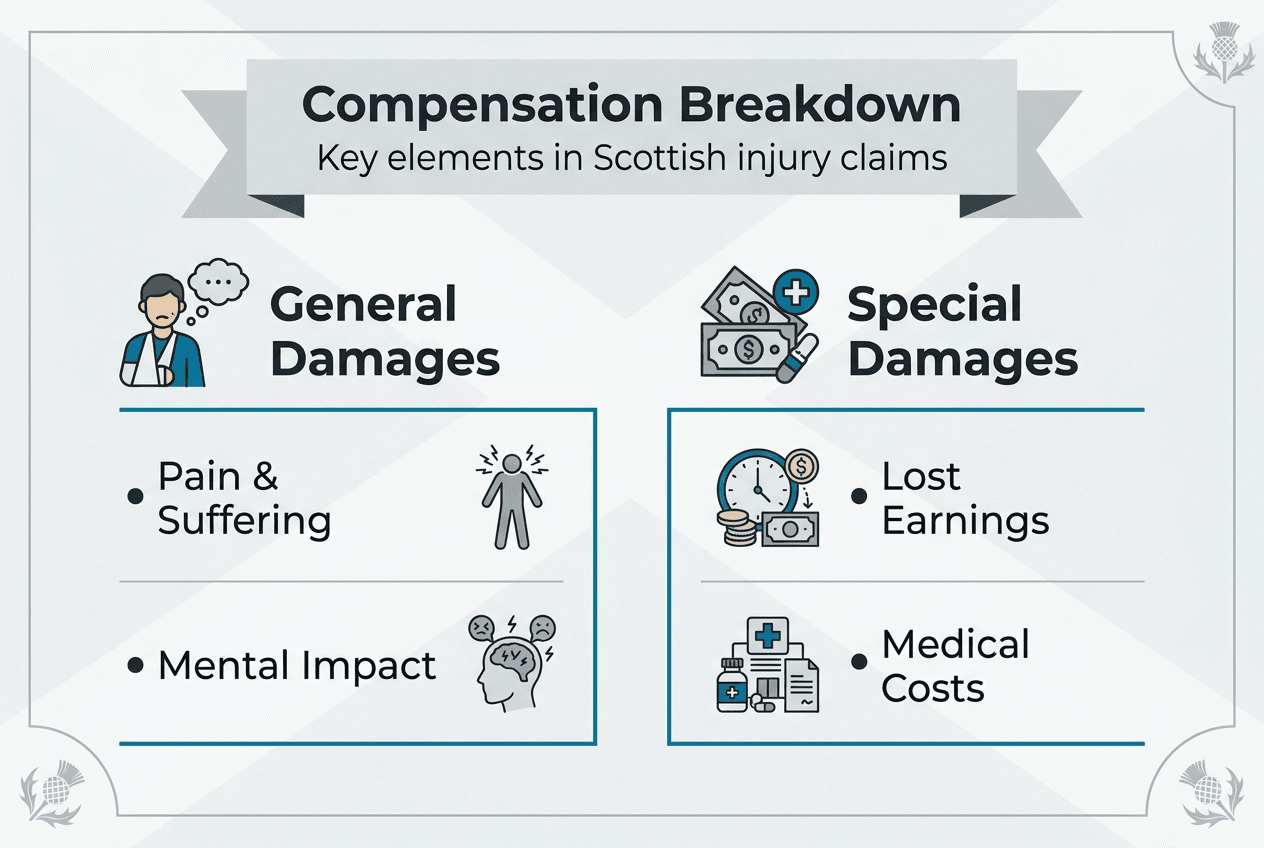
When pursuing a personal injury claim, you need to grasp how Scottish courts categorise and assess damages. Compensation divides into two main types: general damages and special damages. General damages cover intangible losses like pain, suffering, and reduced quality of life, whilst special damages account for quantifiable financial losses such as medical expenses, lost earnings, and travel costs.

Personal injury compensation calculations involve assessing injury severity, loss of earnings, and other financial losses. Courts examine medical evidence, expert opinions, and how the injury affects your daily activities. For instance, in the case of John Good v West Bay Insurance, a motorcyclist received £8,500 in compensation after a low-speed collision caused ongoing knee pain. The sheriff assessed medical evidence showing persistent symptoms despite the relatively minor impact.
Solatium represents a uniquely Scottish legal principle. It compensates you for the physical pain, mental anguish, and diminished enjoyment of life your injury causes. Courts calculate solatium by reviewing precedent cases with similar injuries and adjusting for your specific circumstances. A severe back injury causing permanent mobility restrictions typically warrants higher solatium than temporary soft tissue damage.
Special damages require meticulous documentation. You must prove every financial loss with receipts, payslips, and invoices. These might include:
- Lost wages from time off work during recovery
- Medical treatment costs not covered by NHS services
- Prescription medication and rehabilitation expenses
- Travel costs to medical appointments
- Home adaptation costs if your injury requires accessibility modifications
Accurate evidence separates successful claims from rejected ones. Injury lawyers in Scotland emphasise that vague estimates or missing documentation give defenders grounds to challenge your claim. Courts cannot award compensation for losses you cannot substantiate, regardless of how genuine they are. For knee injury claims, detailed physiotherapy records and employment letters confirming missed work strengthen your position significantly.
Building a compelling claim starts with systematic evidence collection. You need documentation that proves both the accident occurred and the injuries resulted directly from it. Strong evidence transforms a disputed claim into a straightforward settlement.
Follow this evidence gathering process:
- Obtain comprehensive medical records from your GP, hospital, and any specialists who treated your injury
- Collect photographs of the accident scene, your injuries, and any property damage
- Gather witness statements from anyone who saw the accident or can verify your injuries’ impact
- Compile financial records including payslips, tax returns, and receipts for all injury-related expenses
- Request expert reports from medical professionals who can assess long-term prognosis and treatment needs
- Document how the injury affects daily activities through a detailed diary or journal
Expert witnesses play a crucial role in providing evidence to support claims, with courts carefully scrutinising their credibility and independence. Medical experts must demonstrate relevant qualifications, recent experience in their field, and no financial interest in your case outcome. A consultant orthopaedic surgeon carries more weight than a general practitioner when assessing complex joint injuries.
For motorcycle accident claims, forensic engineers might reconstruct the collision to establish fault and impact forces. Their analysis can counter defender arguments that injuries seem disproportionate to accident severity. Similarly, vocational experts assess how injuries affect your earning capacity if you cannot return to your previous role.
Organise documents chronologically and by category. Create separate folders for medical records, financial losses, correspondence, and expert reports. This organisation helps your solicitor build a coherent narrative and respond quickly to defender challenges. When claiming injury compensation in Scotland, missing or disorganised evidence causes unnecessary delays and weakens negotiating position.
Pro Tip: Consult medical experts within weeks of your accident, not months later. Early documentation establishes a clear causal link between the incident and your injuries, making it harder for defenders to argue pre-existing conditions or unrelated causes.
Independent medical examinations arranged by your solicitor provide unbiased assessments. Whilst NHS records document treatment, independent experts focus specifically on compensation-relevant factors like permanent impairment percentages, future care needs, and psychological impact. Their reports form the foundation of your general damages calculation.
Calculating compensation step-by-step
Once you’ve assembled evidence, apply it systematically to determine your claim value. Scottish courts use established frameworks, but each case requires individual assessment based on specific circumstances.
Follow this calculation method:
- Assess general damages by reviewing Judicial College Guidelines and Scottish precedents for similar injuries
- Calculate special damages by totalling all documented financial losses with supporting receipts
- Project future losses including ongoing treatment costs and reduced earning capacity
- Add solatium for pain and suffering based on injury severity and recovery duration
- Adjust for contributory negligence if you share any fault for the accident
- Sum all components to reach your total compensation figure
Solatium awards vary significantly based on injury impact. A minor whiplash injury resolving within months might warrant £2,000 to £4,000, whilst a severe spinal injury causing permanent disability could exceed £100,000. Courts examine how the injury restricts your activities, affects relationships, and diminishes life enjoyment.
Typical compensation ranges for common injuries in Scotland:
| Injury type |
Minor cases |
Moderate cases |
Severe cases |
| Knee injuries |
£2,000 - £8,000 |
£8,000 - £25,000 |
£25,000 - £75,000+ |
| Back injuries |
£2,500 - £10,000 |
£10,000 - £35,000 |
£35,000 - £150,000+ |
| Soft tissue |
£1,000 - £5,000 |
£5,000 - £15,000 |
£15,000 - £40,000+ |
These ranges reflect 2026 values and depend heavily on medical evidence quality, recovery time, and permanent impairment. A moderate knee injury requiring surgery and causing ongoing pain sits at the higher end, whilst one responding well to physiotherapy falls lower.
Defenders challenge evidence by questioning the pursuer’s account, disputing medical opinions, and challenging evidence admissibility. Insurance companies employ medical experts to examine you independently, seeking to minimise injury severity or suggest alternative causes. They scrutinise employment records for discrepancies and investigate social media for evidence contradicting disability claims.
When disputes arise, courts weigh evidence credibility. Your treating physician’s contemporaneous notes typically carry more weight than a one-time defence examination months later. Consistent symptom reporting across multiple medical professionals strengthens your position, whilst contradictory statements raise red flags.
Pro Tip: Use the compensation calculator as a starting point, but verify your figure with a solicitor experienced in Scottish personal injury law. Calculators provide estimates, not guarantees, and cannot account for unique case factors.
Future loss calculations require particular care. If your injury prevents returning to your previous role, vocational experts assess alternative employment options and earning potential. The difference between your pre-accident and post-accident earning capacity, multiplied by your remaining working years, determines this component. Courts apply discount rates to account for receiving a lump sum rather than periodic payments.
No Win No Fee arrangements mean you risk nothing whilst pursuing fair compensation. Your solicitor handles complex calculations, evidence presentation, and negotiation with defenders, ensuring you don’t leave money on the table through undervaluation.
Common mistakes and how to avoid them when calculating compensation
Even with solid evidence, calculation errors can significantly reduce your settlement. Understanding frequent pitfalls helps you avoid costly mistakes that undermine otherwise valid claims.
Typical errors include:
- Undervaluing pain and suffering by focusing only on physical symptoms whilst ignoring psychological impact and lifestyle restrictions
- Omitting future losses like ongoing treatment costs, reduced promotion prospects, or pension contributions
- Failing to account for inflation when calculating multi-year loss of earnings
- Accepting initial settlement offers without independent valuation or legal advice
- Missing limitation deadlines, which bar claims filed more than three years after the accident
- Relying on online calculators without understanding their limitations and assumptions
Incomplete evidence particularly damages claims. Submitting medical records that end abruptly suggests full recovery, even if symptoms persist. Gaps in treatment history allow defenders to argue you weren’t genuinely injured or failed to mitigate losses by seeking appropriate care. If financial constraints prevented private treatment, document this and explain how you pursued all available NHS options.
Weak expert testimony undermines your entire claim. Courts dismiss reports from professionals lacking relevant qualifications or those who overreach their expertise. A physiotherapist cannot credibly opine on psychiatric injuries, nor can a GP provide specialist orthopaedic assessments. Ensure experts stay within their competency boundaries and base opinions on thorough examinations, not brief reviews.
Thorough evidence collection and realistic valuation form the foundation of successful compensation claims. Attempting to inflate figures with unsupported assertions inevitably backfires, whilst conservative estimates leave money you legitimately deserve on the table. Professional legal guidance ensures you strike the right balance.
Verify calculations before filing by consulting experienced solicitors who handle similar cases regularly. They understand current settlement trends, sheriff preferences, and defender tactics. What seems like a strong £20,000 claim might actually warrant £35,000 with proper evidence presentation, or vice versa. Injury compensation examples from recent Scottish cases provide valuable benchmarks for realistic expectations.
Social media posts create unexpected problems. Photographs showing physical activities seemingly inconsistent with claimed disabilities give defenders ammunition. Privacy settings don’t guarantee protection, as courts can order disclosure during litigation. Consider the message your online presence sends about injury severity and lifestyle impact.
Contributory negligence reduces awards proportionally. If you share 25% fault for the accident, your compensation decreases by that percentage. Honesty about circumstances serves you better than concealing facts that inevitably emerge during investigation. Solicitors can often negotiate lower contributory negligence percentages than initially alleged by presenting mitigating evidence.
Get expert help with your compensation claim
Calculating compensation accurately requires detailed legal knowledge and experience with Scottish court precedents. Whilst this guide provides essential principles, every claim involves unique factors that affect valuation. Professional support ensures you don’t undervalue your claim or make procedural errors that jeopardise your case.
Injury lawyers in Scotland offer specialist expertise in personal injury compensation, with no win no fee arrangements that eliminate financial risk. You pay nothing upfront and retain 100% of your compensation if successful. Solicitors handle evidence gathering, expert witness coordination, and negotiation with insurance companies, removing the stress from an already difficult situation.
The compensation calculator provides immediate estimates based on injury type and severity. Whilst calculators cannot replace professional legal advice, they offer a useful starting point for understanding potential claim value. For complex cases involving back injuries or multiple injury types, solicitor consultation ensures all compensation components receive proper consideration.
Contact specialist injury solicitors to discuss your specific circumstances. They’ll review your evidence, identify any gaps, and provide realistic settlement expectations based on current Scottish case law. Early legal involvement often leads to faster settlements and higher compensation, as solicitors prevent common mistakes and present compelling cases that discourage prolonged defender resistance.
How to calculate compensation - frequently asked questions
What factors affect personal injury compensation amounts in Scotland?
Compensation depends on injury severity, recovery duration, financial losses, and how the injury affects your daily life and work capacity. Courts assess medical evidence, expert opinions, and precedent cases with similar injuries. Special damages require documented proof of every expense, whilst general damages reflect pain, suffering, and reduced quality of life based on established guidelines.
How does solatium work in compensation claims?
Solatium compensates for non-economic losses like physical pain, mental anguish, and diminished life enjoyment that injuries cause. Scottish courts award solatium by reviewing similar cases and adjusting for your specific circumstances, injury severity, and recovery prognosis. Unlike special damages, solatium doesn’t require receipts but depends heavily on medical evidence and credible testimony about impact.
Can expert witness reports impact my compensation?
Expert witnesses significantly influence claim outcomes by providing independent, credible evidence about injury severity, causation, and prognosis. Courts scrutinise expert qualifications, independence, and methodology carefully. Strong expert reports from respected professionals in relevant fields can justify higher compensation, whilst weak or biased reports undermine your entire claim and invite defender challenges.
What happens if the defender disputes my evidence?
Defenders routinely challenge evidence quality, witness credibility, and claim validity to reduce payouts. Courts resolve disputes by weighing evidence reliability, with contemporaneous medical records and treating physician opinions typically carrying more weight than retrospective assessments. Your solicitor presents counter-evidence and cross-examines defence experts to protect your claim value during negotiations or court proceedings.
The compensation calculator at scotlandclaims.co.uk provides immediate estimates based on injury type and severity using current Scottish case precedents. However, calculators cannot account for unique case factors, complex injuries, or future loss projections. Use them as starting points, then consult specialist solicitors for accurate valuations that reflect your specific circumstances and maximise your settlement.
Recommended