What is employer liability? Your 2026 guide for Scotland

TL;DR:
- Employer liability makes employers legally responsible for employee safety and health at work.
- Employers must prevent foreseeable harm, and insurance covers payouts for valid injury claims in Scotland.
Employer liability is the legal responsibility an employer holds for the health, safety, and wellbeing of their employees while at work. Under the Health and Safety at Work etc. Act 1974, this duty applies to all employees regardless of contract type, covering physical injuries and work-related psychological harm. Two distinct legal frameworks create this responsibility: statutory duties imposed by Parliament, and the common law doctrine of vicarious liability. Together, they mean an employer can face a compensation claim even when they were not personally present at the time of an accident. For anyone in Scotland who has been injured at work, understanding how employer liability works is the first step towards knowing your rights.
What is employer liability under UK statutory law?
Employer liability, in formal legal terms, is the obligation placed on an employer to prevent foreseeable harm to those who work for them. The Health and Safety Executive (HSE) enforces this obligation across Great Britain, and the primary statute is the Health and Safety at Work etc. Act 1974. That Act requires employers to protect health, safety, and welfare as far as reasonably practicable. The phrase “reasonably practicable” is not fixed. It shifts depending on the industry, the nature of the risk, and the resources available to the employer.

A construction firm managing heavy plant machinery faces a higher standard of precaution than an office managing paper files. The HSE assesses whether the cost and effort of a safety measure was proportionate to the risk it was meant to control. Where employers fall short, the consequences are serious. Employers may face criminal prosecution, unlimited fines, and operational disruption for breaches of the 1974 Act, with penalties applying to both organisations and the individuals responsible for governance.
The duty of care implied by the Act is broad. It covers:
- Providing and maintaining safe equipment and machinery
- Offering adequate training and supervision for all tasks
- Maintaining a safe working environment and access routes
- Assessing and managing risks from workplace stress and mental health
- Reporting and recording accidents and near misses
Mental health issues caused by workplace stress fall within employer duty of care obligations. This means an employer who ignores a worker’s documented anxiety caused by excessive workload can face a liability claim, not just a disciplinary review.
Pro Tip: Keep a personal record of any workplace hazard you report, including the date, who you told, and their response. This record becomes critical evidence if a claim is later disputed.
How does vicarious liability make employers responsible for employees’ actions?
Vicarious liability is the common law doctrine that makes an employer legally responsible for wrongful acts committed by an employee during the course of their employment. The employer does not need to have authorised the act, known about it, or been negligent themselves. Vicarious liability does not depend on employer fault, negligence, or knowledge. It depends entirely on the connection between the wrongful act and the employment role.
Courts apply two legal tests to decide whether vicarious liability applies:
- The relationship test. The court asks whether the relationship between the wrongdoer and the defendant is one that can give rise to vicarious liability. An employment contract satisfies this test. Certain contractor arrangements may also qualify, depending on the level of control the employer exercises.
- The close connection test. The court asks whether the wrongful act was sufficiently connected to the employment role. A security guard who assaults a visitor while on duty passes this test. A delivery driver who causes an accident while making an authorised delivery also passes it.
Employers can be held vicariously liable for wrongful acts or discriminatory behaviour of employees during their employment, even if the employer did not directly authorise the conduct. That covers negligence, harassment, and discrimination claims arising from employee behaviour.
Courts increasingly apply the close connection test to find that even unauthorised or criminal acts closely linked to an employment role can trigger employer liability. The employer benefits from the work and controls the environment. That is why the law places the risk with them.
The doctrine does have limits. If an employee acts entirely outside their role, for purely personal reasons with no connection to their work, the close connection test fails. A warehouse worker who assaults a colleague over a private dispute unrelated to work is less likely to create vicarious liability than one who uses their position of authority to intimidate a subordinate. For a deeper look at how this applies in Scotland, the vicarious liability guide from Scotland Claims Injury Lawyers sets out the key principles clearly.
What are the insurance requirements for employer liability claims?
Employers’ Liability Insurance (ELI) is compulsory for almost all UK businesses that employ staff. ELI covers payouts for successful employee claims so that compensation does not come from business cash flow. It also covers the employer’s legal costs in defending a claim. This matters because a serious workplace injury claim can run to hundreds of thousands of pounds in compensation, far beyond what most businesses hold in reserve.
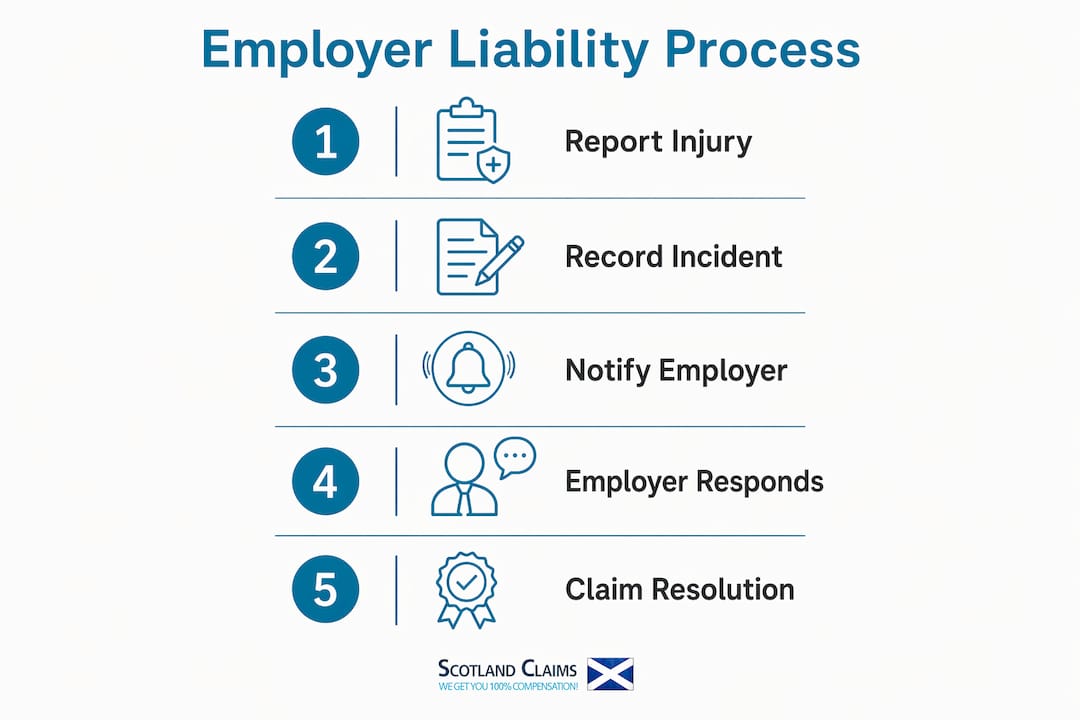
The table below summarises how ELI functions within the claims process:
| Stage |
What happens |
| Injury occurs |
Employee reports the incident; employer logs it formally |
| Claim submitted |
Solicitor notifies the employer of the compensation claim |
| Investigation window |
Employer has 3 months to investigate and respond |
| Insurer involvement |
ELI insurer takes over defence and settlement negotiations |
| Resolution |
Compensation paid by insurer, not from business funds |
The three-month statutory response window is a firm deadline. Failure to respond within it can affect the outcome of the claim and may be treated as an admission that the employer has not properly investigated the incident.
Pro Tip: If your employer is unresponsive after you submit a claim, a specialist solicitor can contact the insurer directly. You do not need your employer’s cooperation to pursue compensation.
For workers who have suffered serious workplace injuries, understanding how insurance interacts with the claims process protects your right to full and fair compensation.
What steps should employees take after a workplace injury in Scotland?
Knowing your rights after a workplace accident is as important as understanding the law itself. The duty of care is implied in every employment contract automatically, meaning you do not need a written clause to enforce it. If your employer breached that duty and you were injured as a result, you have the right to claim compensation.
Employer liability claims commonly arise from slips, trips, falls, industrial diseases, and psychological injuries such as PTSD. These are not rare or unusual situations. They happen across Scottish workplaces every week, in warehouses, offices, care homes, and construction sites alike.
Steps to take after a workplace injury:
- Report the accident to your employer immediately and ask for it to be recorded in the accident book
- Seek medical attention and keep all records, including GP notes and hospital letters
- Photograph the hazard that caused your injury before it is repaired or removed
- Gather witness details from colleagues who saw what happened
- Avoid signing any document from your employer before speaking to a solicitor
- Contact a specialist personal injury solicitor to assess your claim
One fact many workers do not know: employers are prohibited from dismissing employees for pursuing a personal injury claim. Doing so constitutes unfair dismissal and opens the employer to additional legal action. You cannot be punished for asserting your legal rights. For a full breakdown of your rights after an accident at work, the accident at work guide from Scotland Claims Injury Lawyers covers the process in detail.
Understanding common workplace hazards in Scotland also helps you identify whether your employer failed to meet the standard the law requires.
Key takeaways
Employer liability is a structural legal obligation, not a technicality, and Scottish workers who understand it are far better placed to claim the compensation they are owed.
| Point |
Details |
| Statutory duty applies to all workers |
The Health and Safety at Work etc. Act 1974 covers every employee, regardless of contract type. |
| Vicarious liability needs no employer fault |
Employers are liable for employee wrongful acts closely connected to the employment role. |
| ELI pays compensation, not the business |
Employers’ Liability Insurance covers successful claims so workers receive full payment. |
| Three-month response window is binding |
Employers must investigate and respond to formal claims within three months of submission. |
| Dismissal for claiming is unlawful |
Sacking an employee for pursuing a personal injury claim constitutes unfair dismissal. |
Why employer liability is bigger than most employers admit
Roger here. After years of working alongside personal injury solicitors in Scotland, the pattern I see most often is not malicious employers deliberately cutting corners. It is organisations that genuinely believe their safety procedures are adequate, right up until someone is seriously hurt.
Employer liability is a core operational risk linked to organisational culture and HR controls, not merely a legal technicality. That framing matters. A business that treats health and safety as a compliance checkbox will always miss the gaps that a genuine safety culture would catch. The law reflects this. Courts are broadening the scope of vicarious liability year by year, and the close connection test now catches conduct that employers once assumed fell outside their responsibility.
The misconception I find most damaging is the belief that a worker on a zero-hours contract or a short-term placement has fewer rights. They do not. The 1974 Act covers them fully. If you were hurt at work and you are unsure whether your employer is liable, the answer is almost always: speak to a solicitor before you decide. The law is more protective of workers than most people realise.
— Roger
Scotland Claims Injury Lawyers: no success fees, full compensation
If you have been injured at work in Scotland, Scotland Claims Injury Lawyers can help you pursue the compensation you deserve. The team specialises in workplace injury claims, from slips and trips to more serious accidents involving machinery or falls. Every case is handled on a No Win No Fee basis, meaning you pay nothing upfront and nothing if your claim is unsuccessful. Critically, Scotland Claims Injury Lawyers charges no success fee. You keep 100% of your compensation settlement. Many solicitors deduct up to 20% of your payout as a success fee. Scotland Claims Injury Lawyers does not. Speak to the team today through the injury lawyers Scotland page for a free, no-obligation assessment of your claim.
FAQ
What is employer liability in simple terms?
Employer liability is the legal obligation an employer has to keep workers safe and to compensate them if they are injured due to the employer’s failure to meet that obligation.
Does employer liability cover psychological injuries?
Yes. Mental health conditions caused by workplace stress, including anxiety and PTSD, fall within employer duty of care obligations under the Health and Safety at Work etc. Act 1974.
What is the difference between employer liability and vicarious liability?
Employer liability covers the employer’s own failures, such as unsafe premises or inadequate training. Vicarious liability holds the employer responsible for wrongful acts committed by an employee during the course of their employment.
Can my employer sack me for making a workplace injury claim?
No. Dismissing an employee for pursuing a personal injury claim constitutes unfair dismissal and exposes the employer to additional legal action.
How long does an employer have to respond to a workplace injury claim?
Employers have a three-month statutory window to investigate and respond to a formal employee injury claim. Failure to act within this period can affect the outcome of the case.
Recommended