What is duty of care? Your 2026 legal guide

TL;DR:
- Duty of care is a legal obligation to take reasonable steps to prevent foreseeable harm to others.
- Establishing duty of care is essential for any negligence or personal injury claim in Scotland.
Duty of care is a legal obligation requiring you to take reasonable caution to avoid causing foreseeable harm to others. This principle sits at the heart of every negligence claim and personal injury case in Scotland. Without establishing duty of care, a negligence claim cannot proceed, regardless of how serious the injury. Understanding what duty of care means, how courts test for it, and where it applies in practice gives you a clear foundation for assessing any personal injury situation.
What is duty of care in law?
Duty of care is defined as a legal obligation to act with reasonable care towards others who could foreseeably be harmed by your actions or inactions. The concept is not modern. It originates from the 1932 neighbour principle established in Donoghue v Stevenson, where the House of Lords held that you must take reasonable care to avoid acts or omissions that you can reasonably foresee would injure your “neighbour.” In legal terms, your neighbour is anyone closely and directly affected by what you do.

The foreseeability test requires defendants to reasonably foresee injury to those closely and directly affected by their actions. This test remains the cornerstone of duty of care analysis in 2026. Courts ask a straightforward question: could a reasonable person in the defendant’s position have foreseen that their conduct might cause harm to someone like the claimant? If the answer is yes, duty of care is likely to exist.
Duty of care is highly context-specific. The relationship between the parties, the circumstances of the incident, and the nature of the harm all shape whether a duty exists. No single rule applies universally. This is why specialist legal advice matters so much when you are assessing a potential claim.
How is duty of care established legally in Scotland?
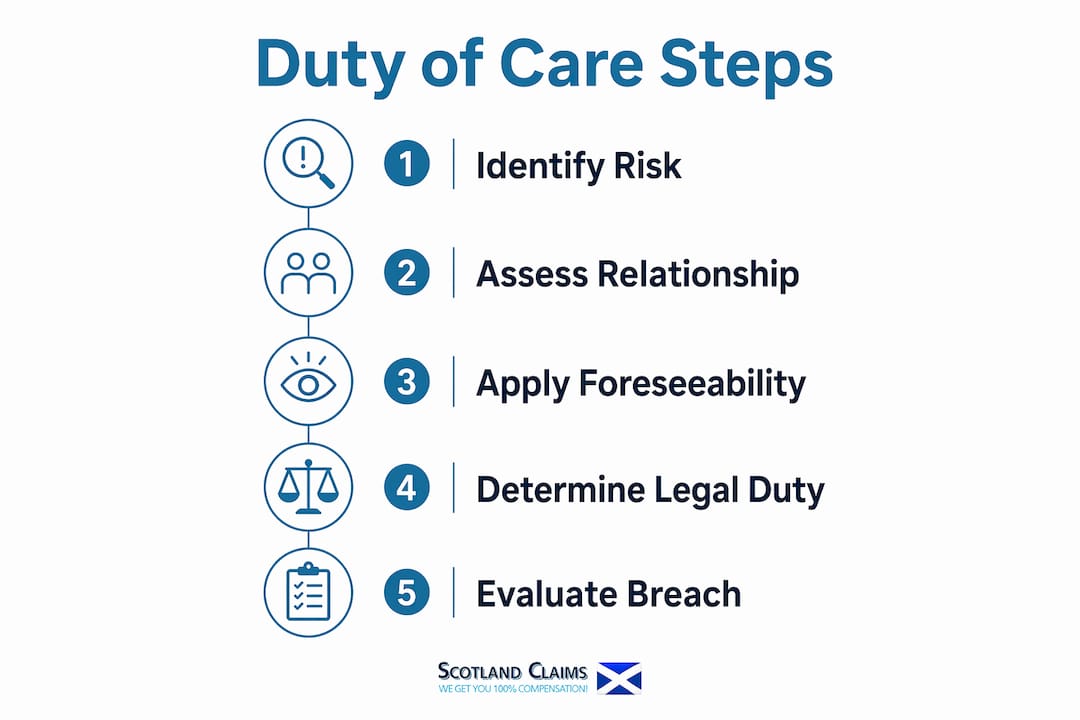
Scottish courts apply a structured approach to determine whether duty of care exists in any given situation. The analysis draws on established legal tests developed through decades of case law in both Scotland and England.
The three core questions courts ask are:
- Was harm foreseeable? Could a reasonable person in the defendant’s position have predicted that their conduct might cause injury to someone in the claimant’s position?
- Was there sufficient proximity? Is the relationship between the parties close enough, physically, legally, or circumstantially, to justify imposing a duty?
- Is it just and reasonable to impose a duty? Courts weigh policy considerations, including the potential impact on defendants and society, before imposing liability.
These three questions form the basis of the Caparo Industries plc v Dickman [1990] test, which remains influential in Scottish courts when dealing with novel duty of care situations.
In established categories, such as employer to employee or driver to road user, courts do not need to work through all three questions. Duty of care is already recognised. The three-part test applies mainly to new or unusual fact patterns where no clear precedent exists.
Courts use incremental reasoning by analogy to determine duty of care in novel situations, considering fairness, vulnerability, reliance, and control. This means a court will look at the closest existing legal category and reason outward from it. A claimant in an unusual situation is not without recourse. The court will ask whether the facts are sufficiently similar to an established duty category to justify the same outcome.
Pro Tip: If you are unsure whether duty of care existed in your situation, focus on the relationship between you and the defendant. Employer and employee, occupier and visitor, driver and pedestrian: these are all established categories where duty is already recognised.
What is the difference between duty of care and standard of care?
These two terms are frequently confused, but they describe entirely different legal questions. Getting them mixed up can lead to misunderstanding why a claim succeeds or fails.
| Concept |
Legal question |
What it measures |
| Duty of care |
Does an obligation exist? |
Whether the defendant owed the claimant any legal duty at all |
| Standard of care |
Was the obligation fulfilled? |
Whether the defendant met the level of care a reasonable person would have shown |
Duty of care is distinct from standard of care. Duty asks whether an obligation exists. Standard asks how well that obligation was fulfilled by the defendant. Both must be addressed in a negligence claim, but they are separate hurdles.
The standard of care benchmark in professional and workplace contexts is the “ordinary competent practitioner.” This means courts do not expect perfection. Liability arises only upon breach of this reasonable standard resulting in harm. A surgeon is not liable simply because an operation had a poor outcome. Liability arises when the surgeon’s conduct fell below what a competent surgeon would have done in the same circumstances.
In personal injury claims, this distinction matters enormously. You might prove that a duty existed, but still fail to show the defendant breached the required standard. Both elements must be established to succeed. This is why gathering detailed evidence about exactly what happened, and how a reasonable person should have acted, is so critical from the outset.
Pro Tip: Think of duty of care as the “on/off switch” and standard of care as the “dial.” First you check whether the switch is on. Then you measure how far the dial was turned in the wrong direction.
What are common examples of duty of care in personal injury and workplace contexts?
Duty of care appears across a wide range of everyday situations. Recognising it in practice helps you identify whether someone may have been legally responsible for your injury.
- Employers and employees. Employers owe a duty to protect workers from foreseeable harm at work. This covers physical safety, adequate training, and appropriate equipment. Failure to provide a safe working environment is one of the most common bases for personal injury claims in Scotland.
- Occupiers and visitors. Under the Occupiers’ Liability (Scotland) Act 1960, those who control premises owe a duty of care to people who enter. A wet floor without a warning sign, or a broken step left unrepaired, can give rise to a valid claim.
- Drivers and other road users. Every driver owes a duty of care to pedestrians, cyclists, passengers, and other drivers. This is one of the most clearly established duty categories in law.
- Healthcare providers and patients. Doctors, nurses, and other health professionals owe a duty to their patients. Note that this article does not cover medical negligence claims, which fall outside the scope of Scotland Claims Injury Lawyers’ services.
- Acts versus omissions. Law differentiates acts and omissions, with general reluctance to impose duty for omissions except where a special relationship exists. A stranger has no legal duty to rescue someone in danger. But an employer, a teacher, or a care worker may have that duty because of the nature of their role.
- Non-delegable duties. Non-delegable duties apply in relationships with high control and vulnerability, such as employer-employee and school-student. An employer cannot escape liability simply by outsourcing a task to a contractor if the duty is non-delegable.
For a broader look at how these situations play out in real cases, the negligence cases guide from Scotland Claims Injury Lawyers provides detailed examples relevant to Scottish law.
Why does duty of care matter in personal injury claims?
Duty of care is the first legal hurdle in any personal injury claim. If it cannot be established, the claim ends there, regardless of the severity of the injury or the financial losses suffered.
Injury alone is not enough. A claimant must prove that duty existed, that it was breached, and that the breach caused the harm. This three-part burden of proof is a rigorous, fact-based process. Each element must be supported by evidence.
The practical implications for anyone pursuing a claim in Scotland include:
- Evidence gathering starts with the relationship. Identifying the duty category, whether employer-employee, occupier-visitor, or driver-road user, shapes what evidence you need to collect.
- Failure to establish duty closes the claim. Courts have dismissed otherwise compelling cases because the claimant could not show the defendant owed them any legal obligation.
- Duty of care defines the scope of liability. A defendant is only responsible for harm that falls within the scope of the duty they owed. This limits what compensation can be claimed.
- Novel situations require specialist advice early. Where the duty category is not established, courts apply the incremental reasoning approach. Getting legal advice before evidence is lost is critical.
There is no general legal duty to volunteer assistance unless a special relationship exists. This is a common misconception. Many people assume that anyone who could have prevented an injury is automatically liable. The law does not work that way. Liability depends on foreseeable risk and the nature of the relationship, not on moral responsibility alone.
Understanding how to establish breach of duty in practice is the next step once you have confirmed that a duty existed. Scotland Claims Injury Lawyers has published detailed guidance on this for Scottish claimants.
Key takeaways
Duty of care is the legal foundation of every negligence claim. Without it, no personal injury case can proceed, regardless of the harm suffered.
| Point |
Details |
| Core definition |
Duty of care is a legal obligation to take reasonable care to avoid foreseeable harm to others. |
| Legal tests |
Courts assess foreseeability, proximity, and whether imposing a duty is just and reasonable. |
| Duty vs standard |
Duty asks if an obligation exists; standard asks whether that obligation was met adequately. |
| Established categories |
Employer-employee, driver-road user, and occupier-visitor are recognised duty relationships in Scotland. |
| Burden of proof |
Claimants must prove duty, breach, and causation. Injury alone is never sufficient to succeed. |
The part most people get wrong about duty of care
People often assume that if someone could have helped them and did not, that person is legally liable. That assumption is wrong, and it causes real problems when people pursue claims without proper advice.
The law does not impose a general duty to rescue or assist. A bystander who watches an accident unfold and does nothing has not breached any legal duty, however troubling that feels morally. Liability requires a pre-existing relationship or a voluntary assumption of responsibility. This is one of the most important distinctions in negligence law, and it is consistently misunderstood.
What I have seen repeatedly is that people either overestimate or underestimate their position. Some dismiss valid claims because they cannot see how a duty existed. Others pursue claims in situations where no duty can be established. Both errors cost time, money, and emotional energy.
The detail that changes everything is usually the relationship between the parties. Was the defendant your employer? Did they control the premises where you were injured? Were they driving the vehicle that struck you? If the answer to any of those questions is yes, you are almost certainly in an established duty category. That is where your claim begins.
Negligence in Scottish law is a precise legal concept, not a general sense of unfairness. Getting specialist advice early, before evidence disappears and memories fade, is the single most effective thing you can do to protect your position.
— Roger
How Scotland Claims Injury Lawyers can help with your claim
If someone owed you a duty of care and failed to meet it, you may have a valid personal injury claim. Scotland Claims Injury Lawyers works exclusively on personal injury claims in Scotland, connecting clients with specialist injury lawyers on a No Win No Fee basis. You pay nothing upfront, and if your claim succeeds, you keep 100% of your compensation. No success fees are deducted. That is the lowest rate in Scotland, compared with up to 20% taken by other large solicitors. Whether you have suffered a back injury at work, a knee injury in a slip or trip, or a road traffic accident injury as a passenger or driver who was not at fault, the specialist injury lawyers at Scotland Claims Injury Lawyers are ready to assess your case.
FAQ
What does duty of care mean in simple terms?
Duty of care is a legal obligation to act carefully to avoid causing foreseeable harm to others. It is the first element a claimant must prove in any negligence or personal injury case.
Does duty of care apply in every situation?
No. Duty of care is context-specific and depends on the relationship between the parties. Established categories include employer-employee, driver-road user, and occupier-visitor, but there is no universal duty to help a stranger.
What happens if duty of care cannot be proved?
If duty of care cannot be established, the negligence claim cannot proceed. Courts will not consider breach or causation unless a duty is first confirmed.
How is duty of care different from standard of care?
Duty of care asks whether a legal obligation existed at all. Standard of care asks whether that obligation was fulfilled to the level a reasonable person would have met. Both must be proved in a negligence claim.
Can I claim compensation if my employer breached their duty of care?
Yes. Employers owe a recognised duty of care to employees under Scottish law. If your employer breached that duty and you suffered injury as a result, you may be entitled to claim compensation through a personal injury claim in Scotland.
Recommended