What is a settlement agreement in personal injury claims?

TL;DR:
- A settlement agreement is a binding contract where an injured person accepts compensation and waives the right to sue. In Scotland, these agreements resolve most personal injury claims quickly and require independent legal advice for validity. Signing the agreement is final, so claimants must fully understand future costs and risks before proceeding.
A settlement agreement is a legally binding contract that resolves a personal injury dispute by exchanging financial compensation for the claimant’s agreement to waive their right to sue. In Scotland, these agreements resolve the majority of civil personal injury cases without the need for a costly court trial. If you have been injured in an accident and someone else is at fault, understanding what a settlement agreement means for your rights and your money is not optional. It is the difference between a fair outcome and one you may regret for years.
What is a settlement agreement and when does it apply?
A settlement agreement, sometimes called a compromise agreement in older legal contexts, is a formal written contract between an injured claimant and the party responsible for their injury, or that party’s insurer. It sets out the compensation amount and the specific legal claims being resolved. Once signed, it is final.

These agreements apply across the full range of personal injury claims in Scotland, including road traffic accidents, workplace injuries, and slips and trips on public or private property. They are the standard method by which insurers and defendants resolve claims without proceeding to a sheriff court or the Court of Session. The settlement agreement definition under Scottish law is consistent with UK-wide principles, though Scottish procedural rules and court structures differ from those in England and Wales.
Independent legal advice is not a formality in this process. It is a legal requirement. Without it, the agreement may not be valid or enforceable.
What makes a settlement agreement legally valid in Scotland?
For a personal injury settlement to be legally enforceable in Scotland, it must meet specific criteria. A valid settlement agreement must be written, clearly identify the claims being waived, and include confirmation that the claimant received independent legal advice from a qualified solicitor.
The key legal requirements are:
- Written form: The agreement must be documented in writing, not agreed verbally.
- Named claims: Every claim being settled must be specifically identified. A vague waiver of “all claims” without detail can create disputes later.
- Independent legal advice: The claimant must receive advice from a qualified solicitor who is not acting for the other party.
- Adviser’s insurance: The solicitor providing advice must hold professional indemnity insurance, and their details must appear in the agreement.
- Consideration: There must be an exchange of value, typically a financial payment, in return for the claimant giving up their right to pursue the claim further.
Both parties must sign the agreement, and payment schedules or conditions must be clearly stated. Timing matters too. Signing before a full medical prognosis is available can leave you undercompensated for conditions that worsen over time.
Pro Tip: Before signing anything, ask your solicitor to confirm in writing that every claim arising from your accident is either included in the settlement or explicitly excluded. Vague wording is the most common source of post-settlement regret.
What are the types of settlement agreements in personal injury cases?
Personal injury settlements in Scotland take several forms. Understanding which type applies to your situation directly affects how much you receive and when.
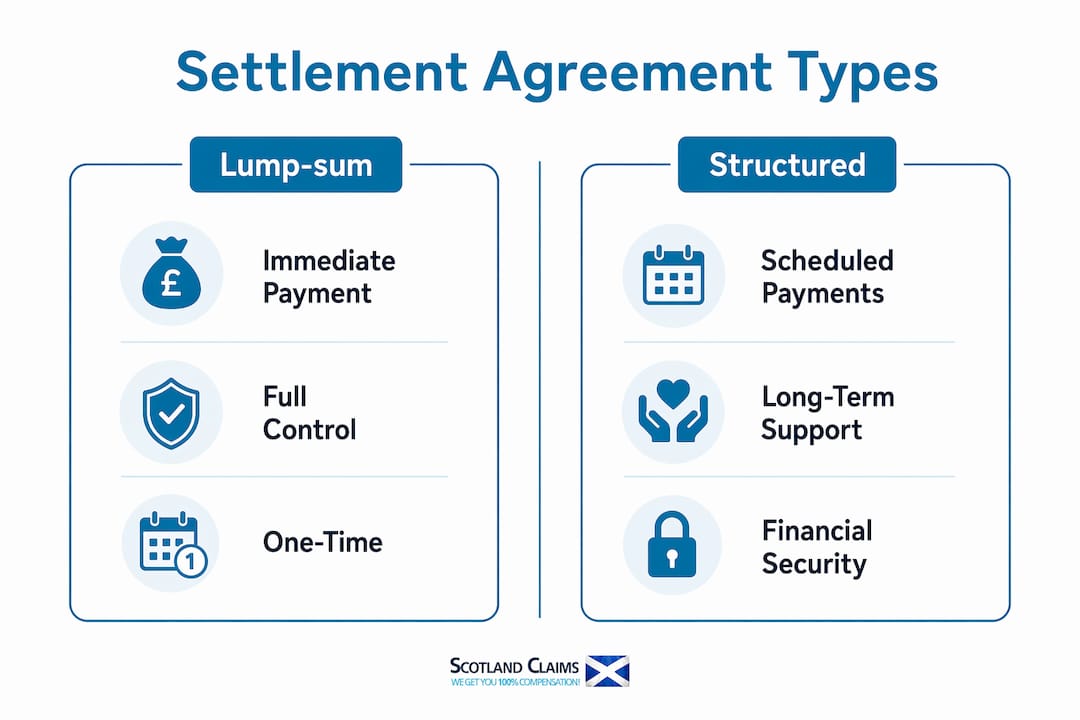
Lump-sum versus structured settlements
A lump-sum payment is the most common form. You receive the full agreed amount in a single payment after signing. A structured settlement, also called a periodical payment order, pays compensation in instalments over time. Structured settlements are typically used in cases involving severe, long-term injuries where ongoing care costs are significant.
Settlements under no win no fee arrangements
Most personal injury claimants in Scotland pursue claims under a no win no fee arrangement. If your claim succeeds, your solicitor’s fees are deducted from the settlement. The deduction amount varies significantly between firms.
Partial waivers and confidentiality clauses
Some agreements settle only part of a claim, leaving other elements open. Others include confidentiality clauses that restrict what you can say publicly about the incident or the settlement terms. These clauses are frequently overlooked by claimants and can have real consequences for your reputation or future employment.
| Settlement type |
Key advantage |
Key disadvantage |
| Lump-sum |
Immediate payment, full control |
Must account for all future costs upfront |
| Structured (periodical) |
Covers ongoing care costs over time |
Less flexibility; tied to payment schedule |
| Partial waiver |
Preserves some future claim rights |
Complex; requires careful legal drafting |
| Confidential settlement |
Often achieves higher compensation |
Restricts public discussion of the case |
The type of settlement that suits you depends on the severity of your injury, your prognosis, and your financial circumstances. A solicitor experienced in Scottish personal injury law will help you identify which structure protects your interests best.
How do settlement offers and negotiations work in personal injury cases?
A settlement offer is a formal proposal from the defendant or their insurer to resolve your claim for a specified amount. Under UK Civil Procedure Rules, formal settlement offers carry legal weight. If you unreasonably reject an offer and the court later awards you less, you may face cost penalties.
When you receive a settlement offer, you have three options:
- Accept the offer. This creates a binding contract. The case closes and you receive the agreed amount.
- Reject the offer. You retain the right to pursue your claim further, but you take on the risk of a less favourable court outcome.
- Make a counter-offer. You propose a different amount or different terms. This is the most common response to an initial offer.
Most initial settlement offers are tactical opening proposals, not final positions. Successful settlements frequently require multiple negotiation rounds. Holding firm on key issues, particularly future disability costs and loss of earnings, consistently produces better outcomes than accepting the first figure presented.
Your solicitor’s role in this process is not passive. An experienced personal injury solicitor will assess the offer against your medical evidence, your prognosis, and comparable court awards in Scotland. They will advise you on whether the offer reflects the true value of your claim and negotiate on your behalf.
Pro Tip: Never respond to a settlement offer without first obtaining an up-to-date medical report. Accepting an offer before your condition has stabilised is one of the most costly mistakes a claimant can make.
What are the implications of signing a settlement agreement?
Signing a settlement agreement is permanent. Once signed, personal injury settlements are generally final and irrevocable. Even if your condition worsens significantly after signing, you cannot reopen the claim. This is the single most important fact every claimant in Scotland must understand before agreeing to any figure.
The implications extend beyond the headline compensation amount:
- Loss of right to sue: The release of liability clause permanently prevents you from pursuing future legal action for the same incident. Misunderstanding its scope can cause permanent loss of rights.
- Net versus gross compensation: Legal fees, medical repayments, and taxes reduce the amount you actually receive. Claimants frequently underestimate this gap between the gross settlement figure and what lands in their bank account.
- Future medical costs: If your injury requires ongoing treatment, surgery, or care, those costs must be factored into the settlement before you sign. You cannot return to claim them later.
- Confidentiality obligations: If the agreement includes a confidentiality clause, breaching it can expose you to legal action by the other party.
- Worsening conditions: Conditions such as post-traumatic arthritis or chronic pain often develop months or years after an accident. Settling too early, before a full prognosis is available, can leave you significantly undercompensated.
The practical step here is straightforward. Do not sign until your solicitor confirms that the settlement accounts for every foreseeable future cost arising from your injury.
How to protect your rights and ensure fair compensation
Protecting your position in a personal injury settlement comes down to preparation, timing, and the quality of legal advice you receive. Claimants who seek legal advice after an accident consistently achieve better outcomes than those who negotiate directly with insurers.
Key steps to protect your rights:
- Instruct a qualified Scottish solicitor before engaging with any offer. The role of solicitors in personal injury settlements goes far beyond paperwork. They assess evidence, challenge low offers, and identify claims you may not have considered.
- Obtain a full medical report from an independent medical expert before accepting any figure.
- Use a compensation calculator to establish a realistic baseline for your claim before negotiations begin.
- Review every clause in the agreement, particularly the release of liability, confidentiality provisions, and any conditions attached to payment.
- Understand your solicitor’s fees before signing. Under no win no fee arrangements, the percentage deducted from your compensation varies between firms. Lower fees mean more money in your pocket.
- Know when to reject an offer. If the offer does not cover your future medical needs, loss of earnings, or care costs, rejecting it and pursuing court action may be the right decision.
Pro Tip: Ask your solicitor to explain the claim process steps from offer to payment before negotiations begin. Understanding the full timeline helps you make decisions without pressure.
Key takeaways
A settlement agreement is a permanent, legally binding contract, and signing one without thorough legal advice in Scotland can cost you far more than the difference between a good and a poor offer.
| Point |
Details |
| Settlement agreements are final |
Once signed, you cannot reopen a personal injury claim even if your condition worsens. |
| Legal validity requires specific steps |
Written form, named claims, and independent solicitor advice are all mandatory in Scotland. |
| Net compensation differs from gross |
Legal fees and medical repayments reduce what you actually receive from the headline figure. |
| Negotiation is expected |
Initial offers are opening positions; multiple rounds of negotiation typically produce better results. |
| Solicitor fees vary significantly |
Choosing a firm with lower fees directly increases the compensation you keep. |
Why rushing a settlement is a mistake I see too often
Most claimants I speak to are surprised by one thing above all others: how permanent a settlement agreement actually is. They assume there is always a way back if things go wrong. There is not. Once you sign, the case is closed, regardless of what happens to your health afterwards.
The second thing that catches people out is the gap between the gross settlement figure and what they actually receive. Solicitor fees, medical report costs, and repayments to insurers or the NHS can reduce a headline figure considerably. Choosing a firm that charges the lowest possible percentage is not a minor detail. It is a decision that directly affects your financial recovery.
What I have found is that claimants who take time to get proper legal advice, wait for a full medical prognosis, and push back on initial offers consistently achieve better outcomes. The insurer’s first offer is rarely their best offer. A good solicitor knows that, and they will negotiate accordingly.
The signs you need a lawyer in a personal injury case are usually obvious in hindsight. Do not wait until after you have signed to wish you had sought advice sooner.
— Roger
Start your personal injury claim with Scotlandclaims
Scotlandclaims specialises in personal injury claims across Scotland, supporting claimants from the first consultation through to final settlement. Scotland Claims retains 100% of your compensation with nothing deducted on every claim type - whether a road traffic accident, slip, trip, or workplace injury. Most other large or national firms charge up to 20% including VAT, so choosing Scotland Claims means more of your settlement stays where it belongs: with you. If you are ready to understand what your claim is worth, use the compensation calculator or speak directly to the injury lawyers at Scotlandclaims today.
FAQ
What is a settlement agreement in simple terms?
A settlement agreement is a legally binding contract where an injured person agrees to accept compensation in exchange for giving up their right to take the matter to court. Once signed, the agreement is final and cannot be reopened.
Is a settlement agreement binding once signed?
Yes. A personal injury settlement agreement is legally binding and generally irrevocable once both parties have signed. This is why reviewing all terms with a qualified solicitor before signing is a legal requirement, not a recommendation.
What is a settlement offer and how does it differ from a settlement agreement?
A settlement offer is a proposal from the defendant or their insurer to resolve your claim for a specific amount. A settlement agreement is the formal, signed contract that results from accepting that offer. The offer is the negotiation stage; the agreement is the final, binding outcome.
Can I reject a settlement offer in Scotland?
Yes, you can reject a settlement offer and make a counter-offer or proceed to court. However, if a court later awards you less than the offer you rejected, you may face financial penalties under Scottish civil procedure rules.
How much of my settlement will I keep under no win no fee?
Scotland Claims deducts nothing from your compensation on any claim type - whether a road traffic accident, slip, trip, or workplace injury - so you keep 100% of your compensation. Most other large or national firms charge up to 20% including VAT.
Recommended