Why cases are settled out of court: a claimant’s guide

TL;DR:
- Most personal injury claims in the UK are settled out of court to guarantee compensation, reduce costs, and avoid uncertainty. Settlement is driven by predictability, financial considerations, procedural frameworks, emotional burden, and confidentiality benefits. While trials can establish clearer legal precedence, settlement offers faster resolution and lower risks, making negotiation the preferred route for injured claimants.
An out-of-court settlement is a legally binding agreement between parties that resolves a dispute without proceeding to trial, offering claimants guaranteed compensation in place of an uncertain court verdict. The vast majority of personal injury claims in Scotland and across the UK never reach a courtroom. Understanding why cases are settled out of court helps you make informed decisions about your own claim, whether you are dealing with a road traffic accident, a workplace injury, or a slip and trip. The reasons span financial risk, procedural burden, emotional toll, and the simple human preference for certainty over a gamble.
Why cases are settled out of court: the core reasons
The single most important driver is predictability. A settlement converts an uncertain outcome into a guaranteed payment, which benefits both the claimant seeking compensation and the defendant managing financial exposure. According to LegalClarity, 99% of civil cases are resolved before a final verdict, with the trial rate sitting at approximately 1%. That figure tells you something profound: the legal system is, in practice, a negotiation system. Trials are the exception, not the rule.

Personal injury claims follow this pattern closely. The UK’s Civil Procedure Rules and Pre-Action Protocols are specifically designed to push parties towards agreement before litigation begins. Defendants typically have 21 days to consider a settlement offer after key evidence is disclosed. This structured process means that most claims are resolved through negotiation, correspondence, and alternative dispute resolution rather than courtroom argument.
What financial factors lead parties to settle?
Cost is the most tangible reason to settle. Trial-related expenses including solicitor fees, expert witness reports, court fees, and deposition costs can reach six figures in complex cases. Even straightforward personal injury trials carry significant expense on both sides. Settlement removes that financial risk entirely.
For claimants, the financial logic is straightforward:
- Solicitor fees accumulate rapidly during litigation, particularly during the disclosure and evidence-gathering phases.
- Expert witness costs for medical reports, accident reconstruction, or occupational health assessments add thousands to the bill.
- Court fees in Scotland are payable at various stages of the Sheriff Court or Court of Session process.
- Delay costs are real. A case that takes three years to reach trial is three years without full financial resolution.
The discovery process alone can last a year or more, making litigation costly and drawn out before a single day in court. Settlement short-circuits this entirely. Parties who settle early avoid the bulk of these costs, which is why solicitors on both sides frequently have a shared financial incentive to reach agreement. No win no fee arrangements, like those offered by Scotlandclaims, align the solicitor’s interest directly with the claimant’s: the faster a fair settlement is reached, the better the outcome for everyone involved.
Pro Tip: If you receive a settlement offer, ask your solicitor to provide a written breakdown of what you would net after fees versus the estimated net recovery at trial. The gap is often smaller than claimants expect, but the certainty is worth considerably more.
How does trial uncertainty influence the decision to settle?
Juries and sheriffs are human. No matter how strong your evidence appears, trial outcomes are unpredictable due to the variability of how decision-makers interpret facts, assess credibility, and weigh competing expert opinions. A claimant with a compelling case can still receive less than expected, or nothing at all, if the court finds against them on a procedural point or a credibility issue.
Settlement replaces that uncertainty with a known payment. As the Programme on Negotiation at Harvard Law School describes it, parties settle “in the shadow of the law” because escalating litigation costs and procedural burdens make settlement the rational choice. Both sides look at the likely trial outcome, discount it for risk, and find a number they can both accept.
“Uncertainty is both legal and human. Trial unpredictability encourages parties to convert risk into a known settlement amount.” — LegalClarity
For personal injury claimants in Scotland, this matters enormously. Consider a workplace accident claim where liability is disputed. The claimant may have strong medical evidence but a defendant who contests the circumstances. Going to trial means risking a finding of contributory negligence that reduces the award, or a finding against liability altogether. A negotiated settlement at a fair figure removes that risk entirely and puts money in the claimant’s hands.
The key factors that make trial outcomes unpredictable include:
- Judicial interpretation of contributory negligence
- Conflicting expert medical evidence
- Witness credibility assessments
- Procedural errors that can affect admissibility of evidence
- The length of time between the accident and the hearing, which affects memory and documentation
What procedural and time considerations encourage settlement?
Litigation is slow. A personal injury case that proceeds to trial in Scotland can take two to four years from the date of the accident to a final verdict. The discovery and evidence exchange phases alone can consume twelve months or more. For a claimant who has been injured, is off work, and is managing medical treatment, that timeline is not just inconvenient. It is genuinely harmful.
The UK’s procedural framework actively discourages unnecessary litigation. The steps towards resolution typically follow this sequence:
- Letter of claim sent to the defendant or their insurer, setting out the facts and basis of liability.
- Pre-action disclosure of medical records, accident reports, and supporting evidence.
- Defendant’s response, usually within 21 days of evidence disclosure, accepting or disputing liability.
- Negotiation phase, where offers and counter-offers are exchanged, often facilitated by solicitors.
- Alternative dispute resolution, including mediation or joint settlement meetings, if direct negotiation stalls.
- Litigation, commenced only if all prior steps fail to produce agreement.
The Civil Procedure Rules require parties to attempt negotiation and ADR before litigation, and courts can penalise parties who unreasonably refuse to engage. This creates a structural incentive to settle that operates independently of the merits of any individual case.
The emotional burden of litigation is also significant. Depositions and trial preparation demand sustained emotional energy, and unresolved lawsuits weigh heavily on individuals who are already dealing with the physical and psychological aftermath of an injury. Settlement allows claimants to close the chapter and focus on recovery. You can read more about how Scottish court proceedings work if you want to understand what litigation actually involves before deciding whether to pursue it.
Pro Tip: Ask your solicitor about joint settlement meetings. These structured negotiations, attended by both parties and their legal representatives, resolve a significant proportion of personal injury claims without any court involvement and typically conclude within a single day.
How do confidentiality and privacy factor into settlement decisions?
Court proceedings are public. Judgments are published, hearings are open, and the details of your injury, your employer’s conduct, or the circumstances of your accident become part of the public record. Settlement agreements, by contrast, are private. Court filings and trials are public; settlement terms can be kept entirely confidential.
Settlement agreements commonly include confidentiality clauses that prevent either party from disclosing the terms or the circumstances of the dispute. This matters to claimants who do not want their medical history or the details of their accident discussed publicly. It also matters to defendants, particularly employers and insurers, who prefer to resolve claims without creating a public record that might encourage further claims.
| Factor |
Trial |
Settlement |
| Privacy of terms |
Public record |
Confidential by agreement |
| Speed of resolution |
Two to four years |
Weeks to months |
| Certainty of outcome |
Unpredictable |
Guaranteed agreed sum |
| Emotional burden |
High, sustained |
Lower, time-limited |
| Cost to claimant |
Potentially significant |
Reduced or eliminated |
Confidentiality is not absolute. Clauses must allow for permitted disclosures such as whistleblowing, regulatory reporting, or legal obligations. A well-drafted settlement agreement, prepared by an experienced solicitor, will balance the claimant’s privacy interests against these lawful disclosure requirements. This is one reason why professional legal representation during settlement negotiations is not optional. It is the difference between a clause that protects you and one that inadvertently restricts your rights.
When might a claimant choose to go to trial instead?
Settlement is not always the right answer. There are specific circumstances where proceeding to trial serves the claimant’s interests better than accepting a negotiated agreement.
- The defendant refuses to negotiate in good faith, making any settlement figure unreasonably low relative to the strength of the claim.
- The claimant wants a public record, for instance where an employer’s systematic safety failures need to be documented and deterred.
- Liability is fundamentally disputed and only a judicial finding will establish the facts clearly enough to support the claim.
- The settlement offer does not reflect the full extent of the injury, particularly in cases involving long-term disability or future loss of earnings.
- A legal precedent is needed to resolve a novel question of law that affects other claimants in similar positions.
Understanding when to settle versus litigate requires an honest assessment of the evidence, the likely trial outcome, and the personal circumstances of the claimant. A specialist personal injury solicitor will advise you on the realistic range of outcomes at trial and compare that directly with the settlement offer on the table. That comparison, not emotion or principle alone, should drive the decision.
Key takeaways
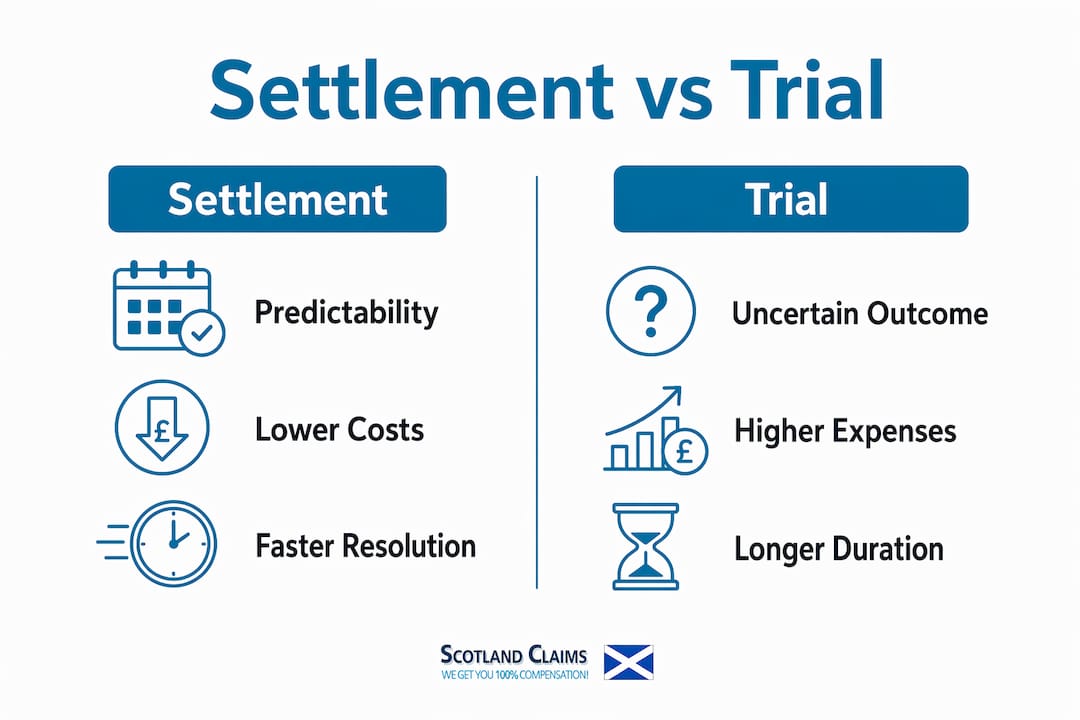
Cases are settled out of court because settlement offers guaranteed compensation, lower costs, and faster resolution compared to the unpredictable, expensive, and time-consuming alternative of a full trial.
| Point |
Details |
| Settlement rate is near-total |
Approximately 99% of civil cases resolve before trial, making negotiation the norm. |
| Cost drives early settlement |
Trial expenses including expert fees and solicitor costs can reach six figures, making settlement financially rational. |
| Certainty outweighs potential gain |
A guaranteed settlement sum removes the risk of receiving less, or nothing, at trial. |
| Procedure encourages negotiation |
UK Pre-Action Protocols require parties to attempt settlement before litigation can begin. |
| Privacy is a genuine benefit |
Settlement terms remain confidential; court judgments become part of the public record. |
Why I think claimants underestimate the value of settling early
Roger here. After years of working with personal injury claimants across Scotland, the pattern I see most often is not claimants who settle too quickly. It is claimants who hold out for a trial outcome that never delivers what they imagined.
The courtroom is not a place where justice is reliably dispensed in proportion to the strength of your case. It is a place where procedural rules, judicial discretion, and the performance of witnesses on a given day determine outcomes. I have seen strong claims reduced by contributory negligence findings that no one anticipated. I have also seen defendants settle cases they could have won at trial simply because the cost and distraction of litigation was not worth it to them.
The honest truth is that settlement negotiations, handled by a solicitor who knows the value of your claim and the strength of your evidence, almost always produce a fair result faster and at lower personal cost than a trial. The timing of settlement negotiations matters enormously. Settling before key evidence is exchanged often means leaving money on the table. Waiting until after medical evidence and liability reports are disclosed puts you in a far stronger negotiating position.
My advice: do not refuse to settle out of principle, and do not accept the first offer out of exhaustion. Get proper legal advice, understand what your claim is genuinely worth, and negotiate from a position of knowledge.
— Roger
How Scotland Claims Injury Lawyers can help with your personal injury settlement
Scotland Claims Injury Lawyers connects injury victims across Scotland with specialist personal injury solicitors who understand how to negotiate settlements that reflect the true value of your claim. For road traffic accident injuries where you are not at fault, including whiplash, you keep 100% of your compensation. Significantly less than the 20% charged by other major firms. Use the compensation calculator to estimate what your claim may be worth, or speak to a specialist about back injury claims on a no win no fee basis.
FAQ
What does settling out of court mean?
Settling out of court means both parties reach a legally binding agreement on compensation without proceeding to a trial. The claimant receives a guaranteed sum and the case is closed.
How long does an out-of-court settlement take?
Most personal injury settlements in the UK are resolved within weeks to months of a formal claim being submitted. Complex cases involving disputed liability or serious injury may take longer, but settlement is almost always faster than proceeding to trial.
Is a settlement legally binding?
Yes. Once both parties sign a settlement agreement, it is legally binding and the claimant typically waives the right to pursue further legal action in relation to the same incident.
Can I reject a settlement offer and go to trial?
You can reject any settlement offer and instruct your solicitor to proceed to litigation. Your solicitor will advise you on whether the offer reflects the realistic value of your claim before you make that decision.
Does settling out of court mean I receive less compensation?
Not necessarily. A well-negotiated settlement, supported by strong medical evidence and experienced legal representation, frequently matches or exceeds what a court might award, without the cost, delay, and uncertainty of a trial.
Recommended