Employment settlement agreement: your rights in Scotland

TL;DR:
- Signing a settlement agreement in Scotland requires understanding its legal weight and potential claims waived. Independent legal advice and written identification of claims are mandatory for enforceability, while confidentiality clauses cannot prevent whistleblowing. Proper preparation and negotiation can substantially impact compensation, with careful review of tax implications and post-signing rights crucial to protecting your interests.
If you have been offered an employment settlement agreement after a workplace dispute, the paperwork in front of you carries serious legal weight. Signing it means waiving your right to bring future tribunal claims, often permanently. Understanding what you are agreeing to, what you are entitled to, and how the settlement agreement process works in Scotland is not optional. It is the difference between walking away fairly compensated and leaving money, or rights, on the table.
Table of Contents
Key takeaways
| Point |
Details |
| Independent legal advice is mandatory |
Without it, your waiver of claims is unenforceable and you may still bring a tribunal claim. |
| Written agreements are a legal requirement |
A valid settlement agreement must be in writing and identify the specific claims being waived. |
| Not all claims can be waived |
Whistleblowing protections and future claims cannot be removed by a settlement agreement. |
| Tax treatment varies by payment type |
Payments below £30,000 may qualify for tax exemption, but notice pay (PILON) is fully taxable. |
| Negotiation is expected |
Most initial offers are not final. A solicitor can help you push for fairer compensation and better terms. |
What makes an employment settlement agreement valid in Scotland
The legal foundation for settlement agreements in Scotland sits within section 203 of the ERA, the Employment Rights Act 1996. This legislation sets out strict conditions that must be satisfied before a settlement agreement is legally binding and enforceable. Miss any of them and the agreement may not hold up.
The core requirements are:
- The agreement must be in writing. There is no such thing as a valid verbal settlement agreement under employment law.
- Specific claims must be identified. The agreement must name the particular complaints or proceedings being waived. Overly broad waivers that sweep up “all claims” without specifying them can be legally challengeable.
- Independent legal advice is mandatory. The employee must receive advice from a qualified independent adviser before signing. This is not a formality. Without proper independent advice, the waiver of claims is invalidated and you may still bring tribunal proceedings.
- The adviser must be identified in the agreement. Their name and the capacity in which they advised you must appear in the document.
- There must be an applicable insurance policy or professional indemnity cover in place for the adviser.
Confidentiality clauses are almost standard in workplace settlement agreements, but they have legal limits. Confidentiality clauses cannot lawfully prevent you from making protected disclosures or whistleblowing. Any clause that purports to silence you on a matter of public interest concern is unenforceable. Solicitors with experience in employment law will flag this immediately.
Pro Tip: Ask your solicitor to check whether the confidentiality clause in your agreement explicitly carves out whistleblowing and protected disclosures. If it does not, that is a drafting problem that needs correcting before you sign.
It is also worth knowing that settlement agreements should not be used as a shortcut in place of proper disciplinary or performance procedures. If your employer has presented you with one in circumstances that feel rushed or pressured, that context matters when assessing your negotiating position.
Preparing to negotiate your settlement agreement
Before you respond to any offer, take a step back. The preparation you do now will directly affect the outcome.
- Assess your claims honestly. What are the actual disputes in play? Unfair dismissal, discrimination, unpaid wages, breach of contract? Each carries different weight and different potential compensation. Your starting position in any negotiation depends on how strong your claims are.
- Find a qualified independent adviser immediately. This must be a solicitor, certified trade union representative, or other adviser listed under ERA 1996 s.203. The independent adviser’s role is genuinely central to protecting your interests, not a box-ticking exercise.
- Review the settlement agreement terms in detail. Look at every clause, not just the compensation figure. Notice period treatment, post-termination restrictions, reference wording, and holiday pay entitlements all matter enormously.
- Request reasonable time to consider. You are not obliged to sign quickly. Acas recommends a minimum of ten calendar days to review any settlement offer. If your employer is applying undue pressure, note this.
- Prepare your questions for your solicitor. Ask specifically about: the compensation amount and whether it reflects your likely tribunal award; whether the notice is being paid as PILON or worked; what reference your employer has agreed to provide; and whether any restrictive covenants could limit your next job.
Pro Tip: Employer contributions to your legal advice costs are common. Employers often cover these costs as part of making the settlement work. Ask your employer to confirm their contribution before instructing a solicitor.
Understanding the difference between a severance agreement vs settlement is also worth clarifying here. In practice, these terms are often used interchangeably in the UK. A severance package is the financial element of what you receive on leaving. A settlement agreement is the legal document that governs the whole arrangement, including what claims you waive. The two frequently overlap, but they are not identical concepts.
From offer to signing: the settlement agreement process
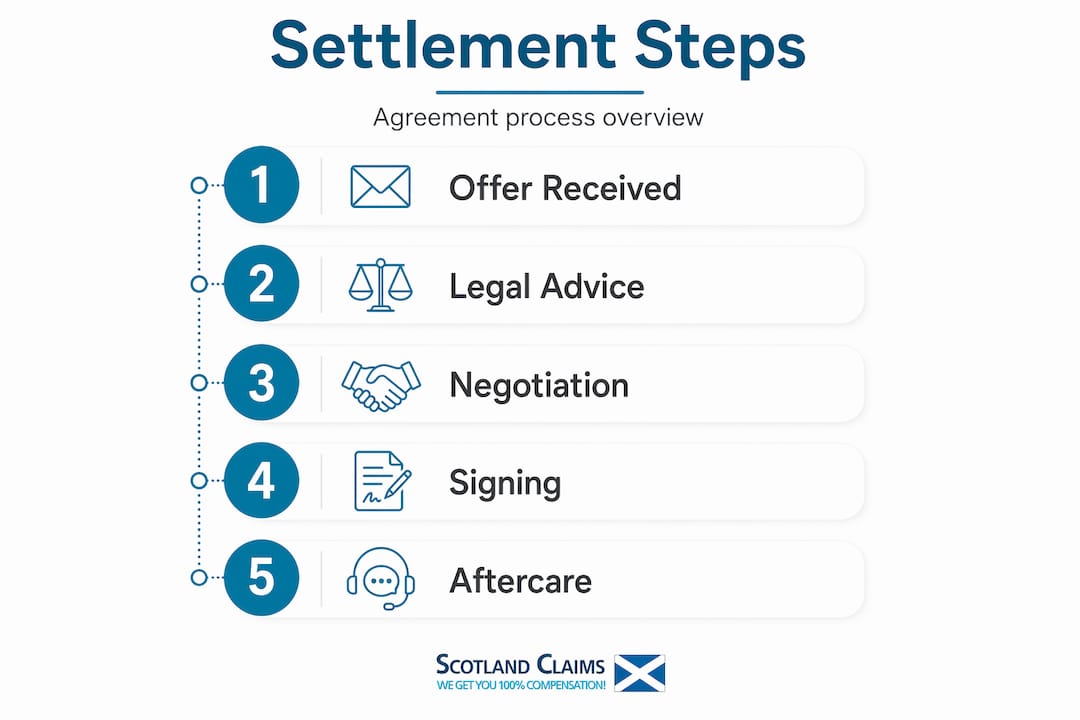
Receiving a settlement offer can feel overwhelming. Here is what the process typically looks like, and where the real decisions happen.
Receiving the offer document. Your employer will present a draft agreement, usually through HR or their legal team. Read it in full before your solicitor appointment. Make a note of anything that feels unclear or unfair.
The independent legal advice meeting. Your solicitor will review the agreement with you, explain the claims being waived, and assess whether the offer is fair. This is where proper claim scoping happens. A good adviser will also flag any restrictive covenants or confidentiality terms that could harm your future employment prospects.

Negotiation. Most first offers are not final. Your solicitor will negotiate on your behalf on compensation, reference wording, notice treatment, and any other terms that need improvement.
Common pitfalls to avoid:
- Accepting the first figure without understanding what tribunal compensation might look like
- Signing an agreement with vague or uncapped confidentiality clauses
- Overlooking restrictive covenants that could prevent you working in your industry
- Failing to confirm the reference wording in writing as part of the agreement
Signing and what follows. Once terms are agreed, both parties sign. The agreement becomes binding at that point. Keep a copy of the signed document and all correspondence leading up to it.
| Stage |
What happens |
Your key action |
| Offer received |
Draft agreement presented by employer |
Read fully, note concerns |
| Legal advice |
Solicitor reviews terms and claims waived |
Ask all your questions here |
| Negotiation |
Terms and compensation discussed |
Let your solicitor lead this |
| Signing |
Agreement executed by both parties |
Retain a signed copy |
| Post-signing |
Payment made, obligations begin |
Monitor payment and comply with terms |
Protected conversations and without prejudice discussions often take place before a formal offer is made. These are confidential by design and cannot generally be used as evidence in tribunal proceedings. If your employer initiated settlement talks this way, it does not mean you are obliged to accept any particular outcome.
Compensation and tax: what you need to understand
The financial package in a settlement agreement is rarely just one lump sum. It typically comprises several distinct elements, and the tax treatment of each one differs.
Common payment components include:
- Ex gratia payment: A goodwill payment on top of your contractual entitlements. This is the element most often negotiated upward.
- Pay in lieu of notice (PILON): If your contract includes a PILON clause, this payment is fully taxable as earnings. This applies regardless of how it is labelled in the agreement.
- Holiday pay: Any accrued but untaken holiday pay is taxable as normal income.
- Compensation for loss of office or unfair dismissal: Payments below £30,000 may qualify for the tax-free exemption, provided they meet HMRC criteria.
The critical point is that incorrect payment categorisation can create unexpected tax liabilities for you after you have already spent the money. Your solicitor should scrutinise how each element is described and confirm the tax position before you sign.
| Payment type |
Tax treatment |
| Ex gratia (qualifying) |
Tax-free up to £30,000 |
| PILON |
Fully taxable as earnings |
| Holiday pay |
Fully taxable as earnings |
| Injury to feelings (discrimination) |
Generally tax-free |
| Legal costs contribution |
Generally not taxable if paid direct |
Pro Tip: Do not assume your employer’s description of each payment in the agreement is tax-correct. Tax treatment on settlements is a specialist area and a single mislabelled payment can result in an unexpected HMRC bill months later.
What happens after you sign
Signing a valid settlement agreement brings legal finality to the claims listed in the document. You generally cannot bring tribunal claims related to those waived matters once the agreement is in force. That is precisely the certainty employers pay for, and why getting the terms right before signing matters so much.
However, there are important exceptions you should understand:
- Protected disclosures and whistleblowing claims cannot be waived. Any attempt to do so is void under legislation.
- Future claims are not covered. The agreement only waives claims that existed at the time of signing. If your employer breaches the agreement after signing, you retain the right to act on that.
- Criminal claims remain outside the scope of what a settlement agreement can restrict.
- Personal injury claims you were not aware of at the time may sometimes be pursued, depending on the wording used.
If your employer breaches the terms after signing, for example by failing to pay on time or providing a reference that contradicts the agreed wording, you should seek legal advice immediately. Keep records of everything: correspondence, the agreement itself, and any payments received. These become critical evidence if you need to enforce the agreement or challenge a breach.
My honest take on settlement agreements in Scotland
I have reviewed enough employment disputes to say this clearly: the single biggest mistake people make is treating independent legal advice as paperwork rather than protection. I have seen individuals sign agreements that waived genuine discrimination claims because nobody explained the value of what they were giving up. The sums involved can be substantial, and an adviser who is properly engaged with your specific situation can make an enormous difference to the final figure.
There is also a widespread misconception that settlement agreements are take-it-or-leave-it offers. They are not. Employers present initial figures knowing they may be negotiated. I have seen first offers revised upward by 30 to 50 per cent through straightforward, well-evidenced negotiation. The leverage you have depends on the strength of your underlying claims, which is exactly why objective claim assessment before any negotiation begins is so valuable.
Confidentiality clauses deserve more scrutiny than most employees give them. I have seen clauses so broadly drafted that they would have prevented the individual from discussing their departure with future employers in any meaningful way. That is not standard and it is not acceptable. Push back on any clause that feels excessive. Your solicitor should be doing this as a matter of course.
Approach the process informed, ask hard questions, and do not let time pressure push you into signing something you do not fully understand.
— Roger
How Scotland Claims Injury Lawyers can help you
If you are facing a workplace dispute or have been offered a settlement agreement in Scotland, Scotland Claims Injury Lawyers can connect you with specialist solicitors who understand both the legal requirements and the negotiation process. Whether you need support reviewing workplace injury settlement terms or guidance on maximising your compensation package, the team works to secure the best possible outcome for you. For workplace injury claims specifically, Scotland Claims Injury Lawyers deducts nothing from your compensation - you keep 100% of your settlement on every type of claim, while most large national firms charge up to 20% including VAT. Use the compensation calculator to get an estimate of what your claim may be worth, then get in touch for a free consultation through no win no fee legal support with no upfront costs.
FAQ
What is an employment settlement agreement?
An employment settlement agreement is a legally binding contract between an employer and employee that resolves a workplace dispute in exchange for the employee waiving specified tribunal claims. It must be in writing and accompanied by independent legal advice to be enforceable.
Do I have to accept a settlement agreement?
No. Settlement agreements are entirely voluntary. You are not obliged to accept any offer, and you can negotiate the terms or reject the agreement altogether without automatic penalty.
How long do I have to consider a settlement offer?
Acas recommends a minimum of ten calendar days to review a settlement offer. Your employer should not pressure you into signing faster than this allows.
Can a settlement agreement stop me from whistleblowing?
No. Confidentiality clauses cannot prevent you from making protected disclosures. Any clause that attempts to do so is unenforceable under employment law.
Is settlement agreement compensation taxable?
It depends on the type of payment. Ex gratia payments up to £30,000 may be tax-free, but elements such as PILON and holiday pay are fully taxable as earnings. Your solicitor should confirm the tax position for each element before you sign.
Recommended