Success fees in Scotland: what you need to know

TL;DR:
- Success fees in Scotland are capped at 20% of the first £100,000 recovered in personal injury claims. Scotland Claims Injury Lawyers charges no success fee, ensuring clients keep 100% of their compensation. Understanding fee structures and getting written breakdowns can save claimants thousands of pounds.
Success fees in Scotland are conditional charges that a solicitor applies only when a personal injury claim is won, calculated as a percentage of the compensation awarded. Under the Civil Litigation (Expenses and Group Proceedings) (Scotland) Act, these fees are legally capped at 20% of the first £100,000 recovered. That cap exists to protect claimants from excessive deductions. Scotland Claims Injury Lawyers takes a different position entirely: zero success fee, meaning clients keep 100% of their compensation. Most solicitors in Scotland charge up to that 20% maximum, including VAT. Knowing the difference before you sign anything can mean thousands of pounds in your pocket.
How do success fees in Scotland work?
A success fee is triggered only when your claim succeeds. Under a Conditional Fee Agreement (CFA), your solicitor charges no fee if you lose, and recovers basic legal costs from the defendant wherever possible. The success fee is then charged on top, as a percentage of your damages.

A Damages-Based Agreement (DBA) works differently. Rather than a fixed uplift, the solicitor takes a percentage of the damages you recover. DBAs must comply with the Success Fee Agreements Regulations 2020, which set out how fees are calculated and disclosed. Both agreement types are lawful in Scotland, but their terms and financial impact on your settlement can differ significantly.
Many claimants assume that “no win no fee” means no fees under any circumstances. That assumption is wrong. No win no fee agreements vary widely on what you owe if a claim fails, including potential liability for disbursements such as medical report fees or court costs. Reading the terms carefully before signing is not optional.
Disbursements are expenses paid out during the claim, such as expert witness fees or medical records. VAT is applied on top of the success fee percentage in most cases. Both items affect the total amount deducted from your settlement, so you need to understand them before agreeing to any arrangement.
- Success fee: charged only on a win, as a percentage of damages
- Disbursements: third-party costs such as medical reports, paid regardless of outcome in some agreements
- VAT: added to the success fee in most cases, increasing the total deduction
- Defendant costs: in some losing cases, claimants may face liability for the other side’s costs
Pro Tip: Ask your solicitor to provide a written breakdown showing the success fee percentage, whether VAT is included, and what disbursements you may owe if the claim does not succeed. Get this before you sign.
What are the legal limits on success fees in Scotland?
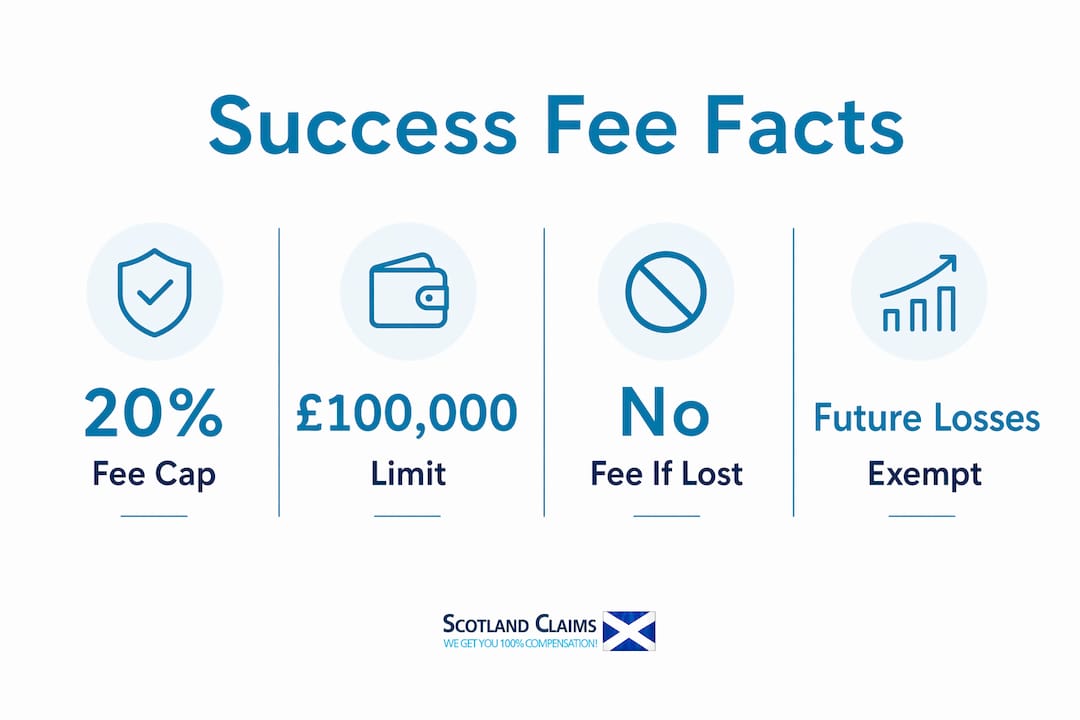
The statutory cap on success fees for personal injury claims in Scotland is 20% of the first £100,000 of the financial benefit recovered. This cap is set by the Civil Litigation (Expenses and Group Proceedings) (Scotland) Act and the Success Fee Agreements Regulations 2020. The percentage can vary for amounts above £100,000, but the cap provides a baseline protection for most claimants.
The cap applies to general damages and past losses. Future losses are not subject to success fee deductions under Scottish legislation. This distinction matters. If your claim includes compensation for future care costs or future loss of earnings, that portion of your award is protected from any success fee deduction.
| Fee element |
Subject to success fee? |
| General damages (pain and suffering) |
Yes, up to 20% cap |
| Past financial losses |
Yes, up to 20% cap |
| Future loss of earnings |
No |
| Future care costs |
No |
| Disbursements |
Separate, not part of cap |
Consumer protection requirements under Scottish law also demand transparency. Solicitors must clearly disclose the percentage charged, whether VAT is included, and how disbursements are handled. A solicitor who cannot answer these questions directly is a warning sign.
Pro Tip: Check whether the success fee percentage quoted to you already includes VAT. A 20% fee plus VAT is effectively higher than 20%. Ask for the all-in figure before comparing firms.
What does a 20% success fee actually cost you?
Most personal injury solicitors in Scotland charge up to 20% including VAT on the compensation they recover for you. On a £10,000 settlement, that deduction is £2,000. On a £50,000 settlement, it is £10,000. That money comes directly out of the compensation awarded to you for your injury, your pain, and your financial losses.
Scotland Claims Injury Lawyers charges no success fee on personal injury claims. Clients keep 100% of their compensation. This applies across the full range of personal injury claims handled, including road traffic accidents, slips and trips, and workplace injuries.
The financial difference is straightforward:
- Road traffic accident claim settled at £8,000: with a 20% success fee, you receive £6,400. With Scotland Claims Injury Lawyers, you receive £8,000.
- Workplace injury claim settled at £25,000: with a 20% success fee, you receive £20,000. With Scotland Claims Injury Lawyers, you receive £25,000.
- Slip or trip claim settled at £15,000: with a 20% success fee, you receive £12,000. With Scotland Claims Injury Lawyers, you receive £15,000.
The zero success fee model is particularly significant for claimants with moderate settlements. A £5,000 award sounds reasonable until a £1,000 deduction reduces it. For someone recovering from an injury and managing lost income, that difference is real and immediate.
Scotland Claims Injury Lawyers handles no win no fee claims across Scotland, covering whiplash, road traffic accidents where you are not at fault, slips, trips, and accidents at work. In every case, the client pays nothing if the claim fails and keeps everything if it succeeds.
How to choose a solicitor based on success fee terms
The right solicitor is not simply the one who advertises the lowest fee. The right solicitor is the one whose terms are clear, written, and fair before you commit. SRA guidance recommends claimants focus on the clarity of success fee terms rather than the headline percentage alone.
Ask these questions before signing any agreement:
- What is the exact success fee percentage, and does it include VAT? A percentage quoted without VAT will cost more than it appears.
- Which parts of my compensation are subject to the success fee? General damages and past losses may be deducted; future losses should not be.
- What disbursements will I owe, and when? Some firms require payment of medical report fees regardless of the outcome.
- What happens if my claim fails? Understand whether you face any liability for the defendant’s costs or your own disbursements.
- Is there a cooling-off period? You have the right to cancel within a set period after signing most legal agreements.
- Is the success fee deducted from my compensation or billed separately? Most firms deduct it from the settlement, reducing what you receive.
Written agreements are not a formality. They are your legal protection. Any solicitor unwilling to provide a clear written breakdown of all fees before you sign is not operating transparently. For further verification, the Law Society of Scotland and the SRA both publish consumer guidance on what regulated solicitors must disclose.
Pro Tip: Request a worked example from your solicitor. Ask them to show you, in writing, what you would receive on a £10,000 settlement after all fees and deductions. If they cannot or will not do this, look elsewhere.
Key takeaways
Success fees in Scotland are legally capped at 20% of the first £100,000 recovered, but Scotland Claims Injury Lawyers charges no success fee at all, meaning clients keep 100% of their compensation.
| Point |
Details |
| Legal cap on success fees |
Scottish law caps success fees at 20% of the first £100,000 recovered in personal injury claims. |
| Future losses are protected |
Success fees cannot be deducted from compensation for future care costs or future loss of earnings. |
| 20% means real money lost |
On a £25,000 settlement, a 20% success fee costs the claimant £5,000 in direct deductions. |
| Scotland Claims charges zero |
Scotland Claims Injury Lawyers takes no success fee, so clients receive their full compensation amount. |
| Always ask for written terms |
Confirm the percentage, VAT treatment, and disbursement liability in writing before signing any agreement. |
Why the success fee conversation matters more than most people realise
Roger here. I have spent years watching claimants sign agreements they do not fully understand, then feel blindsided when their settlement arrives smaller than expected. The success fee is not hidden, exactly. But it is often explained in a way that minimises its impact until the money lands.
The argument for success fees is legitimate. They allow solicitors to take on cases without upfront payment from clients who cannot afford legal costs. That access to justice matters. Without conditional fee arrangements, many valid personal injury claims would never be pursued. I understand why the system exists.
What I find genuinely troubling is when the fee is presented as a minor administrative detail rather than a meaningful deduction from a claimant’s award. A person who has suffered a workplace injury, lost weeks of income, and gone through months of legal process deserves to understand exactly what they will receive at the end of it. Telling them “up to 20%” without a worked example is not transparent enough.
Scotland Claims Injury Lawyers built its model around a simple principle: the compensation belongs to the claimant. Taking nothing from it is not just a commercial decision. It reflects a view that injured people should not fund their own legal costs from the money awarded for their suffering. That position is rare in this industry. It should not be.
If you are comparing solicitors, do not stop at the headline percentage. Ask for the full picture in writing, including VAT and disbursements. The difference between a 20% deduction and zero can be thousands of pounds. That is not a small print issue. It is the most important number in your claim.
— Roger
Scotland Claims Injury Lawyers: 100% compensation, zero deductions
Scotland Claims Injury Lawyers operates on a straightforward promise: no success fee, no deductions, and 100% of your compensation paid directly to you. Whether you have been injured in a road traffic accident, suffered a slip or trip, or been hurt at work, the firm handles your claim on a genuine no win no fee basis. If your claim fails, you pay nothing. If it succeeds, you keep everything.
Claims handled include back injury claims, knee injury claims, whiplash, and a wide range of personal injury cases across Scotland. Use the compensation calculator to get an estimate of what your claim may be worth, then contact Scotland Claims Injury Lawyers for a free consultation with no obligation.
FAQ
What is the maximum success fee allowed in Scotland?
The legal maximum is 20% of the first £100,000 of compensation recovered in a personal injury claim. This cap is set by the Civil Litigation (Expenses and Group Proceedings) (Scotland) Act and the Success Fee Agreements Regulations 2020.
Do I pay a success fee if my claim fails?
No. Under a no win no fee arrangement, no success fee is charged if your claim is unsuccessful. However, you may still owe disbursements or, in some cases, the defendant’s costs, depending on the terms of your agreement.
Are future losses subject to a success fee deduction?
Future losses are not subject to success fee deductions under Scottish law. The cap applies only to general damages and past financial losses, so compensation for future care or future earnings is fully protected.
Does Scotland Claims Injury Lawyers charge a success fee?
Scotland Claims Injury Lawyers charges no success fee on personal injury claims. Clients keep 100% of their compensation, unlike the industry standard of up to 20% including VAT charged by most other firms.
What should I check before signing a success fee agreement?
Confirm the exact percentage including VAT, which parts of your compensation are subject to the fee, what disbursements you may owe, and what happens if your claim fails. Always get these terms in writing before signing.
Recommended