Stress at work claim in Scotland: your 2026 guide

TL;DR:
- A stress at work claim involves a legal action by an employee suffering a diagnosed psychiatric injury caused by employer negligence.
- The claim requires proving duty of care, foreseeability, breach, and direct causation, with documented warning signs supporting foreseeability.
A stress at work claim is a legal action taken by an employee who has suffered a recognised psychiatric illness caused by their employer’s failure to manage workplace stress risks. This is not a claim for feeling under pressure or having a bad week. The legal term is a personal injury claim for work-related psychiatric injury, and it sits under the law of negligence. To succeed, you must prove four specific elements: duty of care, foreseeable psychiatric harm, breach of that duty, and direct causation of a diagnosed psychiatric illness. The Health and Safety at Work Act 1974 places a clear obligation on employers to manage stress risks. When they fail, and you suffer a genuine psychiatric injury as a result, the law gives you the right to claim compensation.
What makes a valid stress at work claim in Scotland?
A valid claim requires more than a stressful job. The law demands a recognised psychiatric illness, such as clinical depression, generalised anxiety disorder, or post-traumatic stress disorder. General unhappiness, burnout without diagnosis, or feeling overwhelmed do not meet the legal threshold on their own.
The four legal elements you must prove are:
- Duty of care. Your employer owes you a duty to take reasonable steps to protect your mental health at work. This is established under the Health and Safety at Work Act 1974 and common law.
- Foreseeability. Your employer must have known, or reasonably should have known, that you were at risk of psychiatric injury. This is the hardest element to prove. It requires clear warning signs such as sickness absence, formal complaints, or requests for support.
- Breach of duty. Your employer failed to take reasonable steps after those warning signs appeared. A workload review, occupational health referral, or adjusted duties would all count as reasonable steps. Doing nothing does not.
- Causation. The employer’s breach directly caused your psychiatric illness. A medical diagnosis linking your condition to workplace conditions is not optional. It is the foundation of your claim.
Employer liability arises only after a clear warning and a failure to act. Many employees assume that suffering at work is enough. The law requires proof that your employer knew about the risk and chose not to address it.
Pro Tip: Get a formal diagnosis from your GP or a psychiatrist before pursuing a claim. A letter confirming a recognised psychiatric condition is one of the most powerful pieces of evidence you can hold.

How does a personal injury claim differ from an employment tribunal?
These are two separate legal routes, and confusing them is one of the most costly mistakes an employee can make. An employment tribunal handles claims about unfair dismissal, discrimination, and breaches of employment rights. A personal injury claim handles negligence and psychiatric injury. They operate under different rules, different time limits, and produce very different financial outcomes.
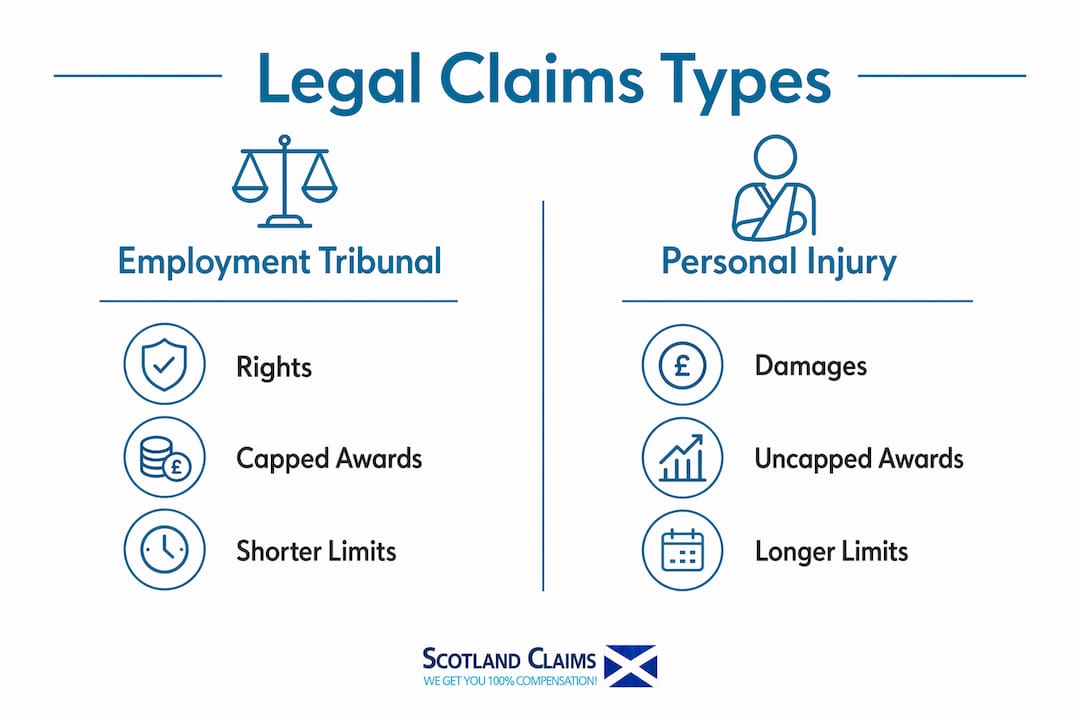
Employment tribunal awards are capped by statute. Personal injury claims are uncapped in value and assessed on the severity of your psychiatric injury and your financial losses. That distinction matters enormously. A civil claim for serious psychiatric injury can result in a significantly larger award than any tribunal settlement.
The time limits also differ sharply. You have three years from the date of injury, or from when you became aware of it, to bring a personal injury claim. Employment tribunal claims carry much shorter deadlines, often three months from the act complained of. Missing either deadline ends your options.
The two routes can also conflict. Strategic decisions about legal route affect what evidence you can use and what options remain open. Pursuing a tribunal claim first can sometimes restrict your civil claim. This is why taking specialist legal advice before you do anything formal is not a suggestion. It is the single most important step you can take.
Pro Tip: Do not raise a formal grievance or start tribunal proceedings without first speaking to a personal injury solicitor. The order in which you take legal steps can determine whether your civil claim survives.
You can read more about how psychiatric injury damages are assessed in Scotland to understand what a successful civil claim might be worth.
What evidence do you need to support your claim?
Evidence is what separates a strong claim from one that fails at the first hurdle. The foreseeability test is the biggest legal challenge in any stress-related injury claim. To pass it, you must show that your employer knew about the risk before your psychiatric injury occurred.
The most effective way to do that is through a detailed paper trail. Start building it the moment you recognise that work is affecting your mental health.
- Report your stress in writing. Email your manager or HR department describing how your workload or working conditions are affecting you. A verbal conversation leaves no record. A written one does.
- Keep all correspondence. Save every email, letter, and message related to your working conditions, your complaints, and your employer’s responses. These show what your employer knew and when.
- Attend every medical appointment and keep records. GP letters, psychiatric assessments, and occupational health reports all serve as clinical evidence linking your condition to your workplace.
- Request an occupational health referral. Occupational health reports can recommend workplace adjustments, and employers are expected to follow those recommendations unless they have reasonable grounds to refuse. A refusal to act on a recommendation strengthens your claim.
- Record sickness absences formally. Every period of stress-related absence should be documented through your employer’s sickness reporting process. These records show a pattern that your employer cannot later deny awareness of.
Your employer’s knowledge of the risk is the legal pivot point. Documented warning signs such as sickness absence and formal complaints are what establish that knowledge. Without them, proving foreseeability becomes very difficult.
Pro Tip: Keep a personal diary of how work affects your health, including dates, symptoms, and any conversations with managers. Courts treat contemporaneous records as highly credible evidence.
What steps should you take if you think you have a claim?
Acting in the right order protects both your health and your legal position. Here is the sequence that gives your claim the best chance of success.
- See your GP immediately. Get your symptoms formally recorded and request a referral to a psychiatrist or psychologist if your GP considers it appropriate. A diagnosis is the legal foundation of your claim.
- Report your stress to your employer in writing. This creates the formal warning that triggers your employer’s duty to act. Without it, foreseeability is almost impossible to establish.
- Request a risk assessment or workload review. Your employer has a duty under the Health and Safety at Work Act 1974 to assess and manage stress risks. Asking formally puts them on notice.
- Raise a formal grievance if your employer does not act. A grievance creates a written record of your employer’s failure to respond. Keep copies of everything.
- Claim Statutory Sick Pay if you are absent. Statutory Sick Pay in 2026/27 is £123.25 per week, with entitlement from day one of absence since the removal of waiting days in april 2024. This provides financial support while your claim progresses.
- Contact a specialist personal injury solicitor. Take legal advice before you take any formal action against your employer. A solicitor will assess your claim, advise on the best legal route, and protect your options.
Key time limits to keep in mind:
- Personal injury claims: three years from the date of injury or awareness
- Employment tribunal claims: three months from the act complained of
The step-by-step compensation process for Scottish injury claims explains what happens once you instruct a solicitor, from initial assessment through to settlement.
Key takeaways
A stress at work claim succeeds only when you can prove a diagnosed psychiatric injury caused by your employer’s known and unaddressed failure to manage workplace stress.
| Point |
Details |
| Diagnosis is non-negotiable |
A recognised psychiatric illness, confirmed by a medical professional, is the legal foundation of any claim. |
| Foreseeability is the hardest test |
You must show your employer knew about the risk before your injury occurred, through documented warning signs. |
| Civil claims are uncapped |
Personal injury awards are assessed on injury severity and losses, often exceeding tribunal settlements significantly. |
| Time limits are strict |
Personal injury claims must be brought within three years; tribunal claims within three months. |
| Early legal advice is critical |
The order in which you take legal steps affects which options remain open to you. |
Why documentation matters more than most employees realise
Employees often come to me having suffered genuinely serious psychiatric injuries, and the first question I ask is always the same: what did you put in writing? The answer, far too often, is nothing. They raised concerns verbally. They had conversations in corridors. They assumed their employer knew how bad things had become. The law does not work on assumptions.
The foreseeability test is where most stress claims fail, not because the injury is not real, but because there is no paper trail showing the employer was on notice. I have seen cases where an employee suffered a complete breakdown, yet the employer successfully argued they had no warning. That outcome is preventable. One email to HR describing your symptoms and requesting support can change the entire legal picture.
The other misconception I encounter regularly is that pursuing a claim means fighting your employer in court. The vast majority of personal injury claims settle before trial. What matters is building a position strong enough that settlement becomes the rational choice for the other side. That position is built on medical evidence, documented complaints, and a clear record of your employer’s failure to act.
My honest advice: do not wait until you are at breaking point to start protecting yourself legally. The moment work begins to affect your mental health, start writing things down. See your GP. Ask for help in writing. You are not being difficult. You are preserving your right to claim.
— Roger
Scotland Claims Injury Lawyers: no success fee, 100% compensation
Scotland Claims Injury Lawyers handles personal injury claims across Scotland, including claims for work-related psychiatric injury, on a no win no fee basis. If your claim does not succeed, you pay nothing. If it does succeed, you keep 100% of your compensation. No deductions. No success fee. Most solicitors charge a success fee of up to 20% of your settlement. Scotland Claims Injury Lawyers charges none. That difference can amount to thousands of pounds in your pocket. Contact Scotland Claims Injury Lawyers today for a free case assessment and find out whether your workplace injury claim has the evidence it needs to succeed.
FAQ
Can I claim for stress at work in Scotland?
Yes. You can make a personal injury claim if you have suffered a recognised psychiatric illness caused by your employer’s negligence in managing workplace stress. General stress without a medical diagnosis does not meet the legal threshold.
The time limit for a personal injury claim is three years from the date of your injury or from when you became aware of it. Employment tribunal claims carry a much shorter deadline of three months.
What is the difference between a tribunal claim and a personal injury claim for stress?
A tribunal claim addresses employment rights such as unfair dismissal or discrimination. A personal injury claim addresses negligence and psychiatric injury, and unlike tribunal awards, personal injury compensation is uncapped by statute.
Does my employer have to know about my stress before I can claim?
Yes. The foreseeability test requires that your employer knew, or should have known, about the risk of psychiatric injury before it occurred. Documented complaints, sickness records, and formal requests for support are the evidence that establishes this knowledge.
Statutory Sick Pay is £123.25 per week in 2026/27, and since april 2024 there are no waiting days, meaning you are entitled to it from the first day of eligible absence.
Recommended