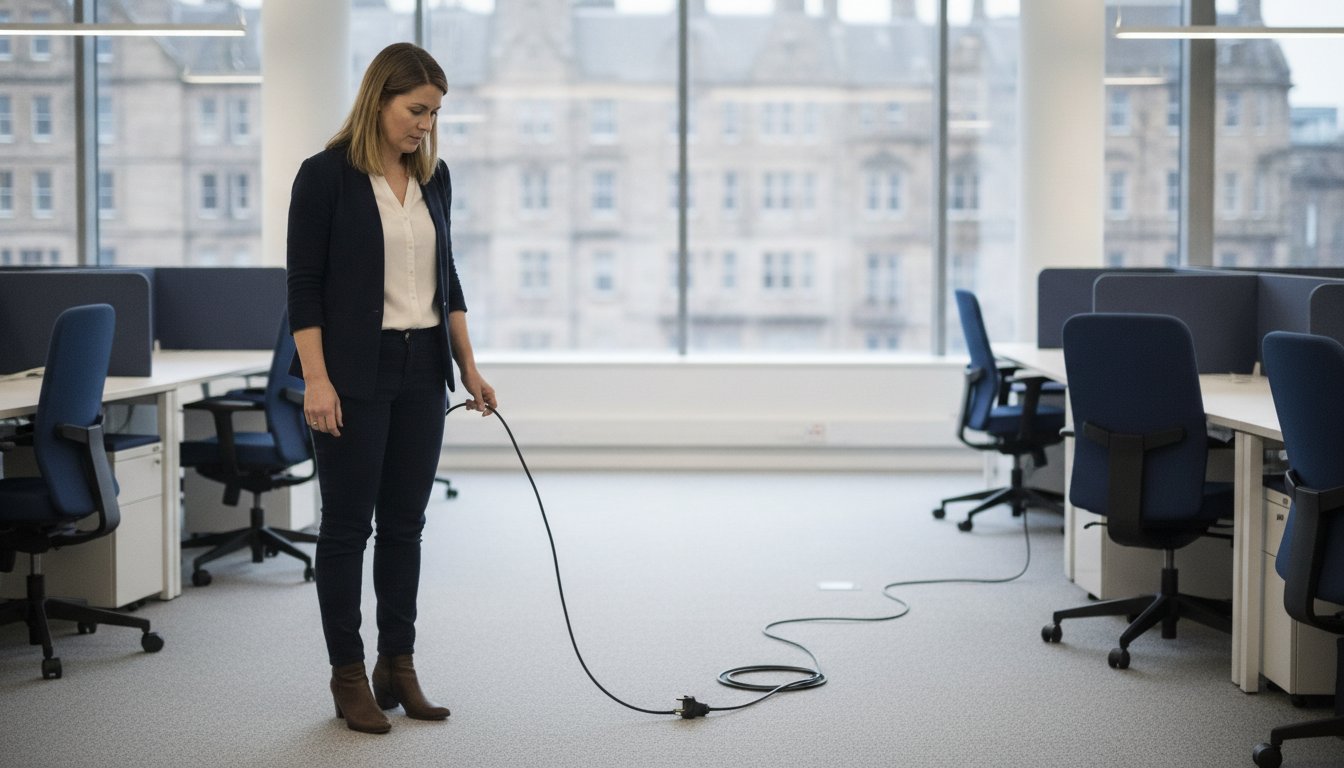
Why should a trip over a loose trailing wire or a fall on a slick breakroom floor cost you a month's wages and a significant portion of your final settlement? If you're considering an office injury claim Scotland has specific legal frameworks that actually work in your favour if you know how to navigate them. You shouldn't have to choose between your professional reputation and the financial support you need to recover from a workplace accident.
We understand the pressure you're under. You might fear being treated differently by your boss or worry that legal fees will swallow your hard-earned compensation. It's a valid concern because many traditional firms take a large cut of your payout as a success fee. This article changes that narrative. We promise a clear, step-by-step 2026 checklist that ensures you retain 100% of your settlement whilst navigating the process with zero financial risk.
You'll gain a full understanding of how Scottish legal timelines differ from the rest of the UK and how to document hidden office hazards effectively. We'll show you exactly how to secure your financial future without the stress of hidden costs or the fear of employer retaliation.
- Prioritise your health and your claim by seeking medical attention and reporting the incident to HR as soon as possible.
- Secure vital evidence like CCTV footage and photographs of the hazard before the office environment is changed or cleaned.
- Hold your employer accountable for their legal duty of care, which includes providing ergonomic equipment and regular workstation assessments.
- Retain 100% of your settlement for an office injury claim Scotland by choosing a model that recovers fees from insurers rather than your payout.
- Start your recovery process within the strict three-year legal window to ensure your path to compensation remains open and risk-free.
The moments following an office accident are often a blur of shock and adrenaline. You might feel tempted to brush off a slip on a wet kitchen floor or a fall from a faulty swivel chair to avoid making a scene in front of colleagues. Don't do this. Taking specific steps in the first sixty minutes is the only way to protect your health and your future office injury claim scotland. Adopting a methodical approach right away ensures that the facts are preserved before the environment changes.
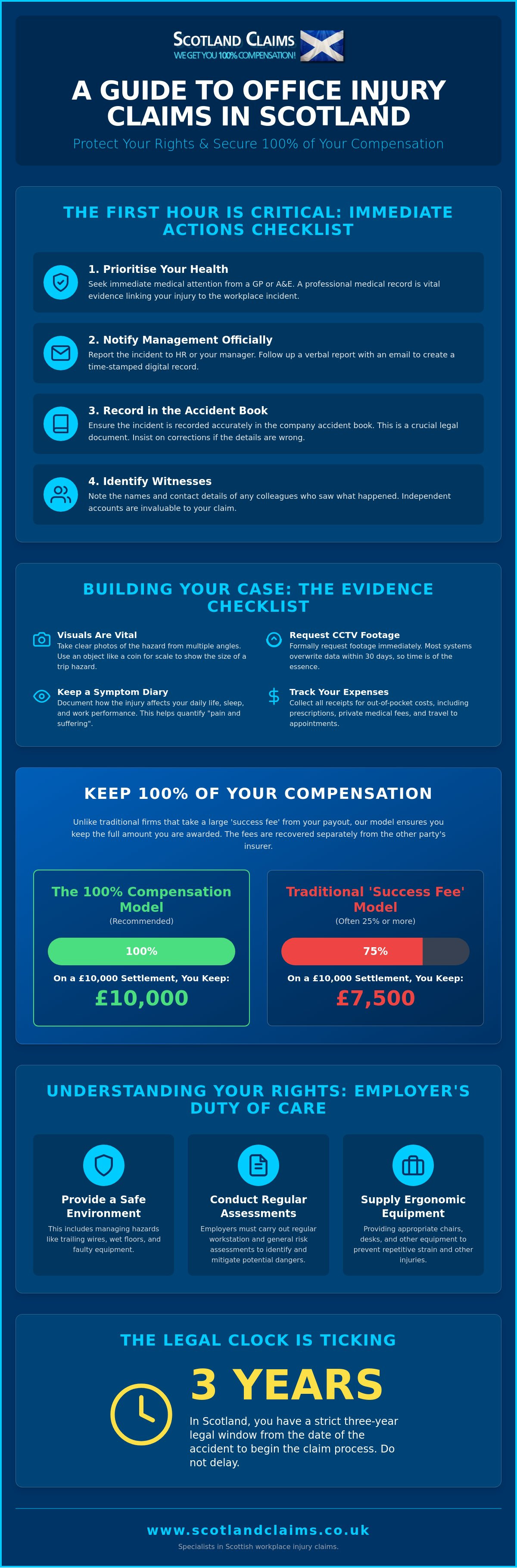
- Prioritise your health: Seek immediate medical attention from a GP or A&E. Even if the injury seems minor, internal damage or soft tissue issues often take hours to manifest.
- Notify management: Report the incident to your office manager or HR department immediately. Verbal notice is a start, but written notice is better.
- Use the accident book: Ensure the incident is recorded accurately in the company accident book whilst the details are fresh in your mind.
- Identify witnesses: Note the names and contact details of any colleagues who saw what happened. Their independent accounts are invaluable.
- Secure your own copy: Request a physical or digital copy of the accident book entry for your personal records before you leave the building.
Reporting the Incident Correctly in an Office Setting
The accident book isn't just a corporate formality; it's a legal safeguard. Under the Scots law of delict, proving that a duty of care was breached requires a clear, contemporaneous record of the event. If your office lacks a formal accident book, send an email to your supervisor or HR representative immediately. This creates a time-stamped digital trail that is difficult for insurers to dispute later. Always ensure the report matches your version of events exactly. If a manager tries to downplay the hazard in the description, insist on a correction before the report is finalised.
Medical Documentation: Why Your GP Visit Matters
A visit to the GP or A&E provides the objective evidence needed for a successful work injury claim. Scottish courts do not simply take a claimant's word for it when assessing "pain and suffering." They rely heavily on professional medical notes. When you speak to the doctor, describe the mechanism of the injury clearly. Don't just say your back hurts; explain that it hurts because a workstation chair collapsed or you tripped on a loose carpet tile. This links the injury directly to the workplace hazard. Early intervention proves you took the injury seriously and prevents the insurer from claiming your condition worsened because you delayed treatment.
Evidence is what turns a rejected claim into a successful settlement. In a professional office environment, hazards like trailing cables or slick floors are often "cleaned up" or "repaired" within hours of an accident. You must act fast to document the environment exactly as it was at the moment of impact. This is the foundation of any office injury claim scotland workers need to build to ensure their employer is held accountable. Without physical proof, a case often becomes your word against theirs, which insurers will always exploit.
- Visuals: Take high-quality photographs of the hazard from multiple angles before maintenance removes the danger.
- CCTV: Request footage from the building manager immediately; most systems overwrite data within 30 days.
- Digital Trail: Retain any emails or memos that prove you or a colleague reported the hazard before the accident occurred.
- Financials: Collect all receipts for out-of-pocket expenses, including prescriptions, private medical fees, and travel costs.
- Daily Logs: Keep a "symptom diary" to document how the injury affects your sleep, your work performance, and your personal life.
Visual Evidence: Capturing Office Hazards
Your mobile phone is your most powerful legal tool. Take photos of the defect immediately. If you tripped over a loose carpet tile, place a coin or a ruler next to it in the photo to provide scale. A flat photo often fails to show the height of a trip hazard, so an object for comparison is vital. You should also take "before and after" photos of your injuries as they heal. This creates a visual timeline of your recovery that helps your solicitor demonstrate the true extent of your suffering. If you're unsure what counts as evidence, you can check your case details with a specialist to see what's missing.
Witness Statements in a Professional Environment
Approaching colleagues for help can feel awkward, but it doesn't have to create workplace tension. Keep the conversation professional and focused on the facts. Simply ask if they would be willing to provide their contact details so your legal representative can reach out later. Under the Health and Safety at Work etc. Act 1974, your employer has a legal duty to protect you, and witnesses help prove where they failed. Independent witnesses, such as delivery drivers or office visitors, are particularly valuable because they have no personal connection to your firm. Witness testimony often proves liability when an employer denies fault.
In Scotland, your employer has a non-negotiable legal obligation to keep you safe. This is known as a "duty of care." Many people assume these protections only apply to high-risk environments like construction sites or factories. That's a misconception. Whether you work in a corporate hub in Glasgow or a creative studio in Edinburgh, the law protects you. If you've suffered because of a workplace hazard, an office injury claim scotland is your legal right to seek restitution for your physical pain and financial loss.
Employers must proactively manage risks. This includes conducting regular Display Screen Equipment (DSE) assessments for anyone using a computer. They're legally required to ensure your workstation is ergonomically sound. If your employer ignored a request for a supportive chair or failed to fix a loose floor tile, they've breached their duty. You shouldn't have to pay the price for their negligence. Your safety isn't a luxury; it's a requirement under the Health and Safety at Work etc. Act 1974.
One of the biggest hurdles for office workers is the fear of damaging their professional relationships. You might worry about the financial impact on your firm. It's vital to understand that your claim is made against your employer’s liability insurance, not their personal bank account. This insurance exists specifically to cover these situations. It's a standard business cost, and using it doesn't make you a "troublemaker." It makes you a person who is rightfully recovering their losses.
Legal Protections Against Unfair Dismissal
The most common fear we hear is the dread of being sacked. Let's be clear: it is legally difficult for an employer to fire you for exercising your legal rights. Doing so would likely constitute "automatic unfair dismissal." Specialist injury lawyers in Scotland are regulated by the Law Society of Scotland to ensure your case is handled with the highest professional standards. For a complete breakdown of your legal standing, you can explore our Accident at Work Scotland pillar.
Common Office Safety Breaches
Office hazards are often subtle, but their impact is significant. We frequently see claims stemming from these specific failures:
- Poor Layouts: Inadequate risk assessments when moving desks, leading to blocked fire exits or cramped walkways.
- Equipment Failure: Providing non-adjustable chairs or faulty electrical equipment that causes shocks or repetitive strain.
- Communal Neglect: Failing to maintain shared areas like kitchens, resulting in slips on wet floors or trips on frayed stair carpets.
Preventing these risks often comes down to rigorous maintenance and compliance checks. For instance, ensuring electrical systems are up to code through a qualified Electrician Dundee is a critical part of meeting an employer's legal duty of care and avoiding preventable accidents caused by faulty wiring or outdated installations.
If you recognise these issues in your own workplace, the law is on your side. You've already taken the first step by learning your rights. Now, it's about ensuring you don't lose out financially because of a mistake that wasn't yours.
You've been injured and you deserve financial support. Many people don't realise that "No Win, No Fee" often comes with a hidden cost that significantly reduces their final payout. In Scotland, most solicitors deduct a success fee from your award to cover their work. We believe that's wrong. When you make an office injury claim scotland through our model, you keep every penny of the settlement. Our goal is to ensure your financial recovery is as complete as your physical one.
The difference in fee structures is stark. If you receive a £5,000 settlement for a trip over a loose cable, a standard firm might take £1,000 as their success fee. You only see £4,000 in your bank account. We operate differently by recovering our legal costs directly from the at-fault insurer. This means the insurer pays our fees on top of your compensation, not out of it. Securing an office injury claim scotland should never mean sacrificing a portion of your justice to pay for the help you needed.
The Mathematics of Fairness: Why 100% Matters
A standard 20% success fee on a £15,000 claim costs the victim £3,000, which is money that should be supporting your family or paying for specialist care. Most firms rely on these deductions to boost their profits, but we prioritise your financial integrity. Our approach ensures the entire settlement reaches your bank account without any hidden deductions. It's a transparent system designed to empower the claimant rather than the legal firm. You can see what your potential award looks like right now by using our Compensation Calculator.
Claiming for "Special Damages" in an Office Context
Compensation is split into two categories: General Damages and Special Damages. General Damages cover your physical pain and mental distress. Special Damages cover every pound you've lost because of the accident. In an office setting, this goes far beyond just your basic salary. We help you recover a wide range of financial losses:
- Lost Overtime: If you missed out on scheduled extra hours whilst recovering.
- Pension Contributions: Ensuring your future security isn't compromised by a gap in work.
- Private Medical Costs: Recovering the price of private physiotherapy or mental health support.
- Home Office Adjustments: Costs for ergonomic desks or chairs if the injury requires you to work from home.
Don't settle for a percentage of what you're owed. Speak to a work injury specialist to ensure you retain 100% of your settlement.
You have exactly three years from the date of your accident to initiate an office injury claim scotland courts will accept. This strict deadline is governed by the Prescription and Limitation (Scotland) Act 1973. Whilst three years sounds like a long time, the reality of legal evidence is much shorter. CCTV is deleted. Witnesses move to different firms. Memories of the specific hazard fade. Starting the process immediately isn't about rushing; it's about securing the facts before they disappear.
Our process begins with a no-obligation assessment. We don't believe in high-pressure sales or complicated legal jargon. Instead, we provide a clear path forward that protects your interests. Every solicitor we work with is authorised by the Law Society of Scotland. This ensures your case is handled by a professional who understands the specific nuances of Scots law, which differs significantly from the English system. You're not just another file; you're a client whose financial future is our priority.
The Scottish Legal Timeline
The first formal step is the "letter of claim." This document outlines the negligence and the injuries you've suffered. Most office-based cases don't end up in a courtroom. Instead, they are settled through methodical negotiation with the employer's insurance company. We focus on proving liability early so that you can receive your 100% compensation payout as quickly as possible. If the insurer admits fault, the roadmap to recovery becomes much smoother. Securing an office injury claim scotland workers can rely on means staying ahead of these procedural steps.
Starting Your Claim with Scotland Claims Injury Lawyers
Getting started is simple. You can use our online claim assessment tool to get an immediate sense of your standing. When you call us, you'll speak to a specialist who listens to your story and provides an honest evaluation of your case. There's no risk and no hidden fees. You can explore our Injury at Work service page to see how we've helped others in your position. We handle the paperwork and the negotiations so you can focus on your health. Our model is built on transparency, ensuring you know exactly where your claim stands at every stage.
Don't let a workplace injury derail your career or your finances. You have a right to a safe office environment and a right to be compensated when that safety is compromised. Our 24-hour freephone helpline is available whenever you're ready to take the first step. Call us today for a free, confidential consultation and find out how we can secure your full settlement with zero financial risk.
You now have the essential tools to handle a workplace accident with absolute confidence. By following this 2026 checklist, you ensure that your health is prioritised and your legal rights are protected from the very first hour. Your employer's duty of care is a non-negotiable legal requirement. Seeking compensation is a standard insurance process; it is not a personal conflict or a risk to your professional future.
When starting an office injury claim scotland workers often worry about hidden costs or legal deductions. We've removed those barriers entirely. We provide a 100% Compensation Guarantee with absolutely no success fees or hidden deductions. Every solicitor in our network is fully regulated by the Law Society of Scotland, providing you with expert advocacy that puts your financial integrity first.
Start your office injury claim online today and keep 100% of your compensation.
You don't have to navigate the recovery process alone. Take a stand for your rights and ensure you receive the full settlement you deserve to move forward. We're ready to help you secure your future starting right now.
How long do I have to make an office injury claim in Scotland?
You have three years from the date of the accident to initiate your legal proceedings. This time limit is set by the Prescription and Limitation (Scotland) Act 1973. If you're dealing with an injury that developed over time, the three-year clock starts from the "date of knowledge." It's best to act quickly to ensure evidence like CCTV or witness statements remains available for your solicitor.
Can I still claim if the office accident was partially my fault?
Yes, you can still claim even if you played a small part in the incident. This is known as "contributory negligence" under Scots law. Your total compensation might be reduced by a percentage that reflects your responsibility. If a court finds you were 25% at fault for a trip, you would still receive 75% of the settlement value. We'll help you establish the employer's primary liability.
Will my employer find out that I am making a claim against them?
Your employer will be notified of the claim because your solicitor must send a formal letter to their insurance provider. However, the process is handled by their Employers' Liability Insurance company rather than the business owner directly. It's a professional insurance matter, and the law protects you from being treated unfairly or dismissed for exercising your legal right to compensation.
Can I claim for Repetitive Strain Injury (RSI) caused by my office workstation?
You can claim for RSI if it's proven that your employer failed to provide an ergonomic workstation or conduct mandatory DSE assessments. When pursuing an office injury claim scotland based, the focus is on whether the employer ignored workstation regulations. If your injury resulted from repetitive tasks performed without proper equipment or breaks, you have a strong basis for a successful settlement.
Do I have to pay anything if my office injury claim is unsuccessful?
You won't pay a penny in legal fees if your case is unsuccessful. We operate on a strict "No Win, No Fee" basis to remove all financial risk from the process. This ensures that everyone has access to specialist legal representation regardless of their bank balance. You only pay if we win, and our unique model ensures you keep 100% of your award.
What happens if my employer does not have insurance?
Almost every UK employer is legally required to have Employers' Liability Insurance under the 1969 Act. If they have failed to maintain insurance, they are personally liable for the settlement. In some cases, you might still be able to recover funds through specific industry bodies. We'll investigate your employer's insurance status during the initial free assessment to determine the best path forward.
How long does the average office injury claim take to settle in Scotland?
Most straightforward office injury claims are resolved within six to twelve months. The timeline depends heavily on whether the employer's insurer admits liability early or disputes the facts. Complex cases involving long-term medical recovery or disputes over negligence can take longer to ensure you receive the full value of your claim. We work to move your case forward as efficiently as possible.
Can I claim if I was working as a contractor or temp in the office?
Yes, contractors and temporary workers are protected by the same health and safety laws as permanent staff. Your host employer owes you a duty of care to provide a safe working environment whilst you're on their premises. If they failed to maintain a safe office and you were injured as a result, you have the same right to an office injury claim scotland workers expect.