Step-by-step compensation guide for Scottish injury claims
TL;DR:
- Proper evidence collection and working with a Scottish solicitor are crucial for successful injury claims.
- The five-step process includes inquiry, investigation, medical assessment, negotiation, and settlement or litigation.
- Compensation varies based on evidence, injury severity, and individual circumstances, not fixed amounts.
Facing a personal injury claim in Scotland can feel overwhelming, particularly when you are unsure where to begin, what evidence to gather, or how solicitors actually move a case forward. Many injury victims lose out simply because they do not know the process, not because their claim lacks merit. This guide cuts through the confusion and gives you a clear, practical walkthrough of every stage, from gathering your first documents to understanding how your compensation is calculated. Whether your injury happened on the road, at work, or in a public space, what follows is written specifically for the Scottish legal context, not a generic template copied from elsewhere.
Table of Contents
Key Takeaways
| Point |
Details |
| Prepare your evidence |
Collect all accident details and medical proof before starting a claim. |
| Follow each step |
Progress through the Scottish process in a clear sequence for best outcomes. |
| Valuation is case-specific |
Guideline figures are not guarantees—real evidence shapes compensation. |
| Avoid common pitfalls |
Missing deadlines or poorly documented claims reduce your chances of success. |
| Expert advice matters |
Scottish solicitors help tailor your claim for fair results. |
What you need before starting your compensation claim
Before you instruct a solicitor or fill in any forms, you need the right information and materials in place. Think of it like building a house: no matter how skilled the builders, the structure will not stand without solid foundations. The same principle applies here.
The evidence and facts required are the backbone of a Scottish compensation claim. Getting this foundation right from day one can dramatically increase your chances of a successful outcome.
Key documents and details to gather immediately:
- The exact date, time, and location of the incident
- A written account of how the accident happened, in your own words
- Contact details for any witnesses present
- Photographs of the accident scene, any hazards, and your visible injuries
- Medical notes or GP records from your first assessment
- Any correspondence with employers, insurers, or local authorities
- Police or incident report numbers if applicable
The type of accident also shapes what evidence you need. Road traffic accidents require vehicle registration details and insurer information. Workplace injuries need employer records and health and safety reports. Slips and trips in public spaces benefit from CCTV footage requests made promptly, before footage is overwritten.
Scotland operates under Scots law, which differs from the law in England and Wales in meaningful ways. Procedural rules, court structures, and some limitation periods have Scottish distinctions. If you are documenting accident evidence after an incident in Scotland, working with a Scotland-based solicitor ensures your evidence is gathered to the right standard from the start.
For road traffic injuries specifically, the MoJ whiplash claim guidance provides useful context on what insurers expect from claimants, even if the Scottish process differs procedurally.
| Evidence type |
Why it matters |
When to gather it |
| Photographs |
Visual proof of hazard or damage |
Immediately |
| Witness statements |
Independent account of events |
Within 24 to 48 hours |
| Medical records |
Establishes injury and treatment |
As soon as possible |
| Incident reports |
Official acknowledgement of event |
Same day if possible |
Pro Tip: Take dated photographs using your smartphone and email them to yourself immediately. This creates a timestamp record that cannot easily be disputed later.
Step-by-step compensation process in Scotland
With all essentials gathered, you are ready to work through the process itself, step by step. Scotland does not use the same online portals as England and Wales, such as the Official Injury Claim portal for low-value road traffic accidents. Scottish claims are almost always solicitor-led, which means having the right legal representation is not optional, it is essential.
Making a personal injury whiplash claim follows a typical five-step process for low-value road traffic accident claims that underpins the Scottish practical sequence, but Scottish procedures are influenced by the unique legal framework north of the border.
The five key stages of a Scottish compensation claim:
- Initial inquiry: Contact a specialist solicitor, outline your accident, and confirm your claim has legal merit. Most Scottish firms offer free initial assessments.
- Investigation and intimation: Your solicitor gathers evidence, contacts the at-fault party, and formally intimates (notifies) the claim to them or their insurer.
- Medical assessment: An independent medical expert examines you and produces a report detailing your injuries, recovery timeline, and any long-term impact.
- Negotiation: Your solicitor negotiates a settlement figure with the defender’s insurer, using your evidence and the medical report as leverage.
- Acceptance or litigation: If a fair offer is made, you accept and receive payment. If not, your solicitor can raise court proceedings in Scotland’s civil courts.
You can find a detailed breakdown of each stage in our full claim process guide, which also covers timelines and what to expect at each point.
| Stage |
Scotland |
England and Wales |
| Portal system |
No dedicated portal |
Official Injury Claim portal |
| Legal representation |
Strongly advised at all stages |
Optional for low-value claims |
| Medical reports |
Independent expert required |
Fixed MedCo panel |
| Court system |
Court of Session or Sheriff Court |
County Court or High Court |
For further detail on how to claim injury compensation easily, our guides walk through each scenario from start to finish.
Pro Tip: Keep a written log of every phone call, email, and letter related to your claim, including dates and what was discussed. This record can prove invaluable if disputes arise over what was said or agreed.
Evidence and valuation: how your compensation is calculated
You have seen the process. Now here is what determines how much compensation you might actually receive. Many claimants assume there is a set price list for injuries. There is not. Claim valuation in Scotland is influenced by evidence, injury impact, duration, and reference to Judicial College Guidelines, but outcomes can diverge based on real case facts.
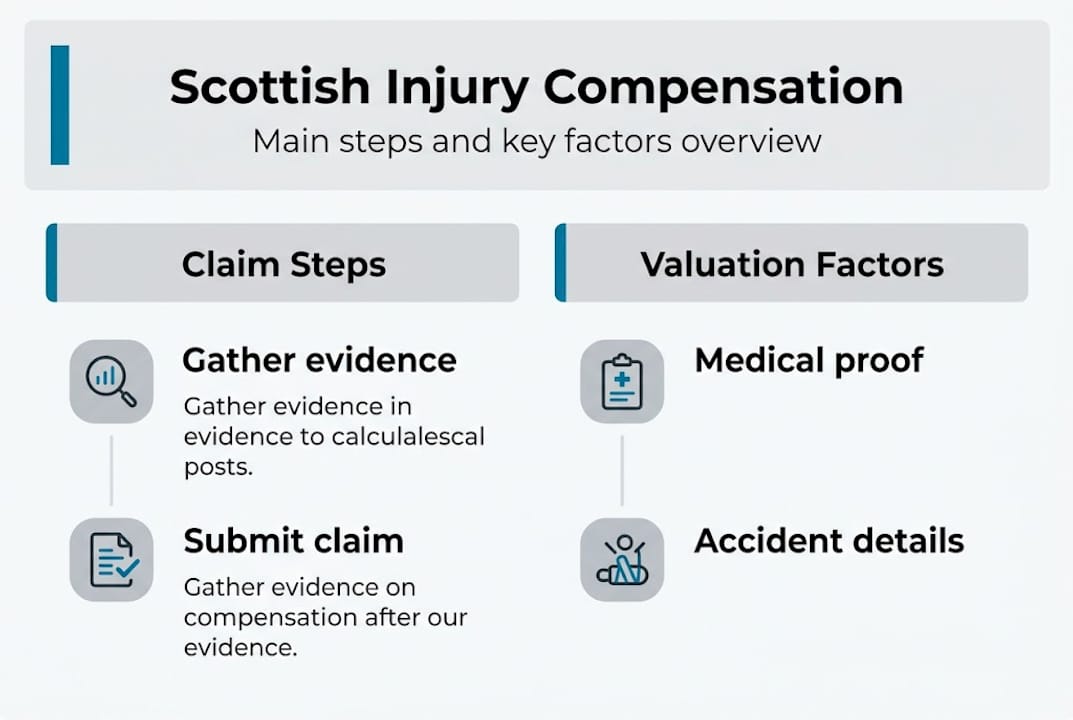
The Judicial College Guidelines (JCG) set out broad ranges for general damages, which cover pain, suffering, and loss of amenity. A moderate back injury, for example, might fall within a range of several thousand pounds to well over £30,000 depending on severity. But the JCG figure is only the starting point.
Evidence that strengthens your valuation:
- Detailed medical reports from independent experts
- GP records and hospital discharge letters
- Physiotherapy or specialist treatment notes
- A personal statement describing impact on your daily life
- Proof of financial losses: lost wages, travel costs, care expenses
- Photographs showing visible injury progression over time
Scottish courts and solicitors look at special damages (financial losses) alongside general damages (pain and suffering). Both categories must be evidenced properly. If you skipped physio appointments or failed to follow medical advice, it can reduce your valuation.
“Guidelines give a range, not a verdict. Two people with the same diagnosis can receive very different settlements depending on how their injury has actually shaped their life. Evidence is what bridges that gap.” — Scotland Claims legal team
For a practical estimate before speaking to a solicitor, our calculating injury compensation guide explains the maths behind the figures. You can also read about what compensation payouts mean in real terms for Scottish claimants. To further understand what counts as collecting effective evidence, our resources cover each evidence type in detail.
Common mistakes and how to avoid them
Avoiding setbacks can make all the difference to your outcome. Here is how to keep your claim on track.
Poor or delayed evidence submission is a major cause of difficulty in Scottish claims. But evidence problems are just one of several avoidable mistakes that derail otherwise strong cases.
The most common errors claimants make:
- Missing the time limit: Scotland’s standard limitation period is three years from the date of the accident or the date you became aware of your injury. Miss this and your claim is almost certainly lost.
- Accepting an early offer: Insurers sometimes make quick, low offers shortly after an accident. Accepting before you know the full extent of your injuries often means settling for far less than you deserve.
- Failing to attend medical appointments: Every missed appointment weakens your medical evidence. Insurers use gaps in treatment to argue you were not seriously hurt.
- Poor documentation: Vague, incomplete, or inconsistent accounts of the accident create openings for the defender to challenge your version of events.
- Going it alone without specialist advice: Scottish procedure is not intuitive, particularly if litigation becomes necessary. Claim process insights show that solicitor-led claims consistently achieve better outcomes than unrepresented ones.
Understanding why evidence matters at every stage helps you appreciate that the effort you put in early pays dividends throughout the process.
Pro Tip: Start a dedicated “claim diary” from the day of your accident. Record your symptoms daily, note how the injury affects your work, sleep, and personal life, and log every interaction with medical professionals. This diary can significantly support your general damages valuation.
Why one-size-fits-all compensation guides fall short in Scotland
Let us take a step back and address why Scotland’s injury claim process cannot be fully standardised. Most online guides are written with England and Wales in mind. They reference the Official Injury Claim portal, fixed tariffs under the Civil Liability Act 2018, and County Court procedures. None of that directly applies in Scotland.
More importantly, even Scotland-specific guides have limits. A guide can tell you the process, but it cannot tell you what your claim is worth. That depends on your specific medical evidence, your personal experience of the injury, and how skillfully your solicitor presents your case. Two people with identical whiplash diagnoses can walk away with settlements that differ by thousands of pounds.
We have seen claimants read a guide, arrive at a rough figure using online calculators, and then feel underwhelmed or misled when their actual settlement differs. The guide was not wrong; their circumstances were simply more nuanced than any template can capture. Understanding Scottish calculation nuances is a starting point, not a finishing line.
Treat every compensation guide, including this one, as a map, not a guarantee. The map shows the territory, but you still need a skilled guide to navigate it safely.
Ready to take the next step?
If reading this guide has clarified the process, the natural next step is getting personalised advice from a specialist who knows Scottish law inside out. Our No Win No Fee lawyers work with injury victims across Scotland, taking on cases at no upfront cost and only charging if your claim succeeds.
Not sure what your claim might be worth? Use our compensation calculator to get an indicative figure based on your injury type. If your injury involves your back, our dedicated back injury claim advice page covers everything specific to those cases. Get in touch today and let a specialist turn this guide into real results for you.
Frequently asked questions
How long do I have to make a compensation claim in Scotland?
Typically, you have three years from the date of the accident or injury discovery to start a claim in Scotland. Acting early gives your solicitor the best chance to gather strong evidence.
What evidence is most important for a Scottish injury claim?
Medical records, accident details, and witness statements are key to a successful injury claim. As specialists confirm, the evidence and facts gathered early form the backbone of any Scottish compensation claim.
Do compensation calculators give accurate payout estimates?
They offer a useful estimate, but actual compensation in Scotland depends on individual circumstances and medical evidence. Judicial College Guidelines set benchmark ranges, but valuation is also shaped by medical evidence, duration, and impact on daily life.
What is No Win No Fee and how does it work?
No Win No Fee means you only pay legal fees if your claim is successful, making legal help accessible without financial risk. It is the most common arrangement for personal injury claims in Scotland and removes any barrier to getting specialist representation.
Recommended