Serious injury claims in Scotland: your 2026 guide

TL;DR:
- A serious injury causes significant, often long-lasting harm that requires immediate medical treatment and affects your quality of life. Scottish law recognizes both physical and psychological injuries as valid for compensation, with detailed legal procedures and no success fee from Scotland Claims Injury Lawyers. Acting promptly and documenting all impacts can maximize your claim, which covers medical costs, lost earnings, and long-term care needs.
A serious injury is defined as physical trauma that requires immediate medical treatment and causes significant, often long-lasting harm to your health, independence, or quality of life. Under Scottish personal injury law, this classification matters enormously. It determines the scope of compensation you can claim, the medical evidence required, and the legal strategy your solicitor will follow. Scotland Claims Injury Lawyers works exclusively with people in Scotland who have suffered this level of harm through accidents or negligence, and uniquely charges no success fee, meaning you keep 100% of your compensation.
What types of injuries count as serious injuries?

A serious injury includes physical trauma that can cause long-term impairment, permanent disfigurement, or mental disturbance. That definition covers a wide range of conditions, from broken bones requiring surgery to psychological disorders that prevent a return to normal life.
Common serious injuries seen in Scottish personal injury claims include:
- Fractures and orthopaedic injuries: Broken hips, spinal fractures, and complex limb fractures that require surgery and extended rehabilitation.
- Head and brain injuries: Concussion, traumatic brain injury, and skull fractures that affect cognition, memory, and behaviour.
- Internal organ damage: Injuries to the liver, spleen, or kidneys caused by road traffic accidents or workplace incidents.
- Severe burns: Burns covering significant body surface area, leading to scarring, nerve damage, and psychological distress.
- Spinal cord injuries: Partial or complete damage affecting mobility and sensation below the injury site.
- Psychological injuries: Clinically diagnosed conditions such as post-traumatic stress disorder, severe anxiety, and depression arising directly from the incident.
Serious vs catastrophic injuries
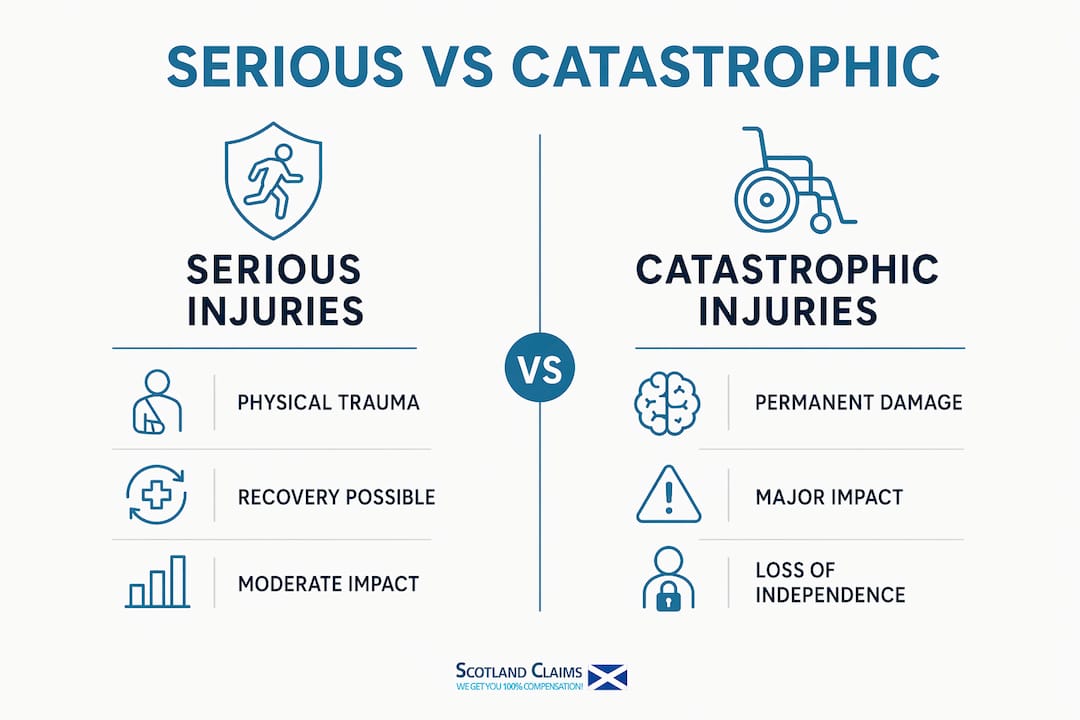
Catastrophic injuries differ from serious injuries mainly in their permanency and their impact on independence and the ability to work. Catastrophic injuries include traumatic brain injury, paralysis, and amputations. Serious injuries, by contrast, may heal fully or partially over time, though many leave lasting effects. The distinction shapes compensation calculations significantly. A catastrophic injury claim typically involves lifetime care costs, whereas a serious injury claim focuses on recovery costs, lost earnings during rehabilitation, and pain and suffering.
| Injury type |
Typical impact |
Recovery outlook |
| Spinal fracture |
Mobility loss, chronic pain |
Partial to full, months to years |
| Traumatic brain injury |
Cognitive and behavioural changes |
Often permanent |
| Severe burns |
Scarring, nerve damage, PTSD |
Partial, ongoing treatment |
| Complex limb fracture |
Reduced function, pain |
Full to partial, 6–18 months |
| Psychological injury (PTSD) |
Anxiety, flashbacks, social withdrawal |
Variable, specialist treatment needed |
Psychological injuries carry the same legal weight as physical ones under Scottish personal injury law. If a road traffic accident or workplace incident caused you to develop a diagnosed mental health condition, that forms a valid part of your claim.
How do serious injuries impact life and recovery expectations?
Recovery from a severe injury rarely follows a straight line. Research shows that a significant proportion of serious injury survivors experience ongoing pain, anxiety, and depression even 10 years after the original trauma, with a 16% mortality rate recorded at the 10-year mark in severe trauma studies. That figure underlines why compensation must account for long-term needs, not just immediate medical costs.
The physical consequences extend well beyond the initial hospital stay. Many people face months of physiotherapy, repeated surgical procedures, and permanent changes to their mobility or strength. Fatigue, chronic pain, and reduced physical capacity are common, and they affect every area of daily life.
The financial impact is equally serious. Studies on post-injury productivity show that 85.8% of people returning to work after hospitalisation experience presenteeism, meaning they are present but unable to work at full capacity. A further 52.6% report absenteeism. These figures confirm that lost earnings and reduced productivity form a major part of the financial damage caused by serious injuries.
Mental health consequences are often underestimated. Psychological reactions such as shock, anxiety, and guilt after injury are normal in the short term. When those symptoms persist beyond a few weeks, they signal the need for trauma-specialised professional support. Untreated psychological injury slows physical recovery and reduces quality of life significantly.
Pro Tip: Ask your care team directly about your expected recovery timeline, your rehabilitation needs, and when it is safe to return to work. Clear answers reduce anxiety and help you set realistic goals.
What legal rights do you have after a serious injury in Scotland?
Every person in Scotland who suffers a serious injury through someone else’s negligence or fault has the right to claim compensation. That right covers medical costs, lost earnings, care costs, and damages for pain and suffering. Scottish personal injury law recognises both physical and psychological harm as compensable losses.
The steps to start a claim are straightforward:
- Seek medical attention immediately. Your medical records are the foundation of your claim. Every diagnosis, treatment, and prognosis note becomes evidence.
- Document all difficulties. Recording all impacts, including inability to perform daily tasks, is critical for calculating care and loss costs accurately.
- Preserve evidence from the scene. Photographs, witness details, accident reports, and CCTV footage all strengthen your case.
- Engage a specialist injury solicitor. A solicitor experienced in Scottish personal injury law understands the procedural rules, timescales, and court processes specific to Scotland. The role of solicitors in building and presenting your claim is central to achieving a fair outcome.
- Act within the time limit. In Scotland, the general limitation period for personal injury claims is three years from the date of the accident or from when you became aware of your injury.
Scotland Claims Injury Lawyers operates on a no win no fee basis and charges no success fee whatsoever. Most solicitors in Scotland deduct up to 20% of your compensation as a success fee. Scotland Claims takes nothing. You receive 100% of your settlement.
Pro Tip: Avoid returning to work before your medical team confirms you are ready. Premature return to work under pressure can hinder both your physical and psychological recovery, and it can also reduce the value of your compensation claim.
How does the serious injury compensation claim process work in Scotland?
The claim process follows a defined sequence, and knowing each stage reduces uncertainty considerably.
- Initial consultation. Your solicitor reviews the facts, assesses liability, and advises on the strength of your claim. Scotland Claims Injury Lawyers offers this at no cost and with no obligation.
- Gathering medical evidence. Independent medical experts assess your injuries and produce reports that quantify your losses and future needs.
- Letter of claim. Your solicitor formally notifies the responsible party, who has a set period to respond and investigate.
- Negotiation or litigation. Most serious injury claims settle through negotiation. Where the other side disputes liability or undervalues the claim, court proceedings may follow.
- Settlement or court award. You receive your compensation in full. With Scotland Claims, no success fee is deducted at any stage.
For a detailed walkthrough of each stage, the guide on what happens after making a claim covers timelines, correspondence, and what to expect from the other side’s insurers.
Common challenges include delays from insurers, disputes over the extent of psychological injury, and pressure to accept early low offers. A specialist solicitor counters each of these. Early offers from insurers rarely reflect the true value of a serious injury claim, particularly where long-term care or loss of earnings is involved.
Pro Tip: Before your first meeting with a solicitor, prepare a written account of the accident, your symptoms, and how your injury affects daily life. The top questions to ask your lawyer guide from Scotland Claims Injury Lawyers can help you prepare.
What support is available for recovery beyond compensation?
Compensation funds your recovery. It does not deliver it. Effective recovery from a severe injury requires active engagement with medical, psychological, and social support systems.
Key sources of support include:
- Physiotherapy and occupational therapy: These services rebuild physical function and help you adapt your home or workplace to your changed needs.
- Psychological therapy: Cognitive behavioural therapy and trauma-focused therapies address PTSD, anxiety, and depression. Persistent psychological symptoms after injury require trauma-specialised professionals, not general counselling alone.
- Social work and community support: Local authority social work teams in Scotland can assess your care needs and arrange practical support at home.
- Peer support networks: Connecting with others who have experienced similar injuries reduces isolation and provides practical coping strategies.
If your injury occurred at work and attracts media attention, you are not obliged to speak to journalists or give public statements. You can appoint a spokesperson or simply decline all contact. Protecting your privacy protects your emotional wellbeing during recovery.
For injuries that include a psychological component, Scotland Claims Injury Lawyers can connect you with solicitors experienced in psychological injury claims in Scotland, ensuring that the full mental health impact is captured in your compensation.
Pro Tip: Set clear boundaries with media, employers, and even well-meaning acquaintances during recovery. Constant retelling of the incident can retraumatise and slow psychological healing.
Key takeaways
Serious injury claims in Scotland succeed when claimants act quickly, document everything, and choose a solicitor who takes no success fee so that 100% of the compensation reaches them.
| Point |
Details |
| Definition matters legally |
A serious injury must cause significant harm or long-term impairment to qualify for full compensation. |
| Document every impact |
Record physical limitations, psychological symptoms, and daily difficulties to maximise claim value. |
| Act within three years |
Scottish law sets a three-year limitation period from the date of injury or date of awareness. |
| No success fee with Scotland Claims |
Scotland Claims Injury Lawyers deducts nothing from your settlement, unlike solicitors who charge up to 20%. |
| Recovery needs more than money |
Physiotherapy, psychological therapy, and community support all play a role in long-term recovery. |
What I have learned from serious injury claims in Scotland
Roger here. After years working with people who have been through serious accidents in Scotland, the single biggest mistake I see is underestimating the claim. People accept early offers because they feel grateful to receive anything, or because they want the process to end. That instinct is understandable. It is also costly.
The second mistake is failing to document psychological harm. Physical injuries show up on X-rays and MRI scans. Anxiety, depression, and PTSD do not. If you do not record how your injury affects your sleep, your relationships, your confidence, and your ability to leave the house, that damage goes uncompensated. Keep a daily diary from the moment of your injury. It becomes one of the most powerful pieces of evidence your solicitor has.
The third thing I would tell anyone reading this is to take the no success fee point seriously. Losing 20% of a serious injury settlement is not a small amount. On a £50,000 award, that is £10,000 gone before you even begin your recovery. Scotland Claims Injury Lawyers was built specifically to stop that from happening. You have already been through enough.
— Roger
Scotland Claims Injury Lawyers: serious injury support with no success fee
Scotland Claims Injury Lawyers specialises in serious personal injury claims across Scotland, from road traffic accidents and workplace injuries to slips, trips, and falls. Every claim runs on a genuine no win no fee basis, and unlike most solicitors in Scotland, no success fee is ever deducted from your settlement. You receive 100% of your compensation, every time. Whether you are dealing with a back injury claim or a more complex serious injury, the team is ready to advise you at no cost and no risk. Contact Scotland Claims today through the injury lawyers Scotland page to request a free callback and start your claim.
FAQ
What qualifies as a serious injury in Scotland?
A serious injury is physical trauma requiring immediate medical treatment that causes significant harm, long-term impairment, permanent disfigurement, or mental disturbance. Psychological conditions such as PTSD also qualify under Scottish personal injury law.
How long do I have to make a serious injury claim in Scotland?
The standard limitation period in Scotland is three years from the date of the accident or from the date you became aware of your injury. Acting promptly gives your solicitor the best chance of gathering strong evidence.
Will I pay a success fee if I use Scotland Claims Injury Lawyers?
No. Scotland Claims Injury Lawyers charges no success fee at any stage. You keep 100% of your compensation, compared with up to 20% deducted by most other solicitors in Scotland.
Can I claim for psychological injury as well as physical injury?
Yes. Clinically diagnosed psychological conditions arising from an accident, such as PTSD, severe anxiety, or depression, are fully compensable under Scottish personal injury law alongside any physical injuries.
Seek medical attention first, then preserve evidence including photographs, witness details, and any accident reports. Contact a specialist solicitor as soon as possible to protect your legal position and begin the step-by-step claim process.
Recommended