Personal injury in Glasgow: your complete claims guide

TL;DR:
- Personal injury claims in Glasgow involve seeking financial compensation for injuries caused by negligence. Claimants must act within three years, document all losses, and may benefit from lawyers who charge no success fee and handle insurer tactics. The most common claims include road traffic accidents, workplace injuries, and slips or falls, with evidence and prompt action critical to maximizing settlement.
Personal injury in Glasgow is the legal process by which someone injured through another party’s negligence seeks financial compensation for their losses and suffering. Scottish law gives you the right to claim for road traffic accidents, workplace injuries, slips, trips, and falls on public or private premises. The Judicial College Guidelines set the framework for valuing your injuries, and the Limitation Act 1980 gives you three years from the date of your accident to act. Scotland Claims Injury Lawyers operates on a No Win No Fee basis and charges no success fee, meaning you keep 100% of every penny awarded to you.
How is compensation calculated for personal injury in Glasgow?
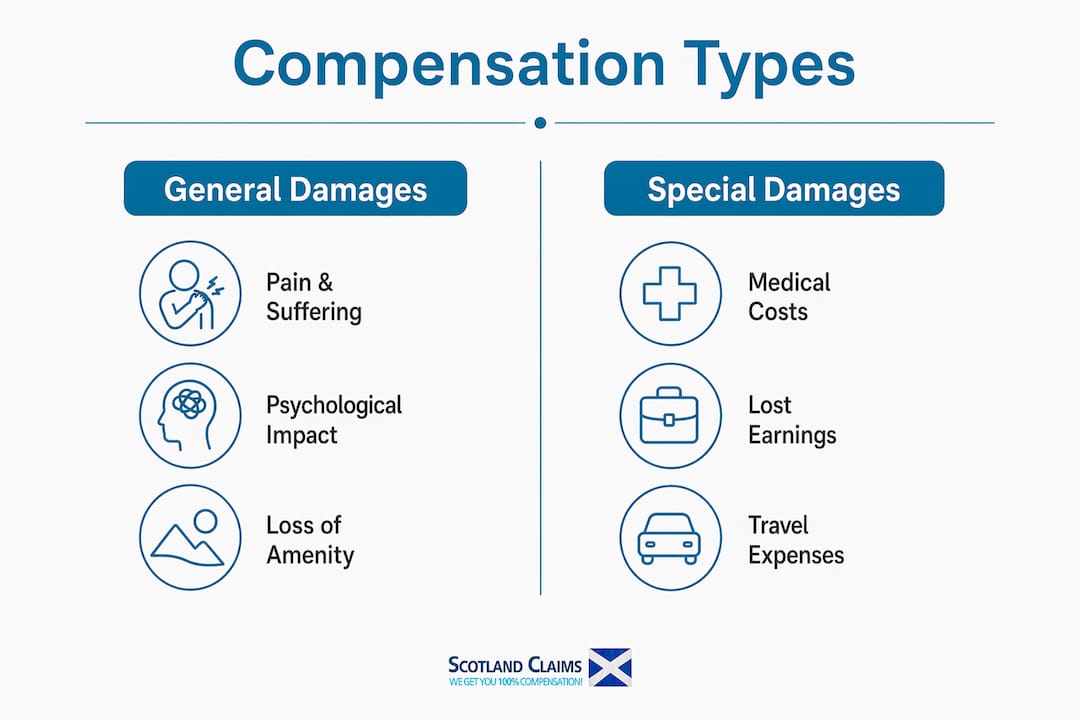
Compensation combines two distinct parts: General Damages and Special Damages. Understanding both is the single most important step in knowing what your claim is worth.
General Damages: pain, suffering, and loss of amenity
General Damages cover the physical and psychological impact of your injury. Solicitors and courts use the Judicial College Guidelines to place your injury into a structured bracket based on type and severity. A moderate whiplash injury, for example, sits in a different bracket from a serious knee injury or a spinal fracture. The Guidelines remove guesswork and produce consistent, defensible valuations.

Compensation is not designed to punish the person who caused your injury. Its purpose is to restore you financially and practically to the position you were in before the accident. That distinction matters because it shapes what evidence you need and how your solicitor frames your claim.
Special Damages: your documented financial losses
Special Damages cover every out-of-pocket cost caused by your injury. These are concrete, receipted losses rather than subjective assessments.
| Type of damage |
Examples |
| General Damages |
Pain and suffering, psychological distress, loss of enjoyment of life |
| Special Damages |
Medical bills, prescription costs, lost earnings, travel to appointments |
| Future losses |
Ongoing care costs, future lost income, home adaptations |
Claimants frequently undervalue Special Damages by failing to record financial losses from the moment of the accident. That gap in documentation directly reduces the final award.
Pro Tip: Start a dedicated folder, physical or digital, on the day of your accident. Log every expense, keep every receipt, and photograph every piece of correspondence. Your solicitor can only claim what you can prove.
What are the time limits for making a claim in Glasgow?
The three-year limitation period is the most critical legal deadline in any personal injury claim. Miss it and you almost certainly lose your right to compensation entirely, regardless of how strong your case is. The clock starts on the date of your accident, or the date you first became aware that your injury was caused by someone else’s negligence.
Exceptions to the three-year rule
The law recognises that some claimants cannot act within the standard window. The main exceptions are:
- Children: The three-year period does not begin until the child turns 18, giving them until their 21st birthday to claim.
- Mental incapacity: Where a claimant lacks mental capacity, the limitation period is suspended for as long as that incapacity continues.
- Late discovery: If you only discover your injury was caused by negligence after the accident, the clock starts from the date of that discovery.
These exceptions are narrow. Courts apply them strictly, and relying on an exception without legal advice is a significant risk.
Steps to protect your claim from day one
Starting promptly protects the quality of your evidence as much as it protects your legal right to claim. Witness memories fade, CCTV footage is deleted, and accident records are overwritten. The steps to initiate a claim include reporting the accident formally, seeking medical attention immediately, gathering witness details, and contacting a solicitor as early as possible.
Pro Tip: Even if you are unsure whether you have a valid claim, contact a solicitor for a free consultation within days of your accident. The assessment costs you nothing and preserves your options.
How does legal help improve outcomes in personal injury claims?
Instructing a solicitor is not a luxury. Insurance companies use established tactics to minimise payouts, and an unrepresented claimant is at a structural disadvantage from the first phone call.
What insurers do and how solicitors respond
Insurers may make early, low settlement offers before the full extent of your injuries is known. They may request recorded statements and use your own words to undermine your claim. They may dispute liability or argue that your injuries were pre-existing. A solicitor handles all communications on your behalf, removing the risk of inadvertent admissions and ensuring every offer is assessed against the Judicial College Guidelines before any response is given.
Solicitors level the playing field by commissioning independent medical reports, gathering expert evidence, and presenting your claim in the format courts and insurers recognise as authoritative. That expertise directly increases the likelihood of a fair settlement.
The No Win No Fee and no success fee difference
Legal professionals offer initial free consultations and work on a No Win No Fee basis, meaning you pay nothing upfront and nothing if your claim fails. Scotland Claims Injury Lawyers goes further. Most solicitors charge a success fee of up to 20% of your compensation when your claim succeeds. Scotland Claims Injury Lawyers charges no success fee at all. You receive 100% of your awarded compensation. On a £10,000 settlement, that difference is £2,000 staying in your pocket rather than being deducted as a fee.
The benefits of instructing a solicitor early include:
- Full management of insurer communications from the outset
- Independent medical evidence commissioned to support your valuation
- Accurate calculation of both General and Special Damages
- Protection against low early settlement offers
- No financial risk under a No Win No Fee arrangement
Choosing injury lawyers in Scotland who charge no success fee is the single most financially significant decision you make in your claim.
What types of personal injury claims are most common in Glasgow?
Road traffic accidents, workplace injuries, and slips, trips, and falls account for the majority of personal injury claims made by Glasgow residents. Each category carries distinct eligibility criteria and evidence requirements.
| Claim type |
Common causes |
Key evidence needed |
| Road traffic accident |
Rear-end collision, junction fault, passenger injury |
Police report, medical records, witness statements |
| Workplace injury |
Manual handling, falls from height, faulty equipment |
Accident book entry, RIDDOR report, safety records |
| Slip, trip, or fall |
Wet floors, uneven pavements, poor lighting |
Photographs of the hazard, incident report, medical notes |
| Passenger injury |
Bus, taxi, or private vehicle accident |
Transport records, insurer details, medical evidence |
Road traffic accidents in Glasgow
Car accident claims in Glasgow are among the most straightforward to establish where liability is clear. If you are a driver or passenger injured by another driver’s fault, you are entitled to claim compensation for your injuries and all associated financial losses. Scotland Claims Injury Lawyers handles whiplash claims, soft tissue injuries, and more serious road traffic injuries, and you keep 100% of your settlement.
Workplace injuries
Employers in Scotland carry a legal duty of care under health and safety legislation. A breach of that duty that causes your injury gives rise to a valid workplace injury claim. Reporting the accident in the workplace accident book on the day it occurs is the single most important step you can take. That record is often the cornerstone of a successful claim.
Slips, trips, and falls
Occupiers of land and premises owe a duty of care to visitors under the Occupiers’ Liability (Scotland) Act 1960. A wet supermarket floor without a warning sign, a cracked pavement maintained by a local authority, or a poorly lit stairwell in a rented property can each give rise to a valid claim. Photographing the hazard immediately is critical, as conditions are often remedied quickly once an incident is reported.
Key takeaways
Personal injury claims in Glasgow succeed when claimants act promptly, document every loss, and instruct a solicitor who charges no success fee, keeping 100% of their compensation.
| Point |
Details |
| Compensation has two parts |
General Damages cover pain and suffering; Special Damages cover documented financial losses. |
| Three-year deadline is firm |
Missing the Limitation Act 1980 deadline almost always ends your right to claim. |
| Evidence quality determines value |
Receipts, medical records, and witness statements directly increase your final award. |
| Solicitors neutralise insurer tactics |
Legal representation prevents low offers and ensures accurate claim valuation. |
| No success fee means 100% compensation |
Scotland Claims Injury Lawyers deducts nothing from your settlement, unlike firms charging up to 20%. |
Why the no success fee model changes everything
I have spent years watching claimants settle for less than they deserve, and the pattern is almost always the same. They either act too late, document too little, or accept the first offer put in front of them by an insurer who knows exactly what the claim is really worth.
The evidence requirement surprises most people. They assume a medical report is enough. In reality, comprehensive record keeping from day one is what separates a full award from a partial one. Special Damages are often the larger component of a claim, particularly where someone has been off work for weeks or months. Without wage slips, receipts, and a mileage log for medical appointments, that money simply does not get claimed.
The success fee issue is one I feel strongly about. A 20% deduction on a £15,000 settlement is £3,000 gone before you have paid a single bill. That is not a small administrative charge. It is a significant sum taken from someone who was already injured through no fault of their own. Scotland Claims Injury Lawyers charges no success fee. The no win no fee arrangement at Scotland Claims means you risk nothing and lose nothing from your award if you win.
My consistent advice is this: contact a solicitor within days of your accident, not weeks. The role of evidence in your claim is established in those first hours and days. Waiting costs you money and, eventually, may cost you your claim entirely.
— Roger
Scotland Claims Injury Lawyers: your next step
Scotland Claims Injury Lawyers offers Glasgow residents specialist personal injury legal support with no upfront costs and no success fee on any successful claim. Whether your injury involves a road traffic accident, a workplace incident, or a slip or fall, you keep every penny of your compensation. Most solicitors deduct up to 20% as a success fee. Scotland Claims Injury Lawyers deducts nothing. Request a free callback today and have your case assessed by a specialist who understands Glasgow personal injury law. Use the compensation calculator to get an initial estimate, or speak directly to the team about your no win no fee claim and what you could recover in full.
FAQ
What is the time limit for a personal injury claim in Glasgow?
The standard time limit is three years from the date of your accident under the Limitation Act 1980. Missing this deadline almost always ends your right to claim compensation.
How is personal injury compensation calculated in Scotland?
Compensation combines General Damages for pain and suffering, valued using the Judicial College Guidelines, with Special Damages for documented financial losses such as lost earnings and medical costs.
Do I pay anything if my claim fails?
Under a No Win No Fee arrangement, you pay nothing if your claim is unsuccessful. Scotland Claims Injury Lawyers also charges no success fee if you win, so you receive 100% of your compensation.
What evidence do I need for a personal injury claim in Glasgow?
Medical records, photographs of the accident scene or hazard, witness contact details, receipts for all expenses, and wage slips for any lost earnings are the core documents. Gathering evidence from the day of the accident gives your claim the strongest possible foundation.
Can I claim if I was injured as a passenger in a car accident?
Yes. Passengers injured in road traffic accidents through no fault of their own are fully entitled to claim compensation for their injuries and financial losses, including whiplash and more serious injuries.
Recommended