Pain and suffering compensation in Scotland: Your complete guide
TL;DR:
- Scotland recognizes non-financial losses, called solatium, for pain emotional distress and life disruption.
- Compensation for pain and suffering in Scotland varies case by case, influenced by injury severity and personal circumstances.
- Claimants must file within three years, and awards are affected by contributory negligence and evidence quality.
Most people assume compensation for an injury is simply about covering medical bills and lost wages. In Scotland, the law goes further. Non-financial losses including physical pain, emotional distress, and disruption to your daily life are formally recognised under a distinct legal concept called solatium. This guide explains exactly what solatium covers, who qualifies, how awards are calculated, and what real-world figures look like. Whether your injury happened on the road, at work, or through someone else’s negligence, understanding solatium could significantly change what you recover.
Table of Contents
Key Takeaways
| Point |
Details |
| Solatium recognition |
Scottish law uniquely compensates pain and emotional suffering through solatium awards. |
| Case-specific calculation |
Pain and suffering compensation is determined using guidelines, medical evidence, and past Scottish cases. |
| Award ranges vary |
Typical Scottish awards differ by injury type, severity, and personal impact but offer flexibility for individual circumstances. |
| Legal nuances matter |
Factors like contributory negligence, divisible injuries, and time limits significantly affect compensation outcomes. |
| Expert help maximises claim |
Personal injury solicitors and strong medical evidence increase your chances of fair pain and suffering compensation. |
What is solatium and how does it differ from financial compensation?
In Scottish personal injury law, your total compensation is typically split into two distinct categories. The first is patrimonial loss, which covers your financial losses: lost earnings, medical costs, travel expenses, and care costs. The second is solatium, which covers everything that cannot be given a receipt or invoice.
Solatium is awarded for non-financial losses such as physical pain, emotional distress, and loss of enjoyment of life. This matters enormously because two people with identical injuries can experience vastly different impacts on their lives. A keen cyclist who suffers a knee injury may lose far more in terms of enjoyment and wellbeing than someone who rarely exercises. Solatium is designed to capture that personal reality.
The types of non-financial losses recognised under solatium include:
- Physical pain and discomfort during recovery
- Ongoing or permanent pain where full recovery is unlikely
- Emotional distress, anxiety, and depression caused by the injury
- Loss of enjoyment of hobbies, sports, or social activities
- Disruption to relationships and family life
- Psychological trauma, including post-traumatic stress disorder
“Solatium ensures that the human cost of an injury is not invisible in the legal process. It places your lived experience at the centre of the claim, not just your bank statements.”
This distinction is crucial when you are assessing what a compensation payout Scotland might realistically look like. Solatium applies across all personal injury claim types, including road traffic accidents, workplace accidents, slips and trips, and injuries caused by any form of negligence or delict (the Scottish legal term for civil wrongdoing).
Unlike England and Wales, where reforms have introduced fixed tariffs for certain injuries, Scotland retains a more flexible, case-by-case approach. That flexibility can work in your favour, provided you understand how the system values your specific circumstances.
How is pain and suffering compensation calculated in Scotland?
Calculating solatium is not a simple formula. It involves several layers of assessment, and the final figure depends on a combination of guidelines, evidence, and judicial discretion.
Here is how the process typically works:
- Medical evidence is gathered. An independent medical expert examines you and produces a report covering the nature of your injuries, current symptoms, prognosis, and expected recovery timeline.
- Judicial College Guidelines are consulted. These guidelines provide injury-specific brackets to help solicitors and courts assess appropriate award ranges. They are persuasive but not legally binding in Scotland.
- Scottish case precedents are reviewed. Decisions from Scottish courts carry significant weight and often guide how similar injuries are valued in practice.
- Personal circumstances are factored in. Age, lifestyle, occupation, psychological effects, and the duration of suffering all influence the final figure.
- A global award is made for multiple injuries. Rather than adding individual values together, a global award is made to reflect the overall impact, preventing double-counting.
The injury compensation calculation also considers how injuries interact with one another. For example, a back injury combined with anxiety disorder may not simply equal the sum of both awards. The court looks at the total picture.

| Factor |
How it affects your award |
| Injury severity |
More severe injuries attract higher awards |
| Recovery duration |
Longer recovery increases solatium |
| Age at time of injury |
Younger claimants may receive more for long-term impact |
| Psychological effects |
Diagnosed conditions like PTSD increase awards |
| Lifestyle disruption |
Loss of hobbies or independence is recognised |
One important distinction from England is that Scotland has not introduced the fixed whiplash tariffs that apply south of the border. Scottish courts retain full discretion to value soft-tissue injuries based on individual circumstances, which often results in fairer outcomes for claimants with genuine, lasting symptoms. Understanding your personal injury rights in this context is essential before accepting any settlement offer.
Pro Tip: Never accept an early settlement offer without first obtaining an independent medical report. Insurers often make quick offers before the full extent of your injuries is known, and accepting prematurely can prevent you from claiming more later.
Benchmarks, case examples, and award ranges
Understanding the real-world figures attached to different injuries helps you contextualise what your claim might be worth. These are not guarantees, but they provide a meaningful starting point.
Solatium benchmarks across common injury types are as follows:
| Injury type |
Severity |
Typical range |
| Whiplash |
Minor |
£1,000 to £4,000 |
| Knee injury |
Minor |
£2,000 to £8,000 |
| Knee injury |
Severe |
£25,000 or more |
| Back injury |
Minor |
£2,500 to £10,000 |
| Back injury |
Severe |
£35,000 to £150,000+ |
| Serious injuries |
Catastrophic |
£50,000 to £200,000+ |
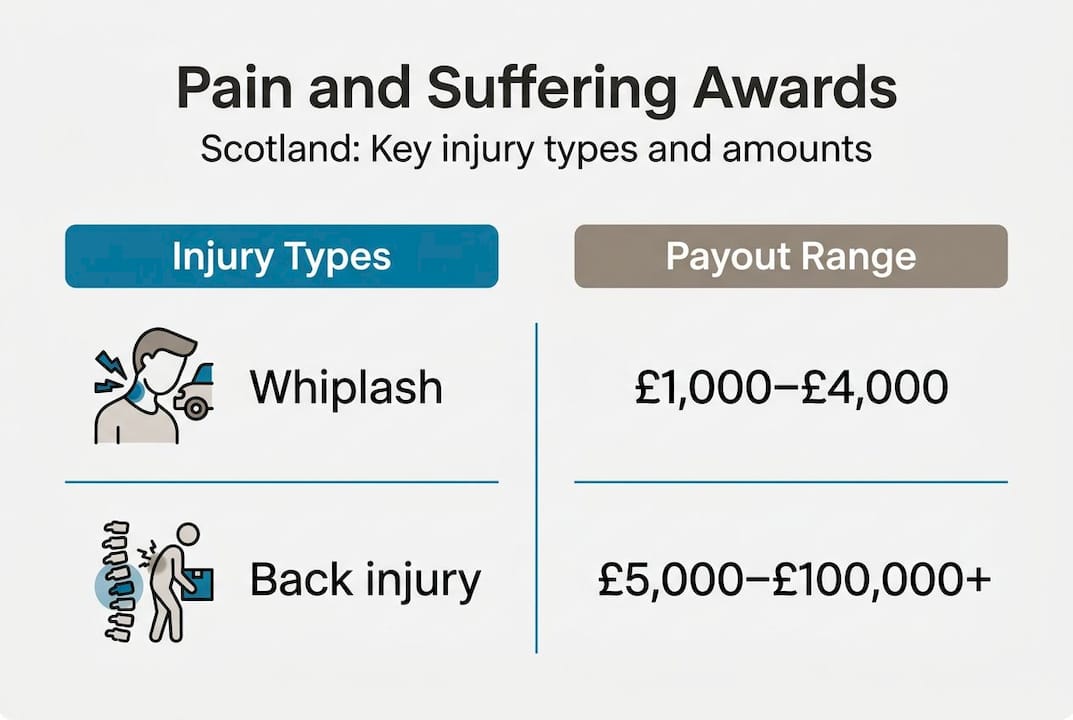
These figures reflect solatium alone. Financial losses such as lost earnings and medical costs are added on top.
Several factors push awards toward the higher end of any bracket:
- Permanent or long-term symptoms with no prospect of full recovery
- Significant psychological impact, particularly diagnosed PTSD or depression
- Loss of ability to work in a chosen profession
- Injury affecting a young person with decades of disruption ahead
- Multiple injuries assessed together under a global award
For car accident compensation examples, a whiplash injury that resolves within three months typically attracts a lower award, while a similar injury with ongoing neurological symptoms and sleep disruption could attract significantly more. Context is everything.
Workplace injury cases often involve additional complexity. If your employer failed to provide adequate training, equipment, or a safe working environment, this negligence strengthens your claim. Solatium in serious workplace cases, such as crush injuries or industrial disease, can reach six figures when combined with long-term care costs.
For those dealing specifically with neck or back injuries from road incidents, the whiplash claims guide outlines how Scottish courts approach these cases in detail. The key takeaway is that the more thoroughly you document your symptoms and their impact on daily life, the stronger your position.
Key legal nuances: contributory fault, flexibility, and time limits
Even a strong claim can be affected by legal nuances that many claimants are unaware of. Understanding these in advance puts you in a much better position.
Contributory negligence is one of the most common factors that reduces a solatium award. If you were partly responsible for your own injury, for example by not wearing a seatbelt during a road accident, your award may be reduced by a corresponding percentage. A 25% finding of contributory negligence means a £20,000 solatium award becomes £15,000.
The key legal nuances to be aware of include:
- Contributory negligence reduces solatium by a percentage proportional to your share of fault
- Divisible injuries, where symptoms have multiple causes, may be apportioned between parties
- Scotland has no fixed whiplash tariff, unlike England, giving courts greater flexibility
- A global award prevents double-counting when multiple injuries are present
- Prior settlements on related injuries can limit what you recover in a new claim
The three-year time limit is perhaps the most critical point. You generally have three years from the date of your accident, or from the date you became aware that your injury was caused by negligence, to raise a court action. Missing this deadline almost always means losing your right to claim entirely.
Pro Tip: If you are unsure whether the three-year clock has started, seek advice immediately. The date of knowledge rule can be complex, particularly in cases involving industrial disease or delayed diagnosis.
Understanding injury valuation Scotland principles also means recognising that Scottish courts have more discretion than their English counterparts. This is a strength, but it also means outcomes can be less predictable. Checking your injury claim eligibility Scotland with a specialist solicitor early removes a great deal of uncertainty.
Expert perspective: Why Scottish flexibility benefits claimants and what to watch for
Scottish law’s approach to solatium is genuinely different from the rest of the UK, and in most cases, that difference works in your favour. The absence of rigid tariffs means your personal story actually matters in court. A judge can hear about how your injury ended your marathon training, disrupted your relationship, or left you unable to sleep, and factor that into the award.
But flexibility cuts both ways. Without fixed figures, there is genuine unpredictability. Two claimants with near-identical injuries might receive different awards depending on the quality of their evidence, the strength of their legal representation, and the specific facts presented.
This is why strong independent evidence is so critical. Medical reports, personal diaries documenting daily symptoms, witness statements from family members, and records of missed activities all build a picture that no insurer can easily dismiss. The claimants who recover the most are not always those with the most severe injuries. They are those who document their experience thoroughly and work with solicitors who understand Scottish law.
If you are unsure where to start, free legal advice Scotland is available and can help you understand your position before committing to anything.
Ready to maximise your compensation? Connect with Scotland injury experts
Knowing what solatium covers is only the first step. Getting the right figure requires specialist legal support. At Scotland Claims, our network of experienced personal injury solicitors understands how Scottish courts value pain and suffering, and they work to ensure your award reflects your real experience. Use our compensation calculator to get an initial estimate of what your claim could be worth. If you have suffered a back injury or any other serious injury, our team can guide you through every stage. All claims are handled on a no win no fee basis, meaning you pay nothing unless you win.
Frequently asked questions
What is solatium in Scottish injury claims?
Solatium is compensation for pain and suffering, covering non-financial losses such as physical discomfort, emotional distress, and loss of enjoyment of life. It is distinct from compensation for financial losses like lost earnings or medical costs.
How are Scottish pain and suffering awards calculated?
Awards are determined using Judicial College Guidelines, Scottish case precedents, and independent medical reports, with age, lifestyle impact, recovery duration, and psychological effects all influencing the final figure.
What are typical pain and suffering compensation amounts in Scotland?
Minor whiplash awards typically range from £1,000 to £4,000, while severe back injuries can exceed £100,000. Serious or catastrophic injuries may attract awards of £50,000 to £200,000 or more.
Can pain and suffering compensation be reduced in Scotland?
Yes. Contributory negligence or prior settlements can reduce your solatium, typically by a percentage that reflects your share of responsibility for the accident.
Is there a time limit to claim pain and suffering compensation in Scotland?
Yes. You must generally claim within three years of the accident or the date you became aware your injury was caused by negligence. Missing this deadline almost always ends your right to claim.
Recommended